
Aprilia SX 125 chip tuning: realistic ECU and fuel tuning for a small supermoto
Aprilia SX 125 chip tuning can improve a small supermoto only when it is matched to the motorcycle’s real hardware and condition. The SX 125 is light, sharp, and fun because it responds quickly, not because it has unlimited power. A chip, fuel controller, or ECU remap may help throttle response or fueling after exhaust and intake changes, but it cannot replace correct service, good gearing, a healthy engine, or safe legal use.
A smart Aprilia SX 125 chip tuning plan begins with diagnosis. Is the bike flat after a new exhaust? Does it hesitate at small throttle? Is it running hot? Is the air filter clean? Are there warning lights? Is chain slack correct? Are the sprockets chosen for top speed or acceleration? Tuning electronics before answering those questions is guessing, and guessing gets expensive quickly.
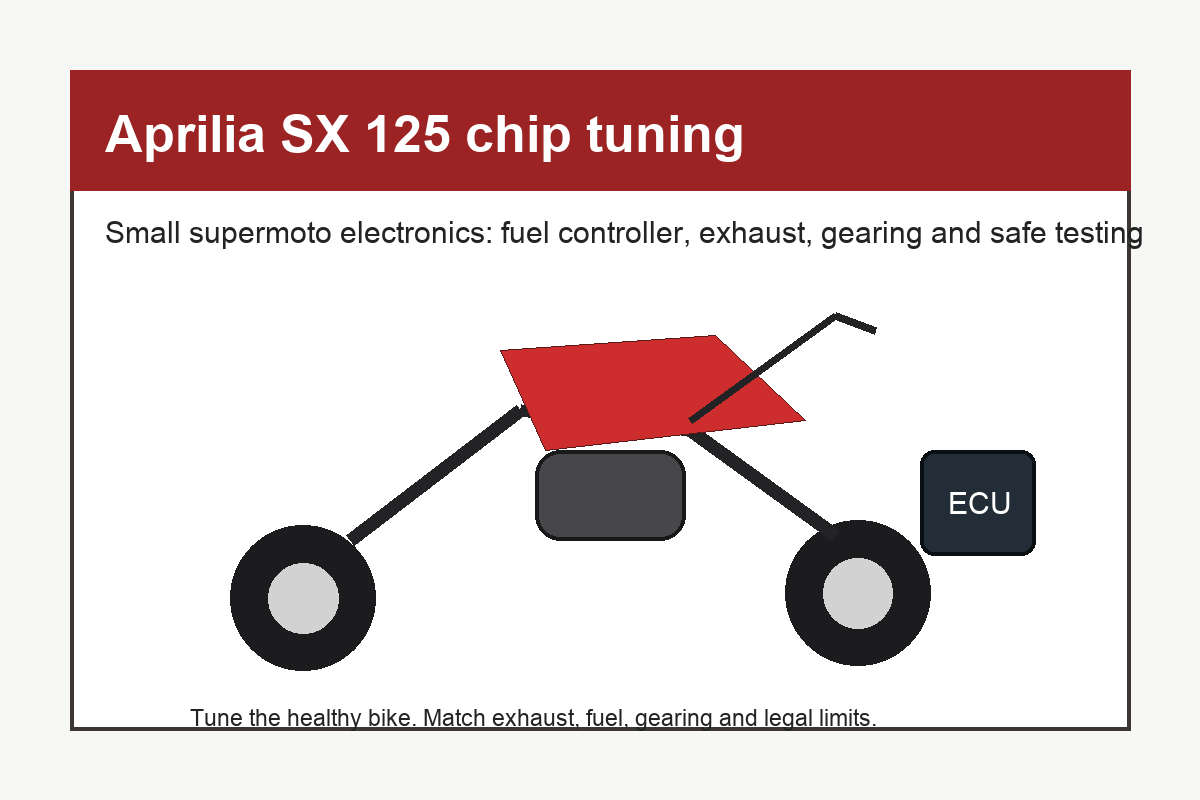
What chip tuning means on an SX 125
Aprilia SX 125 chip tuning can mean several things: a plug-in fuel controller, an ECU remap, a sensor modifier, or a module sold as a performance chip. These are not equal. Some add or subtract fuel in broad ranges. Some alter sensor signals. Some are built for a specific exhaust and intake. Some make claims without showing data. The useful question is what the device changes and how it is verified.
For official model and brand information, use Aprilia’s official site. For safety recalls in markets where it applies, use the NHTSA recall lookup. Road legality, emissions, noise, licence class, insurance, and inspection should be checked before changing ECU behaviour or emissions equipment.
| Device type | Possible use | Risk |
|---|---|---|
| Fuel controller | Correct mixture after hardware changes | Wrong settings if not tested |
| ECU remap | More precise calibration where supported | Poor file or legal issue |
| Sensor modifier | Crude mixture change | Heat, faults, inconsistent fueling |
| Unknown plug-in chip | Rarely the best first choice | Unclear effect and reliability risk |
Baseline checks before Aprilia SX 125 chip tuning
Before Aprilia SX 125 chip tuning, service the motorcycle. Check oil, coolant, spark plug, air filter, injector, throttle body, battery voltage, charging output, intake boot, exhaust joints, oxygen sensor wiring, chain, sprockets, clutch adjustment, brake drag, and tire pressure. A 125cc engine has little spare torque, so every basic fault matters.
If the SX has a warning light, hard starting, poor idle, or overheating, scan and repair before tuning. A fuel controller should not be used to hide a sensor fault. A remap should be built on a healthy engine and known hardware, not on a bike with air leaks or a clogged filter.
Gearing changes feel like tuning
Many riders looking for Aprilia SX 125 chip tuning really want better acceleration. Sprocket changes can make the bike feel much sharper, but they trade top speed and cruising rpm. Decide whether the bike is used for city riding, back roads, or longer commuting before changing gearing.
Chain and clutch basics
A tight chain, worn sprockets, slipping clutch, or dragging brake can make the bike feel weak. Fix those before adjusting fueling.
Exhaust, intake, and fueling
Most Aprilia SX 125 chip tuning requests happen after an exhaust or filter change. A freer exhaust can change airflow and sound, but the engine still needs correct mixture. A loud pipe with lean fueling may feel exciting briefly and then run hot, hesitate, or lose midrange. Check exhaust leaks before changing maps because leaks can create false symptoms.
A high-flow filter must seal properly. Dust damage is not tuning. If the airbox is modified, fueling needs more attention. The best setup starts cleanly, idles steadily, pulls through the midrange, and does not smell rich or run hot.
| Modification | What it can improve | What to verify |
|---|---|---|
| Slip-on exhaust | Sound and small response change | Leaks and fueling behaviour |
| Full exhaust | More flow potential | AFR, legality, noise |
| High-flow filter | Airflow support | Sealing and mixture |
| Fuel controller | Mixture correction | Settings under load |
| Sprocket change | Acceleration feel | Cruising rpm and speedometer |
Dyno and road testing
A proper Aprilia SX 125 chip tuning setup should be tested, not trusted blindly. A dyno with air-fuel ratio measurement is ideal after intake and exhaust changes. For road testing, use the same route, similar fuel level, similar wind, and the same rider position. Test low throttle, midrange roll-on, hill pull, hot restart, and full throttle only when safe and legal.
Peak horsepower is not the only target. A small supermoto should be easy to control at low speed, clean when exiting corners, and predictable in traffic. A tune that only improves one full-throttle number but makes the bike jerky is not a good road setup.
Fuel quality and temperature
Safe Aprilia SX 125 chip tuning respects fuel quality and heat. If the map expects high-octane fuel, use it consistently. If the bike pings, feels hotter, or loses smoothness under load, stop and diagnose.
How to read the symptoms before choosing parts
Good mechanics do not begin with a shopping cart. They begin with the way the motorcycle behaves. If the SX feels lazy only above a certain speed, the problem may be gearing, wind resistance, rider position, or simply the realistic limit of a 125cc four-stroke. If it coughs when the throttle is opened, the discussion changes toward fueling, air leaks, injector condition, throttle position signal, or exhaust sealing. If it feels strong cold and weak hot, temperature, mixture, and sensor behaviour deserve attention before any performance promise is trusted.
Aprilia SX 125 chip tuning should therefore be connected to a symptom. For example, a bike with a full exhaust that pops badly on deceleration, hesitates at small throttle, and runs hotter than before may need careful fuel correction. A completely stock bike with dirty oil, an old spark plug, and a slack chain does not need a chip first. It needs maintenance. That difference saves money and prevents owners from blaming the wrong component.
Another useful habit is to separate sound from speed. A louder exhaust can make the SX feel faster because the rider hears more engine work, but the stopwatch may tell a different story. Use simple notes: date, fuel type, outside temperature, sprocket sizes, exhaust model, filter type, fault codes, and the exact riding complaint. Those notes make a tuner or workshop far more effective because they turn a vague request into a real mechanical case.
| Rider complaint | Likely area to inspect first | Why it matters |
|---|---|---|
| Flat at high rpm | Gearing, airflow, valve health, exhaust choice | Electronics cannot create unlimited power |
| Jerky low throttle | Throttle body, sensor signals, mixture, chain slack | Rideability is often more important than peak speed |
| Hot running after exhaust | Lean mixture, exhaust leak, coolant condition | Heat shortens engine life |
| Poor acceleration | Sprockets, clutch, brake drag, tire pressure | Mechanical drag can mimic low power |
| Warning light after module | Connectors, sensor range, installation route | A fault code is a warning, not a decoration |
Choosing between a plug-in module and an ECU remap
There is no single best answer for every SX 125. A plug-in controller can be attractive because it is reversible and usually easier to install. That matters for riders who may return the bike to standard condition, sell it, or pass inspection. The downside is that a simple controller may adjust only part of the fueling picture. It may not handle ignition strategy, closed-loop behaviour, cold start, or every throttle position with the precision people imagine when they hear the word chip.
Aprilia SX 125 chip tuning with an ECU remap can be cleaner when the ECU is supported properly and the operator understands the engine. A remap can be more integrated, but it also requires trust. A poor file loaded quickly can create more trouble than a well-installed basic controller. Ask what is being changed, whether the file is built for your exact exhaust and filter, whether it has been tested on similar bikes, and whether the original calibration can be restored.
For many riders, the best path is conservative. Keep the airbox sensible, use an exhaust that is not absurdly loud, verify mixture, and avoid extreme claims. A 125cc supermoto rewards a broad, clean response more than a narrow top-end number. If the tune makes city riding smoother, corner exits cleaner, and hill pulls more consistent, it has done its job. If it only makes the bike noisy and difficult to start, it has missed the point.
Questions to ask before paying a tuner
Ask whether the tuner will inspect the motorcycle before changing software, whether they can read fault codes, whether they can measure air-fuel ratio under load, and whether they will explain aftercare. Ask how they handle a bike with a different exhaust, modified airbox, or non-standard gearing. A serious workshop will not be offended by those questions because they are the same questions a careful mechanic asks internally before touching the bike.
Aprilia SX 125 chip tuning is also easier to judge when the tuner is honest about limits. The SX 125 can be improved in response and refinement, but it remains a small-capacity machine. Promises of dramatic power without supporting hardware, testing, or legal discussion should be treated cautiously.
A practical installation and test routine
If you fit a controller yourself, work slowly. Disconnect the battery if the instructions require it. Route wiring away from the exhaust, steering stops, sharp frame edges, and places where water collects. Do not leave connectors hanging under tension. Use proper ties, but do not crush cables. After installation, turn the bars fully left and right and compress the suspension gently to confirm the loom is not pulled tight.
After Aprilia SX 125 chip tuning, the first ride should not be a full-throttle test on a cold engine. Warm the bike normally, listen for exhaust leaks, check idle, and ride at small throttle first. Then test midrange response, hot restart, and steady cruising. Only after those checks make sense should you try harder acceleration in a safe place. When you return, inspect for loose connectors, melted sleeving, fuel smell, and new fault lights.
Keep the original parts and settings. Photograph the installation before panels go back on. Label anything that might confuse a future owner or mechanic. If the bike later develops a problem, being able to return to the known standard configuration is a powerful diagnostic tool. This is especially important on a learner-friendly 125 because the bike may pass through several owners, and the next person may not know what has been changed.
What good results feel like on the road
A healthy result is not dramatic in a theatrical way. It feels normal, but better. The throttle opens without a hole, the engine pulls cleanly through the middle, the bike does not surge at steady speed, and hot starting remains easy. There should be no new warning lights and no smell of excessive fuel. Fuel consumption may change slightly, but it should not collapse unless the bike is being ridden much harder or the settings are too rich.
Aprilia SX 125 chip tuning is successful when it supports the way a supermoto is actually ridden: short bursts, quick direction changes, city work, back-road corners, and frequent throttle transitions. Smoothness matters because a jerky small bike is tiring. Predictability matters because new riders often use these motorcycles to build confidence. Reliability matters because a 125 is usually ridden hard relative to its capacity.
Do not judge the result only on the first excited ride. Live with the setup through traffic, rain, heat, cold starts, and a full tank of fuel. If it remains clean in all those situations, the calibration is far more convincing than a loud first impression.
Maintenance schedule after tuning
Aprilia SX 125 chip tuning does not end when the module is fitted or the file is flashed. Recheck the bike after the first few heat cycles. Look at exhaust flange nuts, springs, clamps, and mounting points. Check the air filter seating and make sure no intake boot has moved. Inspect the spark plug after real riding, not after five minutes of idling. If the bike has a fault memory, scan it again after a few rides.
Oil changes, coolant condition, chain care, and valve-clearance intervals matter more when a small engine is asked to work hard. A tuned 125 that is neglected will not stay crisp. Keep the maintenance boring and the riding fun. That is the right balance for a small Aprilia supermoto.
Legal limits and A1 reality
Aprilia SX 125 chip tuning can affect licence and insurance rules. Many 125cc motorcycles are tied to A1 or learner restrictions. Increasing power, removing emissions equipment, or changing speed-limiting behaviour may create road-use problems depending on country. Do not assume a hidden change is harmless.
For public-road use, keep documentation and understand local rules. If the bike is for track or private land, the tuning target can be different, but safety still matters. Brakes, tires, chain, and suspension should match any increase in performance.
Reliability after electronics changes
A reliable Aprilia SX 125 chip tuning setup should not create warning lights, hot running, hard starting, heavy fuel smell, or unstable idle. After installation, inspect wiring, connectors, sensor plugs, and routing near the exhaust and frame. Poor installation can create intermittent faults that are blamed on the ECU.
Check the spark plug after mixed riding, not only after idling. Monitor fuel consumption over a full tank. Recheck fasteners and exhaust joints after heat cycles. A small bike ridden hard needs clean maintenance.
| After-tune check | Good sign | Bad sign |
|---|---|---|
| Cold start | Clean and steady | Hard start or fuel smell |
| Hot restart | Immediate and stable | Stalling or rough idle |
| Plug condition | Consistent and clean | Very white, sooty, or oily |
| Temperature | Normal for conditions | Fan constantly or heat fade |
| Fault memory | No new codes | Sensor or mixture codes |
Related 125 tuning guides
The thinking behind Aprilia SX 125 chip tuning connects with our Yamaha MT 125 chip tuning guide, where electronics must match hardware. For Honda small-bike logic, the Honda Monkey 125 derestriction guide explains why gearing and fueling matter. For scooter comparison, the Aprilia SR GT 125 tuning guide shows how transmission changes can matter as much as engine tuning.
The same rule applies: service first, diagnose the bottleneck, make one change, and test. Aprilia SX 125 chip tuning should solve a real rideability or fueling problem.
Best order of work
A clean Aprilia SX 125 chip tuning process starts with maintenance. Service the bike, scan faults, inspect intake and exhaust, confirm chain and gearing, then road-test. If the hardware is stock, decide whether electronics are necessary. If exhaust or intake has changed, measure or test fueling before choosing a controller or map.
After tuning, ride normally before calling it finished. Test traffic, corners, hills, steady cruise, hot restart, and full throttle where legal. A good setup should feel natural everywhere.
| Stage | Action | Pass condition |
|---|---|---|
| Baseline | Service and fault scan | Healthy motorcycle |
| Hardware | Exhaust, filter, chain, sprockets | Known stable setup |
| Electronics | Controller or remap | Fueling matches hardware |
| Testing | AFR or repeatable road test | Smooth response and no heat |
| Follow-up | Plug, codes, fasteners | No new problems |
Common mistakes
The biggest mistake in Aprilia SX 125 chip tuning is buying electronics before servicing the bike. The second is changing exhaust, filter, sprockets, and controller all at once. The third is ignoring legal limits. The fourth is chasing top speed while ruining low-speed control. The fifth is using a copied map for different hardware.
Document the original settings, parts, and wiring. If the bike later needs service or inspection, that information matters.
FAQ
Is chip tuning worth it on an Aprilia SX 125?
Aprilia SX 125 chip tuning can be worth it after intake or exhaust changes, or when there is a clear fueling issue. On a stock healthy bike, gains may be modest.
Will it increase top speed?
Possibly a little in some setups, but gearing, power, wind, rider size, and legal limits matter. Better throttle response is usually more realistic.
Do I need a remap after exhaust?
Not always for a mild slip-on, but full exhaust or intake changes should be checked for mixture, heat, popping, and warning lights.
Can chip tuning damage the engine?
Yes. Poor fueling, excessive heat, bad timing, or sensor errors can damage reliability. Test the setup carefully.
Should I change sprockets first?
If the goal is acceleration, gearing may be more noticeable than electronics. Choose sprockets for your roads and riding style.
Is it legal for A1 licence use?
That depends on local law and final power. Aprilia SX 125 chip tuning can affect licence and insurance compliance, so check before road use.
What is the safest first step?
Service the bike, check faults, inspect intake and exhaust, confirm chain and sprockets, then decide whether electronics are actually needed.
Final advice
Aprilia SX 125 chip tuning works best when the SX stays light, sharp, reliable, and legal for its intended use. Start with a healthy motorcycle, match the electronics to real hardware, and test under normal riding conditions. A clean tune should improve response without heat, faults, or poor fuel use.
The SX 125 is fun because it is simple and direct, so Aprilia SX 125 chip tuning should keep that character. If tuning makes it smoother, stronger in the midrange, and easier to ride, it is worthwhile. If it makes the bike fussy or risky, Aprilia SX 125 chip tuning has gone in the wrong direction.