
Honda Monkey 125 derestriction: realistic power, legal limits and reliable tuning choices
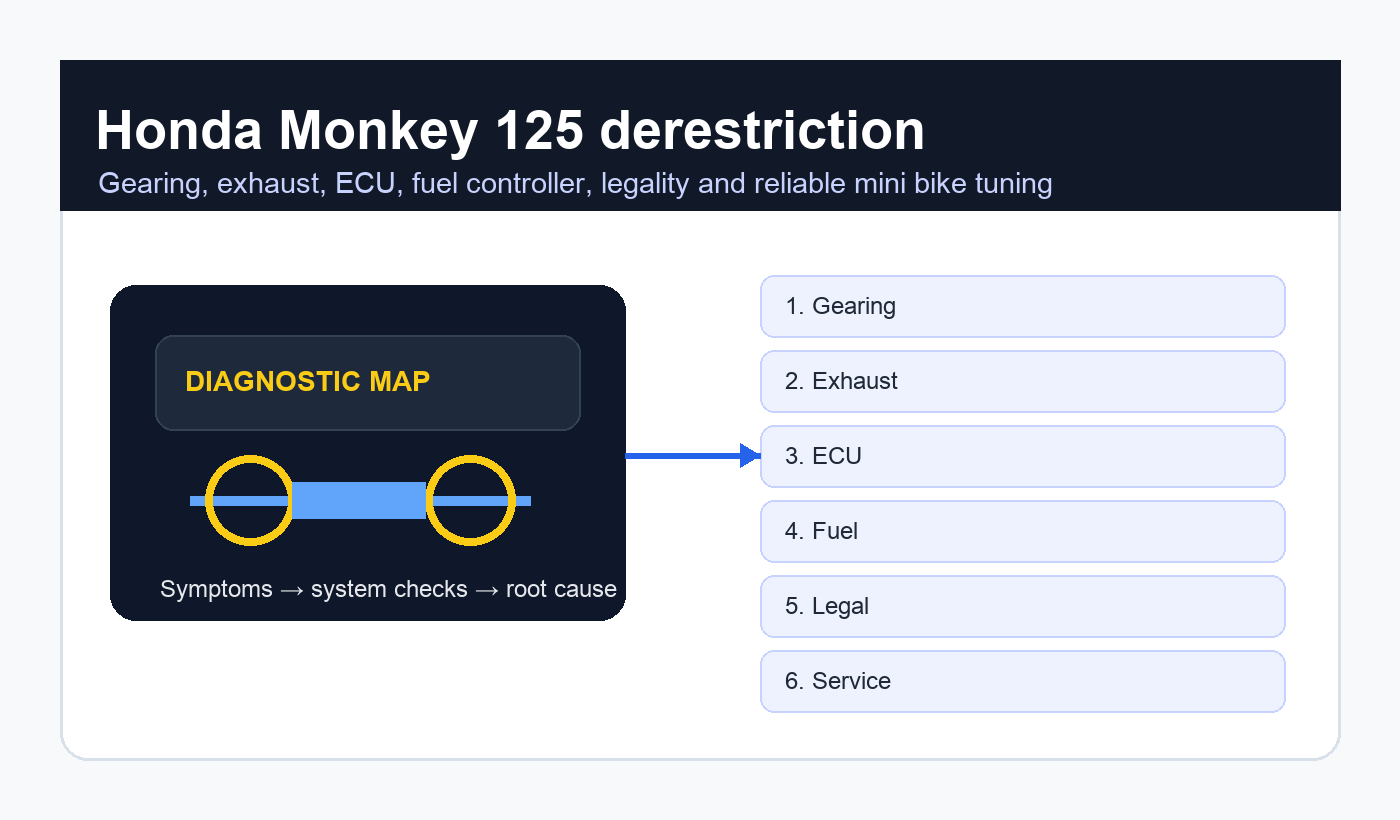
Honda Monkey 125 derestriction sounds like a simple job because the bike is small, friendly and playful, but the modern Monkey is not an old two-stroke with one obvious washer to remove. It is a 124 cc fuel-injected four-stroke mini motorcycle built around reliability, emissions compliance, easy control and everyday charm. The question is not only “can it be made faster?” The better question is what can be improved without ruining the reason people love the Monkey in the first place.
A healthy Monkey 125 should start easily, idle cleanly, shift smoothly, pull through the gears without flat spots and feel light rather than strained. If it feels weak, the cause may be gearing, rider weight, wind, tyre pressure, chain condition, brake drag, old fuel, a dirty air filter or an exhaust fitted without proper fuel support. Good Honda Monkey 125 derestriction begins by separating a real restriction from normal 125 cc performance and from maintenance problems.
This guide explains the sensible path: baseline checks, sprocket changes, exhaust and intake choices, ECU and fuel controller cautions, big-bore temptation, clutch and gearing effects, legal risk, used-bike inspection and the workshop signs that should stop the experiment. It is written for owners who want a better Monkey, not a louder and less reliable one.
Quick answer
Honda Monkey 125 derestriction is usually not one magic limiter removal. Most useful gains come from making the stock bike healthy, then choosing a gearing or fuelling path that matches how it is ridden. A front or rear sprocket change can alter acceleration and cruising feel. A quality exhaust can save weight and improve response if the fuelling remains correct. A fuel controller or ECU solution may help a modified bike, but random parts can create poor running, warning lights or warranty issues.
Honda describes the current Monkey as a 124 cc fuel-injected mini motorcycle with retro styling, front-wheel ABS, a 31 mm inverted fork and the same basic engine family found in the Grom. Use Honda’s official Monkey page for model information and trim details. For road use, also check licensing and entitlement rules such as GOV.UK motorcycle and moped guidance, because capacity, power and insurance matter when a 125 is modified.
| Goal | First thing to check | Sensible route | Common mistake |
|---|---|---|---|
| More acceleration | Chain, sprockets, clutch, tyres | Shorter gearing or lighter setup | Losing comfortable cruising |
| Higher cruising speed | Engine health, wind, rider size | Careful gearing and realistic expectations | Over-gearing a low-power engine |
| Better throttle response | Air filter, fuel quality, spark plug | Service baseline, then fuelling if needed | Fitting a loud exhaust with no checks |
| More character | Exhaust fitment and legality | Quality homologated parts where required | Noise without usable performance |
| Engine build | Budget, workshop skill, road legality | Plan the whole package | Big-bore parts on a neglected bike |
What derestriction can mean on a Monkey
Honda Monkey 125 derestriction can mean different things depending on the rider. Some mean removing a speed limiter. Some mean changing sprockets. Some mean exhaust, intake and fuel controller work. Some mean ECU flashing, camshaft changes or a big-bore kit. These are completely different levels of work, and they do not have the same effect on reliability, insurance or road legality.
The modern Monkey’s charm comes from a small air-cooled single-cylinder engine, low seat height, short wheelbase, chunky tyres and simple manual gearbox. It is not designed to be a motorway weapon. A sensible Honda Monkey 125 derestriction plan should make the bike feel more responsive in town, stronger on rolling roads and cleaner when pulling through the gears, while still starting every morning and staying easy to ride.
Associated owner topics include Monkey 125 tuning, Honda Monkey power increase, Grom engine parts, 125cc sprocket change, front sprocket, rear sprocket, final drive ratio, ECU remap, fuel controller, air filter, sport exhaust, DB killer, big bore kit, camshaft, clutch springs, chain size, tyre pressure, speed limiter, rev limiter, PGM-FI injection, ABS, A1 licence, Euro emissions, commuter tuning, mini moto performance and Honda minimoto upgrades.
Maintenance before parts
The cheapest stage of Honda Monkey 125 derestriction is making sure the bike is not simply tired. Check engine oil level and age, air filter condition, spark plug condition, throttle free play, chain slack, sprocket teeth, tyre pressure, brake drag and clutch adjustment. A Monkey with a tight chain, low rear tyre and dragging rear brake can feel “restricted” even when the engine is fine.
Record a baseline before changing anything. Note how it starts cold, how it pulls from low rpm, how it shifts, what speed it holds on a familiar hill, how it feels into wind and whether fuel economy has changed. After a proper service, ride the same route again. If the bike improves, you have learned something important: some Honda Monkey 125 derestriction jobs are really maintenance jobs in disguise.
Gearing: the most honest first change
For many owners, Honda Monkey 125 derestriction begins with gearing. Changing sprocket sizes can make the Monkey feel sharper or calmer without touching the engine. Shorter gearing usually improves acceleration and hill response but can raise rpm at cruising speed. Taller gearing can reduce rpm at a given speed but may make the bike struggle into wind or uphill because the engine does not have much surplus power.
Small sprocket changes are easy to feel on a 125. That is good and bad. It means a careful rider can tune the bike to local roads, but it also means a poor choice can make every ride worse. If the Monkey is used in steep towns, shorter gearing may be pleasant. If it is used on open flat roads, slightly taller gearing may feel more relaxed only if the engine can pull it. Good Honda Monkey 125 derestriction is honest about the tradeoff.
| Change | Likely effect | Best for | Watch out for |
|---|---|---|---|
| Shorter final drive | Quicker launch, higher rpm | Hills, city riding, heavier riders | More noise and less relaxed cruising |
| Taller final drive | Lower rpm at speed if engine can pull | Flat roads and light riders | Slower acceleration and worse hills |
| Fresh chain and sprockets | Smoother drive | Used bikes and neglected chains | Ignoring alignment and slack |
| Clutch adjustment | Cleaner engagement and shifts | Any bike before tuning | Masking worn clutch parts |
| Tyre pressure correction | Less drag and better feel | Every owner | Using random pressures |
Exhaust and intake reality
Exhausts are popular in Honda Monkey 125 derestriction because they change sound, weight and style immediately. A good exhaust can make the bike feel livelier, especially when paired with correct fuelling and a healthy intake. A bad exhaust can make it loud, flat at low rpm, unpleasant on longer rides and questionable at inspection time.
Keep the DB killer if the exhaust is designed to use one. Check oxygen sensor fitment, exhaust leaks, bracket alignment, heat shielding and clearance around plastics, wiring and luggage. A small bike with a loud pipe attracts attention quickly, and not all attention is helpful. Intake changes should be treated with the same care. A clean standard filter is often better than an exposed filter that pulls hot air, dust or rain.
ECU, fuel controller and limiter claims
Honda Monkey 125 derestriction attracts electronic claims because fuel injection makes owners think every limit is hidden in software. Sometimes fuelling support is useful, especially with exhaust, intake or engine work. But a plug-in box that changes sensor readings is not the same as a careful calibration, and an ECU flash is only as good as the person and data behind it.
Ask what the device actually changes. Does it alter fuelling, ignition, rpm limit, speed signal or throttle response? Is it built for your exact year and market? Can it be removed cleanly? Will it trigger warning lights? Does it have support if the bike runs poorly? A careful Honda Monkey 125 derestriction setup should be reversible enough that the owner is not trapped with a bad map.
Big-bore kits and engine builds
A big-bore kit is the most dramatic version of Honda Monkey 125 derestriction, but it is no longer a simple derestriction. It is an engine build. Bigger displacement can bring real torque, but it also raises questions about heat, fuelling, clutch load, insurance, road legality, emissions, inspection, resale and parts quality. The more power you chase, the more the whole package matters.
If a big-bore route is chosen, plan the supporting parts: injector or fuel controller, camshaft if appropriate, oil cooling where needed, clutch strength, gearing, exhaust, intake, spark plug heat range, break-in process and maintenance interval. A poorly built engine can be slower and less dependable than a well-sorted stock engine. For many riders, the smarter route stops at bolt-on refinement rather than opening the engine.
Legal, insurance and licence limits
The legal side of Honda Monkey 125 derestriction is not paperwork trivia. A 125 is often bought because it fits a licence category, insurance class or local learner rule. If a modification changes power, emissions equipment, noise output or capacity, it may need to be declared and may affect whether the rider is entitled to use it on the road.
Rules vary by country, so the owner must check local law before changing the motorcycle. Keep receipts, original parts and installation notes. If the Monkey is under warranty, ask a dealer before major changes. If a bike is financed, insured as standard or used for commuting, do not assume performance parts are invisible. Sensible Honda Monkey 125 derestriction keeps the bike enjoyable without creating a problem at inspection, claim time or roadside checks.
Step-by-step sensible route
A disciplined plan keeps Honda Monkey 125 derestriction from becoming a box of random parts. First, service the bike and check chain, tyres, brakes and clutch. Second, decide whether the goal is acceleration, cruising, sound or engine power. Third, make one change at a time. Fourth, test on the same road in similar conditions. Fifth, inspect for heat, leaks, warning lights, fuel smell, loose brackets and chain alignment after the first rides.
Do not fit exhaust, intake, sprockets, controller and clutch parts all on the same afternoon unless you are prepared to diagnose the package carefully. If the bike runs worse afterward, you will not know which part caused it. A methodical project may feel slower, but it usually creates a better motorcycle.
Baseline checklist
- Fresh oil at the correct level and specification.
- Clean air filter and healthy spark plug.
- Correct chain slack and aligned rear wheel.
- Sprockets inspected for hooking or uneven wear.
- Tyres set to the correct pressure and checked for wear.
- Brakes checked for drag and fluid condition.
- Battery voltage stable and no warning lights present.
Ride testing without fooling yourself
Testing is where many Honda Monkey 125 derestriction decisions go wrong. A tailwind can make a poor setup look strong. A backpack, cold day or slight hill can make a healthy bike feel weak. Test the same route, with the same rider, similar fuel level and similar weather when possible. Look at acceleration feel, hill holding, shift quality, vibration, engine temperature, fuel use and comfort, not only a single speed number.
After any gearing or exhaust work, inspect the bike again. Check chain slack, axle alignment, exhaust nuts, brackets, sensor wiring and signs of rubbing. Small motorcycles vibrate and owners often ride them hard because they are fun. A good result should survive the second inspection, not just the first ride around the block.
Used Monkey inspection after tuning
A used bike with Honda Monkey 125 derestriction work deserves careful inspection. Ask for original parts, receipts, the exact sprocket sizes, the exhaust brand, fuel controller details and whether the engine has been opened. Look for rounded bolts, stripped threads, cut wiring, missing heat shields, loose exhaust brackets, chain misalignment, oil leaks and warning lights.
Ride it cold and warm. The engine should start cleanly, idle steadily, pull without hesitation and shift without clutch drag. If it pops badly, smells rich, cuts out, overheats or shows electrical warnings, do not be distracted by shiny parts. A modified Monkey can be excellent, but a badly modified one can cost more to correct than buying a standard bike.
| Used-bike clue | What it may mean | What to ask | Buyer action |
|---|---|---|---|
| Aftermarket exhaust | Sound/style change or fuelling need | Is the original included? | Check leaks and legality |
| Different sprockets | Changed acceleration/cruising balance | What sizes are fitted? | Ride hills and open road |
| Fuel controller | Modified fuelling | Who installed and tuned it? | Inspect wiring and warnings |
| Big-bore claim | Engine build, not simple tuning | Which kit and who built it? | Demand proof or walk away |
| Missing original parts | Harder return to stock | Why were they removed? | Budget correction work |
Related Honda tuning guides
Owners comparing Honda Monkey 125 derestriction with other Honda small-bike upgrades should read the Honda Super Cub 125 power increase guide because it shares the same reality of small-displacement tuning. The Honda CB125R power increase article is useful for understanding 125 cc expectations on a more road-focused machine. For a larger Honda single, the Honda CRF300L derestriction guide shows how legal and reliability questions change as displacement rises.
Common mistakes
The first mistake in Honda Monkey 125 derestriction is expecting large-bike performance from a 124 cc fun bike. The second is fitting a loud exhaust before fixing gearing, chain and service condition. The third is choosing taller gearing because it sounds faster, then discovering the bike cannot pull it. The fourth is ignoring legal and insurance consequences. The fifth is changing several parts at once and losing the ability to diagnose.
The sixth mistake is removing the character. The Monkey is enjoyable because it is approachable, light, simple and charming. If the result becomes harsh, fragile, noisy and unpleasant at normal speeds, the project has gone in the wrong direction. The best work makes the bike feel more alive while keeping the smile.
FAQ
Can the Honda Monkey 125 be derestricted?
Honda Monkey 125 derestriction depends on the market version and what the owner means by derestriction. Many useful improvements are gearing, exhaust, fuelling support and maintenance rather than one hidden limiter.
What is the best first change?
The best first step is a full service baseline, then gearing if the rider wants a different feel. For many owners, Honda Monkey 125 derestriction starts with sprockets and chain condition, not engine electronics.
Will an exhaust make it much faster?
An exhaust can change sound, weight and response, but it rarely creates a huge gain alone. Poorly matched exhaust work can make Honda Monkey 125 derestriction louder without making the bike better.
Is a big-bore kit worth it?
It can be worth it for an enthusiast who accepts cost, legality and maintenance changes. For daily riders, Honda Monkey 125 derestriction is often better as a reversible bolt-on setup.
Can tuning affect insurance?
Yes. Any meaningful Honda Monkey 125 derestriction work should be checked against local law, insurance terms and licence entitlement before the bike is used on public roads.
Final advice
Honda Monkey 125 derestriction should be treated as a careful setup project, not a shortcut. Start with maintenance, decide whether you want acceleration or cruising, change one thing at a time and keep the original parts. The Monkey responds best to honest tuning that respects its small engine and playful design.
If the bike becomes smoother, sharper and more enjoyable without losing reliability, the project worked. If it becomes loud, fragile, hard to insure or unpleasant at normal speeds, it missed the point. The smartest Honda Monkey 125 derestriction plan protects the Honda soul of the bike while giving the rider a little more of the response they wanted.