
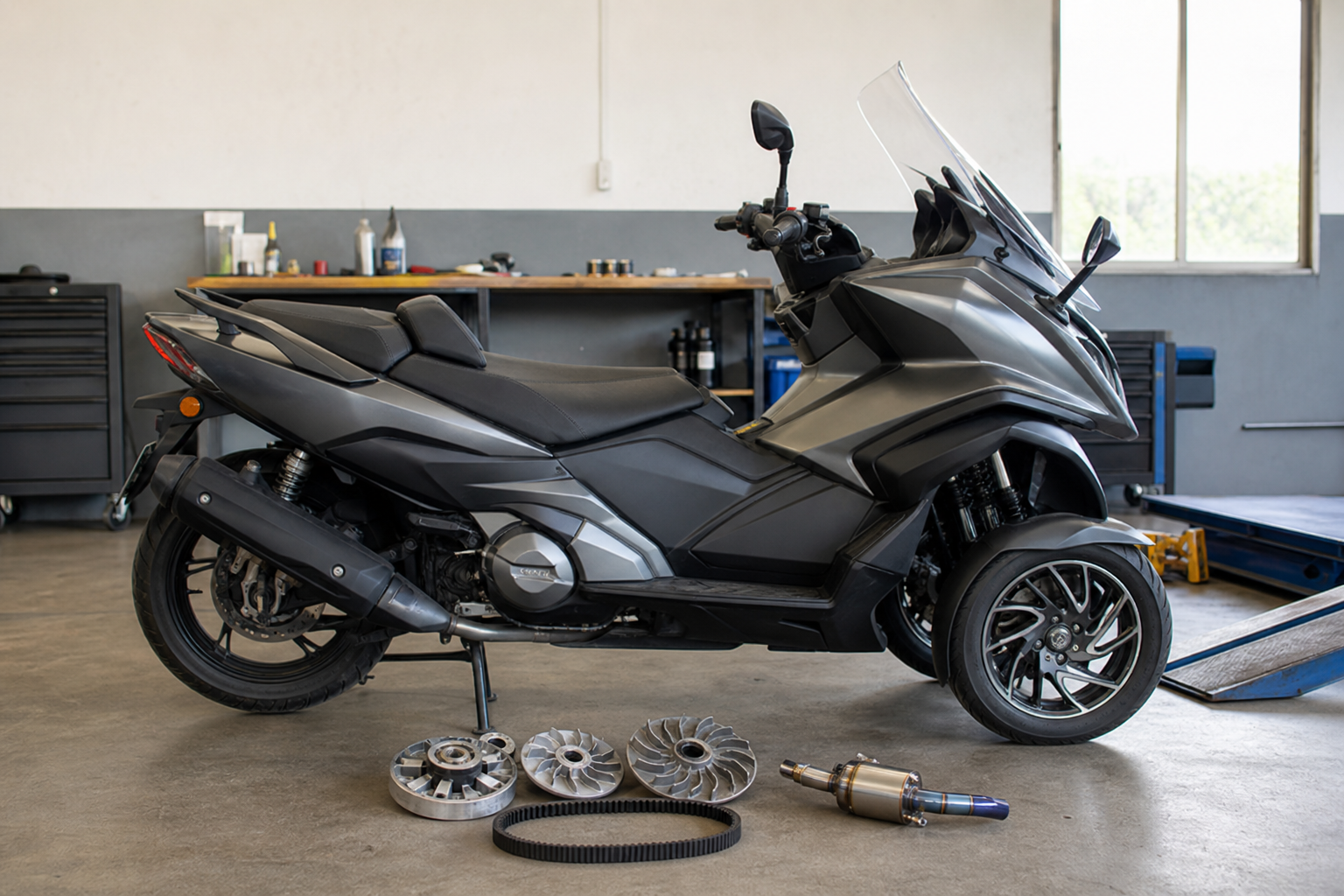
Kymco CV3 tuning: mechanic’s guide to real three-wheel scooter performance
Kymco CV3 tuning is not just about making a big three-wheel scooter louder. The CV3 is heavy, powerful for a scooter, stable at speed and more complex than a simple city 125. A good setup should improve roll-on response, take-off smoothness, CVT behavior, touring confidence and reliability without making the scooter tiring in traffic or risky on long rides.

Kymco CV3 tuning searches usually come from riders who already understand that the CV3 is different. It is not a small scooter with a few rollers and a noisy pipe. It is a leaning multi-wheel maxi-scooter with a strong twin-cylinder engine, CVT transmission, wide front end, serious brakes and touring weight. That means every performance change should be judged as part of the whole machine.
This guide is written for owners comparing CV3 550, CV3 575, stage 1, stage 2, débridage, mehr leistung, exhaust, ECU, variator and acceleration ideas. The aim is practical: make the scooter feel stronger where it is used, keep it stable, keep it legal where needed and avoid wasting money on parts that only change sound.
What riders really mean by Kymco CV3 tuning
Kymco CV3 tuning can mean a faster launch from traffic lights, better overtaking with a passenger, more confident motorway roll-on, a sport exhaust, a different CVT shift curve, a fueling module, ECU remap, derestriction, improved throttle response or simply restoring lost performance after wear. Those are different jobs, and they should not all get the same parts.
The useful search cluster includes Kymco CV3 550i tuning, Kymco CV3 575 tuning, Kymco CV3 mehr leistung, Kymco CV3 débridage, Kymco CV3 stage 1, Kymco CV3 stage 2, Kymco CV3 exhaust, Kymco CV3 sportauspuff, Kymco CV3 acceleration, Kymco CV3 top speed, CV3 variator, CV3 belt, CV3 clutch, reprogrammation Kymco CV3 550, scooter ECU tuning, maxi-scooter CVT, tyre pressure, brake drag and touring setup. Together, they point to a rider who wants real performance, not just a louder scooter.
Confirm the exact CV3 version
Before any Kymco CV3 tuning, identify the exact version. Parts for CV3 550, CV3 575 or market-specific models may not be interchangeable. Some listings use 550i, 575i or CV3 loosely. Exhaust approval, CVT parts, ECU strategy, emissions equipment and diagnostic behavior can differ by year and country.
Start with the official Kymco information for your market, such as the Kymco global website, then compare it with your VIN, registration document and service history. If you are ordering a module or exhaust, send photos of the scooter, exhaust layout and connectors when the supplier asks. Guessing is expensive on a maxi-scooter.
| Before ordering | What to confirm | Why it matters |
|---|---|---|
| Model version | CV3 550, CV3 575, market model | Hardware and mapping can differ |
| Production year | VIN and documents | Emissions and ECU revisions may change |
| CVT condition | Belt, rollers, variator, clutch | Wear can hide or exaggerate gains |
| Exhaust approval | Road-legal, slip-on, catalyst status | Legality and fueling depend on it |
| Use case | Solo, passenger, motorway, touring | Setup should match real load |
Service baseline before performance parts
Kymco CV3 tuning should start with the scooter in excellent mechanical condition. A worn belt, dirty air filter, glazed clutch, flat-spotted rollers, low tyre pressure or dragging brake can make the CV3 feel lazy. If you install performance parts on a worn baseline, you may only mask the real fault.
Check engine oil, final drive oil where applicable, coolant level, air filter, spark plugs, battery health, fault codes, brake condition and tyre pressure. Inspect the CVT carefully: belt width, belt glazing, variator faces, roller or slider condition, clutch shoes, clutch bell heat marks and contra spring behavior. A CV3 that leaves traffic poorly may need CVT service more than a remap.
A proper Kymco CV3 tuning baseline also includes the front-end system. The leaning front suspension, steering joints, wheel alignment, tyre condition and brake balance affect how the scooter feels under power. If the front tyres are worn unevenly or pressures are wrong, the scooter may feel heavy and reluctant even when the engine is healthy.
CVT tuning: where most road feel changes
The CVT is central to Kymco CV3 tuning. A maxi-scooter can make good engine power but still feel slow if the variator does not keep the engine in the right rpm range. Roller weight, sliders, belt condition, variator ramp shape and clutch engagement all affect acceleration. This is where many riders feel the biggest real-world difference.
Changing roller weight can raise or lower engine rpm during acceleration. Lighter weights can make the scooter feel sharper, but too light can create noise, heat and fuel use. Heavier weights can calm the scooter, but too heavy makes it flat. A performance variator can improve shift curve, but only when installed with correct belt, guides and torque values.
| CVT change | Possible benefit | Possible downside | Workshop advice |
|---|---|---|---|
| Fresh belt | Restores ratio range | Needs correct break-in | Measure old belt before blaming power |
| Roller/slider change | Sharper acceleration | Wrong rpm and extra heat | Change in small steps |
| Performance variator | Better shift curve | Can wear badly if mismatched | Use quality parts and correct torque |
| Clutch springs | Cleaner launch | Jerky traffic behavior | Only adjust if engagement is the issue |
| Contra spring | Can support backshift | May increase belt heat | Use with belt-temperature awareness |
Clutch engagement and take-off
Kymco CV3 tuning often feels most obvious at take-off. The CV3 is not light, so clutch condition matters. If the clutch bell is glazed or overheated, if the shoes are contaminated or if the belt is dusty, launch can feel soft or shuddery. A rider may think the engine lacks power when the real problem is engagement.
Clean and inspect the CVT area properly. Look for belt dust patterns, heat marks, uneven shoe contact and bell grooves. Do not breathe dust. If the scooter shudders under load, especially with a passenger, repair the clutch before adding more aggressive parts. A smooth launch is more useful than a harsh one.
Exhaust tuning without cannibalizing the sport exhaust guide
Exhaust is part of Kymco CV3 tuning, but it deserves perspective. A sport exhaust can reduce weight, improve sound and change throttle feel. It can also create drone, heat issues, legal problems or poor low-rpm response if badly chosen. For a dedicated exhaust-only discussion, use the Kymco CV3 sport exhaust guide. This article treats exhaust as one part of a complete setup.
If the exhaust changes flow significantly, fueling may need attention. If the catalyst is removed or emissions equipment is altered, road legality becomes a serious issue. In Europe, type-approval rules for motorcycles and scooters are linked to frameworks such as Regulation (EU) No 168/2013. A daily touring scooter should remain inspectable and usable.
ECU remap, module or stock ECU?
Kymco CV3 tuning with electronics should be handled conservatively. A stock ECU can work very well when the scooter is maintained and the exhaust remains road legal. An external module may help refine response on compatible sensor layouts. A remap can go deeper, but it should be done by someone who understands the CV3 platform, heat, emissions equipment and CVT behavior.
Do not judge electronics after one cold start. Test the scooter warm, in traffic, at steady cruise, during roll-on and after a hot restart. If the scooter smells rich, starts worse, surges, shows a warning light or uses much more fuel, the setup is wrong. A good electronic change should feel almost invisible: cleaner, stronger and calmer.
| Electronic route | Best use | Risk | Good practice |
|---|---|---|---|
| Stock ECU | Reliable road use | May not suit big hardware changes | Service and CVT first |
| External module | Reversible mild correction | Wrong setting can make it rich or flat | Start low and test warm |
| ECU remap | Complete setup after bigger changes | Poor map can cause heat or faults | Use model-specific experience |
| Dyno tune | Measuring before and after | Chasing peak power only | Ask for road manners, not just graph |
Stage 1 and stage 2: what they should mean
Many riders search Kymco CV3 tuning with stage 1 or stage 2. Those labels are not universal. One seller may call a slip-on and filter stage 1. Another may mean variator, exhaust and fueling. Stage 2 might imply deeper exhaust work, remap and CVT changes. Always ask what parts are included and what has been tested.
A sensible stage 1 for a road CV3 is usually service baseline, CVT refresh, careful roller or variator tuning, road-legal exhaust and conservative fueling only if needed. A stage 2 approach should be treated with more caution because heat, legality, warranty, noise and drivability become bigger concerns. The heavier the scooter, the more important reliability becomes.
Front tyres, brakes and chassis setup
Kymco CV3 tuning must include the chassis. The CV3’s two front wheels are a major part of its character. Tyre pressure, tyre brand, tread wear and front-end alignment influence acceleration feel, corner confidence and braking stability. A poorly set front end can make a tuned engine feel wasted.
Set pressures cold. Check both front tyres for matching wear. Inspect brake pad wear on both front wheels and make sure calipers release cleanly. If one side drags, the scooter loses performance and may pull oddly. Rear tyre condition also matters because CVT scooters rely on smooth drive under load.
Touring load, passenger and wind
Real Kymco CV3 tuning should be tested with real load. A top case, passenger, tall screen and motorway headwind change everything. The CV3 may feel strong solo and less impressive when loaded. That does not automatically mean the engine needs more power. It may need a better CVT shift curve, correct tyre pressure, suspension adjustment and a cleaner clutch.
If you tour, test after a long warm ride. Heat changes belt behavior. Stop-and-go traffic after motorway use can reveal clutch problems. A setup that is exciting for five minutes but smells hot after one loaded climb is not a good touring setup.
Road-test method
The best Kymco CV3 tuning road test is repeatable. Use the same route before and after changes. Include cold start, slow traffic, a hill, steady 80-110 km/h cruise where legal, roll-on overtaking and hot restart. If the scooter is normally ridden with a passenger or luggage, test it that way.
Change one thing at a time. Service the CVT, ride. Change rollers, ride. Fit exhaust, ride. Add module or remap, ride. Record belt mileage, roller weight, fuel, temperature, tyre pressure, top-case load and symptoms. This is not glamorous, but it is how you build a scooter that works every day.
What to check after one week
The first ride after a modification can fool almost anyone. The sound is new, the throttle feels different and the owner wants the money to have been well spent. A week later, the scooter tells the truth. Check the CVT cover area for unusual heat smell, fresh dust, loose fasteners and any sign that the belt is running hotter than before. Inspect the exhaust joints for soot marks and listen for ticking leaks on a cold start.
Also compare fuel use. A small increase can happen if the rider enjoys the sharper response, but a large increase during the same commute means the setup may be too aggressive or inefficient. Check hot restart after a fuel stop. If the engine cranks longer, smells rich or idles unevenly, return to a milder setting and diagnose before adding more parts.
Do not ignore bodywork and mounting points. A three-wheel maxi-scooter carries more panels, brackets and hardware than a simple naked motorcycle. After CVT work, exhaust work or suspension checks, ride over rough roads and listen for new rattles. A loose heat shield or body bracket can sound like a mechanical problem and send the owner in the wrong direction.
| One-week check | Healthy result | Warning sign | Next step |
|---|---|---|---|
| Belt area | Normal dust and no heat smell | Heavy dust or burnt smell | Inspect belt, rollers and clutch |
| Exhaust joints | No soot or ticking | Leak marks after heat cycles | Retorque and replace gasket if needed |
| Fuel use | Close to baseline | Large increase on same route | Reduce setting or check CVT rpm |
| Hot restart | Starts normally | Long crank or rich smell | Return to conservative setup |
When to stop and diagnose
More adjustment is not always the cure. Stop and diagnose if warning lights appear, clutch smell increases, the scooter shudders under load, the belt squeals, the engine feels rough when hot or the front end becomes nervous. Those symptoms are not normal side effects of a good setup. They are signs that something is mismatched, worn, loose or overheated.
A careful owner keeps original parts and notes. Write down original roller weight, belt mileage, spring changes, exhaust part numbers and module settings. If the scooter later needs workshop help, those notes save time. They also make it easier to return to a known safe baseline if a new part does not suit the bike.
Best upgrade order
Kymco CV3 tuning works best in stages. The CV3 is too expensive and too heavy for random parts. Start with mechanical health, then CVT, then exhaust, then electronics only if needed. The scooter should improve at each stage without adding new problems.
| Stage | Work | Why it matters | Stop if |
|---|---|---|---|
| 1 | Full service and fault scan | Removes false tuning symptoms | Stored faults or service issues appear |
| 2 | CVT belt, rollers, clutch inspection | Restores launch and acceleration | Belt heat or clutch shudder persists |
| 3 | Tyres, brakes, front-end check | Reduces drag and improves stability | Uneven tyre wear or brake drag remains |
| 4 | Road-legal exhaust | Sound, weight and possible flow benefit | Low-rpm drive gets worse |
| 5 | Fueling module or remap | Matches response to hardware | Hot restart, warning lights or fuel use suffer |
Common mistakes
The biggest Kymco CV3 tuning mistake is chasing sound and ignoring CVT wear. The second is changing roller weight too aggressively. The third is calling any exhaust and module a stage package without testing. The fourth is ignoring the front tyres and brake drag. The fifth is testing solo when the scooter is normally used two-up.
Another mistake is comparing the CV3 to a motorcycle. A motorcycle has gears, clutch control and different weight transfer. The CV3 has a CVT, two front wheels and scooter ergonomics. It can be quick and capable, but it needs scooter-specific tuning logic.
Internal guides worth reading next
Kymco CV3 tuning sits close to several existing X Moto Parts guides. The Kymco AK 550 tuning guide is useful because the AK and CV3 share high-performance Kymco scooter thinking. The BMW C400X tuning guide helps compare premium maxi-scooter CVT and exhaust decisions. The Honda Forza 350 tuning guide is a good reference for practical scooter performance with daily reliability.
If your main question is only sound and exhaust fitment, use the Kymco CV3 sport exhaust guide before buying a silencer. If your question is full setup, stay with this article and work through the scooter one system at a time.
FAQ
Is Kymco CV3 tuning worth it?
Kymco CV3 tuning is worth it when the goal is cleaner acceleration, stronger roll-on and a better touring setup. It is not worth it if the owner expects one part to overcome weight, wind and worn CVT parts.
What should I upgrade first?
Start with service and CVT inspection. Belt, rollers, clutch and tyre pressure decide how the scooter feels every day. Kymco CV3 tuning should not start with electronics on a worn transmission.
Does an exhaust make the CV3 faster?
A good exhaust may reduce weight and improve feel, but it can also lose low-speed smoothness if badly chosen. It should be judged with road testing. Kymco CV3 tuning should keep the scooter civil and usable.
What is stage 1 for a CV3?
There is no universal definition. A sensible stage 1 usually means service baseline, CVT optimization, road-legal exhaust and conservative fueling support if needed. Kymco CV3 tuning labels should always be checked against the actual parts.
Can a remap damage reliability?
A poor remap can create heat, poor fuel use, warning lights and bad hot starts. A careful map can improve response when matched to hardware. Kymco CV3 tuning with ECU work should be done by someone who understands the scooter.
How should I test changes?
Use the same route, same tyre pressure and same load before and after. Include traffic, hills, cruise and hot restart. Good Kymco CV3 tuning feels better after a week, not only during the first ride.
Final mechanic’s advice
Kymco CV3 tuning should make a capable three-wheel maxi-scooter feel sharper without losing its confidence. Service the scooter properly, restore the CVT, check tyres and brakes, choose exhaust parts carefully and use electronics only when they solve a real problem.
If the CV3 launches smoothly, pulls harder under load, cruises without heat smell, restarts normally and still feels stable with luggage or passenger, the setup is doing its job. The best Kymco CV3 tuning is the one that makes the scooter feel complete, not merely louder.