
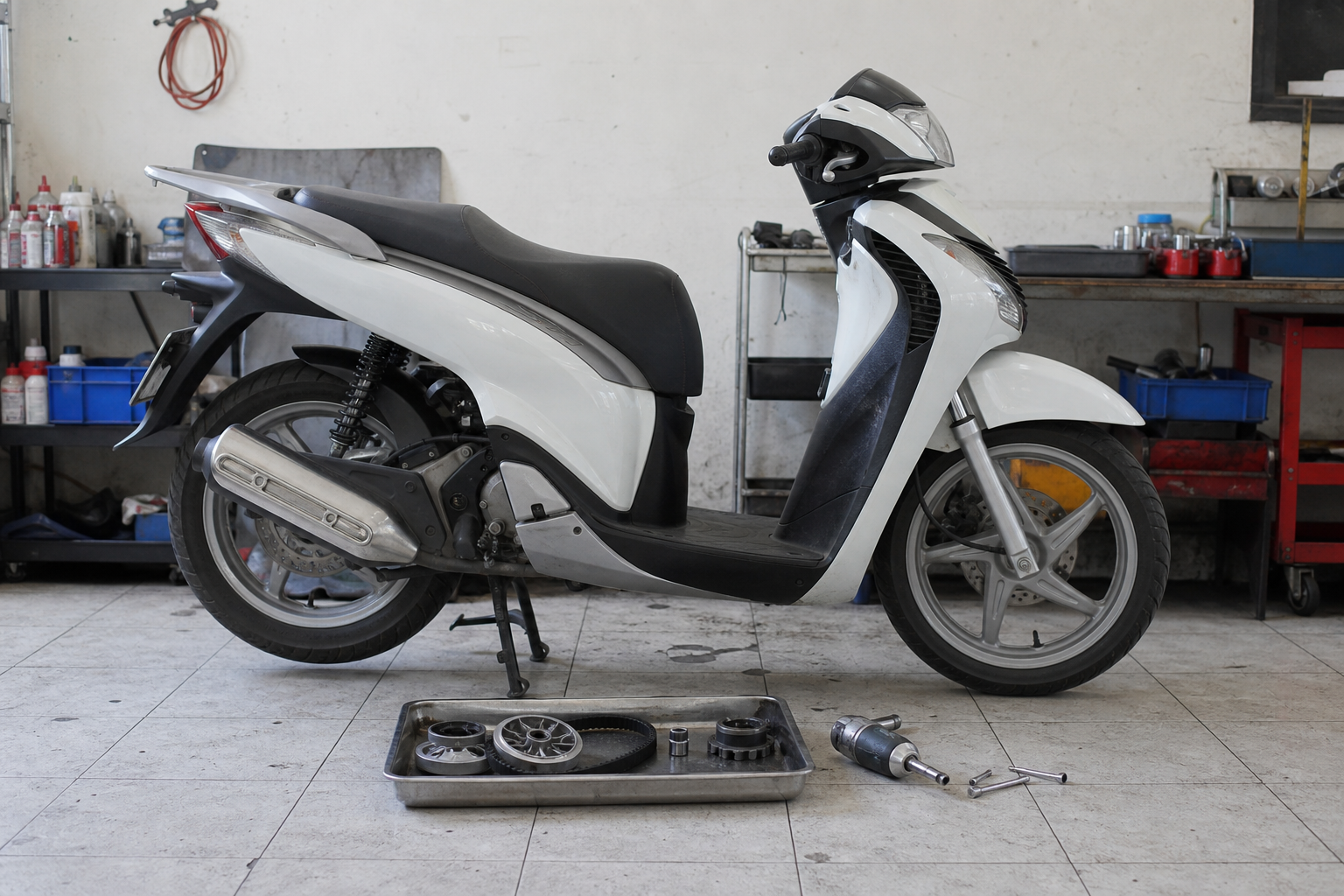
Honda SH 150 tuning: mechanic’s guide to real scooter performance
Honda SH 150 tuning should make the scooter smoother, quicker away from traffic lights and more confident on hills without ruining the reliability that makes the SH popular in the first place. The right work is not one magic part. It is a careful mix of service condition, CVT setup, variator choice, clutch behavior, exhaust flow, fueling, tyres and honest road testing.

Honda SH 150 tuning usually starts because the owner likes the scooter but wants a little more urgency. Maybe the bike feels lazy with a passenger. Maybe acceleration has faded with mileage. Maybe a new exhaust was fitted and the throttle response changed. Maybe the rider has seen kits, ECU modules, Malossi-style variators and clutch springs online and wants to know what actually matters.
This is a practical guide, written from a workshop point of view. It does not promise impossible horsepower from a 150 cc scooter. A good SH setup should start easily, idle cleanly, accelerate smoothly, keep fuel use reasonable and stay comfortable in city traffic. If a modification makes the scooter louder but less pleasant to ride, it is not a good upgrade.
What riders really mean by Honda SH 150 tuning
Honda SH 150 tuning can mean several different jobs. Some riders want better take-off. Some want stronger midrange. Some want a sport exhaust. Some are looking for a centralina or fuel module. Others are trying to restore performance that was lost through wear. Before buying parts, decide if the scooter is actually slow, badly maintained or simply being asked to do more than a 150 should.
The most useful SH upgrades are the ones you feel every day: cleaner clutch engagement, better variator response, correct belt condition, a smooth throttle, stable hot idle and tyres that do not make the scooter feel heavy. Search Console data around this topic points to Honda SH 150i tuning, kit elaborazione Honda SH 150, elaborazione SH 150, modifica centralina SH 150, centralina SH 150, scarico Honda SH 150, marmitta SH 150, variatore Malossi SH 150, migliorare prestazioni SH 150, SH 150 elaborato, Honda SH 150 top speed and Honda SH 150 maintenance. Those searches all orbit the same question: how do you make the SH pull better without spoiling it?
Confirm the exact SH before ordering parts
Before any Honda SH 150 tuning, confirm the exact model year, market version and engine configuration. The SH name has been used for many years, and a 150i from one period may not share every part with another. Some parts listings use SH150, SH150i or SH 150 loosely. That can lead to wrong variator parts, exhaust fitment issues or incompatible electronic modules.
Use the official Honda scooter information for your market where available, starting from Honda’s motorcycle and scooter pages such as Honda Motorcycles UK, then compare with registration documents, VIN plate, service book and the exact engine layout in front of you. Local emissions and approval equipment also matter.
| Before ordering | What to check | Why it matters |
|---|---|---|
| Model year | VIN, registration, service book | CVT, exhaust and electronics can differ |
| Engine version | SH150, SH150i, market specification | Parts listings may be vague |
| CVT condition | Belt, rollers, guides, clutch bell | Wear can feel like lost power |
| Current exhaust | Stock, road-legal silencer, modified system | Noise and fueling change with exhaust type |
| Use case | Solo city, passenger, hills, commuting | The best setup depends on the job |
Service first: most lost performance is not tuning
Honda SH 150 tuning should begin with a service baseline. Many scooters feel slow because the belt is worn, rollers are flat-spotted, the air filter is dirty, the plug is old, tyre pressure is low or the brakes drag. A fresh CVT service can feel like a performance upgrade because the scooter finally shifts as designed.
Inspect the drive belt for width and cracking. Check roller weight and condition. Look at the variator ramps, guide sliders, clutch shoes, clutch bell glazing and contra spring condition. Replace worn parts before tuning around them. If the belt rides low or rollers are damaged, the engine may rev badly and road speed will suffer. No fuel module can fix a tired transmission.
A proper Honda SH 150 tuning baseline also includes valve clearance according to the service schedule, clean air filter, correct spark plug, healthy battery and no stored fault codes. Check brake drag by spinning the wheels. Check tyre pressure cold. Check wheel bearings and rear suspension. A scooter is a whole machine, not just an engine.
CVT and variator setup
The CVT is usually the heart of Honda SH 150 tuning. A variator kit, roller choice or slider setup changes how quickly the engine reaches its useful rpm. Lighter rollers can make the engine rev higher and feel more responsive. Too light, and the scooter becomes noisy, inefficient and tiring. Too heavy, and it may feel lazy.
The aim is not simply more rpm. The aim is to keep the engine in the range where it pulls cleanly while road speed rises. A quality variator can improve response if it is matched with the correct belt and weights. A cheap or badly matched setup can make the scooter worse than stock. Always measure the old parts, note the current roller weight and change one variable at a time.
| CVT change | Possible benefit | Possible downside | Workshop note |
|---|---|---|---|
| Fresh belt | Restores ratio range | Needs correct break-in | Use correct size and quality |
| New rollers | Smoother acceleration | Wrong weight changes rpm badly | Record original weight first |
| Performance variator | Better response and shift curve | Can increase noise or wear if mismatched | Install with clean ramps and guides |
| Clutch spring change | Sharper launch | Can make take-off jerky | Useful only if engagement is the problem |
Clutch, bell and take-off behavior
Honda SH 150 tuning often focuses on take-off because this is what city riders feel most. If the scooter shudders, slips or engages late, inspect the clutch before buying engine parts. Glazed shoes, a blue clutch bell, dust buildup or worn springs can make a healthy engine feel weak.
Clean the CVT area properly. Do not breathe clutch dust. Inspect the clutch bell for heat marks and grooves. Check whether the shoes contact evenly. A mild clutch spring change can sharpen launch, but aggressive springs can make the scooter annoying in traffic. The SH is popular because it is easy to ride; do not remove that quality.
Exhaust and sound
A road-legal exhaust can be part of Honda SH 150 tuning, but sound is not the same as speed. A good silencer may reduce weight and improve tone. A bad exhaust can lose low-rpm pull, leak at the joint, drone at cruising speed or attract problems at inspection. For a daily scooter, comfort matters.
Check fitment carefully. The exhaust must clear the bodywork, rear suspension, centre stand and passenger foot area. After installation, check for leaks when cold and hot. If the scooter begins popping, hesitating or smelling different after an exhaust change, fueling and leaks must be checked. Public-road exhaust changes can also be regulated. In Europe, type-approval rules for motorcycles and scooters are tied to frameworks such as Regulation (EU) No 168/2013.
Fueling modules and ECU changes
Honda SH 150 tuning with a fueling module or ECU change should be approached carefully. A simple external module may help refine signal behavior on compatible models, especially after intake or exhaust changes. It will not turn the SH into a big scooter. The goal is clean throttle response and safe running, not a dramatic dyno claim.
Confirm connector layout before ordering. Work with the ignition off. Route wiring away from heat and moving parts. Start with the most conservative setting and test warm. If the scooter becomes rich, heavy, hesitant, hard to start or shows a warning light, return to baseline and diagnose. Electronic tuning should make the SH easier to ride, not harder to trust.
| Symptom after electronic change | Likely meaning | What to do |
|---|---|---|
| Cleaner roll-on, normal start | Setting may be suitable | Test for several heat cycles |
| Flat, heavy throttle | Too much correction possible | Reduce setting and retest |
| Hot restart worse | Fueling or sensor issue possible | Return to conservative setting |
| Engine light | Connector or signal issue | Stop, scan and inspect wiring |
| Fuel use rises sharply | Setup may be too rich | Compare with baseline notes |
Air filter and intake
A clean air filter is one of the cheapest parts of Honda SH 150 tuning. A dirty filter reduces response and fuel economy. A badly fitted performance filter can let dirt through or change airflow in a way the ECU does not like. For a city scooter, filtration and wet-weather reliability matter more than intake noise.
Keep the airbox sealed. Inspect rubber boots for cracks. Make sure no screws are missing. If a performance filter is fitted, maintain it correctly. Do not run open intake parts on a daily scooter unless you accept the trade-offs. The SH spends much of its life in dust, rain, traffic heat and short trips; tuning must survive those conditions.
Tyres, brakes and suspension
Honda SH 150 tuning is not only engine work. Tyres make a huge difference to how fast a scooter feels. Low pressure, squared tyres or cheap rubber can make steering heavy and acceleration dull. Brake drag also steals performance. Rear shocks that are tired can make the scooter squat and feel unstable with a passenger.
Set tyre pressure cold. Check tread shape, not just tread depth. Spin both wheels. Make sure the brakes release cleanly. If the scooter carries a top box or passenger, adjust rear preload where possible. A scooter that rolls freely and sits correctly feels stronger because less of the engine’s small output is wasted.
Top speed expectations
Many riders approach Honda SH 150 tuning hoping for a much higher top speed. Be realistic. A 150 cc scooter is limited by engine output, CVT ratio, rider size, wind, screen height, tyre condition and road gradient. A setup that improves acceleration may not increase maximum speed. Sometimes it can lower indicated top speed slightly if the CVT is set too short.
Do not tune only for an indicated number. Speedometers can be optimistic. A scooter that reaches a lower displayed top speed but gets there faster and climbs better may be more useful in real traffic. Decide whether you want better launch, better hill pull, smoother cruising or maximum speed. Each goal changes the parts choice.
Road-test method
The best Honda SH 150 tuning test route includes the riding you actually do: cold start, stop-and-go traffic, a warm restart, a hill, a steady cruise and a safe full-throttle section. Test with the top box fitted if you normally use one. Test with a passenger if that is part of the scooter’s job. A setup that feels good on an empty Sunday ride may not suit Monday traffic.
Change one thing at a time. Service the CVT, ride. Change rollers, ride. Fit an exhaust, ride. Add fueling support, ride. Write down roller weight, belt mileage, fuel, weather and symptoms. This discipline saves money because you know which change helped and which one introduced a problem.
After a week, open the transmission cover area for a visual check if major CVT work was done. Look for unusual belt dust, loose fasteners, oil contamination, glazing marks or heat smell. Recheck exhaust bolts after heat cycles and listen for leaks at cold start. A scooter that feels strong on day one but creates new noises by day seven is asking for attention before the next commute.
Fuel consumption is another useful witness. A slightly sharper scooter should not suddenly become thirsty in normal riding. If fuel use rises heavily, the engine revs higher everywhere or the belt looks hot, the setup may be exciting rather than correct.
Best upgrade order
Honda SH 150 tuning works best in stages. Start where the scooter loses performance first: maintenance and CVT wear. Then improve the shift curve. Then consider exhaust and fueling. Do not spend on electronics before checking a worn belt.
| Stage | Work to do | Why it comes first |
|---|---|---|
| 1 | Oil, plug, filter, valve check | Restores engine health |
| 2 | Belt, rollers, guides, clutch inspection | CVT wear is common performance loss |
| 3 | Tyres, brakes, suspension | Reduces drag and improves feel |
| 4 | Variator/roller tuning | Changes acceleration character |
| 5 | Exhaust and fueling support | Fine-tunes the complete setup |
Common mistakes
The biggest Honda SH 150 tuning mistake is installing parts on a worn CVT. The second is choosing roller weights by copying a forum post without checking the rider’s route or scooter year. The third is fitting a loud exhaust and calling it performance. The fourth is using aggressive clutch springs that make city riding unpleasant. The fifth is ignoring tyre pressure and brake drag.
Another mistake is mixing too many brands and parts at once. A variator, belt, clutch, exhaust and module installed on the same day may work, but if it does not, diagnosis becomes slow. Build the scooter in steps. Keep the stock parts. Keep notes. A daily SH should remain easy to service and easy to return to normal.
Internal guides worth reading next
Honda SH 150 tuning sits close to several other scooter tuning guides. The Honda SH 350 tuning guide is useful for understanding the same SH-family logic on a larger engine. The Honda Forza 125 chip tuning guide explains small Honda scooter electronics and realistic expectations. The Piaggio Liberty 125 tuning guide is helpful for comparing high-wheel scooter CVT setup and city performance.
If the rider is considering a bigger step rather than more parts, the Honda Forza 350 tuning guide shows how much easier performance becomes when engine capacity rises. Sometimes the honest answer is not more tuning; it is a scooter that better matches the route.
FAQ
Is Honda SH 150 tuning worth it?
Honda SH 150 tuning is worth it when the goal is better launch, cleaner acceleration and restored performance. It is not worth it if the rider expects a 150 cc scooter to behave like a 300.
What is the first upgrade for an SH 150?
The first upgrade is a full service and CVT inspection. Belt, rollers, guides and clutch condition matter more than most riders think. Honda SH 150 tuning should start with a healthy transmission.
Will a variator make the SH faster?
A variator can improve acceleration and shift behavior, but it may not raise top speed. The result depends on roller weight, belt condition and engine health. Honda SH 150 tuning should be judged by real road response.
Does an exhaust need a fuel module?
Not always. A mild road-legal exhaust may work fine on a healthy scooter. If the bike hesitates, runs hot, smells different or loses smoothness, fueling and leaks should be checked. Honda SH 150 tuning should be based on symptoms, not assumptions.
Can I tune an SH 150 for carrying a passenger?
Yes, but start with belt condition, roller setup, tyre pressure and rear suspension preload. A passenger changes load more than most small engine parts. Honda SH 150 tuning for two-up use should focus on smooth drive and stability.
How do I know if the setup is wrong?
The setup is wrong if the scooter revs loudly without speed, jerks at take-off, starts worse when hot, uses much more fuel, shows warning lights or becomes tiring in traffic. Good Honda SH 150 tuning feels natural and repeatable.
Final mechanic’s advice
Honda SH 150 tuning works best when it respects why people buy the SH: reliability, easy city use and low running cost. Restore the CVT, choose roller weights carefully, keep the intake sealed, use a sensible exhaust and only add electronics when they solve a real problem.
If the scooter leaves traffic more cleanly, holds hills better, restarts hot without drama and still feels calm every day, the work has succeeded. The best Honda SH 150 tuning is not the loudest setup; it is the one that makes the SH feel fresh, strong and dependable again.