
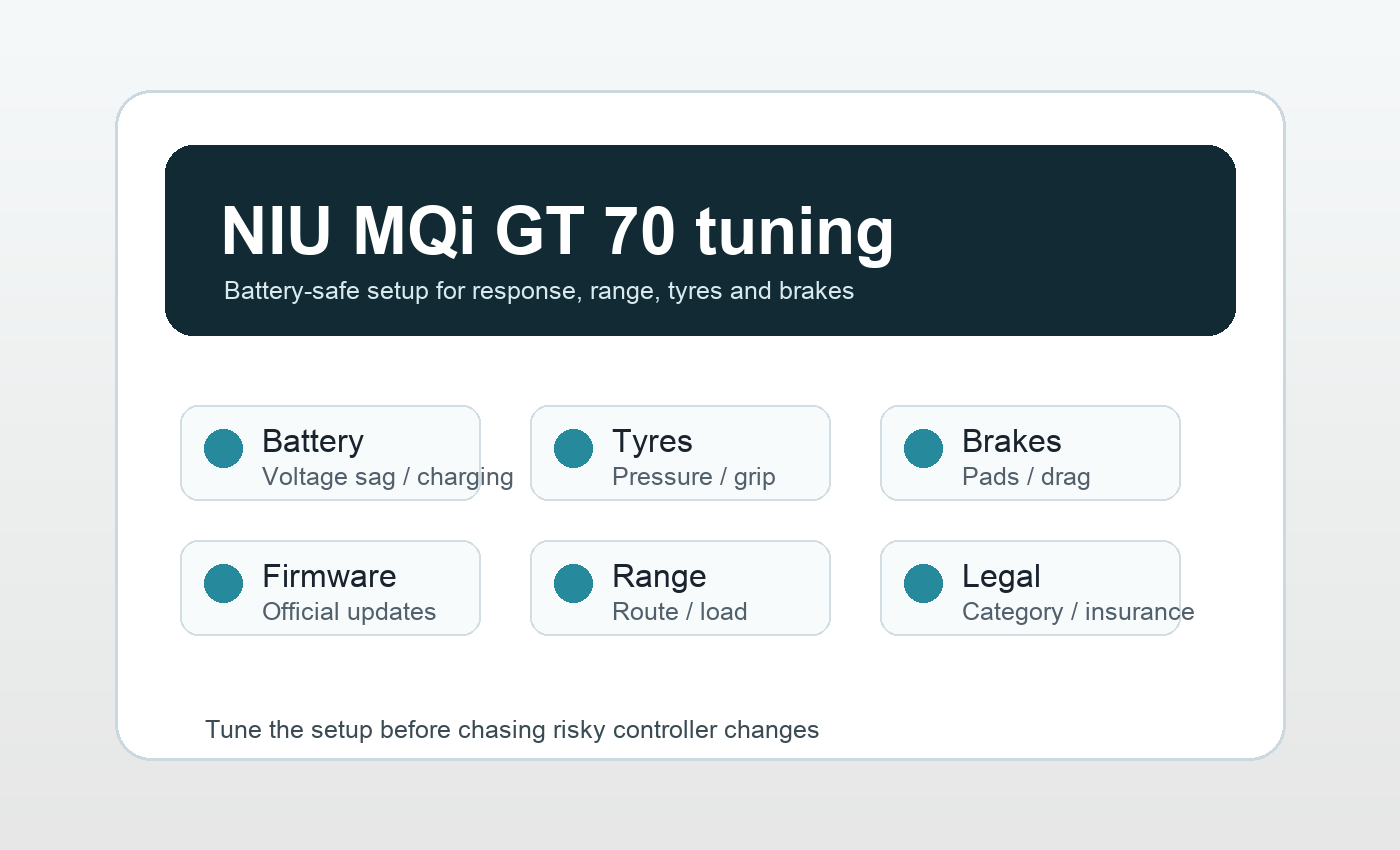
NIU MQi GT 70 tuning: a practical electric scooter guide to safer response, range and reliability
NIU MQi GT 70 tuning should start with one honest idea: this scooter is already a 70 km/h electric moped, not a small petrol scooter with a variator washer to remove. The best gains usually come from making the power delivery cleaner, keeping the battery healthy, fitting the right tyres, improving brake feel, reducing rolling losses and avoiding software or controller changes that turn a reliable commuter into an expensive fault code. If you want a faster-feeling MQi GT 70, the smart route is methodical setup, not random unlocking.

The official NIU MQi GT family includes different speed versions, and the 70 model sits between the 45 km/h moped-style version and the faster 100 km/h version. That matters because NIU MQi GT 70 tuning is not just about one number on the dashboard. The battery, controller, motor, firmware, homologation, tyres, brakes and insurance category all work together. A modification that looks harmless online can change legal status, warranty position, heat load and braking demand.
Quick answer: what is worth tuning first?
NIU MQi GT 70 tuning is most worthwhile when it focuses on ride quality and consistency. Start with tyre pressure, tyre compound, brake pads, clean calipers, wheel alignment, battery care, correct charging habits, app settings, software updates through official channels, bearing drag, suspension condition and load management. These areas can make the scooter accelerate more cleanly, hold speed better on hills and feel safer without opening the controller or abusing the battery.
If your goal is only a much higher top speed, be careful. The official NIU MQi GT page shows that the series is sold in different versions with different designed performance levels. European vehicle approval rules, including Regulation (EU) No 168/2013, are relevant because changing speed or power can move a vehicle outside the category it was registered and insured under. NIU MQi GT 70 tuning should keep that in view before any hardware or software change.
| Tuning area | Good idea | Risky idea |
|---|---|---|
| Battery | Correct charging, temperature care, balanced use | Overvolting or bypassing battery protection |
| Tyres | Quality tyres and correct pressure | Hard cheap tyres for tiny range gains |
| Brakes | Better pads, clean discs, proper bedding-in | More speed with unchanged weak brakes |
| Software | Official updates and app setup | Unknown firmware files from forums |
Understand the scooter before changing it
NIU MQi GT 70 tuning is different from tuning a petrol 50cc or 125cc scooter. There is no carburetor jet, roller weight or exhaust restriction to treat as a simple mechanical bottleneck. Instead, the rider feels a relationship between battery voltage, motor current, controller temperature, firmware maps, riding mode, tyre drag and total load. When battery percentage drops or the pack is cold, the scooter may feel softer even if nothing is broken.
Before modifying anything, establish a baseline. Charge the batteries fully, check tyre pressure, ride the same route in the same mode, note rider weight, temperature, wind, hills and final battery percentage. Then repeat after each change. Without this baseline, NIU MQi GT 70 tuning becomes guesswork. A rider may think a part added power when the real improvement came from warmer weather, higher tyre pressure or a freshly charged pack.
Battery health is performance
NIU MQi GT 70 tuning starts with battery condition because an electric scooter can only deliver what the pack can safely supply. A tired battery sags under load, makes the scooter feel weak on hills and reduces range. Charging habits matter. Avoid storing the scooter empty. Avoid leaving it at 100 percent for long periods if you are not riding soon. Keep the pack away from extreme heat and cold when possible. Let a cold battery warm before demanding hard acceleration.
Do not confuse battery tuning with battery abuse. Higher voltage, non-standard chargers, bypassed BMS protection or mystery battery rebuilds can create serious safety problems. If the scooter suddenly loses range, cuts power under load or shows battery errors, diagnose first. NIU MQi GT 70 tuning should never hide a failing cell, damaged connector or overheating pack behind a performance modification.
| Battery symptom | Likely cause | What to check |
|---|---|---|
| Strong at 100%, weak below 50% | Voltage sag, ageing cells, cold pack | Compare voltage behavior under load and battery temperature |
| Range drops suddenly | Tyre pressure, brake drag, battery imbalance | Check rolling resistance before blaming firmware |
| Power cuts on hills | Controller limit, battery protection, overheating | Scan app warnings and inspect connectors |
| Charging takes much longer | Charger issue, battery temperature, pack fault | Test charger output and battery status through official tools |
Tyres and pressure: the cheapest real improvement
NIU MQi GT 70 tuning often feels better after a tyre change than after an electronic experiment. Tyres influence acceleration, braking, wet grip, steering confidence, range and noise. A square, worn rear tyre makes the scooter feel lazy in turns. A cheap hard tyre may roll easily but lose grip in rain. A soft premium tyre can improve confidence but reduce range slightly. Choose based on your commute, not only forum claims.
Pressure is just as important. Too low, and the scooter wastes energy, steers heavily and heats the tyre. Too high, and it loses comfort and grip. Check pressure cold, with an accurate gauge, and adjust for load if you often carry a passenger. The internal guide on Vespa Elettrica tuning follows the same electric-scooter logic: efficient rolling and predictable grip are performance upgrades, not boring maintenance.
Brakes, pads and regenerative feel
NIU MQi GT 70 tuning must include braking before speed. Electric scooters feel quick because torque arrives immediately, but stopping still depends on tyre contact, pad material, disc condition, caliper movement, hydraulic condition and rider technique. If your brake lever feels wooden, spongy or inconsistent, solve that before chasing more acceleration.
Quality pads can improve bite, but they must be matched to the scooter’s use. Aggressive pads may squeal or wear discs faster. Clean caliper pins, inspect discs for glazing, bed pads in properly and confirm both wheels spin freely. Brake drag can steal range and make the motor work harder. NIU MQi GT 70 tuning that ignores brake drag can feel like an electrical problem when it is really mechanical friction.
Controller and firmware: where caution pays
NIU MQi GT 70 tuning gets risky when people talk about controller swaps, firmware unlocks or hidden speed settings without understanding the system. The controller manages current, temperature, throttle response, regenerative braking and protection logic. Changing those limits can stress the motor, battery, wiring and connectors. It can also create app errors, warranty issues, inspection problems and insurance trouble.
Official software updates are different from random firmware files. If a dealer update improves throttle smoothness or battery communication, that can be worthwhile. But flashing unknown files because someone posted a screenshot of a higher speed is not a professional approach. If your scooter is under warranty, ask a dealer what updates are available and document the current software version. NIU MQi GT 70 tuning should improve the machine you own, not turn it into an untraceable experiment.
| Electronic change | Possible benefit | Possible downside |
|---|---|---|
| Official firmware update | Smoother control, bug fixes, better app behavior | Settings may reset; dealer visit may be needed |
| Controller replacement | Different throttle feel or higher current | Heat, battery stress, errors, legal and warranty issues |
| Speed unlock file | Possible higher displayed speed | Unknown safety margin, no support, insurance risk |
| App setting adjustment | Cleaner daily usability | Limited impact if hardware is already at its limit |
Suspension and handling setup
NIU MQi GT 70 tuning is not only motor output. A scooter that turns cleanly and stays composed over rough roads feels faster because the rider can hold speed with confidence. Check rear shock condition, fork movement, steering head play, wheel bearings and swingarm alignment. If the scooter knocks over bumps or feels vague mid-corner, do not blame the motor map first.
For heavier riders or passenger use, suspension setup matters even more. The MQi GT is designed for two-person use, but load changes braking distance, tyre temperature, acceleration and range. If you often carry cargo, keep pressure and suspension in the sensible part of the range. NIU MQi GT 70 tuning should make the scooter calmer under load, not just sharper when ridden solo on smooth roads.
Range tuning for daily commuting
NIU MQi GT 70 tuning can improve real-world range without changing the battery. The biggest levers are speed, tyre pressure, brake drag, wind, rider posture, load, route choice and acceleration habits. Holding maximum speed into headwinds costs much more energy than riding a little slower and smoother. On an electric scooter, aggressive stop-start riding shows up directly in battery percentage.
Use the app as a diagnostic tool, not just a gadget. Track regular routes, compare battery use, and note temperature. If a route suddenly consumes more energy, check tyres, brakes and bearings. If range falls only in cold weather, that may be normal battery behavior. The internal guide on Biro derestriction covers the same principle for small electric vehicles: controller limits, battery health and legal status are connected.
Legal and insurance reality
NIU MQi GT 70 tuning must respect the registration class of the scooter. A vehicle sold and insured for a certain maximum speed and category can become illegal if modified beyond its approval. That can affect insurance after a crash, roadside inspection, warranty claims and resale value. Even if a modification is physically easy, that does not make it legal for public roads.
The safest distinction is simple: maintenance, tyres, brake pads, ergonomic accessories and official updates are generally sensible. Removing designed speed limits, changing controller power, fitting unapproved lighting or altering battery voltage can cross legal lines. If you use the scooter only on private property, the rules may differ, but road use is where most owners actually ride. NIU MQi GT 70 tuning should be planned around where the scooter will be used every day.
Best upgrade order
| Step | Upgrade or check | Why it comes first |
|---|---|---|
| 1 | Baseline test, tyre pressure, brake drag | Finds lost performance before spending money |
| 2 | Quality tyres and brake pads | Improves confidence, stopping and wet-road control |
| 3 | Battery care and official software check | Keeps torque and range consistent |
| 4 | Suspension and bearing inspection | Reduces drag and makes speed easier to carry |
| 5 | Only then consider electronic changes | Prevents masking basic mechanical or battery faults |
Diagnostic checks before and after any change
A proper electric-scooter setup should be measured before it is judged. Write down odometer reading, outside temperature, tyre pressure, rider weight, route distance, riding mode, starting battery percentage and ending battery percentage. Repeat the same loop after each change. If the scooter feels stronger but uses far more battery on the same route, the change may be trading efficiency for a short burst of torque. If top speed is unchanged but hill speed is steadier, the improvement may still be valuable for commuting.
Use your senses as well as the app. After a steady ride, carefully check for unusual heat around the motor area, brake discs, battery compartment and connectors. A warm motor is normal; a hot smell, discolored connector, dragging brake or sudden power reduction is not. Listen for bearing noise and tyre rubbing. Feel whether the scooter rolls freely with power off. Small mechanical drag can steal more range than many riders expect, especially on a vehicle where every watt comes from the battery.
Do not make three changes at once. If you fit tyres, change brake pads and alter software on the same day, you will not know what helped or what caused a problem. A workshop would isolate variables: tyres first, test; brakes next, test; software only after the scooter is mechanically sound. This patient method is slower, but it prevents chasing imaginary controller faults when the real cause is a dragging rear caliper or a tyre fitted at the wrong pressure.
| After-change symptom | Most likely area | What to do next |
|---|---|---|
| More torque but much less range | Current demand, tyre drag, riding style | Repeat baseline route and compare energy use before keeping the change |
| Brake smell after riding | Pad drag or caliper alignment | Lift the wheel, spin it by hand and inspect pad contact |
| Power reduction after long hill | Thermal protection or voltage sag | Let the scooter cool and check app warnings before further riding |
| Speed wobble or nervous steering | Tyre pressure, tyre profile, bearing play | Check pressure cold, wheel balance and steering head condition |
Comfort upgrades that actually help performance
Comfort is not separate from performance on an electric commuter. A rider who is relaxed, stable and able to see clearly will carry speed more safely than a rider fighting wind, poor mirrors, harsh grips or a loose top box. Sensible upgrades include better mirrors, a correctly mounted phone holder, a compact screen where legal, quality gloves, a brighter legal replacement bulb or auxiliary visibility within local rules, and luggage that does not overload the rear of the scooter.
Be careful with heavy accessories. Large boxes, wide screens and poorly mounted bags increase drag and can make the scooter feel slower at higher speed. A top case is useful, but keep weight low and secure. If you carry a passenger, remember that the same battery, brakes and tyres now handle more mass. The best setup for solo commuting is not always the best setup for two-up riding with groceries and hills.
Common mistakes
NIU MQi GT 70 tuning goes wrong when riders chase screenshots. A dashboard top speed in perfect conditions does not prove the scooter is better. If range collapses, the controller overheats, the battery sags, or braking becomes marginal, the tune is poor. Another mistake is fitting accessories that add weight and drag, then blaming the scooter for reduced range.
Do not ignore warning messages. Do not keep riding with a hot connector smell, power cuts, brake drag or battery errors. Do not pressure-wash battery areas or connectors. Do not use chargers that are not correct for the pack. The internal guide on Super Soco CUX tuning is useful if you want another electric-scooter comparison built around reliability rather than fantasy top-speed claims.
FAQ
Can the NIU MQi GT 70 be made as fast as the MQi GT 100?
NIU MQi GT 70 tuning should not assume the 70 and 100 versions are identical apart from software. Even when platforms look similar, homologation, controller settings, battery load, motor limits and legal category can differ. Treat the faster model as a different specification, not a guaranteed unlock target.
What is the safest first modification?
The safest first NIU MQi GT 70 tuning step is a baseline service: correct tyre pressure, clean brakes, no bearing drag, healthy battery, updated official software and good tyres. These changes improve the scooter without compromising protection systems.
Will better tyres reduce range?
Sometimes. A grippier tyre can create slightly more rolling resistance, but it may improve braking and wet confidence. Good NIU MQi GT 70 tuning balances range with safety, because a commuter scooter must stop and turn well, not only travel far.
Should I install an aftermarket controller?
An aftermarket controller is not a casual upgrade. It can change current draw, heat, diagnostics and legal status. For most riders, NIU MQi GT 70 tuning should stay with tyres, brakes, battery care and official diagnostics unless a specialist can prove the full system is safe.
How do I know if the battery is limiting performance?
If power fades under load, range drops suddenly, voltage sag is obvious, or errors appear during hills, the battery needs diagnosis. Do not continue NIU MQi GT 70 tuning until the pack, charger, connectors and temperature behavior have been checked.
Final mechanic-style takeaway
NIU MQi GT 70 tuning is best treated as setup work, not a hunt for a secret speed switch. The useful gains are a scooter that launches cleanly, holds speed consistently, brakes harder, turns with confidence, uses battery intelligently and does not punish you with errors or warranty arguments. Start with the mechanical and battery basics, then move carefully.
If you want a faster registered scooter, compare the official MQi GT versions and the legal category in your country before modifying the 70. For daily road use, the smartest NIU MQi GT 70 tuning keeps the machine reliable, legal and predictable. That kind of tuning may sound less dramatic, but it is exactly what makes an electric commuter feel better every morning.