
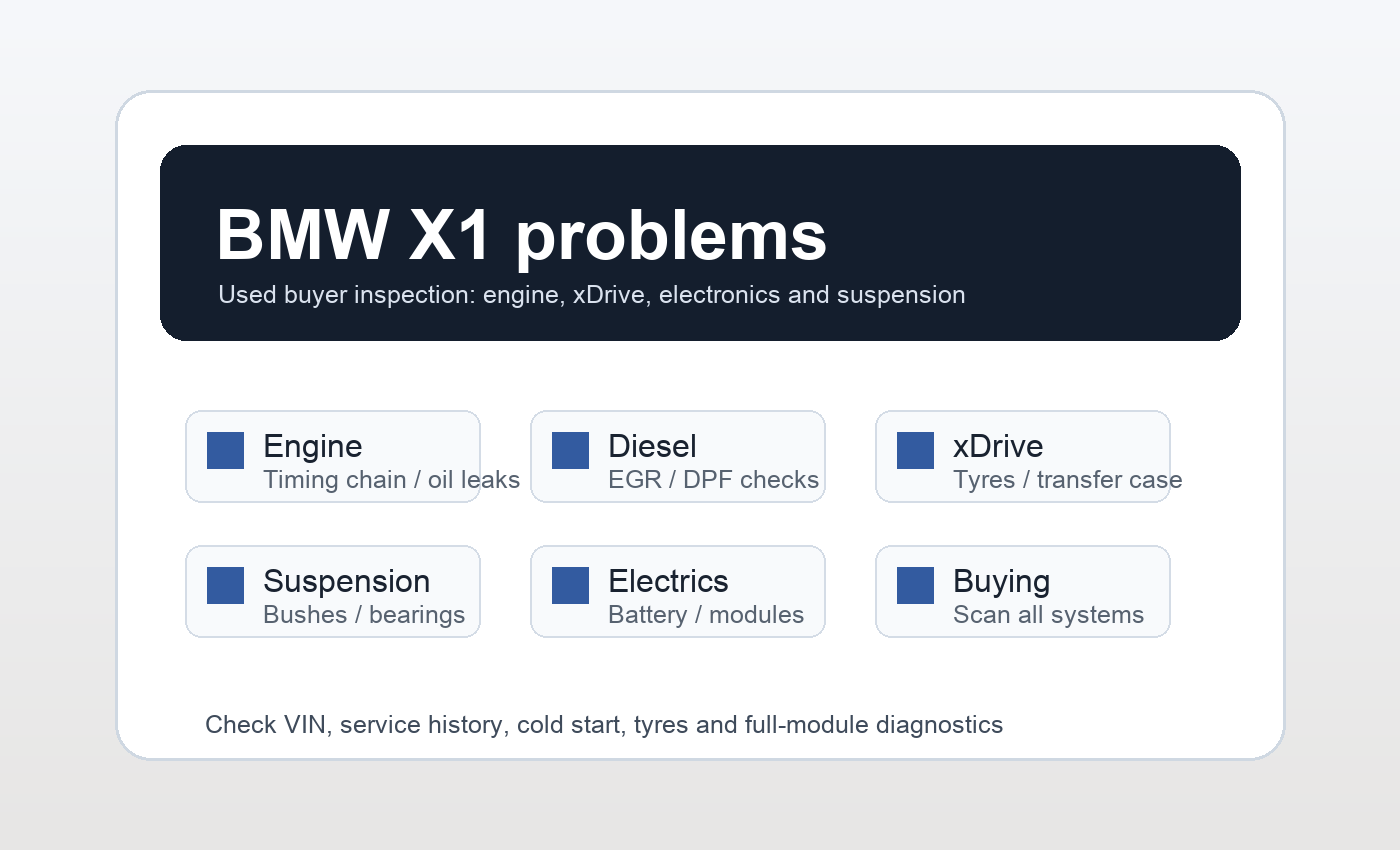
BMW X1 problems: a mechanic-style used buyer guide to engines, xDrive, electronics, suspension and repair checks
BMW X1 problems depend heavily on generation, engine, maintenance history and how the car has been used. A well-serviced X1 can be a sharp, practical small SUV, but a neglected one can hide expensive faults in the timing chain, EGR system, turbo plumbing, automatic gearbox, xDrive transfer case, suspension, cooling system, battery management and infotainment electronics. The trick is not to fear the badge; it is to inspect the right areas before buying or before throwing parts at a warning light.

This guide covers the first-generation E84, the second-generation F48, and the newer U11 in a practical way. BMW X1 problems on an older diesel E84 are not the same as faults on a petrol F48, a plug-in hybrid, or a newer mild-hybrid car. When you search forums, many complaints are real, but they only make sense if you know which engine, gearbox and drivetrain the owner is talking about. Always start with the VIN, service history and exact model designation.
Quick answer: the problems worth checking first
BMW X1 problems that deserve early attention include timing chain noise on some older diesel and petrol engines, EGR cooler and intake contamination on diesels, oil leaks, coolant leaks, turbo boost leaks, worn suspension arms, noisy wheel bearings, xDrive transfer case judder, automatic gearbox service neglect, battery and IBS sensor issues, parking sensor faults, iDrive glitches, tailgate wiring faults, panoramic roof leaks, and uneven tyre wear. None of these automatically makes the X1 a bad car, but each one changes the real purchase price.
If you are already driving one, separate inconvenience from risk. A faulty parking sensor is annoying. A rattling timing chain, coolant loss, repeated drivetrain warnings, overheating, brake system warning, fuel smell or smoke from the engine bay is different. BMW X1 problems should be triaged by safety and repair cost, not by how dramatic the dashboard message looks.
| Area | Common symptom | First practical check |
|---|---|---|
| Engine timing chain | Rattle at cold start, metallic noise, fault codes | Listen cold, check service history, scan cam/crank correlation faults |
| Diesel EGR/intake | Smoke, hesitation, coolant smell, limp mode | Check recalls, inspect EGR cooler, boost pipes and intake soot |
| xDrive | Judder on tight turns, tyre scrub, drivetrain warning | Check matching tyres, transfer case oil history and fault codes |
| Suspension | Knocks, wandering, uneven tyre wear | Inspect control arms, bushes, dampers, top mounts and alignment |
Know which BMW X1 you are dealing with
BMW X1 problems are easier to understand if you split the car into generations. The E84, sold from 2009, is closely related to rear-wheel-drive BMW platforms and is popular in diesel form in Europe. The F48 moved to a front-wheel-drive-based platform with xDrive versions available. The U11 is the newer generation with more digital systems, mild-hybrid or electrified variants depending on market, and more driver assistance technology.
That generation change matters. An E84 xDrive20d with a manual gearbox and N47 diesel has different risk points from an F48 sDrive18i petrol automatic. A newer U11 may have fewer age-related leaks but more software, sensor and electronic systems. BMW X1 problems are not one single list; they are a map of engine family, gearbox type, drivetrain layout and maintenance quality.
| Generation | Typical age now | Main buyer focus |
|---|---|---|
| E84 | Older used cars | Timing chain history, diesel intake/EGR, suspension wear, xDrive condition |
| F48 | Mid-age used cars | Cooling leaks, automatic gearbox behavior, electronics, tyres and service records |
| U11 | Newer cars | Warranty status, software updates, recalls, driver-assistance and hybrid systems |
Engine and timing chain concerns
BMW X1 problems that scare buyers most are usually engine-related. On older diesel cars, especially those using the N47 family, timing chain wear has a reputation that should not be ignored. The classic warning is a rattling or scraping noise from the rear of the engine, often more noticeable on cold start or at idle. If a seller says “they all sound like that,” be careful. A chain job can be expensive because access is labor-intensive.
Petrol engines can also have timing, oil leak, coolant leak and turbo-related concerns depending on engine family and year. The N20 petrol engine, used in some BMW models, is known among mechanics for timing chain guide concerns in certain applications. Later B-series engines are generally better regarded, but they still need clean oil, correct coolant, good plugs, no boost leaks and proper service intervals. BMW X1 problems become expensive when long-life servicing is treated as an excuse to skip oil changes.
What to listen for on a cold start
Arrive before the engine is started. Put your hand on the bonnet to confirm it is cold. Listen for chain rattle, harsh metallic scraping, uneven idle, misfire, turbo whistle, belt squeal and fan noise. Watch for smoke on start-up and during acceleration. BMW X1 problems that disappear once warm can still be serious, especially chain noise, injector imbalance, glow plug faults and turbo actuator issues.
Diesel EGR, DPF and intake faults
BMW X1 problems on diesel models often involve the emissions system. The EGR valve, EGR cooler, intake manifold, swirl flaps, boost pipes, DPF, temperature sensors and differential pressure sensors all work in a harsh environment. Short trips make soot and condensation worse. A diesel X1 used only for city school runs can have more intake and DPF trouble than one used for steady motorway driving.
Check for recall status before buying, especially where EGR cooler campaigns are relevant. The official NHTSA recall lookup explains how VIN and model searches can reveal recalls, investigations and manufacturer communications. BMW owners should also use BMW’s official owner and service channels, starting from BMW X1 information and local BMW owner portals, because recall and service campaign coverage varies by market and VIN.
| Diesel symptom | Likely area | Mechanic-style check |
|---|---|---|
| Limp mode under load | Boost leak, turbo actuator, EGR, DPF restriction | Smoke test intake, scan boost requested vs actual, check DPF data |
| Coolant smell or loss | EGR cooler, coolant flange, radiator, expansion tank | Pressure test cold and inspect for dried coolant traces |
| Rough idle on cold start | Glow plugs, injectors, compression, EGR sticking | Read smooth running values and glow module faults |
| Frequent regeneration or DPF warning | DPF loading, thermostat, sensor fault, driving pattern | Check coolant temperature, ash load, soot load and pressure sensor |
Automatic gearbox and clutch issues
BMW X1 problems with gearboxes often come from service neglect or misdiagnosis. Many owners were told automatic gearboxes are “sealed for life,” but mechanics see a different reality once mileage climbs. Harsh engagement, delayed reverse, shudder under light throttle, flaring shifts or a drivetrain warning can point to old fluid, adaptations, mechatronic issues, worn mounts, software or internal wear. Do not buy a car with gearbox symptoms unless the price reflects proper diagnosis.
Manual cars need clutch and dual-mass flywheel checks. Listen for rattles at idle with clutch engaged and disengaged, test for clutch slip in a high gear, and feel for vibration through the pedal. If a manual diesel X1 has high mileage and towing history, budget for clutch work. Drivetrain trouble often starts as small noises that owners ignore until the bill becomes a gearbox-out repair.
xDrive, tyres and transfer case judder
BMW X1 problems on all-wheel-drive models deserve careful tyre inspection. xDrive systems do not like mismatched rolling circumference. Four tyres with different brands, sizes, wear levels or pressures can create transfer case stress, judder on tight turns and drivetrain warnings. If an X1 shudders in a parking lot on full lock, do not assume it is normal all-wheel-drive behavior.
Check that all four tyres are the correct size and similar tread depth. Look for star-marked BMW-approved tyres where applicable, but more importantly check matching axle pairs and rolling circumference. Ask whether transfer case oil has ever been changed. During the test drive, turn slowly in both directions, accelerate gently from low speed and feel for binding. xDrive trouble can become expensive because tyres, fluid service, calibration and hardware may all be involved.
Suspension, steering and brakes
BMW X1 problems in the suspension are common because the car is heavier than a hatchback but often driven like one. Front control arm bushes, drop links, ball joints, dampers, top mounts, rear bushes and wheel bearings can wear. Symptoms include clunks over speed bumps, wandering under braking, uneven tyre wear, vibration at motorway speed and a dull knock from the rear.
Do not diagnose suspension by sound alone. Put the car on a lift, lever the bushes, spin the wheels, inspect tyres, check wheel alignment and look for leaking dampers. Brake vibration may be warped discs, but it can also be worn suspension allowing the wheel to move. Faults that feel like brake trouble sometimes begin in bushes, tyres or wheel bearings.
| Road-test feel | Possible cause | What to inspect |
|---|---|---|
| Clunk over small bumps | Drop links, control arm bushes, top mounts | Front suspension with car loaded and unloaded |
| Drone that changes with speed | Wheel bearing or tyre wear | Wheel bearing play, tyre feathering, rear alignment |
| Steering vibration | Wheel balance, tyre damage, brake disc runout | Wheels, tyres, hub faces and brake discs |
| Car pulls under braking | Brake caliper, bush wear, tyre mismatch | Caliper slide pins, bushes, tyre pressures and alignment |
Electrical and battery-related faults
BMW X1 problems can look mysterious when the real issue is low voltage. Modern BMWs are sensitive to battery condition, intelligent battery sensor data, alternator output and registration after battery replacement. A weak battery can cause random warning lights, start-stop failure, comfort access issues, parking sensor glitches, transmission warnings and infotainment restarts.
Before chasing modules, test the battery properly and scan the car with BMW-capable diagnostics. If the battery was replaced, confirm it was registered to the car. Check water ingress in the boot, tailgate wiring, fuse boxes and connector corrosion. The same discipline applies to other electrical guides, such as Toyota Corolla electronic key system fault: voltage, history and wiring checks often matter more than the warning text itself.
Cooling system, oil leaks and service neglect
BMW X1 problems often become expensive because coolant and oil leaks are ignored. Look around the oil filter housing, rocker cover, sump area, turbo oil lines, coolant expansion tank, radiator seams, thermostat housing and water pump area. Any dried coolant crust, sweet smell, wet undertray or oil smoke after a drive deserves attention. A used X1 with a freshly steam-cleaned engine bay is not automatically suspicious, but it should make you inspect harder.
Ask for oil change intervals, not just stamps. A car serviced every 25,000 to 30,000 km may technically have a history, but short oil intervals are kinder to turbochargers, timing chains and VANOS systems. BMW X1 problems are often blamed on “BMW reliability” when the deeper cause is deferred maintenance, cheap oil, wrong coolant, late gearbox service or ignoring early leaks.
Interior, iDrive, sensors and comfort equipment
Cabin faults are usually less catastrophic but still affect ownership cost. Check iDrive controller function, screen pixels, Bluetooth, navigation, parking sensors, reversing camera, heated seats, panoramic roof shade, central locking, windows, mirrors, climate control and tailgate operation. A panoramic roof should open, close and drain properly. Wet carpets or musty smell can point to blocked drains or water ingress.
Parking sensors and cameras are useful, but sensor faults can become irritating. Test each sensor by engaging reverse and listening/feeling for clicking, or scan the parking module. If the car has aftermarket electronics, dash cameras, Android head units or tracker wiring, inspect the installation quality. The internal guide on Chinese car radio apps shows how dashboard electronics can create confusing symptoms when wiring or software is messy.
Used buying checklist
BMW X1 problems are easiest to spot with a disciplined inspection. Do not view the car at night. Do not accept a warm engine. Do not skip the test drive because the seller is busy. Scan all modules, not only the engine ECU. Check recalls by VIN, service invoices, tyre matching, coolant level, oil leaks, cold start behavior, gearbox shifts, xDrive behavior, suspension knocks and every electrical feature.
| Before buying | Pass sign | Walk-away sign |
|---|---|---|
| Cold start | Clean start, no chain rattle, no smoke cloud | Metallic rattle, coolant smell, heavy smoke |
| Service history | Invoices with oil, filters, brake fluid, gearbox/xDrive care | Only vague stamps, missing years, no proof of major work |
| Diagnostic scan | No active drivetrain, EGR, DPF, gearbox or safety faults | Codes recently cleared, monitors incomplete, repeated warnings |
| Road test | Smooth shifts, straight braking, no judder on full lock | Gearbox flares, xDrive binding, suspension knocks |
What to fix first if you already own one
BMW X1 problems should be prioritized by risk. Fix overheating, oil pressure, brake warnings, fuel leaks, coolant leaks, chain noise, severe misfires and drivetrain limp mode before cosmetic or comfort faults. Then handle suspension, tyres and alignment because they affect safety and xDrive health. After that, tackle parking sensors, infotainment, trim and convenience features.
If the dashboard shows confusing OBD labels or generic scanner messages, read the internal 07E9 code guide before assuming a module label is the actual fault. A BMW-capable scan tool is worth using because generic OBD may miss transfer case, gearbox, body, airbag, parking and comfort access modules. BMW X1 problems are often solved faster when you scan the whole car instead of guessing from the first warning light.
FAQ
Is the BMW X1 unreliable?
BMW X1 problems do not make every X1 unreliable. The car can be dependable when serviced well, inspected properly and repaired early. The expensive examples are usually neglected cars, wrong-engine/wrong-history purchases, or cars with ignored drivetrain and emissions faults.
Which BMW X1 engine should I be careful with?
Older diesel engines with timing chain reputation and emissions hardware need careful checks, and some earlier petrol turbo engines also deserve timing and oil-service scrutiny. With BMW X1 problems, condition and history matter more than internet fear around one engine code.
What is the most expensive used BMW X1 fault?
Major engine timing failure, gearbox failure, transfer case damage, severe diesel emissions faults and water-damaged electronics can all become expensive. The worst BMW X1 problems are the ones a buyer ignores because the car looks clean and drives well for ten minutes.
Should I buy an xDrive model?
xDrive is useful in poor weather, but it needs matching tyres, correct servicing and careful diagnosis if it judders. If you are worried about BMW X1 problems and want the simplest ownership, a well-kept sDrive can be cheaper to maintain.
Can a cheap OBD scanner diagnose an X1 properly?
A cheap scanner can read basic engine faults, but many BMW X1 problems live in gearbox, transfer case, body, parking, comfort access or safety modules. Use a BMW-capable tool for a pre-purchase inspection or serious diagnosis.
Final mechanic-style takeaway
BMW X1 problems are manageable when you inspect the car by system: engine, emissions, gearbox, xDrive, suspension, cooling, battery, electronics and service history. Do not buy only on mileage, paint shine or badge appeal. A higher-mileage X1 with invoices, matching tyres, clean diagnostics and smooth cold behavior can be a better car than a low-mileage one with warning lights, cheap tyres and a missing history.
For owners, the best strategy is early diagnosis. Listen cold, scan all modules, check recalls, keep oil intervals sensible, fix leaks quickly and take tyre matching seriously on xDrive models. If you treat BMW X1 problems as clues rather than disasters, the car becomes much easier to judge, buy and maintain without nasty surprises.