
07E9 code: what it really means when your OBD scanner shows it
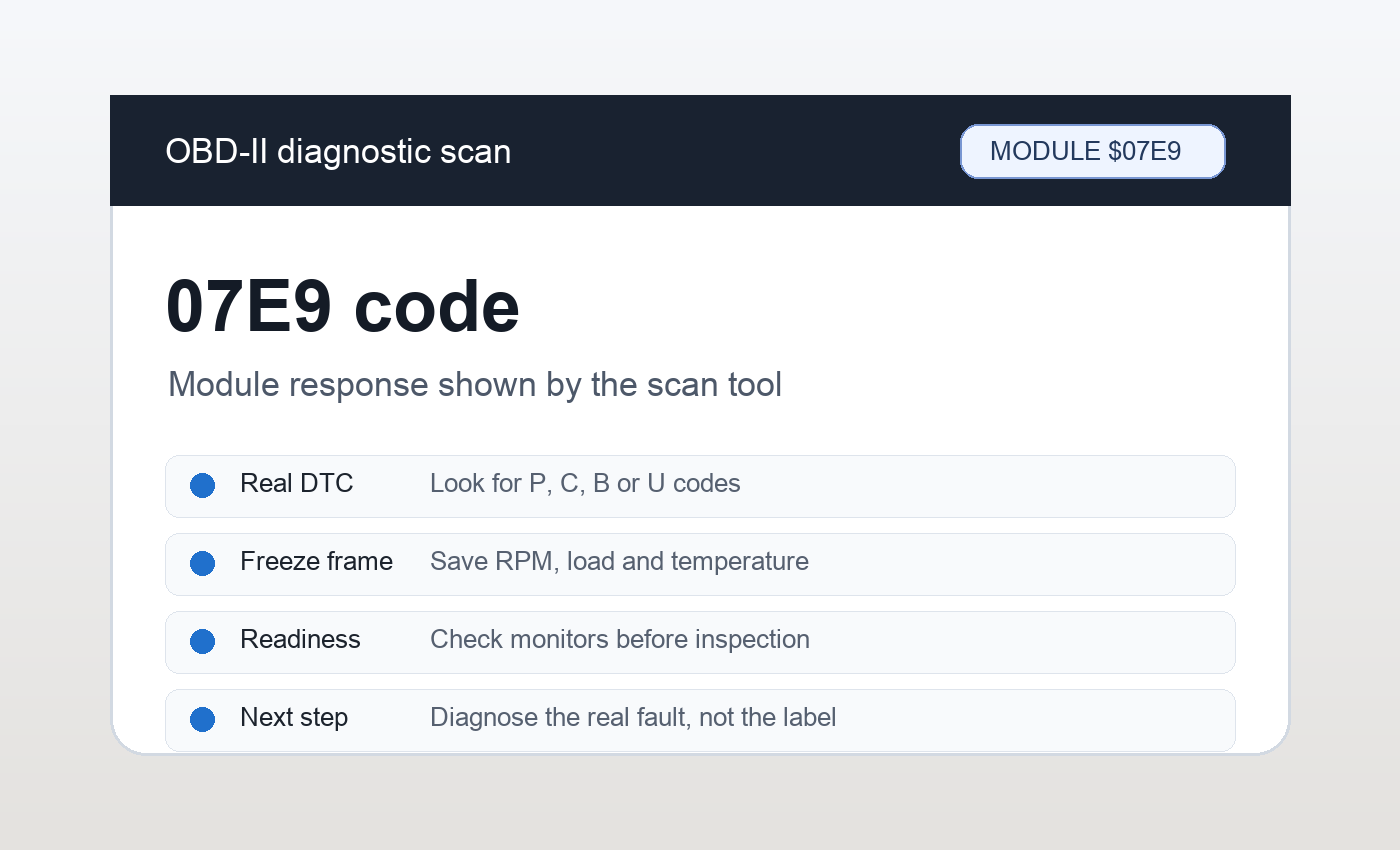
07E9 code looks like a fault code, but in many scan tools it is not the actual diagnostic trouble code. It is usually a module response address or controller label that appears when the OBD-II reader is talking to an engine, transmission, hybrid, or emissions-related control unit. The useful repair information is normally found in the real DTC shown underneath it, such as a P0300 misfire code, a P0420 catalyst efficiency code, a P0171 lean condition, or another five-character code beginning with P, C, B, or U.

If your scanner shows 07E9 code and nothing else, do not buy sensors yet. The first job is to make the scanner display all modules, all stored codes, all pending codes, and freeze-frame data. A cheap Bluetooth dongle or a basic handheld reader may show the controller header but hide the useful detail behind it. A better scan, or a deeper menu inside the same scanner, often reveals the real fault.
Quick answer for drivers seeing 07E9 on a scan tool
07E9 code normally points to a responding OBD module, not a replace-this-part instruction. On many cars the engine ECU answers as 7E8, while another controller can answer as 7E9, 7EA, or similar. Some tools display that response address as if it were a code, which is why owners search for it after a check engine light, failed emissions test, limp mode event, rough idle, hard starting, or fuel economy problem.
The important rule is simple: 07E9 code tells you where the scanner is listening, but the five-character DTC tells you what the vehicle is complaining about. If you only write down 07E9, the repair trail is incomplete. If you write down 07E9 plus the DTC, freeze-frame RPM, coolant temperature, fuel trim, mileage, and whether the code is stored or pending, a mechanic can actually diagnose the vehicle.
| What the scanner shows | What it usually means | What to do next |
|---|---|---|
| 07E9 only | Module/header shown without a usable DTC | Rescan all modules and look for stored, pending, and permanent codes |
| 07E9 plus P0xxx | Controller label plus a generic powertrain fault | Diagnose the P-code, not the 07E9 label alone |
| 07E9 with no check engine light | Possible pending code, readiness check, or scanner display quirk | Check monitor readiness and freeze-frame data before clearing anything |
| 07E9 after clearing codes | The controller still responds, but faults may be temporarily erased | Drive the correct cycle and rescan after monitors run |
Why 07E9 appears instead of a normal P-code
07E9 code appears because OBD-II communication is not just a list of faults. A scan tool sends requests, control modules reply, and those replies carry addresses, services, parameter IDs, live data, readiness results, freeze-frame information, and DTCs. In plain workshop language, 07E9 can be the name tag on the envelope, while the DTC inside the envelope is the actual message.
On CAN-based OBD systems, a functional request may be sent to the vehicle, and the ECU that answers can respond with identifiers such as 7E8, 7E9, 7EA, or 7EB. The exact module depends on the vehicle, powertrain, and network layout. A simple reader may show the response identifier because it is seeing traffic, but it may not translate the next layer of information cleanly. That is why 07E9 code often appears on Hyundai, Mercedes-Benz, Ford, Peugeot, Renault, Opel, Toyota, Volkswagen, and other vehicles in very different situations.
Authoritative OBD references matter here because this is a communication issue as much as a repair issue. The ISO page for diagnostics on controller area networks for emissions-related systems describes the role of external test equipment and OBD-compliant ECUs. The EPA’s on-board diagnostics information is also useful background for why emissions faults, readiness monitors, and diagnostic data exist in the first place.
The difference between 07E9 and a real diagnostic trouble code
07E9 code is easy to misread because it has numbers and a letter, just like the codes drivers are used to seeing. Real OBD-II diagnostic trouble codes are normally five characters long. A powertrain fault begins with P, a chassis fault with C, a body fault with B, and a network communication fault with U. For example, P0420 is a catalyst efficiency code, P0301 is a cylinder one misfire, P0171 is a lean mixture code, and U0100 is a lost communication code.
When a driver asks what part fixes 07E9 code, the honest answer is: no part fixes that label by itself. A mass air flow sensor, oxygen sensor, ignition coil, fuel injector, catalytic converter, battery, thermostat, EGR valve, or transmission solenoid may be involved, but only if the actual DTC and test results point there. Replacing parts from a module label is the fastest way to spend money without learning what the car needs.
How to spot the real code on common scanners
Look for menu names such as “stored codes,” “pending codes,” “permanent codes,” “enhanced codes,” “all modules,” “freeze frame,” and “readiness.” On some apps the first screen may show 07E9 code, then the next screen reveals P-codes under engine, transmission, hybrid, or emissions. On basic readers, press enter on the module line, scroll down, or change from “generic OBD” to “manufacturer” mode if the tool supports it.
| OBD item | Looks like | Useful repair value |
|---|---|---|
| Module response | 7E8, 7E9, 7EA, module $07E9 | Shows which controller replied, but rarely identifies the failed part |
| Generic DTC | P0300, P0420, P0171 | High value; gives the diagnostic direction |
| Manufacturer DTC | P1xxx, P2xxx, enhanced brand-specific data | High value when interpreted with vehicle-specific service information |
| Freeze frame | RPM, load, coolant temperature, speed, fuel trim | Very high value; shows conditions when the fault was recorded |
What to do before clearing 07E9 or any related fault
07E9 code should not be cleared blindly. Clearing codes erases freeze-frame data on many vehicles, resets readiness monitors, and can make an intermittent fault harder to catch. If the vehicle must pass inspection, clearing the light five minutes before the test usually creates another problem: monitors become “not ready,” so the car may fail even if the light is off.
Before pressing erase, save the scan report. Take photos of every screen. Write down the mileage, whether the engine was hot or cold, whether the fault appeared after refueling, rain, towing, highway driving, battery replacement, jump start, rough idle, stalling, misfire, or limp mode. With 07E9 code, context is often what separates a scanner display issue from a real drivability problem.
Step-by-step diagnostic process
First, connect the scanner with the ignition on and stable battery voltage. Low voltage can create strange communication behavior, especially if the car has been sitting. Second, run a full scan rather than only the quick engine scan. Third, record stored, pending, and permanent DTCs. Fourth, inspect freeze-frame data. Fifth, check readiness monitors. Sixth, clear codes only after documenting them, then perform the correct drive cycle and rescan.
If 07E9 code returns with a P0300-family misfire, start with ignition, fuel, compression, vacuum leaks, and injector balance. If it returns with a P0420 or P0430, do not condemn the catalytic converter until you check exhaust leaks, oxygen sensor activity, fuel trim, misfire history, oil burning, and coolant contamination. If it returns with lean codes such as P0171 or P0174, smoke testing the intake and checking live fuel trims can save hours.
| Symptom with 07E9 displayed | Most useful first check | Why it matters |
|---|---|---|
| Check engine light, car drives normally | Stored and pending DTCs plus readiness monitors | Many emissions faults do not create obvious drivability symptoms |
| Rough idle or shaking | Misfire counters, spark plugs, coils, vacuum leaks | Misfires can damage the catalyst if ignored |
| Poor fuel economy | Fuel trims, oxygen sensor switching, coolant temperature | The ECU may be adding fuel to compensate for a false lean condition |
| Limp mode or gearbox warning | Transmission and ABS module scan, not only engine OBD | Some generic readers miss non-engine controller detail |
Common situations where drivers see 07E9
07E9 code is often reported after a warning light scan at home. The owner plugs in a reader, sees the 07E9 label, searches the internet, and finds conflicting answers. Some forums call it an engine code, some call it a transmission code, and some say it is nothing. The truth depends on the rest of the scan data. By itself, it is a clue about communication, not a diagnosis.
After a battery replacement or jump start
Low battery voltage, recent battery disconnection, or a jump start can leave modules waking up at different times. A scanner may display the 07E9 module label while the vehicle is relearning idle, fuel trims, throttle position, or readiness. If no DTCs return after a proper drive cycle and voltage is healthy, the 07E9 display may not represent an active fault.
During an emissions inspection problem
When an emissions test fails, the real issue is usually a DTC, a readiness monitor that has not completed, or a system that is reporting out-of-range data. 07E9 code may appear in the scanner report, but the repair path is built around catalyst monitor status, oxygen sensor monitor status, evaporative system readiness, misfire history, and fuel trim. If you are dealing with a catalyst-related issue, the internal guide on catalyst check by number helps explain why identification and correct diagnosis matter before replacing expensive parts.
When 07E8 and 07E9 appear together
Many owners see 07E9 code alongside 07E8. That pairing is common because multiple controllers can answer an OBD request. The related guide on 07E8 code / 07E8 engine code explains the sister problem in detail: a scanner label can look like a repair code even when the real DTC is elsewhere in the report. Read both together if your tool shows 07E8, 07E9, and one or more P-codes.
On Opel, GM, and stability-control warnings
Sometimes an engine fault triggers stability-control messages because the car reduces torque control, cruise control, traction control, or gearbox strategy. If 07E9 code appears with an Opel or GM warning, do not assume the stability system itself has failed. Compare engine, ABS, steering angle, wheel speed, and body module codes. The internal article on Opel Service StabiliTrak warning shows how one warning message can be caused by several systems working together.
Brand notes: Hyundai, Mercedes, Ford, Peugeot, Renault, and Toyota
07E9 code is not owned by one manufacturer. It can show up on European, American, Korean, and Japanese cars because it belongs to the OBD communication world rather than a single brand’s parts catalog. That said, the next diagnostic step can differ by brand because each manufacturer adds enhanced data, proprietary modules, and model-specific service procedures.
On Hyundai and Kia vehicles, owners often find 07E9 while chasing misfires, catalytic efficiency codes, evaporative emissions leaks, or oxygen sensor faults. On Mercedes-Benz, a generic reader may miss enhanced powertrain, transmission, and body module details, so a brand-capable scanner can be important. On Ford, the vehicle may store helpful Mode $06 test data and misfire counters that a basic tool does not explain well. On Peugeot and Renault, the wording may be translated strangely by apps, making the module label look even more like a fault.
| Vehicle group | Useful scanner mode | Owner mistake to avoid |
|---|---|---|
| Hyundai / Kia | Generic OBD plus manufacturer enhanced engine data | Replacing oxygen sensors before checking fuel trim and exhaust leaks |
| Mercedes-Benz | Brand-capable full module scan | Trusting a cheap reader that only shows partial powertrain data |
| Ford | Mode $06, misfire data, all-module scan | Ignoring pending codes because the check engine light is intermittent |
| Peugeot / Renault / Opel | Generic OBD plus European manufacturer data | Confusing translated scanner labels with actual repair codes |
When it is safe to drive and when you should stop
07E9 code alone does not tell you whether the vehicle is safe to drive. The answer comes from symptoms and real DTCs. If the car drives normally, the check engine light is steady, temperature is normal, oil pressure is normal, and there are no braking, steering, battery, or transmission warnings, you can usually drive gently to a workshop or complete a short diagnostic drive. Still, record the data before clearing anything.
Stop driving if the check engine light is flashing, the engine is misfiring badly, the temperature gauge climbs, the oil pressure warning comes on, the vehicle loses power severely, the transmission bangs into gear, or you smell fuel or burning catalyst. A flashing light with misfire codes can overheat the catalytic converter quickly. In that case, the 07E9 label is not the danger; the real fault behind it is.
How a mechanic would approach the diagnosis
A good technician does not start with the part. They start with the complaint, the scan report, and the conditions. If the customer says the only code is 07E9 code, the mechanic will usually rescan with a better tool and look for hidden information. The work may include battery and charging checks, all-module scan, live data review, freeze-frame interpretation, visual inspection, smoke test, fuel pressure test, compression test, oscilloscope checks, or road testing with data logging.
The practical order matters. For example, if fuel trim is very positive at idle and improves at higher RPM, the mechanic thinks vacuum leak. If trims are positive at all loads, fuel delivery or MAF measurement becomes more likely. If oxygen sensors are lazy but fuel trims are normal, the sensor may be suspect. If catalyst efficiency is low after misfires, the converter may be a victim, not the first cause. This is why 07E9 code should be treated as the beginning of a diagnostic conversation, not the end.
Mistakes that waste money
The first mistake is searching for a magic part that fixes the 07E9 display. There is no universal 07E9 sensor. The second mistake is clearing codes before saving freeze-frame data. The third mistake is replacing the catalytic converter because an emissions-related controller appeared, without checking fuel trim, oxygen sensor behavior, exhaust leaks, software updates, and misfire history. The fourth mistake is using only one cheap app on a vehicle that needs manufacturer-level data.
Another common mistake is ignoring pending codes. Pending codes are early warnings that a monitor has seen a problem but has not yet confirmed it enough to turn on the light. If a 07E9 module line appears with pending P0171, P0300, P0442, or P0420, the pending code is the useful part. It can tell you where the next test should begin, especially when the vehicle behaves normally during a short driveway scan.
Practical checklist before visiting a workshop
07E9 code becomes far less confusing when you bring organized information to the mechanic. Take clear photos of the scanner screens. Note the exact vehicle model, year, engine, mileage, fuel type, recent repairs, battery condition, and whether the light is steady or flashing. Ask the shop to scan all modules, not only generic OBD, and ask for the actual DTC list with freeze-frame data.
| Bring this information | Example | Why it helps |
|---|---|---|
| Exact scanner text | Module $07E9 plus P0420 pending | Separates module labels from repair codes |
| Freeze-frame conditions | 2500 RPM, warm engine, highway speed | Shows when the fault happened |
| Recent events | Battery replaced, fuel cap loose, heavy rain | Points toward voltage, EVAP, or connector issues |
| Symptoms | Rough idle, poor economy, no power, no symptoms | Helps prioritize tests and safety decisions |
FAQ
Is 07E9 a fault code?
07E9 code is usually not a standard repair fault by itself. It is commonly a module response or scanner label. You still need the actual DTC, such as P0300, P0171, P0420, or another five-character code, before making repair decisions.
Can I erase it?
You can erase stored diagnostic information with a scan tool, but you should not erase the scan data before saving the full report. Clearing codes can delete freeze-frame information and reset readiness monitors, which can delay inspection or hide an intermittent fault.
Why does my scanner show 07E8 and 07E9 together?
Multiple modules can answer OBD requests. Seeing 07E9 code together with 07E8 often means the tool is showing more than one controller response. The actual repair direction still comes from the DTCs and live data attached to those modules.
Does 07E9 mean transmission failure?
Not automatically. 07E9 code may appear while scanning a vehicle with transmission symptoms, but it does not prove the transmission has failed. Scan the transmission module, check fluid condition where applicable, read manufacturer-specific codes, and compare engine torque-related faults before assuming a gearbox problem.
Can a bad oxygen sensor cause 07E9?
An oxygen sensor fault may appear in the same scan report, but the 07E9 module label itself is not the oxygen sensor code. Look for P0130 to P0167 family codes, fuel trim numbers, heater circuit faults, and sensor activity before replacing an oxygen sensor.
Final mechanic-style takeaway
07E9 code is best treated as a scanner clue, not a diagnosis. It tells you that the scan tool is seeing a controller response, but it does not tell you which part to replace. The smart move is to rescan all modules, record stored and pending DTCs, save freeze-frame data, check readiness, and diagnose the real P, C, B, or U code that comes with it.
If your vehicle has no symptoms and no real DTCs after a proper scan, monitor it and avoid unnecessary parts. If the light returns, scan again before clearing. If you have a flashing check engine light, rough running, overheating, strong fuel smell, or limp mode, stop treating 07E9 code as an internet mystery and get a proper diagnostic session. The repair starts when the real fault data is found.