
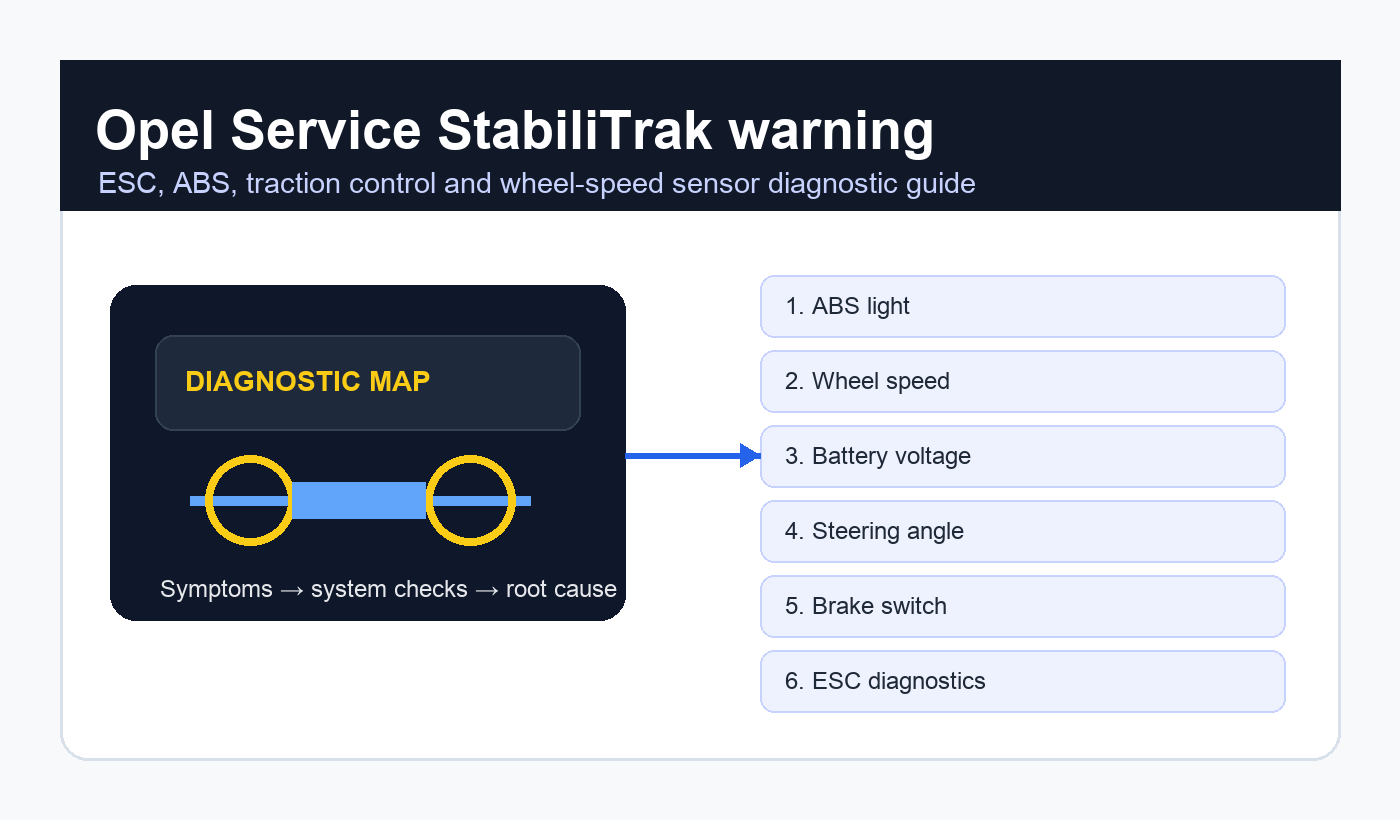
Opel Service StabiliTrak warning: What It Means, Why It Appears, and How to Diagnose It Properly
Opel Service StabiliTrak warning is a problem wording that usually describes a stability-control or traction-control fault on a GM-related Opel, Vauxhall, Buick, Chevrolet or Holden platform. Strictly speaking, StabiliTrak is General Motors terminology, while many Opel markets use names such as ESC, ESP, TC, traction control or electronic stability control. The owner’s problem is the same: the car is warning that the system that helps manage wheel slip, yaw and braking intervention may not be fully available.
The warning can be annoying, but it should not be dismissed as a dashboard decoration. Stability control shares information with ABS, wheel-speed sensors, steering-angle data, brake-light switching, yaw/lateral sensors, engine torque management, battery voltage and sometimes power steering. One small fault can cause several warning lamps to appear together.
This guide explains Opel Service StabiliTrak warning like a diagnostic story, not a code list. It covers reader need, likely causes, symptoms, safety priorities, repair logic, used-car checks and the difference between a real stability-system fault and a secondary warning caused by voltage, wiring or engine management.

What owners need to know first
This guide is written for owners, buyers and technicians dealing with Opel Service StabiliTrak warning in the real world. It focuses on symptoms, checks, realistic repair decisions, legal limits where relevant, and the points worth confirming before buying parts or trusting a seller’s claim.
Related terms include Opel ESC warning, Opel ESP light, Service StabiliTrak, traction control warning, ABS light, wheel speed sensor, steering angle sensor, yaw rate sensor, brake light switch, traction control off, reduced engine power, Opel Astra stability control, Opel Insignia ESP fault, Opel Mokka traction control, Vauxhall Service ESP, GM StabiliTrak warning, C0561 code, C0035 wheel speed sensor, C0040 wheel speed sensor, U0121 ABS communication, low battery voltage, bad ground, brake pedal sensor, tire size mismatch and stability control calibration.
| Reader need | Driver question | Best answer |
|---|---|---|
| Safety | Can I keep driving? | Drive cautiously only if brakes feel normal; stop for brake, steering or power-loss symptoms |
| Repair cost | Is it a sensor or module? | Scan ABS/ESC data before replacing parts |
| Model confusion | Why does Opel show a GM phrase? | Explain shared platforms and naming differences |
| DIY diagnosis | What should I check first? | Battery, tires, wheel sensors, brake switch, live data |
What stability control actually does
Electronic stability control compares what the driver asks for with what the car is actually doing. Steering angle, wheel speeds, yaw rate, lateral acceleration and brake inputs allow the control module to estimate whether the car is understeering, oversteering or losing traction. If intervention is needed, the system can brake individual wheels and reduce engine torque.
That is why Opel Service StabiliTrak warning can appear with ABS lights, traction control lights, engine power reduction messages or steering warnings. The system is not isolated. It is a network. When one data source becomes unreliable, the vehicle may disable stability intervention because it cannot trust the calculation.
For authoritative safety context, use the official NHTSA electronic stability control resource. For brand and owner information, start from Opel’s official site and the correct owner manual for the vehicle market.
Why Opel and StabiliTrak appear together
Opel Service StabiliTrak warning exists because owners, scan tools and forums often mix naming from related GM vehicles. Opel, Vauxhall, Chevrolet, Buick and Holden models have shared platforms, modules, engines and diagnostic vocabulary across markets. A scan tool may show “StabiliTrak” because its database uses GM naming, while the dashboard or manual may say ESC, ESP or traction control.
The diagnostic approach should not depend on the label. Whether the display says ESP fault, ESC service, traction control warning or Service StabiliTrak, the technician should inspect the same families of data: wheel speeds, steering angle, brake switch, yaw/lateral sensor values, communication codes, voltage stability and engine control requests.
Most common causes
The most common cause behind Opel Service StabiliTrak warning is not always the most expensive module. Wheel-speed sensors and hub wiring are frequent suspects because stability control depends on comparing wheel rotation. Corrosion, damaged tone rings, broken sensor wires or debris around a sensor can make one wheel report implausible speed.
Battery voltage is another major cause. Modern control modules dislike weak voltage. A tired battery, loose terminal, poor ground or alternator problem can create warning lights that look unrelated. If several systems complain at once after a cold start, voltage testing should happen early.
Brake-pedal switches, steering-angle sensors and tire issues also matter. A brake switch that sends conflicting signals can confuse the stability system. A steering-angle sensor that is not calibrated can make the car think the driver is steering differently from reality. Mismatched tire sizes or very uneven tread can upset wheel-speed comparisons.
| Cause | Typical clue | Diagnostic check | Risk |
|---|---|---|---|
| Wheel-speed sensor | ABS and traction lights together | Read live wheel-speed data while moving | High |
| Weak battery or ground | Multiple warnings after start | Load-test battery, inspect terminals and charging voltage | Medium |
| Steering-angle calibration | Warning after alignment or steering work | Scan steering angle and perform calibration | Medium |
| Brake-light switch | Brake lights behave oddly | Check switch data and lamp operation | High |
| Tire mismatch | Warning after tire replacement | Verify size, pressure and rolling diameter | Medium |
| ABS module communication | Network or U-codes | Scan all modules, inspect power, ground and CAN lines | High |
Symptoms that change the urgency
Opel Service StabiliTrak warning alone, with normal brake pedal feel and no engine power loss, is usually less urgent than a combined warning with brake, steering or reduced-power symptoms. If the brake pedal feels abnormal, the car pulls during braking, steering assistance changes, or the engine enters limp mode, the situation deserves immediate inspection.
Weather matters too. If the warning appears on wet roads, snow, gravel or after hitting a pothole, inspect wheel sensors, harnesses and tires. If it appears after battery replacement, alignment, suspension work or tire changes, look for calibration, connector or rolling-diameter issues.
Diagnostic order that saves money
The right first step for Opel Service StabiliTrak warning is a full module scan, not a generic engine-only code read. Many cheap OBD readers show only powertrain codes. Stability control faults usually live in ABS, chassis, steering or body modules. Without those codes and live data, replacing parts is mostly guessing.
Start with freeze-frame information and all stored/pending/current codes. Then inspect battery voltage, charging voltage, grounds and fuses. After that, read live wheel-speed data at low speed and compare all four wheels. Then check steering-angle value with wheels straight, brake switch status, yaw sensor communication and tire size/pressure.
A good workshop report should include more than a code number. It should list the modules scanned, whether the fault was current or stored, the battery voltage observed, the live-data values that looked wrong and the road-test condition that reproduced the message. That report protects the owner from vague repairs and gives the next technician a real trail if the fault returns.
Why live data matters
A code can say which system complained; live data shows why. A wheel sensor may read normally when parked and fail only while moving. A steering angle may show an offset only after the wheels are straight. A brake switch may flicker between on and off. Live data turns Opel Service StabiliTrak warning from a warning into evidence.
Battery, charging and ground checks
Many owners underestimate voltage. A car can crank and start while still producing module faults from low voltage during the crank event. Test the battery under load, measure charging voltage with accessories on, inspect ground straps and clean terminals. Do not assume a new battery is good without testing; new parts can be discharged, underspecified or poorly connected.
If Opel Service StabiliTrak warning appears together with random dashboard warnings, clock resets, steering assistance messages or communication codes, the electrical foundation deserves attention before any expensive stability-control module is blamed.
Ground checks are especially important on cars that have lived through wet winters, battery changes or previous body repairs. A ground strap can look acceptable from above and still have corrosion between the cable and mounting point. Cleaning the contact surface, tightening the fastener and confirming voltage drop under load is often more useful than staring at the part. Stability systems need clean power because they compare fast sensor signals in real time.
Wheel-speed sensors and hubs
Wheel-speed sensors are central to ABS, traction control and stability control. They report wheel rotation so the module can detect lockup, slip and instability. Dirt, rust, cracked tone rings, failing hub bearings, damaged wiring and poor connectors can interrupt that data. Sometimes the harness flexes near the wheel and fails intermittently.
A scan tool should show all four wheel speeds increasing smoothly and consistently. If one wheel drops to zero, spikes, or differs sharply from the others at the same speed, the fault has a direction. Visual inspection should include sensor wiring, connector seating, signs of rubbing, corrosion and wheel bearing play.
Steering-angle and yaw sensors
Opel Service StabiliTrak warning after alignment, suspension work, steering rack work or battery disconnection can involve steering-angle calibration. The car needs to know what “straight ahead” means. If the module sees the steering wheel turned while the vehicle travels straight, it may distrust the stability calculation.
Yaw and lateral acceleration sensors are less commonly replaced first, but they matter. They tell the module how the vehicle body is rotating and moving sideways. A communication failure, incorrect calibration or internal sensor fault can disable intervention. These components should be diagnosed with scan data, not suspicion.
Brake switch and brake system issues
The brake switch is a small part with a large role. Stability control needs to know whether the driver is braking. If the switch reports contradictory status, if brake lights stay on, or if brake lights fail to illuminate, warnings can appear. Because this touches safety, brake-switch faults should be handled quickly.
Brake-fluid level, ABS pump operation, hydraulic faults and worn brake components can also change the warning story. A stability warning with brake warning light, soft pedal or fluid loss is not a casual diagnostic project. Stop driving and inspect the brake system.
Tires, alignment and suspension
Tires are part of the stability-control system even though they have no wires. Mismatched sizes, incorrect pressure, severe tread differences, low-quality tires, uneven wear or a recent spare-wheel installation can create wheel-speed differences. Alignment and worn suspension parts can also make the car behave differently from the steering-angle calculation.
A car with Opel Service StabiliTrak warning after tire replacement should have all four tire sizes, load ratings, pressures and tread depths checked before modules are blamed. This is especially important on vehicles sensitive to rolling diameter.
Engine faults that trigger stability warnings
Sometimes the stability system is not the root cause. Engine misfires, throttle faults, turbo or intake problems, reduced engine power and communication problems can disable traction or stability functions because the stability module cannot control torque reliably. That is why an engine light and stability warning can appear together.
If the car has rough running, hesitation, misfire codes or reduced power, diagnose the engine condition alongside the chassis warnings. Clearing the stability message without fixing torque-control problems may only make the warning return.
Cost and repair planning
Opel Service StabiliTrak warning can be cheap or expensive depending on evidence. A brake switch, battery service or sensor wiring repair may be straightforward. A failed ABS module, network fault or repeated intermittent wiring issue can take more time. The costly mistake is replacing modules before checking voltage, tires, grounds, wheel data and service history.
| Repair path | When it makes sense | Mistake to avoid |
|---|---|---|
| Battery/ground service | Low voltage or multiple random warnings | Ignoring charging voltage |
| Wheel sensor repair | One wheel shows bad live data | Replacing all sensors blindly |
| Calibration | Warning after alignment or steering work | Replacing sensors before calibration |
| Brake switch replacement | Brake switch data or lamps are wrong | Ignoring brake safety symptoms |
| ABS module diagnosis | Power, ground and communication evidence points there | Condemning the module from one code |
Used Opel buyer checklist
A buyer who sees Opel Service StabiliTrak warning during a test drive should not accept “it only needs clearing” as proof. Ask for a full scan report, check whether the warning returns after driving, inspect tires, confirm brake lights, look for recent battery replacement, review alignment or suspension work and test the car on a safe road at low speed.
If the seller says the fault appeared after a battery change, alignment or tire replacement, that may be plausible, but it still needs verification. If the warning is paired with ABS, brake, steering or engine power warnings, budget for proper diagnosis or walk away.
What not to do
Do not clear the warning and call the car fixed. Do not replace a wheel sensor without checking live data. Do not ignore mismatched tires. Do not assume the ABS module is bad because a forum thread said so. Do not keep driving normally if brake feel, steering assist or engine power changes.
Most of all, do not treat this warning as a single-part problem. It is a system warning. The right repair follows the evidence.
Related internal reading
For deeper electrical thinking, read our Toyota electronic key fault guide, automotive electronics guides, and Kymco X-Town diagnostic guide. The vehicles differ, but the method is the same: understand the system, test power and signals, then replace parts only when the data supports it.
FAQ
Can I drive with the warning on?
You may be able to drive cautiously if brakes and steering feel normal, but Opel Service StabiliTrak warning means stability intervention may be unavailable. Avoid aggressive driving, wet-road risk and high-speed maneuvers until diagnosed.
Is it always a wheel-speed sensor?
No. Wheel-speed sensors are common, but Opel Service StabiliTrak warning can also come from battery voltage, grounds, brake switch faults, steering-angle calibration, tire mismatch, engine faults or ABS module communication issues.
Why did it appear after changing tires?
Incorrect tire size, pressure difference, rolling-diameter mismatch or disturbed sensor wiring can trigger stability warnings after tire work.
Why did it appear after battery replacement?
Low voltage, disconnected modules, steering-angle calibration needs or disturbed terminals can create warnings after battery work. Scan and voltage-test before replacing parts.
Final diagnostic verdict
The practical answer to Opel Service StabiliTrak warning is disciplined diagnosis. Start with all-module scan data, battery and ground health, tire condition, wheel-speed live data, steering-angle values and brake-switch status. Then decide whether the issue is a simple sensor fault, a calibration need, a voltage problem or a deeper ABS/ESC concern.
Opel Service StabiliTrak warning with ABS light should begin with wheel-speed and brake-system checks.
Opel Service StabiliTrak warning after a battery event should begin with voltage, charging and grounds.
Opel Service StabiliTrak warning after tire replacement should begin with size, pressure and rolling diameter.
Opel Service StabiliTrak warning after alignment should include steering-angle calibration.
Opel Service StabiliTrak warning with reduced engine power should include engine and throttle diagnostics.
Opel Service StabiliTrak warning with brake symptoms should stop the car until inspected.
Opel Service StabiliTrak warning with intermittent behavior should be diagnosed with live data, not guesswork.
Opel Service StabiliTrak warning on a used car should affect the purchase price and inspection plan.
Opel Service StabiliTrak warning can be minor, but only evidence can prove it.
Opel Service StabiliTrak warning deserves a careful, safety-first repair path because stability control is there for the moments when grip disappears quickly.