
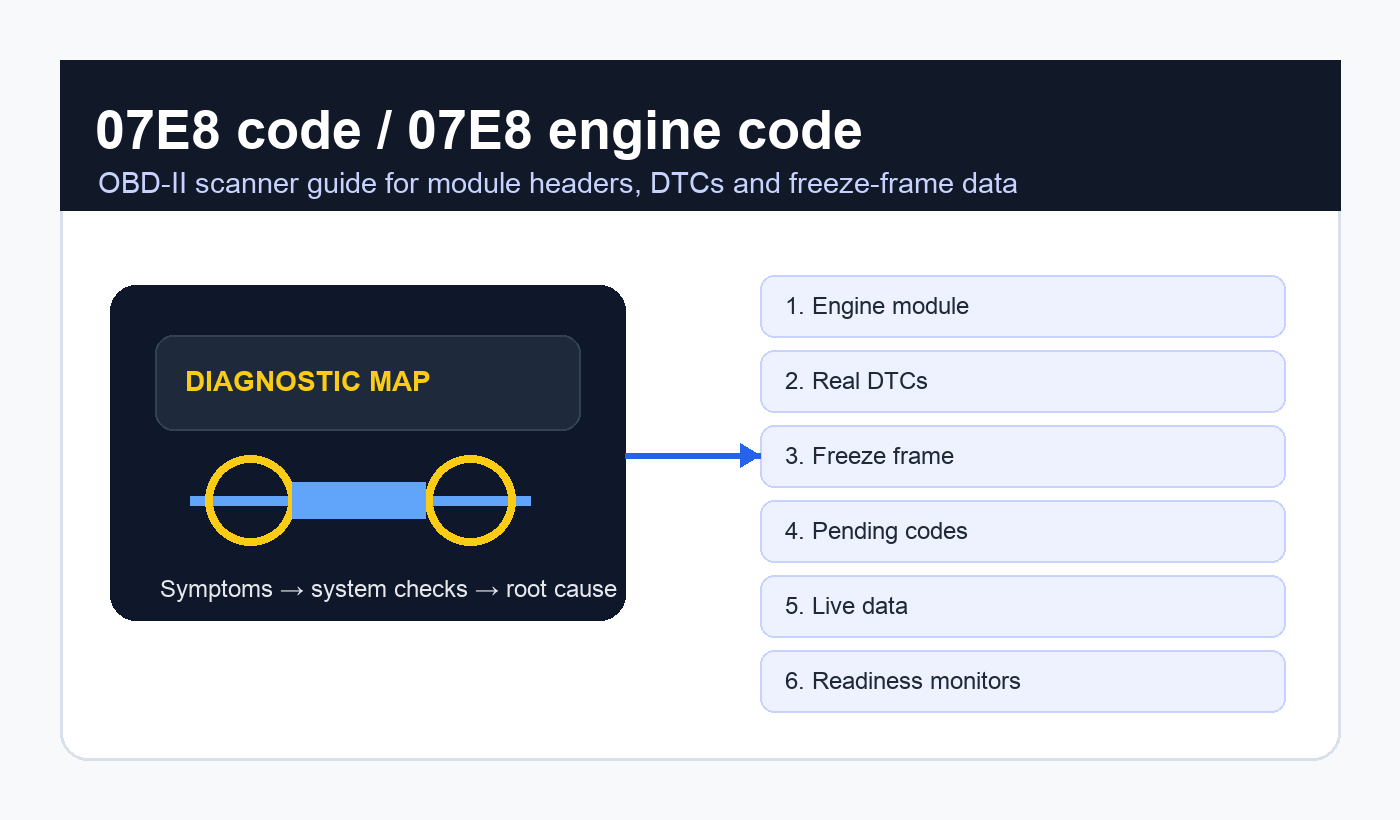
07E8 code / 07E8 engine code: What It Really Means on an OBD-II Scanner
07E8 code / 07E8 engine code is one of the most misunderstood messages a driver can see on a scan tool. In many cases, 07E8 is not the actual diagnostic trouble code that tells you what is broken. It is commonly a response address or module header used by the engine control module during OBD-II communication. The real fault is usually the P-code, pending code, freeze-frame data or live-data pattern that appears after you enter that module.
This distinction matters. If a driver treats 07E8 code / 07E8 engine code as a repair code, they may replace oxygen sensors, spark plugs, catalytic converters or fuel parts without evidence. A serious diagnosis starts by asking what the scanner is actually showing: a module label, a request response, or a stored diagnostic trouble code.
This guide explains 07E8 code / 07E8 engine code in plain language for owners, used-car buyers, technicians and anyone holding a budget Bluetooth scanner while a check engine light is on. It covers reader need, related topics, what 07E8 means, what it does not mean, how to find the true DTC and how to avoid the most expensive diagnostic mistakes.

What owners need to know first
This guide is written for owners, buyers and technicians dealing with 07E8 code / 07E8 engine code in the real world. It focuses on symptoms, checks, realistic repair decisions, legal limits where relevant, and the points worth confirming before buying parts or trusting a seller’s claim.
Common related topics include 07E8 engine control module, 07E8 OBD2 code, 07E8 and 07E9, OBD-II scanner codes, check engine light, diagnostic trouble code, DTC, powertrain code, freeze frame data, pending code, stored code, permanent code, readiness monitors, Mode 03, Mode 07, oxygen sensor code, EVAP code, misfire code, catalytic converter code, fuel trim, live data, ELM327 scanner, generic OBD reader, emissions test, ECU response, CAN bus, module address and engine control unit.
| Problem wording | Likely user intent | Correct response |
|---|---|---|
| 07E8 engine code | Driver thinks 07E8 is the fault | Explain module/header versus real DTC |
| 07E8 OBD2 code | Scanner confusion | Show how to enter module and retrieve P-codes |
| 07E8 07E9 code | Multiple module responses | Explain engine/transmission or module response labels |
| Check engine 07E8 | Active MIL with unclear scanner result | Read stored, pending and permanent codes |
The short answer
07E8 code / 07E8 engine code usually means your scanner is communicating with the engine control side of the vehicle, not that “07E8” itself identifies the failed part. The next screen matters. A meaningful OBD-II fault code normally looks like P0300, P0420, P0171, P0442 or another letter-plus-four-digit diagnostic trouble code.
If your scanner stops at 07E8, select it, open the stored codes, pending codes and freeze-frame information, then record the actual P-code. Without that next step, the repair path is incomplete.
Why 07E8 appears on scan tools
OBD-II communication involves requests and responses between a scan tool and vehicle modules. Some tools display module addresses or response identifiers in a way that looks like a fault code. That is how 07E8 code / 07E8 engine code becomes confusing. The number appears on the screen, but it may simply identify where the scan data is coming from.
Budget scanners and phone apps vary widely. Some show “07E8 Engine,” some show “7E8,” some show “ECM,” and some show multiple entries such as 07E8 and 07E9. The driver may assume every displayed number is a code. A professional scan tool usually makes the distinction clearer by separating modules, DTCs, live data, readiness monitors and freeze-frame records.
What 07E8 is not
07E8 code / 07E8 engine code is not normally a complete fault definition. It does not mean the oxygen sensor is bad. It does not automatically mean the catalytic converter has failed. It does not tell you to replace the engine control unit. It does not identify a cylinder misfire, EVAP leak, lean condition or transmission issue by itself.
The danger is that many drivers search the phrase and land on generic lists that treat it like a direct repair instruction. That is backwards. The real diagnostic trouble code and freeze-frame data must come first.
How a real OBD-II trouble code looks
A standard diagnostic trouble code begins with a letter. P means powertrain, C means chassis, B means body and U means network communication. The following digits narrow the system and fault. For example, P0300 means random/multiple cylinder misfire, while P0420 points toward catalyst system efficiency below threshold. Those examples are real DTC shapes; 07E8 code / 07E8 engine code is different.
For official background on onboard diagnostics and emissions-related fault monitoring, use the U.S. EPA transportation and emissions resources. For safety recalls that may relate to a vehicle’s symptoms, use the official NHTSA recalls database.
| Display | What it often means | Repair information? |
|---|---|---|
| 07E8 or 7E8 | Engine module response/header on many tools | No, not by itself |
| 07E9 or 7E9 | Another module response, often transmission on some tools | No, not by itself |
| P0300 | Random/multiple misfire | Yes, with diagnosis |
| P0171 | System too lean on bank 1 | Yes, with fuel-trim data |
| P0420 | Catalyst efficiency below threshold | Yes, with oxygen-sensor and exhaust checks |
| U0100 | Lost communication with ECM/PCM | Yes, with network diagnosis |
Step-by-step: what to do when you see it
The first step with 07E8 code / 07E8 engine code is to slow down. Do not clear anything yet. Clearing codes erases freeze-frame data that may show engine load, coolant temperature, vehicle speed, fuel trim and other clues at the moment the fault was detected.
Open the engine module entry. Read stored codes. Read pending codes. Read permanent codes if the tool supports them. Save freeze-frame data. Check whether readiness monitors are complete. Then write down the exact letter-plus-number DTCs. Only then should diagnosis begin.
Basic scanner workflow
Connect the scanner with ignition on and engine off. Let it identify modules. Select the 07E8 or engine entry if shown. Choose diagnostic trouble codes. Record every stored, pending and permanent code. Open freeze frame. Save or photograph the data. Check live data only after recording the original evidence.
Why clearing the message is risky
07E8 code / 07E8 engine code often appears when the driver wants the check engine light gone quickly. Clearing codes may turn off the light temporarily, but it does not repair the cause. It can also reset readiness monitors, which may prevent an emissions inspection from passing until the vehicle completes drive cycles.
If the vehicle has a misfire, overheating, low oil pressure, fuel smell, severe hesitation or flashing check engine light, do not clear and continue driving. A flashing check engine light usually means catalyst-damaging misfire risk. The correct response is diagnosis, not code deletion.
Common real codes found after 07E8
Once the driver gets past 07E8 code / 07E8 engine code, the real fault may be in many categories. Lean codes such as P0171 can involve vacuum leaks, intake leaks, fuel delivery, dirty mass-airflow sensors or exhaust leaks. Misfire codes such as P0300 or P0301 can involve ignition, fuel, compression or air leaks. EVAP codes can involve caps, valves, hoses and leak detection. Catalyst codes can involve the converter, oxygen sensors, exhaust leaks or fuel-control problems.
| Actual code family | Common symptoms | Data to inspect | Common mistake |
|---|---|---|---|
| P01xx fuel/air | Lean running, hesitation, rough idle | Fuel trim, MAF/MAP, oxygen sensor data | Replacing oxygen sensors without checking air leaks |
| P03xx misfire | Rough running, flashing MIL, poor power | Misfire counters, plugs, coils, compression | Swapping parts without locating the cylinder pattern |
| P04xx emissions | Inspection failure, fuel smell, EVAP warning | Purge command, pressure data, smoke test | Replacing gas cap blindly every time |
| P0420/P0430 catalyst | MIL, emissions failure, sometimes no symptoms | Upstream/downstream oxygen sensor patterns | Replacing converter before fixing misfire or fuel trim |
| U-codes | Multiple warnings, communication faults | Module scan, voltage, grounds, CAN network | Using engine-only scanner data |
Freeze-frame data: the evidence people skip
07E8 code / 07E8 engine code is only the doorway. Freeze-frame data is often the room. It can show whether the fault occurred cold or hot, idling or highway cruising, under load or deceleration, in open loop or closed loop, with lean fuel trim or normal fuel trim. Those facts change the repair plan.
A P0171 lean code at idle with high positive fuel trim suggests a different path from a lean condition under heavy load. A misfire at cold start differs from a misfire under acceleration. A catalyst-efficiency code after a misfire history should not be diagnosed like an isolated catalyst code.
Freeze-frame interpretation also protects the owner from coincidence. A code stored at full operating temperature on the highway tells a different story from a code stored during the first minute after startup. Vehicle speed, calculated load, coolant temperature and fuel trim can separate a small vacuum leak from a weak fuel pump, a cold-start misfire from a coil that fails under heat, or a catalyst monitor from a broader fuel-control issue.
Readiness monitors are just as important when inspection is due. After codes are cleared, the vehicle must run enough self-tests before many emissions programs will accept it. A car can have no visible warning light and still fail because monitors are incomplete. That is why a serious diagnostic report includes monitor status before and after repair.
Live data that helps most
After recording codes, live data can make 07E8 code / 07E8 engine code useful. Look at short-term fuel trim, long-term fuel trim, coolant temperature, intake air temperature, mass airflow, manifold pressure, oxygen sensor behavior, engine rpm, vehicle speed, misfire counters and commanded EVAP purge. The right data depends on the actual DTC.
Do not stare at every PID. Choose data that matches the code. For a lean code, fuel trim and air-measurement data matter. For misfire, counters, ignition and fuel evidence matter. For catalyst efficiency, oxygen sensor switching and exhaust integrity matter. For communication codes, voltage and module status matter.
When 07E8 and 07E9 appear together
Some scanners show both 07E8 and 07E9. Drivers often panic because two entries look like two faults. In many cases, the tool is showing more than one module response. One may relate to engine control and another may relate to transmission or another powertrain controller, depending on the vehicle and scanner.
If this display appears with 07E9, open each module entry separately and record the real DTCs inside each one. Do not assume the numbers themselves identify engine and transmission failures.
Repair priority and safety
Some actual codes are more urgent than others. A loose gas cap code is not the same as a flashing misfire. A stored historical code is not the same as a current fault that returns immediately. A permanent emissions code may need drive cycles after repair. A network code with multiple warning lights may require broader electrical diagnosis.
| Situation | Priority | Best action |
|---|---|---|
| Flashing check engine light | Very high | Stop heavy driving and diagnose misfire risk |
| Rough running or fuel smell | High | Inspect before continuing normal use |
| Single EVAP code, normal driving | Medium | Record data, inspect cap/hoses/valves |
| Readiness monitors not complete | Medium | Complete drive cycle after repair |
| 07E8 displayed with no DTCs | Low-to-medium | Use better scanner or verify module data |
Used-car buyer checklist
A buyer who sees 07E8 code / 07E8 engine code on a seller’s scanner should ask for the actual stored and pending DTCs. If the seller says “it only says 07E8,” the scan is incomplete. Ask whether the check engine light was recently cleared, whether readiness monitors are complete and whether emissions inspection is due.
Bring a scanner that can show readiness monitors and freeze-frame data. A car with all monitors incomplete may have been cleared recently. A car with permanent codes may need confirmed repair and drive cycles. A car with misfire, catalyst or lean codes should be priced with diagnostic risk in mind.
Common mistakes to avoid
The first mistake with 07E8 code / 07E8 engine code is Googling the number and buying a part. The second is clearing evidence before saving freeze frame. The third is using an engine-only scan when the symptoms involve transmission, ABS or network warnings. The fourth is treating a pending code as meaningless. The fifth is assuming a catalyst code means the converter is bad before checking misfire and fuel control.
Good diagnosis is boring in the best way. It records data, checks basics, follows the actual DTC and verifies the repair. Bad diagnosis starts with a guess and ends with a box of replaced parts.
When to use a better scan tool
If your tool shows only 07E8 code / 07E8 engine code and no actual DTC, use a better scanner or ask a workshop for a full report. The report should include all modules scanned, stored/pending/permanent codes, freeze frame, readiness monitor status and relevant live data. For modern vehicles, a single generic reader may not see enough information.
This is especially important when there are multiple dashboard warnings, limp mode, transmission behavior, hybrid-system messages, ABS lights or communication codes. The engine module is only one part of the vehicle network.
Related internal reading
For more diagnostic logic, see our Opel stability-control warning guide, Toyota electronic key fault guide, and automotive electronics guides. The systems are different, but the discipline is the same: identify the module, collect data and avoid blind parts replacement.
FAQ
Is 07E8 a real trouble code?
Usually no. 07E8 code / 07E8 engine code is commonly a module response or engine-module entry shown by the scanner. The real diagnostic trouble code is usually a P, C, B or U code inside that module.
Can 07E8 cause a check engine light?
The check engine light is caused by the actual stored or pending fault. 07E8 code / 07E8 engine code may simply be the scanner’s way of showing the engine module where that fault information lives.
Should I clear it?
Do not clear codes before recording stored codes, pending codes, permanent codes and freeze-frame data. Clearing can erase useful evidence and reset readiness monitors.
What if no P-code appears?
Try a better scanner, update the app, check vehicle compatibility and scan all modules. If symptoms are present, a workshop scan is worth the cost.
Final diagnostic verdict
The right way to handle 07E8 code / 07E8 engine code is to treat it as a signpost, not a diagnosis. Enter the module, read the actual DTCs, save freeze-frame data, check readiness monitors and then diagnose the system named by the real code.
07E8 code / 07E8 engine code with no P-code means the scan is incomplete.
07E8 code / 07E8 engine code with a misfire code should be treated seriously.
07E8 code / 07E8 engine code with a catalyst code needs fuel-control and misfire history checked first.
07E8 code / 07E8 engine code with EVAP codes needs leak and purge diagnosis.
07E8 code / 07E8 engine code with U-codes needs network, battery and ground checks.
After clearing, the same scanner display may hide readiness-monitor problems.
07E8 code / 07E8 engine code on a used car should trigger a complete scan report.
07E8 code / 07E8 engine code is not a license to replace parts without evidence.
07E8 code / 07E8 engine code becomes useful only when the real diagnostic trouble code and data behind it are recorded.