
Toyota Corolla electronic key system fault: the complete diagnostic guide for owners who want the real cause, not a guess
Toyota Corolla electronic key system fault is the kind of warning that looks simple on the dashboard and immediately becomes complicated in real life. The car may still unlock, it may refuse to start, it may start only when the key fob is held near the button, or it may behave normally for days before the same message returns. That uncertainty is why owners often replace a key battery, then a second key battery, then start wondering whether the smart key, immobilizer, receiver, 12-volt battery, brake switch, start button, or body control module is actually responsible.
The useful way to approach a Toyota Corolla electronic key system fault is not to treat the key fob as the only suspect. The electronic key system is a chain. The fob has to wake up, the car has to detect it, the security system has to authenticate it, the brake or clutch signal has to be believable, the 12-volt supply has to stay stable, and the start authorization logic has to agree that the vehicle is safe to power on. A weak link anywhere in that chain can look like a key problem from the driver seat.
This guide is written for Corolla owners, independent technicians, used-car buyers, and anyone trying to understand the warning before paying for unnecessary parts. It covers the common causes, the checks you can do at home, the situations where a dealer scan is worth it, and the difference between a temporary low-battery symptom and a genuine smart key system fault.
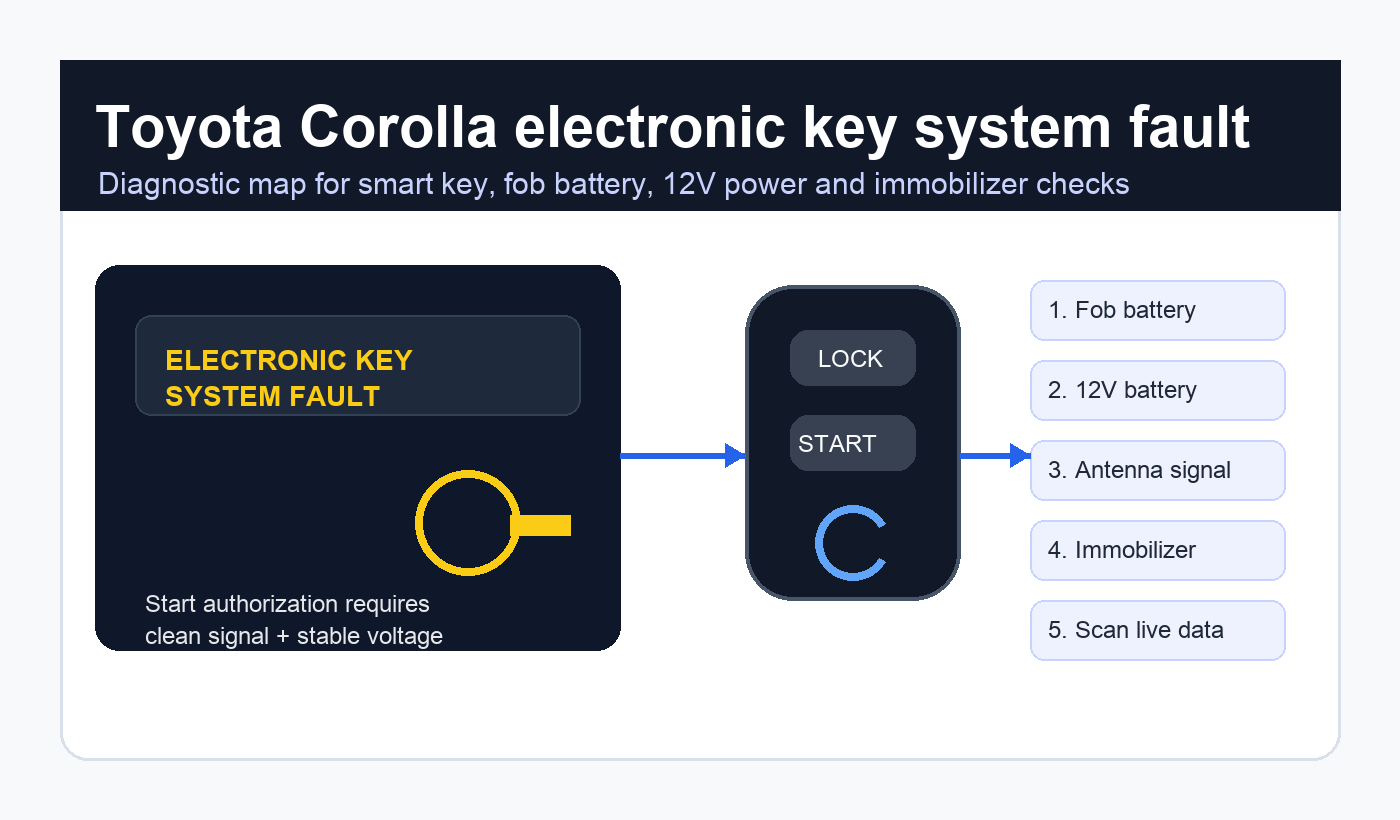
Quick answer: what the warning usually means
A Toyota Corolla electronic key system fault usually means the vehicle cannot reliably complete communication between the electronic key, the smart key antennas, and the immobilizer/start authorization system. In many cases the cause is ordinary: a weak CR2032 key fob battery, a low 12-volt battery, radio interference, a key stored beside a phone or metal object, or a start procedure issue such as the brake pedal signal not being seen. In less common cases, the fault can point to a damaged key, water intrusion, a failing interior/exterior antenna, a defective start switch, wiring corrosion, or a control-module fault that needs Toyota Techstream or an equivalent professional scan tool.
The important detail is that the message should not be diagnosed from the dashboard wording alone. A Corolla can display a smart key warning because the fob is weak, but it can also display a similar warning because the car itself is under-voltage. Modern keyless entry systems are convenient, but they depend on clean electrical supply and correctly synchronized security communication.
| Symptom | Most likely area | First check | Urgency |
|---|---|---|---|
| Car unlocks but will not start | Smart key detection, brake switch, 12-volt battery | Hold fob against start button and press brake firmly | Medium to high |
| Message appears only in cold weather | Weak fob battery or weak 12-volt battery | Test both batteries under load | Medium |
| Both keys fail at the same time | Vehicle-side power, receiver, antenna, module | Check 12-volt battery and scan codes | High |
| One key fails, spare works | Key fob battery, damaged fob, lost programming | Replace fob battery and compare spare | Low to medium |
| Intermittent no-detect near certain locations | Radio interference or key shielding | Move vehicle/key away from interference sources | Low |
What owners need to know first
The exact phrase Toyota Corolla electronic key system fault is a long-tail diagnostic question. It is not a broad shopping topic. People using it are usually already seeing a dashboard message, a no-start condition, or an intermittent smart key failure. In public search behavior, exact-match volume for a phrase this specific is typically low, but the surrounding cluster is much larger because owners search the same fault in many different ways.
The strongest associated phrases include Toyota Corolla smart key system malfunction, Toyota Corolla key not detected, Toyota Corolla key fob not working, Toyota Corolla push button start not working, Toyota Corolla immobilizer problem, Toyota Corolla key battery warning, Toyota Corolla keyless entry problem, Toyota Corolla remote key not unlocking, Toyota Corolla start button no response, Toyota smart key system warning, Toyota electronic key malfunction, Toyota Corolla spare key works, Corolla cannot detect key, Corolla key fob battery replacement, Toyota Corolla 12V battery smart key issue, Toyota Corolla security light flashing, Toyota Corolla no start key symbol, Toyota Corolla key programming, Toyota Corolla door handle sensor not working, Toyota Corolla antenna smart key fault, Toyota Corolla body control module key fault, Toyota Corolla brake switch start problem, Toyota Corolla dealership key diagnosis, and Toyota Corolla diagnostic trouble codes.
That cluster matters because a driver may not know Toyota’s exact wording. Some will type Toyota Corolla electronic key system fault; others will type “key not detected” or “Corolla won’t start with smart key.” A good diagnostic article has to answer all of those intents without becoming a stack of topics. The owner wants a decision tree: what to check first, what not to replace blindly, when the vehicle is safe to drive, and when professional diagnosis is the cheaper route.
How the Corolla electronic key system works
To understand a Toyota Corolla electronic key system fault, picture the system as a conversation rather than a single part. The key fob is not simply a remote. It is a coded transmitter and transponder. The vehicle has antennas and receivers positioned to detect whether the key is outside the car for locking/unlocking or inside the cabin for starting. The immobilizer verifies that the key is authorized. The push-button start logic then checks other inputs, including brake pedal status, gear selector position, and vehicle power state.
When everything is healthy, the driver touches the door handle, the car detects the key, unlocks the door, and later authorizes the start sequence when the brake pedal and start button are pressed. When something is weak or inconsistent, the same process can fail at different points. That is why one Corolla may unlock but not start, while another may start but show a warning after shutdown.
The key fob side
The electronic key contains a small battery, a transmitter circuit, buttons, a passive transponder function, and sometimes an emergency mechanical blade. A low fob battery can reduce range long before it dies completely. The buttons may still work at close distance while the passive smart key detection becomes unreliable. This is one reason a Toyota Corolla electronic key system fault can appear even though the lock button still seems to operate.
The vehicle side
The vehicle side includes smart key antennas, a certification ECU or smart key control logic depending on model year and market, the immobilizer system, body electrical control, door handle sensors, start switch, brake switch, wiring, fuses, and the 12-volt electrical supply. A fault on the vehicle side is more likely when both key fobs fail, when the car behaves differently after a jump start, or when the warning appears with other electrical symptoms.
The authorization side
The authorization step is the security gate. The car does not only need to “see” a key; it needs to verify that the key belongs to the vehicle. If the key is damaged, unregistered, desynchronized, or blocked by interference, the immobilizer can refuse start authorization. In that moment, the driver may see a key symbol, a smart key warning, or a no-start condition that feels random.
Most common causes, ranked by probability
A good diagnosis starts with probability. The most common causes of a Toyota Corolla electronic key system fault are not the most expensive modules. They are usually small, testable, and often related to power quality.
| Rank | Cause | Why it happens | Typical clue | Best next action |
|---|---|---|---|---|
| 1 | Weak key fob battery | Reduced signal strength or unstable fob wake-up | Works close to vehicle, fails at distance | Replace with quality CR2032 and retest |
| 2 | Weak 12-volt battery | Modules wake up slowly or voltage drops during start request | Warnings after sitting overnight | Load-test the 12-volt battery |
| 3 | Interference or key shielding | RF communication is blocked or disturbed | Problem occurs in one location or with key near phone | Move key/vehicle, remove metal cases |
| 4 | Brake switch or start condition issue | Car does not see a valid start request | Brake lights inconsistent, start button does not change mode | Check brake lights and scan live data |
| 5 | Damaged key fob | Water, impact, worn buttons, cracked board | Spare key works normally | Inspect fob and test spare |
| 6 | Antenna/receiver fault | Vehicle cannot detect key in one zone | Works in cabin but not at handle, or opposite | Scan smart key data and antenna codes |
| 7 | Module or wiring fault | Control unit, connector, fuse, corrosion, prior repair | Both keys fail, codes return after clearing | Professional diagnosis |
Step-by-step diagnosis before replacing parts
Step 1: try the emergency start method
If the Corolla does not recognize the key, hold the fob close to the start button while pressing the brake pedal and then press the start button. Many Toyota smart key systems include a fallback recognition method for a weak key battery. If this works, the fault is likely related to fob power or detection range rather than a completely dead immobilizer system.
When a Toyota Corolla electronic key system fault disappears after using the fob near the start button, do not stop at “it started.” Replace the fob battery and test the spare key. The emergency start trick is a clue, not a permanent repair.
Step 2: replace the key fob battery correctly
Use the correct battery type for your fob, commonly CR2032 on many Toyota smart keys, but always confirm for your exact key. Install it with clean hands, avoid bending the battery contacts, and make sure the case snaps shut evenly. Cheap old-stock batteries can test acceptably with no load but fail in real use. If the warning began after a battery change, reopen the fob and check polarity and contact pressure.
A Toyota Corolla electronic key system fault after a fob battery replacement often comes from a poor contact, a damaged shell, or a battery that was already weak in the package. Comparing the main key against the spare is one of the fastest ways to separate key-side faults from vehicle-side faults.
Step 3: check the 12-volt battery, not just the key battery
Many owners overlook the 12-volt battery because the warning mentions the electronic key. That is a mistake. Smart key modules, immobilizer logic, relays, and brake/start authorization circuits all rely on stable low-voltage power. A Corolla can have enough power to light the dash and still be weak enough to confuse modules during start-up.
If the car has been parked for days, if the warning appears in cold weather, if multiple warning lights appear together, or if the message comes after a jump start, test the 12-volt battery under load. Voltage at rest is useful, but it is not the whole story. A battery can show around 12 volts and still collapse during a start request.
Step 4: compare both keys
The spare key is not just a backup; it is a diagnostic tool. If one key produces a Toyota Corolla electronic key system fault and the other key works normally in the same location, the problem is probably the key fob, its battery, or its registration. If both keys fail in the same way, the vehicle side becomes more suspicious.
When testing, keep conditions identical. Stand in the same place, use the same door, press the same buttons, and try the same start procedure. Do not test one key at home and the other at a fuel station surrounded by different interference sources.
Step 5: remove interference and bad storage habits
Smart keys can be affected by where they are stored. A key fob pressed against a smartphone, tablet, wireless charger, metal wallet, RFID-blocking pouch, laptop, or stack of other keys may not communicate cleanly. Some owners only see the problem when the fob is in a particular bag or pocket.
Before assuming a serious Toyota Corolla electronic key system fault, place the key by itself, away from electronics and metal. Try unlocking from a few positions around the car and then try starting with the fob in the center console area. If the symptom changes dramatically, the issue may be signal environment rather than a failed module.
Step 6: inspect simple vehicle inputs
The car must see the correct conditions before it starts. On automatic models, it expects the gear selector position to be valid. It expects the brake pedal signal. It expects the start button press. A brake light switch fault can feel like a key problem because the car sees the key but does not accept the start request.
Check whether the brake lights illuminate consistently. Notice whether the start button changes from accessory to ignition-on modes. If the dash acts alive but the vehicle refuses to crank or ready-on, the electronic key may not be the only part of the story.
When the fault appears after a battery replacement or jump start
A Toyota Corolla electronic key system fault after battery work deserves special attention. Disconnecting or jump-starting a weak 12-volt battery can expose a marginal electrical system. Sometimes modules need a clean restart. Sometimes a fuse, terminal, ground, or battery sensor connection was disturbed. Sometimes the original battery was not the only issue.
Start with the basics: confirm the battery terminals are tight, clean, and correctly seated. Check the ground connection. Look for corrosion. Verify that the battery is the correct size and specification. If the warning appeared immediately after someone worked under the hood, inspect what was touched before replacing electronic parts.
Dashboard messages that owners confuse with this fault
Not every key-related warning is the same. Owners may describe several messages as Toyota Corolla electronic key system fault, but the root meaning can vary by model year, market, trim, and instrument cluster language.
| Driver description | Likely meaning | Diagnostic direction |
|---|---|---|
| “Key not detected” | Vehicle cannot detect an authorized fob in range | Fob battery, antenna zone, interference |
| “Key battery low” | Fob battery voltage is weak | Replace fob battery and retest |
| “Smart key system malfunction” | Vehicle detected a system fault | Scan smart key/immobilizer codes |
| Security light flashing | Immobilizer status or key authorization issue | Compare spare key, check immobilizer codes |
| No message, no start | May not be a key fault at all | 12-volt battery, brake switch, starter circuit |
What a professional scan should include
If basic checks do not solve the Toyota Corolla electronic key system fault, the next step is a proper scan. A generic OBD reader may not be enough. The problem may live in body control, smart key, immobilizer, certification, or gateway modules rather than the engine ECU. Toyota Techstream or a professional scan tool with deep Toyota coverage is the right approach.
A useful diagnostic session should check stored and current DTCs, key registration status, antenna recognition data, start switch input, brake switch input, vehicle battery voltage during start request, door handle sensor status, and immobilizer authorization. Clearing codes without recording them is bad practice. Intermittent smart key problems often depend on freeze-frame clues.
Codes do not replace logic
A diagnostic trouble code can point to a circuit, but it does not always name the failed part. For example, an antenna-related code may be caused by the antenna, wiring, connector corrosion, water intrusion, or a control-unit issue. A Toyota Corolla electronic key system fault should be diagnosed with live data and physical checks, not only with a code list.
Can you drive with this warning?
If the Corolla starts normally and the warning appears only briefly, you may be able to drive to a safe location or repair appointment. But you should not ignore a recurring Toyota Corolla electronic key system fault. The risk is not usually that the car will suddenly shut off while driving; the more common risk is being unable to restart after parking.
If the car is already refusing to start, if both keys fail, if the 12-volt battery is weak, or if the warning appears with multiple electrical warnings, treat the issue as urgent. Do not keep cycling the start button repeatedly until the battery is drained. That can add a second problem to the first.
Owner checks versus dealer-level checks
| Check | Owner can do? | Tools needed | What it proves |
|---|---|---|---|
| Replace fob battery | Yes | Correct coin cell, small tool | Rules out the most common key-side cause |
| Try spare key | Yes | Spare key | Separates key fault from vehicle fault |
| Move away from interference | Yes | None | Identifies location or storage-related signal issues |
| 12-volt load test | Sometimes | Battery tester | Confirms power stability |
| Smart key live data | No, usually | Toyota-capable scan tool | Shows antenna and authorization status |
| Key registration | No | Dealer/locksmith equipment | Confirms programmed key identity |
How not to waste money
The expensive mistake is replacing parts in the order they are imagined rather than tested. A Toyota Corolla electronic key system fault should not automatically lead to a new key, a new start button, or a new module. The best order is battery, spare key comparison, interference check, 12-volt test, scan data, then parts.
Another mistake is buying a used key online and expecting it to work without programming. Smart keys are security components. Depending on model year and system, adding or replacing a key may require proper registration equipment and proof of ownership. A cheap key shell may fix a broken case; it will not create authorization by itself.
Model year differences and why they matter
Corolla electronics differ by generation, trim, market, and whether the vehicle uses a traditional key, remote keyless entry, or full smart key with push-button start. A 2014 Corolla with a conventional ignition does not behave like a late-model hybrid Corolla with smart entry and start. That is why a Toyota Corolla electronic key system fault must be matched to the exact vehicle.
When searching for information or ordering parts, use the VIN, market, model year, trim, and key type. The wrong assumption can lead to the wrong battery, wrong fob, wrong programming method, or wrong diagnosis.
Security context: why keyless systems are complex
Remote and passive keyless systems are designed to be convenient while resisting unauthorized access. That requires rolling codes, encrypted communication, immobilizer validation, and safeguards against accidental start authorization. Academic research into remote keyless entry and passive keyless systems shows why these systems are more than simple radio remotes: they are security protocols running in a noisy real-world environment.
For an owner, this explains why a Toyota Corolla electronic key system fault may feel inconsistent. The system is trying to avoid accepting a weak, invalid, or suspicious signal. It is better for the car to refuse a start request than to accept the wrong key. The downside is that low voltage, interference, or a marginal fob can produce a frustrating warning.
When to call Toyota, a dealer, or an automotive locksmith
Call a Toyota dealer or a qualified automotive locksmith if both keys fail, the car will not start after a fresh fob battery and 12-volt battery test, the warning returns immediately after clearing codes, the vehicle was recently repaired after water damage or collision, or the key was lost and replaced with an unregistered unit.
For official owner documentation, use Toyota’s owner manual portal: Toyota Owner’s Manuals and Warranty Guides. For safety recalls and VIN-based recall checks, use the official U.S. government recall lookup: NHTSA recalls database. These two references are more reliable than forum guesses when you need model-specific safety or service context.
Related diagnostic reading on this site
If you work on other electronic systems, the same diagnostic discipline applies: power first, signal second, module last. You may also find these internal guides useful: motorcycle electronics guides, fitment guides, and motorcycle electronics parts. They are not Corolla-specific, but they follow the same practical logic: confirm compatibility, check power and connectors, and avoid replacing parts without evidence.
Practical diagnostic checklist
Use this checklist when a Toyota Corolla electronic key system fault appears:
- Confirm the exact dashboard wording and when it appears.
- Try the spare key under the same conditions.
- Replace the key fob battery with a fresh quality cell.
- Hold the fob against the start button and try the emergency start method.
- Move the key away from phones, metal cases, wallets, and wireless chargers.
- Test the 12-volt battery under load, especially after cold starts or parking.
- Check brake lights and start-button behavior.
- Look for water damage, recent repair work, or loose battery terminals.
- Scan Toyota body/smart key/immobilizer modules, not only engine codes.
- Record all codes before clearing them.
Frequently asked questions
Can a weak key fob battery cause this message?
Yes. A weak fob battery is one of the most common reasons for a Toyota Corolla electronic key system fault. The confusing part is that the fob may still unlock the doors in some conditions. Passive detection and button operation do not always fail at the same moment.
Can the 12-volt battery cause a key system warning?
Yes. A weak 12-volt battery can cause modules to wake up incorrectly, communicate slowly, or drop voltage during a start request. If multiple warnings appear together, check the 12-volt battery before blaming the smart key.
Why does the car start when I hold the key near the start button?
That usually means the fallback recognition method is working. It often points to a weak fob battery or reduced detection range. It does not prove the system is fully healthy; it simply helps separate a completely dead authorization system from a weak key detection condition.
Is the fault dangerous?
The biggest practical risk is being stranded after parking. A recurring Toyota Corolla electronic key system fault should be handled before it becomes a no-start problem. If the warning comes with other electrical faults, treat it more urgently.
Do I need a new key?
Not necessarily. You need evidence first. If the spare key works perfectly and the main key fails after a fresh battery, a damaged or unregistered key becomes likely. If both keys fail, look at the vehicle side before buying another fob.
Final diagnosis strategy
The best way to solve a Toyota Corolla electronic key system fault is to move from simple evidence to deeper evidence. Start with the fob battery because it is cheap and common. Compare the spare key because it is decisive. Test the 12-volt battery because modern electronics are sensitive to voltage. Remove interference because wireless systems are vulnerable to environment. Then scan the smart key and immobilizer modules because hidden body-electrical codes often tell the truth.
When you follow that order, the warning becomes less mysterious. A Toyota Corolla electronic key system fault is not a command to replace the most expensive part. It is a request to verify the communication chain: key, power, antenna, immobilizer, start input, and module logic. Diagnose that chain carefully and the repair becomes much clearer.
Owner notes by situation
Toyota Corolla electronic key system fault after rain or a car wash should make you think about moisture around handles, connectors and the key itself.
Toyota Corolla electronic key system fault after a long airport parking stay should make you test the 12-volt battery before condemning the fob.