
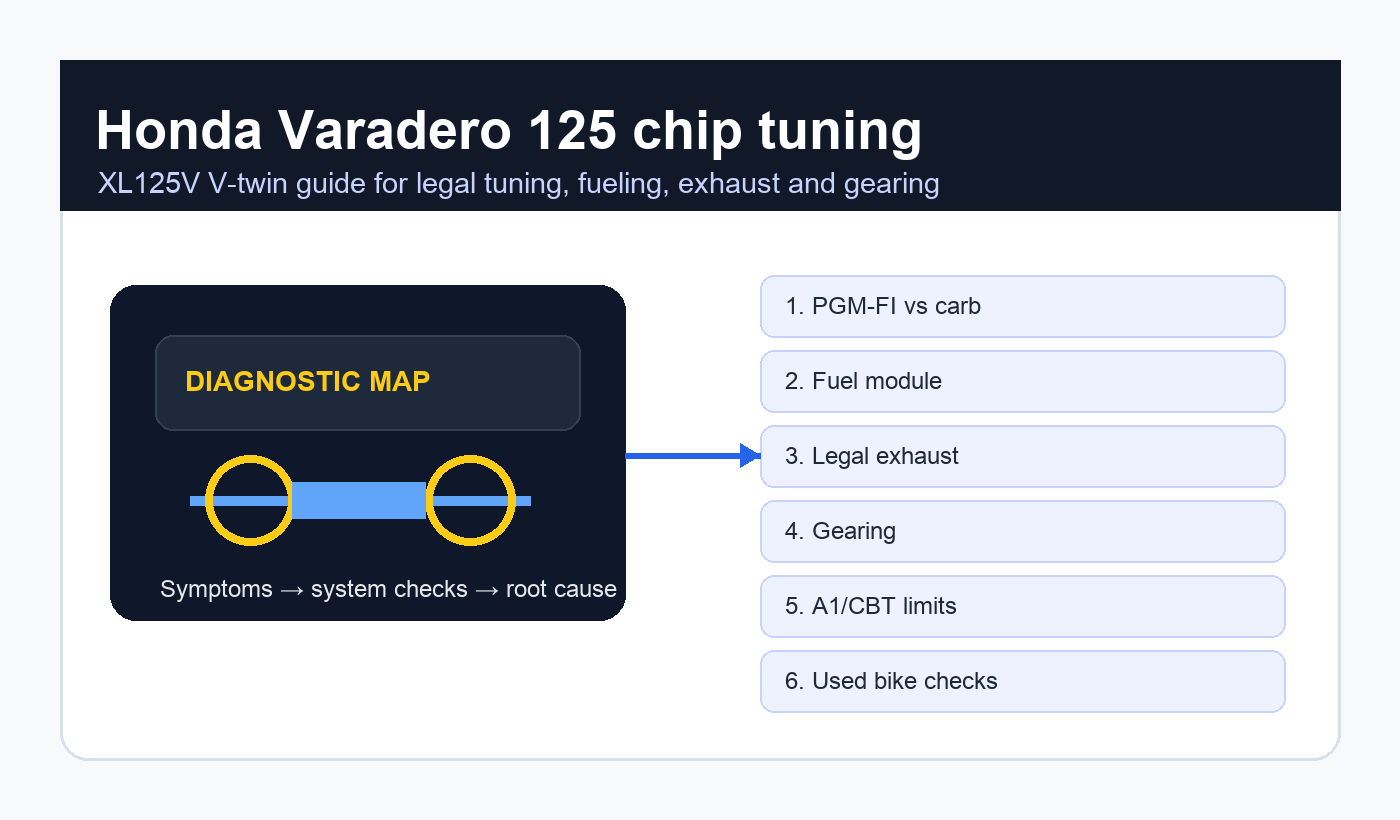
Honda Varadero 125 chip tuning: Realistic Tuning Guide for the XL125V V-Twin
Honda Varadero 125 chip tuning is a popular search because the XL125V Varadero looks and feels bigger than most 125cc motorcycles. It has adventure styling, road presence, a liquid-cooled V-twin engine and the kind of proportions that make riders wonder whether a small electronic upgrade can unlock hidden performance. The honest answer is more interesting than the marketing: the Varadero can be improved, but it cannot be magically turned into a larger motorcycle.
The 125cc class is limited by displacement, licensing rules, emissions equipment, gearing, rider weight and aerodynamics. A chip module, ECU adjustment or fueling device can help only when it solves a real fueling or setup problem. It will not create a secret reserve of horsepower if the engine is already healthy and near the legal limit. Good tuning begins with maintenance and expectations.
This guide treats Honda Varadero 125 chip tuning as a serious owner topic. It explains reader need, related topics, carburetor versus fuel-injected models, chip-module claims, exhaust and air-filter setup, gearing, legality, insurance, used-bike inspection and the safest path to making the Varadero 125 feel cleaner without ruining reliability.

What owners need to know first
This guide is written for owners, buyers and technicians dealing with Honda Varadero 125 chip tuning in the real world. It focuses on symptoms, checks, realistic repair decisions, legal limits where relevant, and the points worth confirming before buying parts or trusting a seller’s claim.
Common related topics include Honda XL125V tuning, Varadero 125 performance, 125cc chip tuning, Honda 125 V-twin tuning, PGM-FI tuning, carburetor jetting, fuel controller, ECU remap, piggyback module, road legal exhaust, air filter, sprocket change, final drive gearing, 125cc top speed, A1 licence, CBT motorcycle, insurance declaration, spark plug, valve clearance, chain tension, tire pressure, Dyno testing, fuel injection, catalytic converter and learner motorcycle tuning.
| Reader need | Rider question | Responsible answer |
|---|---|---|
| More speed | Can a chip make it much faster? | Only small gains are realistic on a legal 125 |
| Fueling | Can a module improve throttle response? | Sometimes, especially with exhaust/intake changes |
| Legality | Can I ride it on road after tuning? | Check licence, insurance and local approval rules |
| Maintenance | Why does it feel slow? | Service condition may matter more than electronics |
Know which Varadero 125 you have
The first rule for Honda Varadero 125 chip tuning is model identification. Early Varadero 125 models used carburetors. Later models moved to Honda PGM-FI fuel injection and emissions changes. A chip or fuel module discussion applies mainly to fuel-injected bikes. Carbureted bikes are tuned through jetting, airbox, exhaust and mechanical setup rather than an ECU chip in the modern sense.
For current Honda brand and owner context, start with Honda UK Motorcycles. For UK learner and CBT context around 125cc road use, the official GOV.UK motorcycle CBT guidance is a useful legal reference. Riders outside the UK should check their own licensing and insurance rules.
Why the Varadero feels different from other 125s
Honda Varadero 125 chip tuning attracts attention because the bike does not feel like a tiny commuter. The V-twin character, tall stance, fairing and touring-friendly proportions make it feel mature. That can create unrealistic performance expectations. The engine is still a small 125, and the bike is not especially light compared with many naked 125s.
The result is a motorcycle that can feel solid and comfortable, but not explosive. Tuning should focus on clean response, healthy running and suitable gearing rather than chasing impossible power numbers.
Chip tuning on fuel-injected models
Honda Varadero 125 chip tuning on a PGM-FI model usually means a piggyback fuel controller, sensor modifier or ECU-related tuning device. These devices may adjust fueling signals or throttle-area response. Their value depends on the bike’s condition and modifications. A stock, healthy bike may not gain much. A bike with a legal exhaust and intake change may benefit from cleaner fueling if the module is well matched.
The important question is not “does a chip work?” but “what exactly does this device change?” A reputable seller should explain whether it modifies fuel, ignition, sensor signals or throttle behavior. They should also explain compatibility by model year, connector type and whether the device is legal for road use.
| Upgrade type | Possible benefit | Risk | Best use |
|---|---|---|---|
| Fuel controller | Smoother response with matching setup | Bad fueling if generic | After confirming model and modifications |
| Road-legal exhaust | Sound, weight, small response change | Noise/approval issues | Only with homologation |
| Air filter | Restores flow if old filter is dirty | Poor filtration or lean running | Quality filter and correct sealing |
| Sprocket change | Changes acceleration feel | Can reduce top speed or raise rpm | Match rider roads and weight |
| Full service | Restores lost performance | Low risk | Always first |
Carbureted models need a different approach
Older carbureted bikes make Honda Varadero 125 chip tuning a misleading phrase. There is no simple electronic chip to unlock the bike in the same way people imagine with a car ECU. Carbureted tuning means jets, needles, airbox condition, carb synchronization, intake sealing, exhaust compatibility and spark quality.
If a carbureted Varadero feels weak, begin with carb cleaning, synchronization, valve clearance, spark plugs, fuel flow, air filter and compression. A poorly synchronized V-twin can feel tired even when no performance part is needed.
Maintenance before tuning
The best first step in Honda Varadero 125 chip tuning is a boring one: make the bike healthy. Check valve clearance, spark plugs, air filter, oil, coolant, chain slack, sprocket wear, tire pressure, brake drag and fuel quality. On a small engine, friction and poor maintenance are not small details. They are performance.
A weak battery or charging issue can also distort electronic behavior on later models. Before installing modules, check voltage, grounds and connectors. Good power supply is part of good fueling.
Exhaust and intake reality
Honda Varadero 125 chip tuning is often sold together with exhaust and filter claims. A legal exhaust can improve sound and reduce weight, but it rarely transforms a 125. A race-only exhaust may create noise, inspection trouble and fueling problems. A filter can help only if it maintains proper sealing and matches the rest of the setup.
Do not remove emissions equipment for road use. Apart from legal problems, random changes can make the bike run worse. The best setup is documented, road legal and matched to the model year.
Gearing changes
Some riders searching Honda Varadero 125 chip tuning really want better acceleration. A sprocket change can alter how the bike feels without increasing engine power. Shorter gearing can make the Varadero feel more eager in town and hills. Taller gearing may reduce rpm at cruise but can make the bike struggle into wind.
| Gearing choice | Feel | Tradeoff |
|---|---|---|
| Shorter final drive | Better launch and hill response | Higher rpm and possible lower top speed |
| Taller final drive | Lower rpm when cruising | Weaker acceleration if engine cannot pull it |
| Stock gearing | Balanced general use | May not suit heavy riders or steep roads |
Top speed expectations
Honda Varadero 125 chip tuning should not be judged only by top speed. A 125’s indicated maximum varies with wind, rider size, luggage, tire pressure, chain condition, gradient and engine health. A module that claims dramatic top-speed gains should be treated with skepticism unless backed by proper testing.
Rideability matters more. A Varadero that starts cleanly, pulls smoothly, holds speed consistently and uses fuel reasonably is more valuable than one tuned into noisy unreliability.
Legal and insurance reality
Any Honda Varadero 125 chip tuning plan must include legal status. Many riders use the Varadero under learner or A1-style restrictions. Increasing power beyond legal limits, removing emissions equipment or fitting non-approved parts can affect licence compliance, insurance and inspection. Even a minor declared modification is better than a hidden one after a crash.
Keep invoices, homologation papers, original parts and tuner documentation. If the modification cannot be explained clearly to an insurer or buyer, it is not a clean modification.
Used bike checks before buying a tuned Varadero
A used bike advertised with Honda Varadero 125 chip tuning needs careful inspection. Ask whether it is carbureted or injected. Ask what module is fitted, who installed it, whether original parts are included and whether the seller declared it to insurance. Check idle, cold start, throttle response, fuel smell, warning lights, wiring and exhaust approval marks.
| Inspection point | Good sign | Warning sign |
|---|---|---|
| Fueling device | Brand, invoice, model-year compatibility | Unknown box, cut wires, no paperwork |
| Exhaust | Road approval and original part included | Race pipe, missing catalyst, excessive noise |
| Carb/injection | Clear owner knowledge | Seller does not know which system it has |
| Running | Clean cold start and stable idle | Stalling, popping, hesitation |
| Legal | Declared modifications | “No one checks” attitude |
Diagnostic table before spending money
Before buying parts for Honda Varadero 125 chip tuning, diagnose the complaint. A bike that feels slow may have a tight chain, dragging brake, old plug, dirty filter, poor carb balance, wrong tire pressure or heavy luggage. A fuel module will not fix those problems.
| Complaint | Likely cause | First check |
|---|---|---|
| Flat acceleration | Maintenance, gearing, rider/load, fueling | Service condition, chain, plugs, filter |
| Hesitation | Carb/injection, air leak, plug, fuel quality | Fuel system and intake inspection |
| Poor top speed | Wind, gearing, compression, brake drag | Tire pressure, brake heat, compression if needed |
| High fuel use | Rich setup, dirty filter, riding style | Plug color, filter, tuning module setting |
| Rough idle | Carb balance, valves, injector, air leak | Valve clearance, synchronization, scan data if injected |
Best legal upgrade path
The cleanest Honda Varadero 125 chip tuning path is: full service, good tires, correct chain, fresh plugs, clean filter, brake check, then road-legal exhaust or fueling improvement only if there is a reason. If the goal is stronger acceleration, consider gearing before electronics. If the goal is comfort, invest in screen, luggage or suspension condition.
A dyno can be useful, but only if the tuner understands small 125cc engines. A good tuner will talk about torque curve, fueling stability and rideability, not fantasy horsepower.
Road test baseline before tuning
Before changing parts, create a baseline. Start the bike cold, listen to idle quality, note choke or warm-up behavior on carbureted models, and record whether hesitation appears cold, hot, under load or at steady throttle. Ride the same route before and after any change. Use similar weather, fuel level and luggage if possible.
A good baseline includes cruising rpm, hill performance, fuel consumption, throttle response and starting behavior. Without that baseline, riders often confuse louder sound with better acceleration. The stopwatch and the fuel log are less emotional than the exhaust note, and that is exactly why they help.
How to judge a chip module seller
A credible seller should provide model-year compatibility, connector photos, installation instructions, what signal the module changes, whether it is intended for stock or modified bikes, and whether road legality is claimed. Vague language such as “up to huge power gains” without testing should make the buyer cautious.
Ask whether the module can be removed without cutting the harness, whether it causes warning lights, whether it has settings, whether those settings are documented and whether support exists if the bike runs poorly. A small motorcycle deserves clean wiring just as much as a larger one.
Carburetor synchronization on early bikes
Early Varadero 125 models can feel flat when the twin carburetors are dirty or out of balance. Synchronization affects smoothness, idle and pickup. A rider may think the engine needs performance parts when it actually needs carb cleaning, fresh intake rubbers, correct jets and careful balancing.
Carburetor work should be precise. Random jet changes can make the bike richer, louder or thirstier without improving real performance. If the exhaust and intake remain stock, returning the carburetors to clean factory condition is often the best “tune.”
Electrical and sensor checks on injected bikes
Fuel-injected later bikes depend on stable voltage and clean sensor signals. A weak battery, poor ground, corroded connector or charging issue can make the motorcycle feel inconsistent. Before adding a controller, check battery health, charging voltage, sensor connectors and any stored fault codes if diagnostic access is available.
This matters because a module changes signals inside a system that must already be healthy. Adding electronics to an unhealthy electrical system makes diagnosis harder. Fix the foundation first.
Connector quality is especially important on an older touring-style 125 that may have seen rain, storage and owner-fitted accessories. Inspect the harness for Scotch-lock connectors, crushed wires, loose earth points and non-factory alarm wiring before blaming the ECU or fuel system. Small details matter here.
Touring use changes the tuning decision
The Varadero 125 is often used differently from a tiny naked 125. Owners add screens, top boxes, panniers, heated grips, phone chargers and commuting luggage. Those accessories change weight, wind resistance and electrical load. A rider may blame the engine when the real issue is a heavy box, low tire pressure, a tired chain or a weak charging system feeding too many accessories.
Before spending money on performance electronics, remove unnecessary luggage for a test ride, check pressures, clean and lubricate the chain, and verify that the brakes are not dragging. Then ride the same road again. If the bike feels noticeably better, the problem was load and rolling resistance rather than fueling.
When a bigger bike is the honest upgrade
There is a point where tuning a 125 stops making economic sense. If the rider wants sustained motorway speed, strong two-up performance, rapid overtakes or effortless hill climbing, the honest answer may be a larger licence and a larger motorcycle. The Varadero 125 is charming because it feels mature, but it remains a learner-class machine.
That does not make tuning pointless. It means the target should be realistic: smoother pickup, cleaner running, better setup for the rider’s roads and reliable daily use. A well-sorted small motorcycle is more satisfying than an over-modified one that is noisy, thirsty and still not fast.
Common mistakes
The first mistake with Honda Varadero 125 chip tuning is buying the cheapest module before servicing the motorcycle. The second is using injection advice on a carbureted bike. The third is believing top-speed claims without conditions. The fourth is fitting a loud exhaust and calling it performance. The fifth is ignoring insurance.
Another mistake is comparing the Varadero 125 with larger adventure bikes. It looks substantial, but the engine remains a 125. Respecting that fact leads to better ownership decisions.
Related internal reading
For more 125cc tuning context, read our Honda Varadero 125 tuning guide, Husqvarna Svartpilen 125 derestriction guide, and motorcycle tuning guides. They help compare chip modules, legal limits and realistic small-engine gains.
FAQ
Does chip tuning work on the Varadero 125?
It can help only in specific situations, mainly on fuel-injected bikes with a compatible setup. Honda Varadero 125 chip tuning is not a magic horsepower unlock.
Can I chip tune a carbureted Varadero?
Not in the modern ECU sense. Carbureted models need mechanical tuning: carb cleaning, jetting, synchronization, intake sealing and exhaust matching.
Will it increase top speed?
Maybe slightly under the right conditions, but top speed on a 125 depends heavily on wind, rider size, gearing and engine health.
What should I do first?
Service the bike fully before adding parts. A healthy stock Varadero often feels better than a neglected bike with a module.
Final practical verdict
The honest verdict on Honda Varadero 125 chip tuning is that it should be treated as fine-tuning, not transformation. The Varadero 125 can be made smoother, cleaner and more enjoyable, but the best gains come from health, setup and legal matching rather than miracle electronics.
Honda Varadero 125 chip tuning should start by identifying carburetor or PGM-FI model.
Honda Varadero 125 chip tuning should follow a full service, not replace it.
Honda Varadero 125 chip tuning works best when fueling changes match real modifications.
Honda Varadero 125 chip tuning with exhaust changes should keep road approval.
Honda Varadero 125 chip tuning should be declared to insurance where required.
Honda Varadero 125 chip tuning cannot ignore 125cc displacement and licence limits.
Honda Varadero 125 chip tuning on a used bike needs paperwork and clean wiring.
Honda Varadero 125 chip tuning is most valuable when it improves rideability, not just noise.
Honda Varadero 125 chip tuning should leave the bike reliable enough for daily use.