2.0 TDI 140 engine diagram: Complete Layout Guide for VW Group Diesel Owners
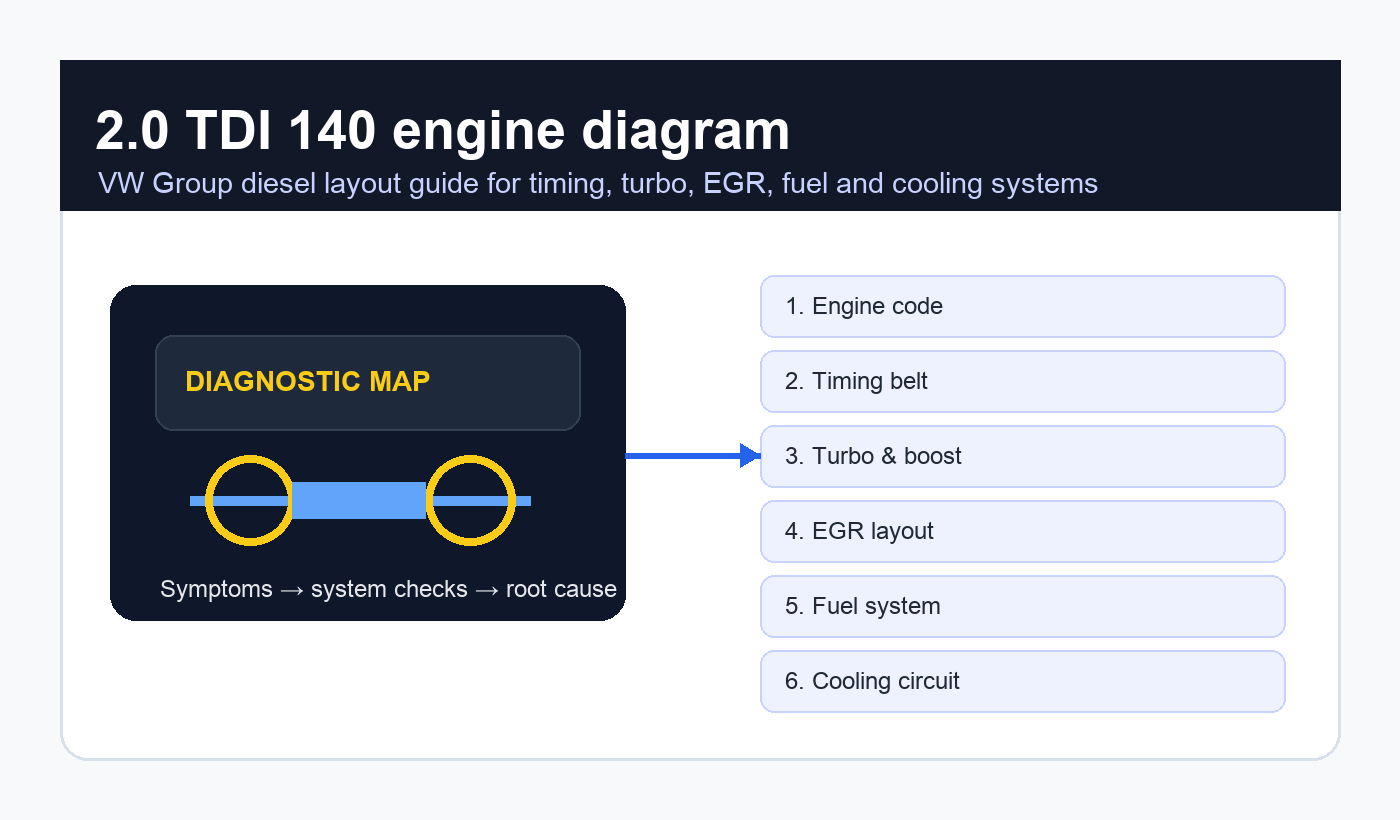
2.0 TDI 140 engine diagram is usually searched by someone who needs to understand a Volkswagen Group diesel engine before touching parts. The phrase may come from a French question such as “schéma moteur 2.0 tdi 140,” but the intent is universal: where are the main components, what does the timing belt drive, how do the turbo, EGR, fuel system and cooling circuit fit together, and what should be checked before a repair?
The most important caution is that a public article cannot replace the factory repair manual for a specific engine code. The 2.0 TDI 140 family includes several variants across Volkswagen, Audi, SEAT and Skoda models, including 8-valve and 16-valve versions, pump-jet and common-rail generations, different EGR layouts, different turbocharger hardware and different emissions equipment. A useful diagram starts with the exact engine code.
This guide explains 2.0 TDI 140 engine diagram in a practical, workshop-minded way. It does not copy proprietary service diagrams. Instead, it maps the main systems, shows what to identify, explains common layout mistakes and gives owners a safe method for understanding the engine before diagnosing leaks, belt service, turbo faults, EGR issues or sensor problems.

What owners need to know first
This guide is written for owners, buyers and technicians dealing with 2.0 TDI 140 engine diagram in the real world. It focuses on symptoms, checks, realistic repair decisions, legal limits where relevant, and the points worth confirming before buying parts or trusting a seller’s claim.
Common related topics include VW 2.0 TDI 140 engine layout, BKD engine diagram, BMM engine diagram, 2.0 TDI timing belt diagram, 2.0 TDI turbo actuator, EGR valve location, tandem pump, fuel filter, common rail, pump-jet injector, glow plug harness, coolant flange, thermostat housing, oil cooler, intercooler hose, MAF sensor, MAP sensor, crankshaft sensor, camshaft sensor, vacuum lines, N75 valve, diesel particulate filter, intake manifold, alternator belt and engine code location.
| Reader need | What the owner needs | Best article response |
|---|---|---|
| Component identification | Find turbo, EGR, sensors, belts and filters | Explain system layout and typical positions |
| Repair planning | Know what must be removed first | Separate timing, intake, cooling and fuel systems |
| Fault diagnosis | Trace a leak, boost fault or starting problem | Map symptoms to components |
| Manual search | Need the official diagram | Direct the reader to VIN/engine-code repair information |
Start with the engine code
The first rule for 2.0 TDI 140 engine diagram is to identify the engine code before trusting any diagram. A 2.0 TDI 140 may be associated with codes such as BKD, BMM, BMP, BRE, BLB or other market-specific variants. Some are 16-valve engines, some are 8-valve, some are pump-jet, and later engines may use common-rail architecture. Similar displacement does not guarantee identical component placement.
Look for the engine code on the vehicle data sticker, service book, timing-belt cover area, engine block markings or diagnostic scan data. If the engine has been swapped, the sticker may not match the hardware. In that case, visual identification and part numbers matter.
Why the 140 hp label is not enough
The 140 hp badge is a power rating, not a repair identity. Two cars can both be described as 2.0 TDI 140 and still use different cylinder heads, emissions hardware, injectors, engine mounts, cooling hoses and accessory brackets. That is why parts catalogues ask for VIN, engine code and build date rather than only displacement and horsepower.
For a repair plan, the engine code tells the truth. It helps identify the timing belt kit, water pump type, injector system, sensor locations, turbocharger variant and emissions hardware. If an online picture does not name the engine code, treat it as orientation only.
High-level engine layout
2.0 TDI 140 engine diagram can be understood as four main zones: the belt/accessory side, the intake and EGR side, the turbo/exhaust side and the service/filter side. The exact location changes by model because transverse Golf/A3/Octavia installations are packaged differently from longitudinal Passat/A4-style layouts.
| Zone | Common components | What owners usually look for |
|---|---|---|
| Timing side | Timing belt, tensioner, idlers, water pump, cam sprocket | Belt service, coolant leaks, timing marks |
| Accessory side | Alternator, auxiliary belt, tensioner, A/C compressor | Squeal, belt routing, charging faults |
| Intake/EGR side | EGR valve, intake manifold, anti-shudder valve, boost pipes | Soot, limp mode, hesitation |
| Turbo/exhaust side | Turbocharger, actuator, exhaust manifold, DPF/catalyst hardware | Boost faults, smoke, whistle, oil leaks |
| Service side | Fuel filter, oil filter, coolant bottle, sensors, vacuum valves | Maintenance and diagnosis access |
Timing belt side
One of the most common reasons to search 2.0 TDI 140 engine diagram is timing-belt work. The 2.0 TDI 140 is an interference diesel engine family, so timing errors can be expensive. The belt side may include camshaft drive, crankshaft sprocket, tensioner, idlers and often water pump service at the same time. Exact locking tools and procedures depend on engine code.
Do not use a generic internet image as the only timing reference. Use official service information, correct locking tools and engine-code-specific torque procedures. For official Volkswagen Group repair documentation, the proper starting point is Volkswagen erWin, where repair manuals are tied to vehicle and market details.
Accessory belt layout
2.0 TDI 140 engine diagram is also searched for serpentine belt routing. The auxiliary belt usually drives accessories such as alternator, air-conditioning compressor and sometimes power-related ancillaries depending on model. The tensioner, overrunning alternator pulley and belt condition can create squeals, vibration or charging complaints.
If the auxiliary belt is shredded or misrouted, inspect every pulley before fitting a new belt. A seized alternator pulley, worn tensioner or misaligned accessory can destroy the replacement belt quickly. Belt routing is simple only when all pulleys are healthy.
Fuel system: pump-jet versus common rail
The most important technical split behind 2.0 TDI 140 engine diagram is injection system. Earlier 2.0 TDI 140 engines often used pump-jet technology, where each injector is mechanically actuated by the camshaft and electronically controlled. Later engines may use common-rail fuel injection, with a high-pressure pump feeding a rail and solenoid or piezo injectors.
| System | Visual clues | Common diagnostic focus |
|---|---|---|
| Pump-jet / PD | Injector harness under valve cover, tandem pump, no external common rail | Injector loom, tandem pump leaks, cam wear, starting issues |
| Common rail | High-pressure rail and lines to injectors | Rail pressure, high-pressure pump, injectors, pressure sensor |
| Both | Fuel filter, lift pump on many models, sensors | Air in fuel, clogged filter, low-pressure supply |
Turbocharger and boost control
2.0 TDI 140 engine diagram should include the turbo system because many owners are chasing limp mode or underboost/overboost. The turbocharger is connected to the exhaust manifold, intake charge pipework, intercooler and boost-control system. Many versions use variable geometry turbo control, vacuum actuation and an N75 boost control valve.
Common checks include vacuum supply, actuator movement, split intercooler hoses, sticky vanes, MAP sensor readings, MAF sensor plausibility and oil leaks. A diagram helps identify parts, but live data and pressure testing prove the fault. A new turbo should not be fitted before boost control and air leaks are checked.
EGR, intake flap and soot
2.0 TDI 140 engine diagram often points the owner toward the EGR valve or intake manifold. Exhaust gas recirculation reduces emissions but introduces soot into the intake path. Combined with oil vapor from crankcase ventilation, soot can build deposits around the EGR, anti-shudder valve and intake manifold. Symptoms can include rough running, hesitation, smoke, limp mode or fault codes.
The layout differs by engine and emissions package. Some systems include a cooler, bypass flap, throttle/anti-shudder valve and multiple hoses. Cleaning or replacing parts should follow diagnosis. Randomly blanking emissions equipment can create legal, inspection and drivability problems.
Cooling system layout
For 2.0 TDI 140 engine diagram, the cooling circuit includes radiator, expansion tank, thermostat, water pump, hoses, coolant flange, heater circuit, EGR cooler where fitted and temperature sensors. Coolant leaks are common on aging engines because plastic flanges, seals and hoses harden over time.
Water pump service is often considered during timing belt work, but the exact pump choice and interval should follow the engine code and service information. Repeated coolant loss should not be dismissed. Diesel engines can tolerate many things, but overheating is not one of them.
Sensor map
A practical 2.0 TDI 140 engine diagram needs a sensor map. Modern diesels depend on MAF, MAP, coolant temperature, camshaft position, crankshaft position, fuel temperature, boost pressure and exhaust-related sensors. Some components are easy to reach; others require removing covers, ducts or undertrays.
| Sensor/component | Typical role | Symptoms when data is wrong |
|---|---|---|
| MAF sensor | Measures incoming air mass | Low power, smoke, plausibility faults |
| MAP/boost sensor | Reports manifold pressure | Limp mode, boost deviation, poor response |
| Coolant temperature sensor | Reports engine temperature | Hard start, fan issues, poor economy |
| Cam/crank sensors | Synchronize injection and timing | No start, intermittent stall, sync faults |
| Fuel pressure/supply data | Controls injection stability | Hard start, hesitation, rail or supply faults |
Oil system and crankcase ventilation
2.0 TDI 140 engine diagram should also help owners find the oil filter housing, oil cooler, sump, turbo oil feed/return and crankcase ventilation path. Oil leaks around the filter housing, cooler seals, cam cover, turbo lines or intercooler pipes can be mistaken for one another because airflow spreads residue around the engine bay.
Clean the area before diagnosing. A fresh leak is easier to trace than an engine covered in years of mist. Turbo oil in intercooler pipes should be judged carefully: a light film can be normal on older diesels, while pooling oil, smoke and shaft play need deeper diagnosis.
Common diagram mistakes
The biggest mistake is using the wrong engine picture. A BKD diagram may not match a BMM. A transverse Golf diagram may not match a longitudinal Passat. A common-rail diagram may not match a pump-jet engine. A 170 hp variant may have different emissions and boost hardware from a 140 hp version.
The second mistake is treating a diagram as a repair procedure. A diagram shows where things are. It does not provide torque settings, locking tool steps, bleeding procedures or adaptation routines. Those belong in official service information.
Symptom-to-component table
When using 2.0 TDI 140 engine diagram for diagnosis, begin with symptoms. The component you can see is not automatically the component that failed. A boost fault can be a vacuum leak. A fuel fault can be a clogged filter. A temperature fault can be a sensor, thermostat, pump or wiring issue.
| Symptom | Likely systems | First useful checks |
|---|---|---|
| Limp mode under acceleration | Turbo, vacuum, boost pipes, MAP/MAF | Scan codes, live boost data, pressure test, vacuum test |
| Hard cold start | Glow plugs, battery, fuel supply, coolant sensor | Voltage, glow system, fuel filter, temperature data |
| Coolant loss | Flanges, radiator, EGR cooler, water pump | Pressure test, inspect dried coolant traces |
| Rough idle | Injectors, air leaks, EGR, mounts, timing | Scan data, balance values, intake inspection |
| Smoke | Air metering, boost leak, injectors, turbo, EGR | MAF/MAP data, hose inspection, oil consumption |
How to use a diagram before a repair
The right way to use 2.0 TDI 140 engine diagram is to plan access. Identify the component, the parts that block it, the connectors and hoses attached to it, the gaskets or seals that should be replaced, and the procedure needed after installation. Some repairs require bleeding, adaptation, basic settings or fault-code clearing.
Take photos before removing hoses and connectors. Label vacuum lines. Keep bolts grouped by component. Do not pull brittle plastic fittings sideways. Older TDI engines often punish haste with broken clips, cracked hoses and mystery leaks.
Vacuum line and boost-control planning
Many older diesel boost-control complaints begin with vacuum routing. A small cracked hose can create the same driving complaint as a far more expensive turbocharger problem. Before replacing large parts, trace the vacuum supply from pump to valves, reservoir where fitted, actuator and control solenoids. Replace brittle hose only with suitable vacuum line and copy the original routing carefully.
It is wise to photograph the vacuum layout before touching anything. Small hoses can be swapped accidentally, and the engine may still run while boost control behaves badly. A simple hand vacuum pump can reveal actuator movement, leaks and sticky mechanisms faster than guessing.
Connector and harness awareness
Diesel engine bays become hot, oily and cramped with age. Connector locks become brittle, loom tape breaks down and previous repairs may leave clips missing. When a component is hard to access, do not pull on the wire to identify it. Follow the connector body, release the lock properly and inspect terminals for corrosion or oil contamination.
Harness issues can imitate sensor failure. A MAP sensor fault can come from wiring. A coolant temperature reading can be wrong because of a connector problem. A glow plug code can involve the harness, not only the plug. The physical map is useful because it lets the owner inspect the route between sensor and loom, not only the sensor itself.
Timing belt warning
2.0 TDI 140 engine diagram is not enough for timing belt replacement. Timing work needs engine locking tools, correct belt kit, tensioning procedure, torque specs, cam/crank relationship and often water pump service. If the belt slips, valve damage is possible. If the engine code is uncertain, stop before disassembly.
For belt and drive-system technical context from an established component manufacturer, Continental’s engine parts resources are a useful high-level reference: Continental engine parts information. Use it for general component awareness, not as a replacement for VIN-specific repair instructions.
Used-car inspection
A buyer searching 2.0 TDI 140 engine diagram before inspecting a used car should focus on evidence. Ask for timing belt history, engine code, oil service records, coolant type, turbo work, EGR/DPF history, fault-code scan, cold-start behavior and proof of repairs. A clean engine bay can be good, but it can also hide recent leak cleaning.
During inspection, look for coolant crust, oil around charge pipes, broken undertray, missing clips, non-factory vacuum routing, unplugged sensors, poor remap claims and warning lights. A healthy TDI should start cleanly, idle steadily, pull smoothly and reach temperature normally.
Related internal reading
For more diagnostic logic, read our 07E8 engine code guide, Opel Service StabiliTrak warning guide, and automotive repair guides. They help with scan-tool thinking, warning lights and practical repair planning.
FAQ
Is every 2.0 TDI 140 engine layout the same?
No. 2.0 TDI 140 engine diagram depends on engine code, model, production year, injection system and emissions package.
Can I use an online diagram for timing belt replacement?
No. Use official service information, locking tools and engine-code-specific instructions. A public diagram is not enough for timing work.
Where is the turbo on a 2.0 TDI 140?
The turbo is on the exhaust side of the engine and connects to boost pipes, intercooler plumbing and exhaust hardware. Access depends on vehicle layout.
Why do diagrams look different online?
Because the 2.0 TDI family includes different engine codes, transverse and longitudinal installations, 8-valve and 16-valve variants and different emissions packages.
Final practical verdict
The safest way to use 2.0 TDI 140 engine diagram is as an orientation tool, not as a substitute for the correct repair manual. Identify the engine code, confirm the injection system, map the timing, turbo, EGR, fuel and cooling systems, then use official instructions for actual procedures.
2.0 TDI 140 engine diagram should always begin with engine-code identification.
2.0 TDI 140 engine diagram is useful for locating systems before diagnosis.
2.0 TDI 140 engine diagram cannot replace timing-belt locking procedures.
2.0 TDI 140 engine diagram should separate pump-jet and common-rail variants.
2.0 TDI 140 engine diagram helps trace boost, EGR, cooling and fuel faults logically.
2.0 TDI 140 engine diagram should not be copied from a different engine code blindly.
2.0 TDI 140 engine diagram is most valuable when paired with scan data and service history.
This layout guide makes repairs calmer because the owner understands the system before removing parts.
2.0 TDI 140 engine diagram is a map; the factory manual is the procedure.