
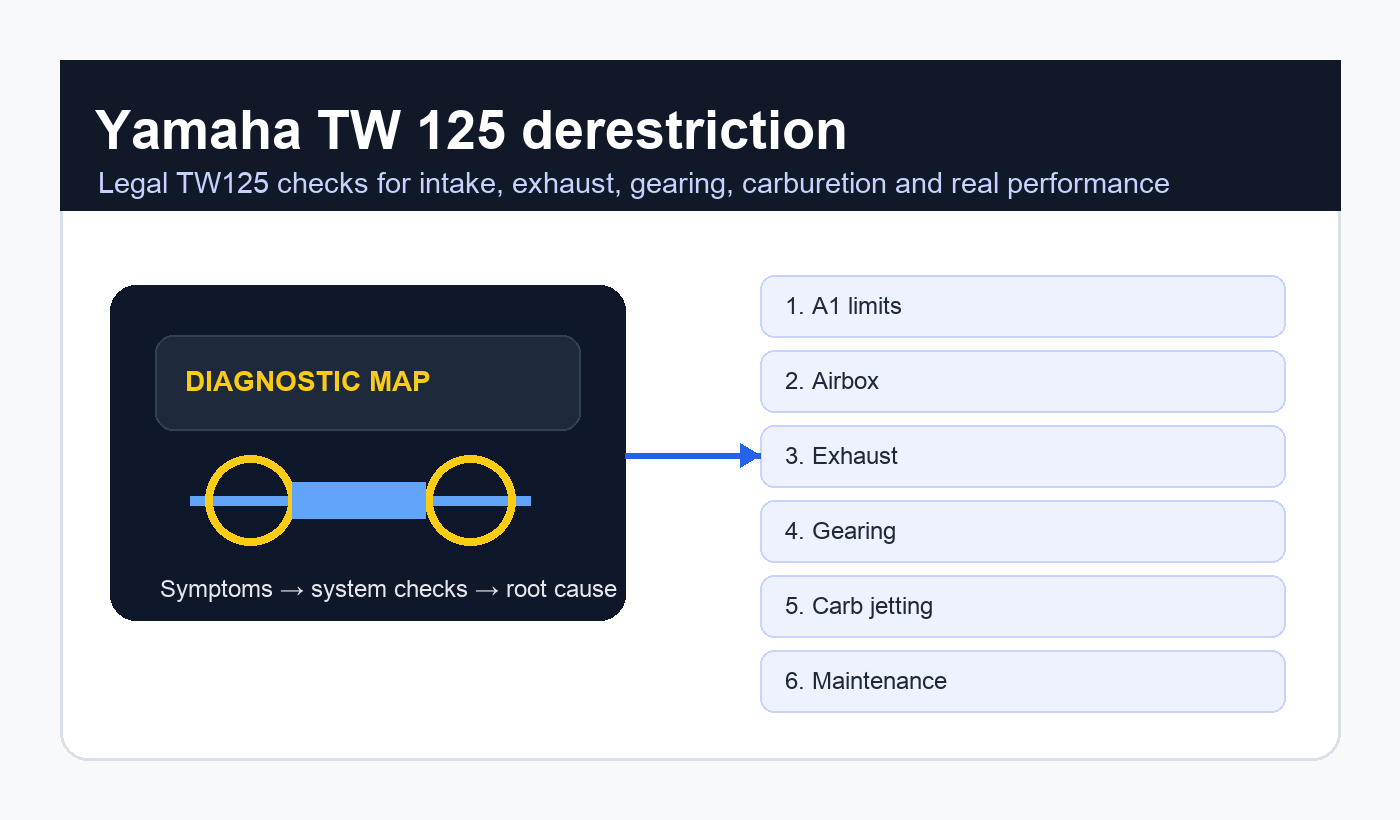
Yamaha TW 125 derestriction: Legal Checks, Myths And Real Performance Gains
Yamaha TW 125 derestriction is a phrase riders use when a friendly-looking trail bike feels slower than expected. The Yamaha TW 125 has wide tyres, relaxed ergonomics and a simple character, so it is easy to assume that a hidden limiter is holding it back. Sometimes the bike does have market-specific intake, exhaust or carburetion details worth checking, but many complaints come from maintenance, gearing, tyre drag, rider weight, wind and unrealistic expectations from a 125cc four-stroke.
This guide explains the subject like a workshop-minded owner would: identify the exact model, restore the baseline, check whether the motorcycle is genuinely restricted, understand legal licence limits, and choose changes that improve rideability without making the bike illegal or unreliable. It is not a guide to bypass road law. It is a practical article about diagnosis, safe ownership and honest performance.
This guide is written for riders who want to understand what can realistically be improved and what should be left alone. Before changing parts, confirm the bike is healthy, legal for its intended use and maintained well enough to benefit from any upgrade.
The useful content gap is that many pages talk about making a 125 faster without explaining how to decide whether the bike is actually underperforming. A rider needs reference conditions: tyre pressures checked cold, chain adjusted, no brake drag, fresh fuel, warm engine, flat road, normal riding kit and a repeatable route. Without that baseline, every modification feels successful for a day because the owner wants it to work. Proper testing keeps the project honest.
What Yamaha TW 125 derestriction Usually Means
When riders ask about Yamaha TW 125 derestriction, they may mean three separate things. One rider wants to know if there is a factory restriction. Another wants more speed on open roads. A third wants the bike to pull hills better without losing reliability. Those are not the same job, so the correct first step is to define the complaint before ordering parts.
The TW style can also trick expectations. Wide tyres and trail-bike stance create more rolling resistance than a narrow street 125. The engine may be healthy while the bike still feels modest compared with a sportier 125. That is not always a fault; it is the design brief.
That is why Yamaha TW 125 derestriction should begin with evidence, not a parts list. A route note, GPS number and service inspection tell you more than a claim from a comment thread.
What owners need to know first
A useful Yamaha TW 125 derestriction article must answer intent, not only repeat power claims. The owner needs to know whether the motorcycle is sick, restricted, poorly geared or simply doing what a small trail bike does.
| Search cluster | Likely intent | Best answer |
|---|---|---|
| Yamaha TW125 restrictions | Find hidden intake, exhaust or carb limits | Verify model year and compare factory parts |
| TW125 top speed | Understand normal performance | Use GPS, flat road and realistic load |
| 125cc derestriction | Increase power legally or illegally | Explain licence, insurance and road approval |
| TW125 sprocket gearing | Improve hill pull or cruising | Choose gearing based on route |
| TW125 carburetor jetting | Fix flat spots or modified intake/exhaust | Start with service condition and plug reading |
Legal First: 125cc Limits And Insurance
Yamaha TW 125 derestriction has to start with legality. If the motorcycle is ridden under learner, CBT, A1 or similar 125cc rules, the bike must remain within the relevant power, displacement and road-use restrictions in that country. UK riders should check official GOV.UK CBT guidance rather than relying on forum shorthand. Owners should also tell their insurer about modifications that affect performance, exhaust, intake or declared specification.
Yamaha’s official owner-manual portal is a better reference point than a random chart when checking maintenance, controls and model-specific literature: Yamaha Motor owner manuals. If a claimed derestriction contradicts the manual, road approval or insurance terms, the saving is probably not worth the risk.
There is also a difference between private-land experimentation and public-road use. Many riders blur that line online, but the practical consequences land on the person riding the bike. A motorcycle that is no longer compliant can affect inspection status, insurance cover and liability after an accident. The safest editorial answer is therefore to explain the mechanics while keeping the road-use boundary clear.
Baseline Service Before Derestriction Talk
The first stage of Yamaha TW 125 derestriction is maintenance. A restricted-feeling 125 often has a dirty air filter, tight valves, worn spark plug, dragging brake, old chain, wrong tyre pressure or incorrect carburetor adjustment. Fixing those problems is not glamorous, but it can transform the feel of a small engine.
A disciplined Yamaha TW 125 derestriction baseline also protects the engine, because tuning a neglected motorcycle can turn a small running issue into a costly repair.
| Check | What to look for | Why it matters |
|---|---|---|
| Air filter | Dirt, oiling condition, blocked snorkel | Controls mixture and throttle response |
| Spark plug | Wear, heat range, color, deposits | Reveals combustion quality |
| Valve clearance | Tight or overdue adjustment | Affects compression and hot starting |
| Chain | Slack, dry links, tight spots | Reduces drag and improves response |
| Tyres | Pressure, age, tread type | Wide tyres strongly affect a TW-style bike |
| Brakes | Pad drag, drum adjustment, free wheel spin | Small brake drag feels like lost power |
If this baseline work restores the bike, the best Yamaha TW 125 derestriction decision may be to stop before changing parts. A clean, legal, reliable TW 125 is more useful than a loud one that only feels faster for a week.
Intake Restrictions And Airbox Myths
Yamaha TW 125 derestriction advice often focuses on the airbox. Some owners talk about snorkels, intake plates or filter changes. The safe answer is to compare the bike with model-specific factory information before removing anything. The airbox is not just a container; it manages noise, airflow velocity and mixture stability.
Opening the airbox can make the engine lean or uneven if the carburetor is not adjusted correctly. On dusty routes, poor filtration can also shorten engine life. A clean original-style filter and sealed intake boot are often better than a noisy modification.
For road use, Yamaha TW 125 derestriction should never mean sacrificing filtration just to make the intake louder.
Exhaust And Road Approval
Exhaust changes are another common Yamaha TW 125 derestriction topic. A road-legal exhaust may save weight or sharpen sound, but a non-approved exhaust can cause inspection, insurance and noise problems. It can also reduce low-end torque if the engine is not matched to it.
Check homologation markings, keep purchase documents, and avoid removing baffles or emissions-related parts for road use. If a seller claims a huge gain from a pipe alone, ask for independent dyno evidence and road-legal paperwork.
The safest Yamaha TW 125 derestriction exhaust decision is the one that preserves approval, does not upset fueling and remains tolerable on long rides.
Carburetion, Jetting And Fueling
On carbureted versions, Yamaha TW 125 derestriction may involve jetting after intake or exhaust changes. That work should be based on symptoms, plug reading, throttle position and professional judgement. Rich and lean problems feel different, and guessing jets can create worse running than the original setup.
A carburetor also has several circuits, so one symptom does not always point to one jet. Idle and tiny throttle openings depend on the pilot circuit and air screw. Midrange response can involve needle position and taper. Full-throttle running is more connected to the main jet. Fuel height, vacuum leaks and worn diaphragms can imitate jetting problems, which is why careful diagnosis matters before changing brass parts.
| Symptom | Possible cause | First check | Do not do |
|---|---|---|---|
| Flat at full throttle | Main jet, intake restriction, weak spark | Filter, plug, fuel flow | Install random oversized jet |
| Hesitates off idle | Pilot circuit or air leak | Manifold boot and idle mixture | Blame exhaust immediately |
| Hard hot start | Valve clearance or mixture issue | Service history | Keep riding until stranded |
| Popping on overrun | Air leak or lean condition | Exhaust joints and intake boot | Assume it is harmless |
Gearing: The Honest Way To Change Feel
For many owners, Yamaha TW 125 derestriction is really a gearing question. Shorter gearing helps hills, trails and city riding but increases revs at cruising speed. Taller gearing can make open roads calmer but may make acceleration worse. Because the TW has wide tyres and relaxed trail manners, gearing should match the route, not internet bragging rights.
| Goal | Gearing direction | Benefit | Trade-off |
|---|---|---|---|
| Better hill pull | Shorter | More useful low-speed response | Higher rpm at road speed |
| Lower cruising rpm | Taller | Less busy engine feel on flat roads | Weaker acceleration |
| Restore normal behavior | Stock | Balanced factory compromise | No headline modification |
Always count the current front and rear sprocket teeth before ordering. Used bikes are often changed already, which means the owner may be trying to fix a modification they did not know existed.
Measured carefully, Yamaha TW 125 derestriction through gearing can be more honest than chasing a hidden restrictor that may not exist on the specific bike.
Tyres, Brakes And Rolling Resistance
Yamaha TW 125 derestriction discussions often miss the effect of the TW’s tyres. Big-looking tyres can be part of the charm, but pressure, tread pattern and wear have a real effect on acceleration and top speed. Underinflated tyres or aggressive tread on mostly road riding can make the bike feel restricted.
Brake drag matters just as much. Spin the wheels off the ground when safe, check drum adjustment where fitted, inspect calipers where fitted, and make sure bearings are healthy. On a 125, friction is not a small detail.
Rider position matters too. An upright trail-bike posture catches wind, especially on exposed roads. A small change in jacket, luggage or headwind can make the same motorcycle feel different on two consecutive days. That is why a repeatable test route and GPS reading are better than judging the bike by memory.
Realistic Performance Expectations
Yamaha TW 125 derestriction should not be sold as magic. The bike can be made healthier and more responsive, but it will remain a 125cc single-cylinder trail-style motorcycle. Wind, hills, rider weight and luggage change results. GPS speed on a flat road is more honest than a speedometer number on a downhill run.
The real win is often quicker response, smoother fueling, fewer flat spots and confidence that the engine is not fighting neglect. That is a better ownership goal than chasing an exaggerated top-speed claim.
Owners who treat Yamaha TW 125 derestriction as refinement rather than transformation usually end up with the best motorcycle.
If the bike is used for commuting, reliability should outrank peak speed. A 125 that starts every morning, idles cleanly in traffic and pulls predictably out of junctions is more valuable than one that gained a tiny amount at the top of the rev range but became temperamental in cold weather.
Used-Bike Inspection Before Modification
If you are buying a used machine, Yamaha TW 125 derestriction should wait until the inspection is done. Look for cut intake parts, missing exhaust baffles, poor carburetor screws, damaged fasteners, oil leaks, noisy valve train, charging issues and non-standard gearing. A badly modified bike may feel slow because previous work made it worse.
Ask the seller for removed original parts, receipts and the reason for each change. A tidy owner can usually explain what sprockets were fitted, whether the carburetor was adjusted and when the last valve check was done. Vague answers do not prove a problem, but they do tell you to budget for returning the motorcycle to a known condition.
| Clue | What it may mean | Priority |
|---|---|---|
| Very loud exhaust | Baffle removed or poor aftermarket part | High |
| Cut airbox | Unmeasured intake modification | High |
| Different sprocket sizes | Changed acceleration/cruise compromise | Medium |
| Uneven idle | Air leak, carb issue or valve clearance | High |
| Slow despite high rpm | Clutch slip or short gearing | High |
Internal Reading For 125cc Owners
For a modern comparison, read the Xmotoparts guide to Zontes G1 125 derestriction. If you are comparing trail and adventure-style 125s, the Malaguti Dune 125 tuning article covers similar legal and gearing choices. For another Yamaha-style small-bike topic, see the broader Honda Varadero 125 chip tuning guide on realistic 125cc expectations.
Best Step-By-Step Plan
The most responsible Yamaha TW 125 derestriction plan is staged. Do one thing at a time, record the result, and avoid modifications that create legal uncertainty. A notebook with sprocket sizes, plug condition, tyre pressure and GPS observations is more useful than a box of untested parts.
Photographs help as much as notes. Take pictures of the airbox, exhaust markings, sprocket numbers, plug condition and any non-standard wiring before making changes. If a later symptom appears, those photos make it easier to reverse the last step instead of guessing from memory.
- Identify year, market and exact model specification.
- Return maintenance items to correct condition.
- Measure current performance with GPS on a safe flat route.
- Check whether intake, exhaust or gearing differs from stock.
- Choose legal parts only if a real need remains.
- Adjust carburetion only with evidence, not guesswork.
- Declare relevant modifications to insurance.
Common Mistakes
The biggest Yamaha TW 125 derestriction mistake is assuming the bike is restricted before checking service condition. The second is removing intake or exhaust parts without measuring mixture. The third is using top-speed stories as proof. The fourth is forgetting that a learner-legal bike must remain legal for the licence and insurance being used.
A small trail bike rewards smooth riding. Carry momentum, use the gearbox, avoid unnecessary weight and keep the engine serviced. Those habits often matter more than the first modification people buy.
The practical measure of Yamaha TW 125 derestriction is not a louder bike; it is a TW 125 that starts easily, pulls cleanly and remains legal.
Another common mistake is comparing the TW to a completely different type of 125. A narrow-tyred sport model, a light commuter and a chunky trail-style machine can share a capacity number while feeling very different on the same road. The fair comparison is not only engine size; it is weight, tyres, gearing, aerodynamics, riding position and the route where the motorcycle is actually used.
FAQ
Is Yamaha TW 125 derestriction always possible?
Yamaha TW 125 derestriction is not always a single hidden limiter. Some bikes are already close to their legal class specification, while others feel slow because of maintenance, gearing or rolling resistance.
Will a bigger jet make the TW125 faster?
Not by itself. Jetting must match airflow, exhaust, altitude and engine condition. A random bigger jet can make the motorcycle run worse.
Does an exhaust derestrict the bike?
A legal exhaust may change sound and feel, but it is not guaranteed to increase speed. Non-approved exhaust changes can create road, insurance and inspection problems.
What is the safest first change?
The safest first change is a complete baseline service with correct tyre pressure, chain adjustment, spark plug, filter and valve-clearance check when due.
Can gearing help more than engine tuning?
Often yes. Gearing can change how the bike feels on hills or open roads, but it always involves a trade-off between acceleration and cruising rpm.
Final Verdict
Yamaha TW 125 derestriction is best approached as a careful diagnostic project. Find the real cause of slow performance, respect legal limits, use model-specific information and change one variable at a time. The Yamaha TW 125 will never become a high-power motorcycle, but it can become cleaner, sharper and more enjoyable when the basics are right and the owner avoids exaggerated derestriction myths.
