Catalyst check by number: how to identify a catalytic converter before you buy, fit, or reject it
Catalyst check by number is the practical way to stop guessing when a catalytic converter has a stamped code, an OE reference, an E-mark, or a manufacturer label but no clear vehicle application. A converter can look physically similar and still be wrong for the engine, emission standard, oxygen sensor layout, pipe diameter, flange angle, or legal approval. Before you spend money on a used catalyst, aftermarket unit, or replacement downpipe, the number on the shell is the first clue and the vehicle data is the second.
A proper Catalyst check by number does not mean reading one code and trusting it blindly. Heat shields are replaced, used parts are mislabelled, and some aftermarket units carry family codes that cover several shapes. The job is to compare the visible number with the vehicle VIN, engine code, emission label, exhaust layout, sensor positions, homologation mark, and diagnostic symptoms. When those details agree, the part has a chance. When they disagree, the number is warning you before the garage bill does.
Why the number on a catalytic converter matters
The number stamped on a catalyst can identify an original equipment part, an aftermarket type approval, a production batch, or a converter family. On many cars the number is partly hidden by heat shields, corrosion, road dirt, or the floor pan. A useful Catalyst check by number starts with cleaning the area gently, photographing every marking, and writing down the vehicle details before searching catalogues or calling a parts supplier.
The number matters because a catalytic converter is not just a metal box in the exhaust. It is sized for engine displacement, fuel type, exhaust temperature, flow, emissions class, and oxygen sensor strategy. The wrong unit can trigger P0420, P0430, rich/lean fuel trim faults, slow oxygen sensor response, poor emissions test results, exhaust leaks, rattles, and sometimes a refusal at inspection because the approval mark does not match the required standard.
For legal and emissions context, use official sources such as the U.S. EPA vehicle and engine enforcement information and the California Air Resources Board aftermarket catalytic converter database. Even if you are outside the United States, these references show why approval, application, and anti-tampering rules matter.
What numbers you may find on the catalyst
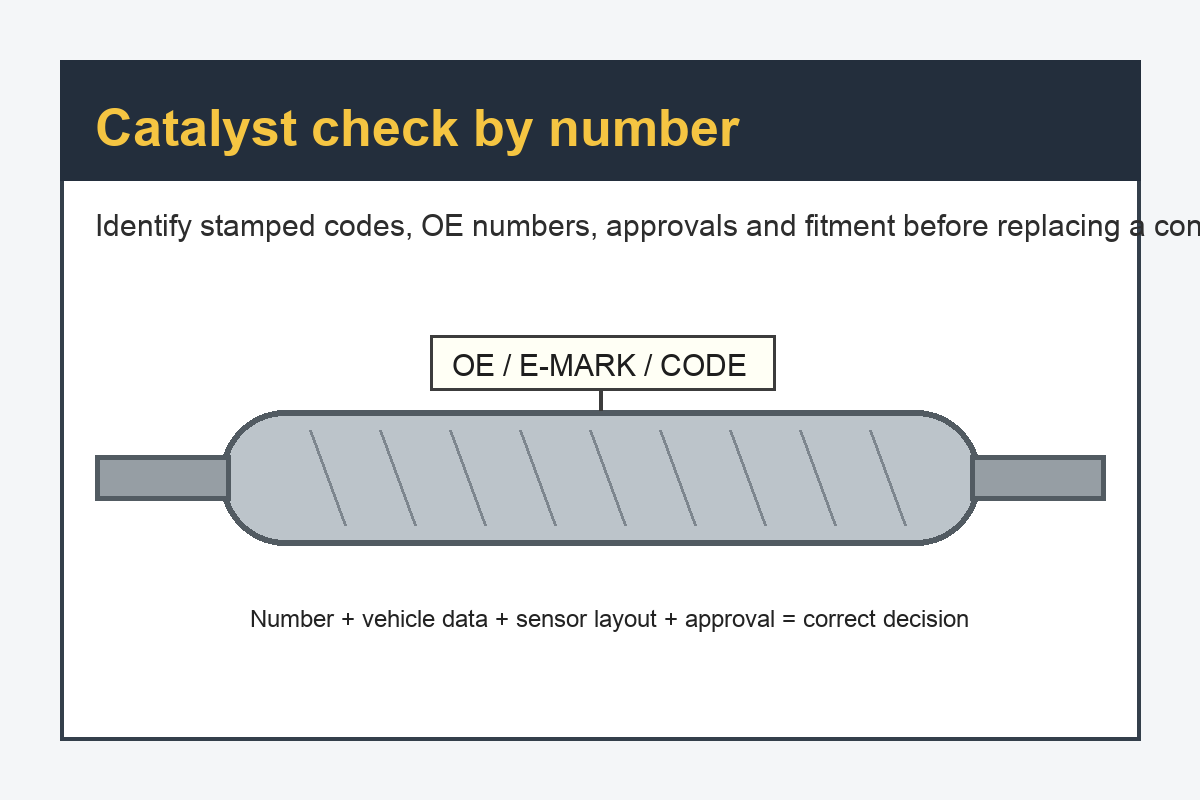
A Catalyst check by number can involve several different markings. An OE number usually links the converter to the vehicle manufacturer. An aftermarket code usually links it to a supplier catalogue. An E-mark or type approval number proves that the part was approved under a specific regulation. A precious metal recycler code may only identify scrap value and not vehicle fitment. Treat each marking differently.
| Marking type | What it may tell you | What it cannot prove alone |
|---|---|---|
| OE part number | Original vehicle application, engine family, exhaust section | Condition, sensor function, legal suitability in every market |
| Aftermarket catalogue code | Replacement brand, cross-reference, body style | Exact vehicle match without catalogue confirmation |
| E-mark or approval number | Regulatory approval family | That it belongs on your exact car |
| Scrap or recycler number | Material category or buying reference | Fitment, emissions standard, quality |
| Engine or platform note | Possible donor vehicle clue | Complete compatibility |
The basic information you need before checking
Before starting a Catalyst check by number, collect the VIN, registration year, engine code, fuel type, transmission type, emission standard, and whether the vehicle has one or two oxygen sensors around the converter. Diesel vehicles may also have a diesel oxidation catalyst, DPF, NOx trap, SCR catalyst, AdBlue system, exhaust temperature sensors, and pressure pipes. Petrol vehicles usually rely on upstream and downstream lambda sensors to monitor converter efficiency.
Do not skip the engine code. Two cars with the same model name and year can use different exhaust parts because one has Euro 4 and another has Euro 5, one is automatic and another manual, or one uses a close-coupled manifold catalyst while another uses an underfloor catalyst. A visual match is not enough when the pipe angle, bracket, flex joint, flange, or sensor boss differs by a few millimetres.
Clean the code without damaging evidence
Use a nylon brush, degreaser, and light to reveal the code. Avoid grinding, sanding, or aggressive wire wheels that erase weak stampings. Photograph the code from several angles. If the shell is rusty, chalk or marker around the stamped area can make the characters easier to read. For a reliable Catalyst check by number, record uncertain characters with alternatives, for example 8/B, 0/O, 5/S, and 1/I.
Step-by-step catalyst identification
The first step is to separate identification from diagnosis. A Catalyst check by number tells you what the part is supposed to be. It does not prove that the catalyst is chemically alive, not melted, not empty, and not contaminated. Once the identity is clear, you still need condition checks if the car has warning lights, failed emissions, rattling, sulfur smell, poor power, or fault codes.
- Write down the vehicle VIN, engine code, year, fuel type, and emission standard from the vehicle label or documents.
- Photograph every catalyst marking, including stamped numbers, labels, E-marks, arrows, and manufacturer logos.
- Compare the number with OE catalogues, brand catalogues, dealer parts systems, or approved converter databases.
- Check the physical layout: manifold or underfloor position, pipe length, flanges, flex section, brackets, and sensor bosses.
- Confirm the oxygen sensor count and position. A converter with the wrong sensor layout may fit badly or fail monitoring.
- Inspect condition: dents, welded repairs, cut marks, rattles, broken substrate, heat damage, missing shields, and leaks.
- Use scan data and emissions results to decide whether the identified part is also functioning correctly.
At this point, Catalyst check by number should leave you with either a confirmed application or a clear reason to reject the part before money changes hands.
Cross-reference checks and common traps
A good Catalyst check by number uses cross-reference data carefully. Many aftermarket catalogues show that one replacement can cover several OE numbers, but the reverse is not always true. A cheap online listing may copy every compatible model from a catalogue without respecting engine code or emissions level. If the listing says it fits every engine in a model range, be suspicious.
Another trap is confusing the manifold, front pipe, flex pipe, catalyst, DPF, and resonator. Sellers may call any exhaust section a cat. On some engines the catalyst is built into the exhaust manifold; on others it is a separate canister under the car. Diesel exhaust systems may have several emissions components in a row. A number stamped on one canister does not automatically identify the next one.
| Trap | Why it happens | How to avoid it |
|---|---|---|
| Wrong engine code | Same model name, different engine family | Confirm engine code before ordering |
| Wrong emissions standard | Euro 4, Euro 5, Euro 6 or federal/CARB differences | Match approval and vehicle market |
| Sensor boss mismatch | One part has different lambda positions | Count and locate sensors before purchase |
| Universal cat sold as direct fit | Body can be welded into many systems | Check flanges, length, brackets, and legality |
| Scrap code mistaken for part number | Recycler references are common online | Verify through parts catalogues, not scrap lists only |
When catalogues disagree, repeat Catalyst check by number with the full vehicle data instead of forcing the closest result to fit.
How OBD faults connect to the number check
Many people begin a Catalyst check by number after seeing a check engine light. The common catalyst efficiency codes are P0420 for bank 1 and P0430 for bank 2. They do not automatically mean the catalytic converter is the only bad part. Exhaust leaks, lazy oxygen sensors, fuel trim problems, misfires, oil burning, coolant contamination, and software issues can all make a good catalyst look bad to the ECU.
If your scan tool shows a module response such as 07E8 while reading engine data, our 07E8 code / 07E8 engine code guide explains why that label is not the fault itself. For scan-tool communication basics, the OBD2 protocol list helps when a reader connects poorly or shows confusing module names. If the driver only sees a dashboard lamp, the Dacia Duster warning lights guide shows the same principle: the light tells you where to start, not which part to throw away.
Live data that supports catalyst diagnosis
After a Catalyst check by number confirms the part is correct, live data can show whether it works. On a warm petrol engine in closed loop, the upstream oxygen sensor usually switches actively while the downstream sensor should be steadier if the catalyst stores oxygen properly. If both sensors mirror each other closely after warm-up, the converter may be weak, empty, cold, or affected by an exhaust leak. Fuel trims also matter. A rich or lean engine can ruin the test.
Temperature and pressure clues
A severely blocked converter can create poor acceleration, high exhaust backpressure, heat under the floor, and a glowing shell. A failed or empty converter can pass flow but fail emissions. Infrared temperature checks before and after the catalyst can help, but they are not a complete proof because load, airflow, and sensor position change readings. Backpressure testing is better when blockage is suspected.
Used catalytic converters: what to inspect
A used part makes a Catalyst check by number even more important. Confirm that the shell has not been cut open and welded shut. Shake it gently; a rattling ceramic brick usually means damage. Look for dents that may crush the substrate. Check the flange faces for warping and broken studs. Inspect sensor threads. A converter with a correct number but broken internals is still a bad buy.
Ask why the donor vehicle was dismantled. If the engine failed from oil burning, head gasket damage, misfire, or rich running, the catalyst may be contaminated even if it looks clean. Oil ash and coolant additives can coat the substrate and reduce efficiency. A converter removed from a crashed rear-end vehicle is usually less suspicious than one removed from a car with months of misfire faults.
| Used part check | Good sign | Bad sign |
|---|---|---|
| Stamped number | Clear, consistent with catalogues | Ground off, missing, inconsistent, or unreadable |
| Shell condition | No dents, no cut lines, no fresh welds | Crushed body, split seams, welded patch |
| Internal substrate | No rattle, no loose dust at ends | Rattle, ceramic pieces, empty sound |
| Sensor threads | Clean bosses, undamaged threads | Cross-threaded, welded plugs, broken sensors |
| Approval mark | Visible and suitable for the market | Missing or incompatible approval |
A careful Catalyst check by number can save a used converter from being blamed unfairly, but it can also stop a worn part from being installed just because the code looks promising.
Aftermarket and universal catalysts
An aftermarket Catalyst check by number should confirm both fitment and approval. Direct-fit converters are designed to bolt into a specific exhaust position. Universal converters require cutting and welding, and their legality depends on application, emissions standard, and local rules. A universal body with the right pipe diameter is not automatically legal or effective on a modern monitored system.
Check whether the replacement supports the vehicle’s emission certification. Some markets require specific approved converters for specific vehicles. Some diesel systems are integrated with temperature sensors, pressure pipes, DPF regeneration strategy, or SCR dosing. Installing a generic part can create new fault codes even if the exhaust becomes quiet and physically sealed.
For aftermarket parts, Catalyst check by number should always include the brand catalogue reference and the approval document, not only the seller listing.
Why cheap converters fail quickly
Low-cost units may contain less precious metal loading, weaker substrate, poor welds, thin flanges, or wrong internal volume. They may work for a short time and then trigger efficiency codes. If the original failure was caused by misfire, oil burning, coolant contamination, or rich running, even a quality converter can fail early unless the engine fault is fixed first.
Legal and inspection considerations
A Catalyst check by number is also a legal check. Removing, gutting, or replacing a converter with a non-approved part can fail inspection and may violate emissions laws. Some regions inspect the physical presence and approval number; others rely on OBD readiness monitors and tailpipe emissions. Many use both. If the converter number does not match the vehicle application, the car may fail even with no warning light.
Never rely on a seller’s promise that a part is road legal. Ask for the manufacturer, part number, approval reference, and application list. Keep the invoice and documentation. If the vehicle is modified, imported, engine-swapped, or used for competition, rules can become more complicated. A workshop that understands local inspection law is worth paying for before the exhaust is welded.
If an inspector questions the part, a documented Catalyst check by number gives you a much stronger answer than a receipt with a vague description.
When the number matches but the car still fails
Sometimes a Catalyst check by number confirms the correct unit and the car still fails emissions. That is when the upstream causes must be tested. Misfires dump oxygen and unburned fuel into the catalyst. Rich running overheats and coats it. Oil burning leaves ash. Coolant leaks poison the substrate. Exhaust leaks pull fresh oxygen into the downstream sensor area and confuse the monitor.
Check pending and stored codes, fuel trims, misfire counters, oxygen sensor waveforms, coolant temperature, thermostat operation, intake leaks, exhaust leaks, and readiness status. A converter is the final cleaner in the system; it cannot compensate forever for an engine that is not running correctly. Replacing the catalyst without fixing the engine fault often leads to the same code returning after the drive cycle completes.
Workshop decision table
| Situation | Best next step | Do not do this first |
|---|---|---|
| Unknown used converter with visible number | Complete the number check, verify fitment and approval | Buy it because it looks the same |
| P0420 or P0430 only | Check leaks, sensors, trims, misfires, and catalyst data | Replace the converter immediately |
| Rattle inside catalyst | Inspect substrate damage and exhaust restriction | Ignore it until pieces block the exhaust |
| Failed emissions with no codes | Check readiness, fuel control, temperature, and tailpipe values | Assume the ECU would always set a code |
| Different approval mark | Confirm local inspection requirements | Weld it in and hope the inspector misses it |
The final workshop note is simple: Catalyst check by number identifies the part, while scan data and emissions testing judge whether the system is healthy.
FAQ
Can I identify every catalytic converter by the number?
No. A Catalyst check by number is powerful, but some markings are incomplete, damaged, aftermarket-only, or scrap references. You still need vehicle data, catalogue confirmation, and physical inspection.
Is an OE number better than an aftermarket number?
An OE number usually gives the clearest original application. An aftermarket number can still be valid if it comes from a reputable catalogue and the approval matches the vehicle and market.
Does a matching number prove the catalyst is good?
No. Catalyst check by number proves identity, not chemical condition. A correct converter can be melted, empty, contaminated, cracked, or too weak to pass emissions.
Can a bad oxygen sensor look like a bad catalyst?
Yes. A slow, biased, or incorrectly fitted oxygen sensor can mislead the ECU. Exhaust leaks and fuel trim faults can do the same. Test the system before condemning the converter.
Can I fit a universal catalytic converter?
Sometimes, but only if it is suitable for the engine, emissions standard, sensor layout, and local law. Universal fit does not automatically mean legal fit.
Why did the new catalyst fail again?
The engine may still have a misfire, rich mixture, oil burning, coolant contamination, exhaust leak, or incorrect sensor data. A new catalyst will not survive long if the upstream cause remains.
What photo should I send to a parts supplier?
For remote help, Catalyst check by number depends on clear evidence, so one blurred close-up is rarely enough.
Send the stamped number, full converter body, flanges, sensor bosses, vehicle VIN, engine code, registration year, and emission label if available. Clear photos prevent wrong parts.
Final advice before buying or fitting
Catalyst check by number should be treated as the first gate, not the entire diagnosis. If the number, vehicle data, approval mark, layout, and sensor positions all agree, you can move forward with more confidence. If one detail disagrees, pause and verify. Catalytic converters are expensive, legally sensitive, and easy to misidentify from poor photos.
The clean workflow is simple: identify the number, match the application, inspect condition, diagnose any engine or OBD faults, confirm legal approval, and only then buy or install. A final Catalyst check by number before payment is faster than removing the wrong exhaust section later. That process turns Catalyst check by number from a quick internet search into a proper workshop decision, which is exactly how you avoid wasting money on the wrong catalyst.