
PZ19 carburetor adjustment: a mechanic’s guide to clean idle, stronger throttle response and safe jetting
PZ19 carburetor adjustment starts with one rule: do not turn screws at random. The small PZ19 is used on many pit bikes, minibikes, small ATVs, horizontal-engine 50cc to 125cc motorcycles, children’s dirt bikes and utility machines, and it can make an engine feel either crisp or impossible depending on a few millimeters of cable slack, one dirty pilot jet, a leaking intake boot or a float level that is slightly wrong.
PZ19 carburetor adjustment is not just “set the idle screw and ride.” A good result means the engine starts without drama, idles hot and cold, accepts throttle without coughing, pulls cleanly through the middle, and does not run so lean that it overheats or so rich that it fouls plugs. On a small engine, the carburetor is not a decorative part. It is the meter that decides whether the bike feels alive or tired.
What the PZ19 actually controls
PZ19 carburetor adjustment involves several overlapping circuits. The idle screw controls how far the slide stays open at rest. The mixture screw fine-tunes the low-speed fuel or air balance, depending on the carb version. The pilot jet controls idle and very small throttle openings. The needle and needle jet shape the midrange. The main jet matters most at large throttle openings. The float height decides whether the carburetor has the correct fuel level available to all of those circuits.
That is why PZ19 carburetor adjustment can be frustrating when you try to fix everything with one screw. If the pilot jet is blocked, the mixture screw will not behave normally. If the throttle cable is tight, the idle screw becomes misleading. If the intake boot leaks, every setting looks lean. If the main jet is wrong, the engine may idle nicely and still fall on its face at full throttle.
Before touching the screws
The best PZ19 carburetor adjustment begins before the screwdriver comes out. Confirm that the engine has compression, correct valve clearance, a clean air filter, fresh fuel, a good spark plug, a sealed intake boot, a clean fuel tap and a free throttle cable. A carburetor cannot compensate for a weak engine or a blocked fuel line.
If the bike has been parked for months, assume the pilot jet is dirty. If it has an open foam filter, assume the previous owner may have changed jetting. If it has a louder exhaust, assume the mixture may need checking. If the engine only runs with the choke on, do not simply raise the idle; find the lean condition or blockage that is causing it.
| Pre-check | Why it matters | What good looks like | What to fix first |
|---|---|---|---|
| Throttle cable | A tight cable holds the slide open | Small free play at the grip | Adjust cable before idle speed |
| Air filter | Dirty or missing filter changes mixture | Clean, oiled if foam, properly seated | Service filter before jetting |
| Intake rubber | Air leaks create a lean idle | No cracks, clamps tight | Replace cracked boot |
| Fuel flow | Low flow mimics wrong jetting | Steady flow from tap and hose | Clean tank, tap and filter |
| Spark plug | Old plugs hide mixture clues | Correct heat range, clean electrode | Fit correct plug before testing |
Identify the screws on your PZ19
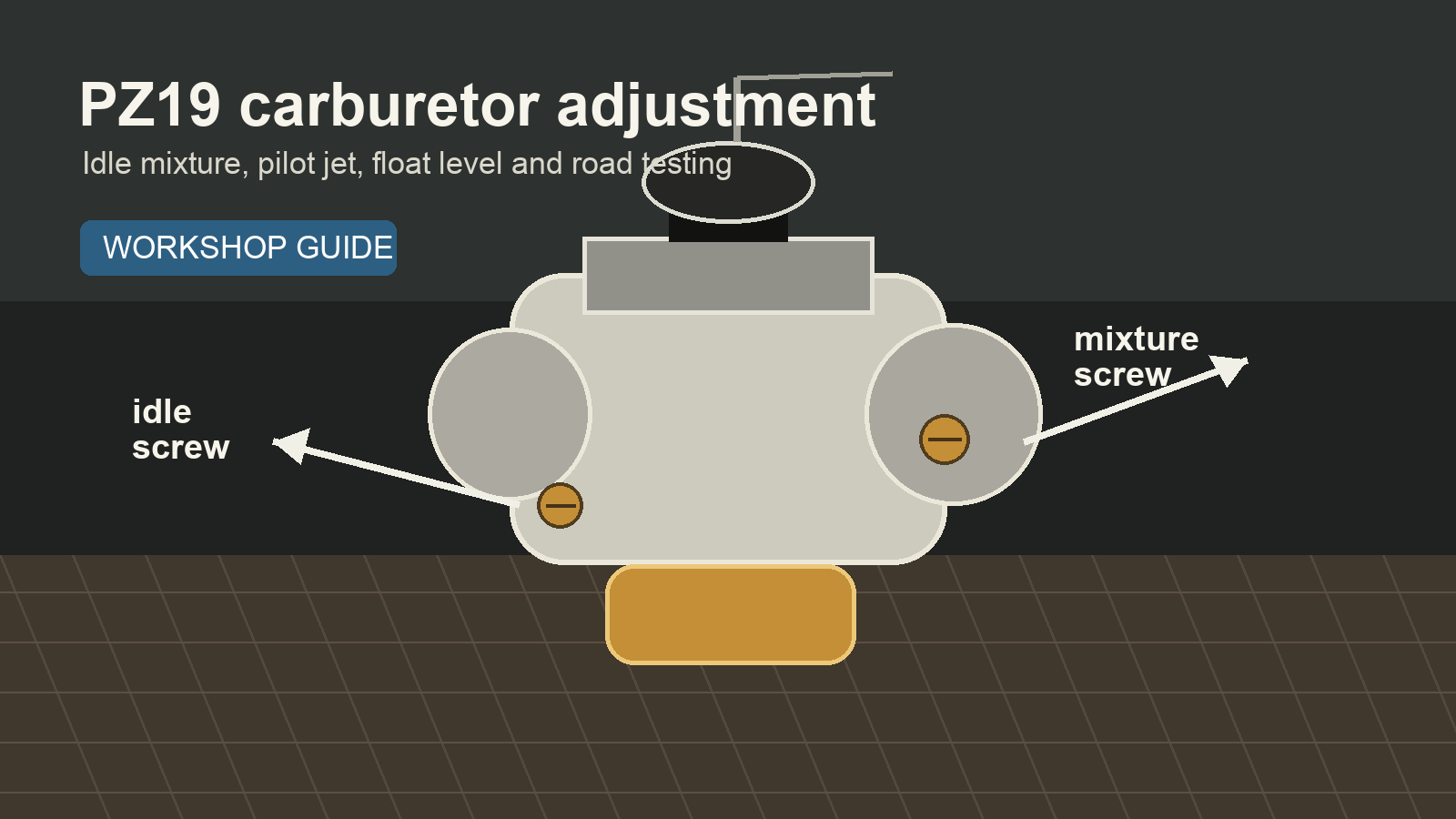
PZ19 carburetor adjustment depends on knowing which screw you are turning. The idle-speed screw normally presses on the slide or throttle stop. Turning it in raises idle because it lifts the slide. Turning it out lowers idle. The mixture screw is smaller and usually sits near the engine side or airbox side of the carb body. Its behavior depends on location.
If the mixture screw is on the engine side, it is commonly a fuel screw: turning it out adds fuel and turning it in reduces fuel. If the screw is on the air-filter side, it is commonly an air screw: turning it out adds air and turning it in reduces air. Many cheap replacement PZ19 carbs vary, so do not assume blindly. Watch the engine response and use small movements.
Idle screw
The idle screw is not a tuning cure. It only sets resting slide height. During PZ19 carburetor adjustment, use it to keep the engine running while you tune the mixture, then return to a sensible idle speed after the mixture is correct.
Mixture screw
The mixture screw should respond clearly. If turning it from half a turn to three turns does almost nothing, the pilot jet may be blocked, the passage may be dirty, the idle speed may be too high, or there may be an air leak. A healthy carburetor gives a noticeable change in rpm and smoothness.
Base setting for PZ19 carburetor adjustment
A practical base setting for PZ19 carburetor adjustment is to seat the mixture screw gently, then back it out around one and a half turns. Do not tighten it hard. The tip can be damaged. Set the idle screw so the engine will start and keep running. Warm the engine completely before final tuning because a cold engine lies.
Once warm, turn the mixture screw slowly in one-quarter-turn steps. Pause after each movement. Find the position where idle is highest and smoothest. Then use the idle screw to bring rpm back down. Repeat the mixture adjustment once more. The final setting should give a stable idle and clean response when the throttle is snapped open lightly.
| Step | Action | What you are listening for | If it goes wrong |
|---|---|---|---|
| 1 | Warm engine fully | Stable temperature and no choke needed | Fix choke, pilot or air leak first |
| 2 | Set mixture screw to base | Engine starts and idles | Clean pilot circuit if it will not run |
| 3 | Turn screw slowly | Highest, smoothest idle | No change means blockage or wrong circuit |
| 4 | Reset idle speed | Low but steady idle | Too high masks mixture setting |
| 5 | Blip throttle lightly | Clean pick-up without cough | Investigate lean or rich pilot area |
Reading lean and rich symptoms
PZ19 carburetor adjustment becomes easier when you stop using vague words like “bad” and start separating lean from rich. A lean engine may need choke to run, hang at high idle, cough through the intake, surge at steady throttle, run hot or show a very pale plug. A rich engine may smell of fuel, respond dullly, smoke, foul plugs, stumble when opened and leave sooty deposits.
Do not diagnose from one symptom alone. An exhaust leak can sound like lean popping. A weak ignition can look like rich misfire. A dirty air filter can hide a lean pilot. The point of PZ19 carburetor adjustment is to build evidence: throttle position, temperature, plug color, fuel smell, sound, and road behavior.
| Throttle area | Main circuit involved | Lean clue | Rich clue |
|---|---|---|---|
| Idle to 1/8 | Pilot jet and mixture screw | Needs choke, hanging idle | Blubbery idle, fuel smell |
| 1/8 to 1/2 | Needle position | Flat response, intake cough | Heavy midrange, sooty plug |
| 1/2 to full | Main jet | Surging, heat, weak top end | Won’t rev cleanly, dark plug |
| All positions | Float level and fuel flow | Starves after long pull | Overflow or wet plug |
Cleaning the pilot jet properly
Most failed PZ19 carburetor adjustment attempts are actually dirty pilot-jet problems. The pilot jet has a tiny hole. If old fuel dries inside it, the engine may only run with choke, idle poorly, or die when the throttle closes. Spraying cleaner into the float bowl is not the same as cleaning the jet.
Remove the carburetor, take off the float bowl, unscrew the pilot jet with a good screwdriver and hold it to the light. Use carb cleaner and compressed air. Do not enlarge it with a hard steel wire. If you must use a strand, use something softer and only to clear varnish, not to modify the size. Reassemble with clean gaskets and check for leaks before tuning again.
Float height and fuel level
PZ19 carburetor adjustment will never stay consistent if the float level is wrong. Too high, and the engine may run rich, leak fuel or flood when parked. Too low, and it may idle acceptably but starve under load. The float needle also wears, and a worn needle can make a perfectly jetted carburetor behave like a mess.
Inspect the float for cracks, fuel inside the float, bent tangs and dirt under the needle seat. Set the height according to the carburetor supplier’s specification if available. If no reliable specification exists, compare carefully with the old setting before changing it and test in small steps. Float work is delicate; one heavy-handed bend can create two new problems.
Choosing jets without guessing wildly
PZ19 carburetor adjustment sometimes requires jet changes, especially after an exhaust, open filter or big-bore change. The pilot jet handles starting and low throttle. The main jet protects the engine at high load. The needle position tunes the middle. Move one area at a time, then test. Changing pilot, needle and main together makes it impossible to know what helped.
If the mixture screw ends up less than half a turn out or more than about three turns out, the pilot jet size may be wrong or the carb may have a fault. If wide-open throttle is weak or hot, inspect the main jet and fuel supply. If midrange hesitates, look at needle height, air leaks and exhaust changes. Good PZ19 carburetor adjustment is patient, not dramatic.
| Change made to bike | Likely carb area to revisit | Common mistake | Better method |
|---|---|---|---|
| Open foam filter | Pilot, needle and main | Assuming only main jet changes | Test all throttle areas |
| Louder exhaust | Needle and main, sometimes pilot | Judging by sound only | Read plug and road behavior |
| Big-bore kit | All circuits | Keeping stock jetting | Start safely rich, tune down carefully |
| High altitude | Main and needle | Using sea-level jet advice | Jet for actual riding location |
| Cold weather | Pilot and starting circuit | Opening idle too far | Check choke and pilot circuit |
Throttle cable and slide position
PZ19 carburetor adjustment also includes cable setup. If the cable has no free play, the slide may not return fully and the engine will idle high. If there is too much free play, throttle response feels delayed. Turn the handlebar from lock to lock while the engine idles. If rpm changes, the cable routing or adjustment is wrong.
Remove the slide cap and inspect the slide orientation. Some small carburetors allow incorrect assembly if someone is careless. The cutaway must face the correct direction, the needle clip must be seated, and the spring must return the slide cleanly. A sticky slide is a safety issue, not just a tuning annoyance.
Road testing after PZ19 carburetor adjustment
PZ19 carburetor adjustment should end with a road test in the real range where the bike is used. Warm the engine, ride gently at small throttle, cruise at steady mid-throttle, then perform a safe full-throttle pull if the machine and location allow it. Note exactly where the engine hesitates: off idle, midrange, or top end.
After the test, let the engine cool and inspect the plug, fuel leaks, intake clamps and idle behavior. For plug reading, use a fresh plug if possible and do not rely only on idling in the garage. NGK’s official spark plug information is a useful reference for understanding deposit patterns, and a general motorcycle inspection checklist such as the MSF T-CLOCS sheet helps keep carb work connected to the whole machine: NGK spark plug reading guide and MSF T-CLOCS inspection checklist.
Common mistakes
The first mistake in PZ19 carburetor adjustment is using the idle screw to hide a blocked pilot jet. The second is opening the air filter and leaving the jetting untouched. The third is chasing main jets when the problem occurs at one-eighth throttle. The fourth is ignoring intake leaks. The fifth is making five changes and then wondering which one worked.
Another common error is tuning while the engine is cold. Choke and enrichment circuits are there because cold engines need a richer mixture. If you tune around cold behavior, the bike may run poorly when hot. Do the rough setting cold only to start the engine. Do the real PZ19 carburetor adjustment after the cylinder head and intake tract have warmed up.
When adjustment is not enough
PZ19 carburetor adjustment cannot save a carburetor with a warped flange, missing O-ring, damaged mixture-screw tip, worn slide or loose choke plunger. If every setting changes after one ride, stop tuning and inspect the hardware. PZ19 carburetor adjustment should be repeatable: same warm engine, same screw position, same idle quality. When it is not repeatable, the problem is mechanical. PZ19 carburetor adjustment comes after repair, not before it.
Internal guides for deeper carb and small-bike work
If you are working with a larger version of the same family, read the PZ27 carburetor manual because the circuit logic is similar even when jet sizes differ. For a bigger small-engine carb, compare the PZ30 carburetor manual before copying settings. When reinstalling manifolds, clamps and engine parts, our motorcycle bolt torque specs guide helps avoid stripped threads on small engines.
FAQ
What is the starting point for PZ19 carburetor adjustment?
A sensible starting point is a clean carburetor, fresh fuel, no intake leaks, and the mixture screw around one and a half turns out from gently seated. Then warm the engine and tune for the highest smooth idle before resetting idle speed.
Why does my engine only run with the choke on?
That usually points to a lean condition: blocked pilot jet, air leak, low fuel level or wrong pilot setting. PZ19 carburetor adjustment cannot be finished until the pilot circuit is clean and the intake is sealed.
Should I change the main jet first?
Only if the problem is at large throttle openings or you have changed airflow significantly. If the bike will not idle or hesitates just off idle, start with pilot circuit, mixture screw, intake leaks and cable setup.
How do I know if the mixture is too rich?
Rich symptoms include dull throttle response, fuel smell, black plug deposits, smoke and stumbling when the throttle opens. Confirm with plug reading and road behavior rather than one symptom alone.
Can PZ19 carburetor adjustment fix a worn engine?
No. It can make a healthy engine run correctly, but it cannot repair low compression, tight valves, weak spark, worn rings or dragging brakes. Check the machine before blaming the carburetor.
How often should I clean a PZ19 carburetor?
Clean it whenever old fuel has sat in the bike, when the pilot circuit stops responding, or when dirt reaches the bowl. With clean fuel and regular use, it should not need constant disassembly.
Final mechanic’s view
PZ19 carburetor adjustment rewards patience. Start with a healthy engine, clean fuel, sealed intake, correct cable free play and a spotless pilot jet. Then tune the mixture screw in small steps, reset idle speed, test each throttle range and make only one change at a time.
For a workshop note, mark the final screw position on paper, not on memory. Write down the pilot jet, main jet, needle clip, plug type, air filter and exhaust. The next time the weather changes or the bike starts badly after storage, those notes will tell you whether you are diagnosing a new fault or repeating an old setting.
A well-set PZ19 will not turn a small pit bike or 110cc commuter into a race machine, but it will make the engine start easier, idle cleaner, pull better and last longer. That is the real goal of PZ19 carburetor adjustment: not noise, not guesswork, but a small engine that finally feels mechanically honest.