
PZ27 carburetor manual: setup, cleaning, jetting and troubleshooting guide
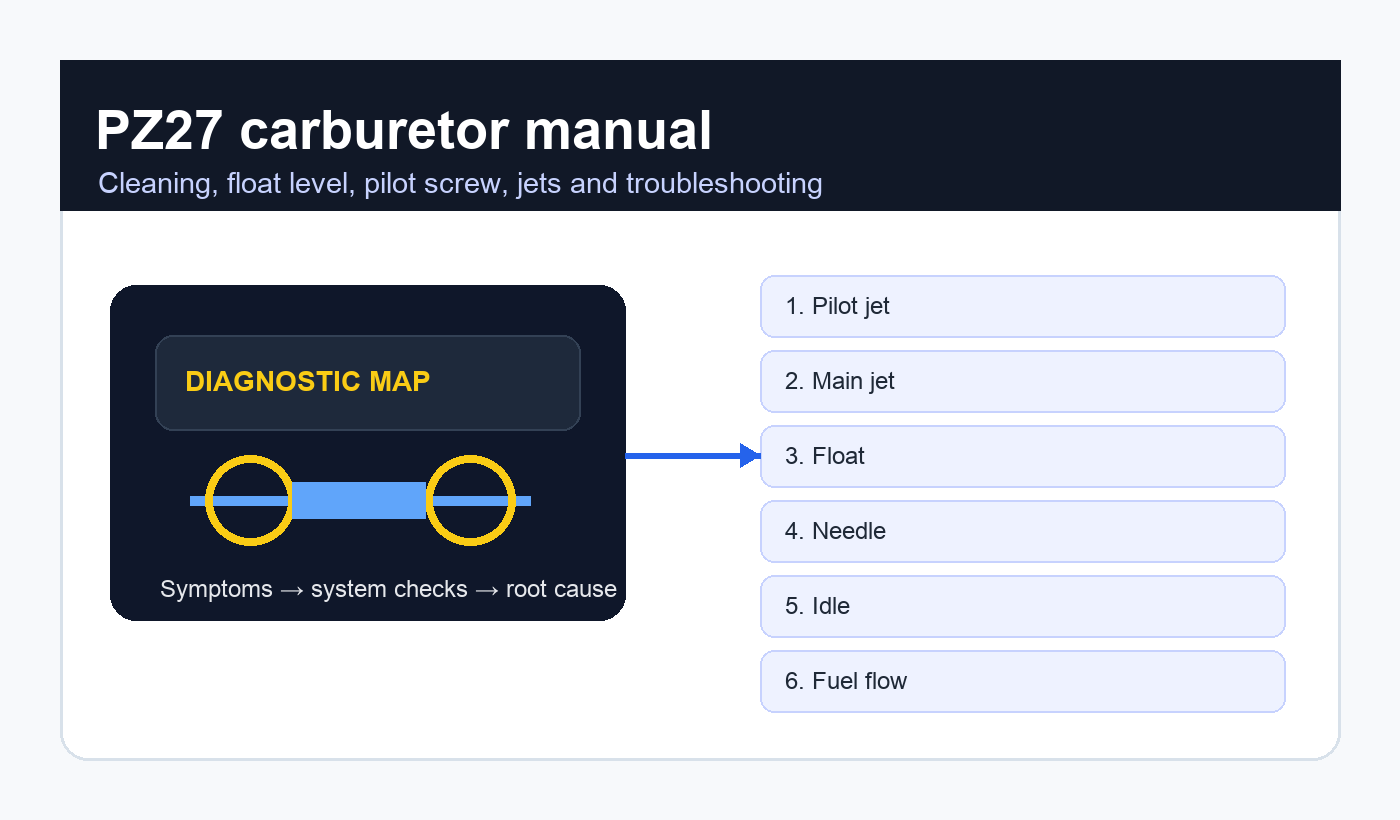
PZ27 carburetor manual guidance is useful when a small motorcycle, pit bike, ATV, quad, scooter or utility engine starts poorly, idles unevenly, bogs when the throttle opens or runs too rich after an exhaust or air-filter change. The PZ27 is a simple round-slide style carburetor used on many small-displacement four-stroke engines, often in the 125cc to 250cc range depending on the engine, manifold, airbox and tuning. It is not complicated, but it punishes guessing. A blocked pilot jet, wrong float height, cracked intake boot or badly adjusted mixture screw can make a good engine feel broken.
This PZ27 carburetor manual is written for a rider or mechanic who needs a practical workflow: identify the parts, clean the carburetor safely, set a baseline, understand rich and lean symptoms, choose jets carefully and know when the fault is not the carburetor at all. The goal is not to turn every engine into a race build. The goal is a bike that starts cleanly, idles reliably, pulls without hesitation and does not destroy spark plugs, valves or fuel economy because the mixture is wrong.
Before touching the screws, remember one rule: a carburetor only meters fuel correctly when the rest of the engine is healthy. Valve clearance, compression, ignition timing, spark plug condition, fuel flow, airbox sealing, intake-manifold condition and exhaust leaks all matter. Many frustrating cases blamed on carburetion are really weak ignition, tight valves, old fuel or an air leak downstream of the carburetor.
What a PZ27 carburetor does
A carburetor mixes air and fuel by using airflow through a venturi to draw fuel from small calibrated passages. On a PZ27, the slide, needle, pilot circuit, main jet, float bowl and choke/enrichment system each control a different part of the ride. This PZ27 carburetor manual starts with that division because it prevents random adjustment. If the engine idles badly, the main jet is usually not the first suspect. If it only misfires at full throttle, the pilot screw is not the main answer.
The pilot circuit controls starting, idle and the first opening of the throttle. The needle and needle jet shape midrange response. The main jet controls high-throttle fuel flow. The float valve and float height control fuel level in the bowl, which affects every circuit. The choke or enrichment lever helps cold starting by adding fuel or changing airflow, depending on the specific version.
| Throttle area | Main carburetor part | Typical symptom if wrong | First thing to inspect |
|---|---|---|---|
| Cold start and idle | Pilot jet, mixture screw, choke | Hard start, hanging idle, stalling | Pilot jet cleanliness and air leaks |
| Small throttle | Pilot circuit and slide cutaway | Bog when leaving idle | Mixture screw and intake boot |
| Mid throttle | Needle position and needle jet | Flat response or rich burble | Needle clip and plug colour |
| Full throttle | Main jet and fuel supply | Weak top end or black smoke | Main jet size and fuel flow |
| All ranges | Float height and float valve | Overflow, richness or starvation | Float valve, seat and fuel level |
Safety before removal
Use this PZ27 carburetor manual with basic fuel safety in mind. Work outside or in a well-ventilated area, keep sparks and cigarettes away, wear eye protection, catch fuel in a safe container and dispose of old fuel responsibly. Carburetor cleaner is aggressive. It can damage paint, rubber, skin and eyes. Compressed air can blow debris back into your face if you are careless.
Turn the fuel tap off before removing the fuel hose. If the machine uses a vacuum petcock, clamp or drain the line carefully. Photograph the throttle cable routing, choke cable or lever position, fuel hose, overflow hose and vent hoses before removal. Many running problems after carburetor service are caused by a trapped cable, kinked fuel line or blocked bowl vent rather than anything inside the carburetor.
For general fuel-system caution and small-engine service principles, manufacturer service resources are useful. See Briggs & Stratton carburetor repair help and NGK spark plug reading guidance.
Identification and baseline checks
A practical PZ27 carburetor manual begins with identification. Many PZ-style carburetors look similar, and cheap replacements are not always identical internally. Check the spigot diameter, airbox-side diameter, throttle cable top, choke style, fuel inlet angle, idle screw location, mixture screw location, drain screw and jet markings. If the carburetor was bought online, do not assume the jets are correct for your engine.
Before disassembly, inspect the outside. Look for cracked rubber manifold, loose clamps, missing airbox boot, stripped screws, fuel stains around the overflow, damaged float bowl gasket and a slide that snaps shut cleanly. A sticky slide is dangerous because the throttle may not return. A cracked intake boot can create a lean condition no jet will fix.
Keep a small notebook beside the bench. A useful PZ27 carburetor manual record includes the main jet number, pilot jet number, needle clip position, mixture screw turns, float condition and the exact symptom before the carburetor was removed.
Use the existing Xmotoparts guides for nearby checks. The fuel color guide helps identify contaminated fuel. The motorcycle bolt torque specs article is useful when refitting small fasteners without stripping them. For a 125cc tuning context, compare the Yamaha TW 125 derestriction guide, which explains why carburetor changes must match the whole engine setup.
Tools and supplies
You do not need a race workshop to follow a PZ27 carburetor manual, but you do need the right small tools. Use JIS-style screwdrivers where possible because many carburetor screws are damaged by ordinary Phillips drivers. Have carburetor cleaner, compressed air, clean rags, nitrile gloves, a container for small parts, new fuel hose if the old one is hard, spare clamps, a spark plug, and a set of jets only if you are actually changing setup.
A soft copper wire can help clear a blocked passage, but never enlarge a jet with drills or hard wire. Jets meter fuel by precise hole size. Scratching or widening the hole changes the calibration and makes future diagnosis harder. If a jet will not clean properly, replace it.
| Item | Why it matters | Common mistake |
|---|---|---|
| Correct screwdriver | Prevents stripped bowl and top-cap screws | Using a poor Phillips bit |
| Carb cleaner | Dissolves varnish and fuel deposits | Spraying rubber parts carelessly |
| Compressed air | Clears passages after cleaner | Blowing debris into eyes |
| Clean tray | Keeps jets, screws and springs organized | Mixing parts or losing the mixture spring |
| Fresh fuel hose | Prevents leaks and flow restriction | Reusing cracked hardened hose |
Cleaning procedure
The cleaning part of this PZ27 carburetor manual should be slow and orderly. Remove the carburetor from the motorcycle, drain the float bowl and take off the bowl screws. Remove the main jet, pilot jet, float pin, float, float needle and mixture screw only after counting its current turns-in position. Write that number down. A typical baseline may be around one and a half to two turns out, but your carburetor and engine may differ.
Clean the float bowl, jets and passages. Spray cleaner through the pilot passage, main jet passage, choke circuit, fuel inlet and bowl vent. Follow with compressed air. Hold jets up to light; a clean pilot jet should show a clear round hole. The pilot jet is tiny, and even a small blockage can cause hard starting, poor idle and stalling.
Inspect the float needle tip. If it is grooved, swollen or dirty, fuel may overflow or the bowl level may become unstable. Check that the float moves freely and does not contain fuel inside it. Replace brittle gaskets. A leaking bowl gasket may look minor but can create fuel smell, fire risk and dirt entry.
Never rush reassembly after cleaning. The best PZ27 carburetor manual habit is to hold each jet to the light again, confirm the float pin is seated and make sure the bowl gasket has not twisted before the screws are tightened.
Float height and fuel level
No PZ27 carburetor manual is complete without float-level logic. Float height determines the fuel level in the bowl. Too high, and the engine may run rich, drip fuel, flood at idle or smell strongly of petrol. Too low, and the engine may starve at high throttle or hesitate after sustained load. Because PZ27 copies vary, use the specification for your exact carburetor if available. If not, compare carefully with the previous setting before changing anything.
When checking float height, hold the carburetor at the angle where the float tang just touches the needle without compressing the spring-loaded tip. Bend the tang only slightly. Large changes are a warning that something else may be wrong, such as the wrong needle, damaged seat, swollen float or incorrect replacement parts.
Pilot screw and idle adjustment
The most useful part of a PZ27 carburetor manual for everyday riders is idle setup. Warm the engine fully before final adjustment. Set the idle speed screw so the engine runs without the rear wheel driving dangerously on the stand. Turn the mixture screw slowly in small steps and listen for the strongest, smoothest idle. Then adjust idle speed again if needed.
If the best setting is extremely far from the normal range, do not keep turning forever. A mixture screw that works best nearly closed may indicate a rich pilot circuit or too-large pilot jet. A mixture screw that wants to be many turns out may indicate a lean pilot circuit, blocked passage, air leak or too-small pilot jet. This is where patience beats guessing.
| Idle behaviour | Likely direction | What to check before changing jets |
|---|---|---|
| Hanging idle after revving | Often lean or air leak | Intake boot, clamps, pilot passage |
| Loads up and smells rich | Often rich or high fuel level | Choke, float needle, pilot jet size |
| Dies when throttle opens | Pilot transition issue | Mixture screw, pilot jet, slide needle |
| Idle changes when sprayed near boot | Air leak likely | Replace cracked manifold or gasket |
Main jet and needle tuning
This PZ27 carburetor manual treats jetting as measured adjustment, not guesswork. Change only one thing at a time. If you install a freer-flowing air filter or exhaust, the engine may need more fuel, but it may also become noisier without meaningful power gain. Start from a clean carburetor, fresh plug, correct valve clearance and no air leaks before changing jets.
The needle clip affects midrange. Moving the clip down usually raises the needle and richens the midrange. Moving the clip up lowers the needle and leans the midrange. The main jet affects larger throttle openings. If the bike pulls cleanly at small throttle but falls flat near wide-open throttle, inspect fuel flow, main jet size, tank venting and plug reading.
Do not tune by sound alone. A lean engine may feel crisp briefly and then overheat. A rich engine may feel safe but foul plugs, wash oil from the cylinder wall and waste fuel. Plug reading, throttle-position awareness and controlled testing are better than random jet swaps.
If you change the needle clip, write it down. A disciplined PZ27 carburetor manual approach avoids making a midrange change and a main jet change at the same time, because the test ride will no longer tell you which part improved or worsened the engine.
Rich and lean symptoms
A rider using a PZ27 carburetor manual needs to recognize mixture direction. Rich means too much fuel or not enough air. Lean means too much air or not enough fuel. Both can cause poor running, but they feel different. Rich often gives black plug colour, fuel smell, muffled response and smoke. Lean often gives hanging idle, surging, heat, popping through the intake or exhaust and hesitation when opening the throttle.
Be careful with exhaust popping. A lean pilot circuit can cause popping on deceleration, but so can an exhaust leak. A dirty air filter can create richness, but so can a stuck choke. A blocked tank cap vent can feel like a main jet problem after a few minutes of riding. Diagnosis is a chain, not a single guess.
Use this PZ27 carburetor manual with engine temperature in mind. A cold engine can lie to you, because choke use, cold oil and poor fuel vaporization can hide the real warm-running mixture.
Common installation mistakes
Many problems after following a PZ27 carburetor manual come from refitting, not cleaning. The throttle slide can be installed incorrectly on some carburetors. The needle clip can fall out of position. The top cap can pinch the cable. The manifold clamp can sit crooked. The airbox boot can leak. Vent hoses can be routed upward or blocked. The fuel hose can kink when the tank is lowered.
After installation, twist the throttle fully and release it several times before starting. It must snap shut every time. Check for fuel leaks with the tap on. Start the engine without revving it hard immediately. Let it warm, then adjust idle. Test ride gently before full-throttle runs.
A final PZ27 carburetor manual safety check is simple: bars turned left, bars straight, bars turned right, throttle opened and released each time. If rpm changes with steering movement, fix the cable routing before riding.
When the carburetor is not the fault
A good PZ27 carburetor manual should save you from blaming the carburetor for everything. Tight intake valves can cause hard starting and poor idle. Weak compression can make jetting impossible. A bad coil, plug cap or stator can mimic fuel starvation. A blocked exhaust can kill top-end power. A leaking intake manifold can make every pilot adjustment fail.
If the engine needs choke when hot, check for lean conditions or air leaks. If it only runs with the choke on, inspect the pilot jet, fuel flow and intake boot. If it fouls plugs repeatedly, inspect choke operation, float level and ignition strength. If it runs well for two minutes then dies, check tank venting and fuel flow before changing jets.
Before blaming the carburetor again, use the PZ27 carburetor manual checklist alongside compression, spark and valve checks. Fuel mixture cannot compensate for an engine that cannot seal, ignite or breathe correctly.
Baseline setup checklist
Use this PZ27 carburetor manual checklist before calling the job finished. The fuel tank should contain fresh fuel. The filter should flow freely. The intake boot should be sealed. The air filter should be clean and fitted. The spark plug should be correct and not fouled. The throttle should snap shut. The idle should be stable when warm. The engine should accept small throttle openings without coughing. There should be no fuel overflow and no hanging idle.
A printed PZ27 carburetor manual checklist on the bench can prevent the two most common mistakes: forgetting the original screw setting and refitting the carburetor before confirming that every passage is clear.
| Final check | Pass condition | If it fails |
|---|---|---|
| Cold start | Starts with appropriate choke/enrichment | Inspect pilot circuit and valve clearance |
| Warm idle | Stable without throttle | Adjust mixture and check air leaks |
| Throttle return | Slide closes instantly | Reroute cable or inspect slide |
| Full-throttle pull | Clean acceleration under load | Check main jet, fuel flow and plug |
| Fuel tightness | No dripping or smell | Check float needle, bowl gasket and hoses |
FAQ
What engine size is a PZ27 carburetor for?
A PZ27 is commonly used on small four-stroke engines, often around 125cc to 250cc depending on the motorcycle, intake, exhaust and tune. This PZ27 carburetor manual cannot replace the specification for your exact engine, so always compare physical fit and jetting baseline.
How many turns out should the mixture screw be?
Many setups begin around one and a half to two turns out, but that is only a starting point. A proper PZ27 carburetor manual adjustment is done warm, in small steps, while listening for the strongest idle and checking for air leaks.
Why does fuel leak from the overflow?
Overflow usually means the float needle is dirty, worn, stuck or the float level is too high. It can also happen if debris from the tank reaches the carburetor. Stop riding until the leak is fixed; fuel leakage is a fire risk.
Should I fit a bigger main jet after an exhaust?
Maybe, but do not guess. Use this PZ27 carburetor manual approach: clean the carburetor, verify the engine is healthy, test the current setup, read the plug and change one step at a time only if symptoms justify it.
Final advice
PZ27 carburetor manual work rewards patience. Clean passages, correct float level, sealed intake rubber and careful idle adjustment usually matter more than dramatic jet changes. If the engine was running well before storage, start with old fuel and pilot blockage. If the problem appeared after fitting an open filter or exhaust, inspect mixture and air leaks. If the carburetor has never worked well, verify that it is the correct size and style for the engine.
A PZ27 is simple enough to service at home, but it is precise enough that careless work creates new faults. Keep notes, change one thing at a time and test under real load, not only on the stand. Used properly, this PZ27 carburetor manual should help you get back to a stable idle, clean throttle response and safer riding without replacing half the engine by guesswork.
The best result from a PZ27 carburetor manual is not a perfect-looking parts layout on the bench. It is a machine that starts predictably, warms cleanly, responds to throttle and returns home without leaks, smells or surprises.