
Honda Vision 110 problems: practical owner guide for symptoms, checks and used buying
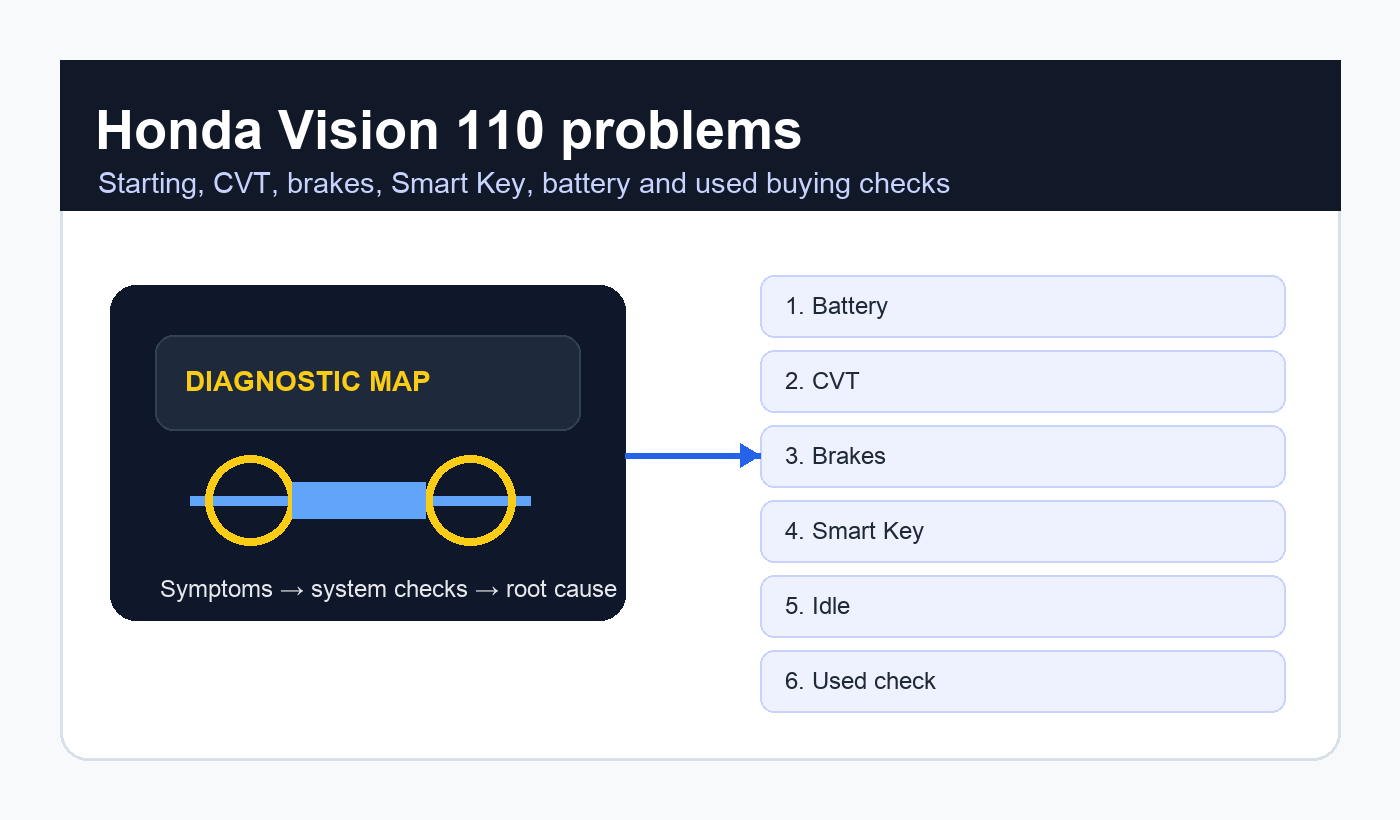
Honda Vision 110 problems are usually not dramatic engine failures. The Vision 110 is a simple, light, fuel-injected city scooter with an air-cooled single-cylinder engine, automatic CVT transmission, modest running costs and the kind of everyday reliability that made small Hondas popular in Europe. When trouble appears, it is often caused by battery weakness, neglected CVT service, old fuel, brake wear, tyre condition, Smart Key habits, charging faults, intake leaks, valve-clearance neglect or rough city use rather than a fundamentally fragile design.
That is good news for owners and used buyers. Most Honda Vision 110 problems can be sorted by methodical inspection instead of random parts replacement. A scooter that starts slowly, hesitates away from traffic lights, vibrates through the floorboard or feels weak uphill is asking for a basic health check before anyone blames the ECU, fuel injector or engine. The correct order is simple: battery, fuel, air filter, spark plug, valve clearance, CVT belt, rollers, clutch, brakes, tyres and service history.
This guide is written for the rider standing beside a scooter, not for a workshop fantasy. It explains the common symptoms, what they usually mean, what you can check at home, when a mechanic is the better choice and how to judge a used Vision 110 before buying. It also separates normal small-scooter behaviour from real Honda Vision 110 problems, because a 110cc commuter will never accelerate like a maxi scooter or climb hills like a 300cc machine.
Quick verdict before you start diagnosing
The Vision 110 is generally a dependable scooter when maintained on time. Its engine is low-stressed, its CVT is conventional, its fuel injection is simple and its chassis is built for short trips, school runs, delivery errands and low-cost commuting. The most common Honda Vision 110 problems come from the same environment that makes the scooter useful: repeated cold starts, short journeys, traffic heat, potholes, rain, parked-outside corrosion and riders who postpone small services because the scooter “still runs.”
A healthy Vision should start quickly, idle cleanly, pull away smoothly, hold a steady indicated speed for its size and stop without pulsing, grinding or wandering. It should not smell strongly of fuel, flatten batteries every few days, rattle loudly from the CVT cover, stall repeatedly at junctions or shake violently when the clutch engages. Those symptoms deserve attention.
| Symptom | Most likely area | First check | Urgency |
|---|---|---|---|
| Slow cranking or no start | Battery, terminals, starter relay | Load-test battery and clean terminals | High if used daily |
| Stalls when hot | Idle control, valve clearance, fuel quality | Check service history and idle behaviour | Medium to high |
| Judder on take-off | CVT clutch, belt dust, glazed shoes | Inspect variator and clutch | Medium |
| Weak acceleration | Belt, rollers, air filter, plug | Baseline service before tuning | Medium |
| Brake noise or long stopping distance | Pads, disc, rear drum, CBS adjustment | Inspect friction material and cable/free play | High |
Starting and battery trouble
Many Honda Vision 110 problems begin with a weak battery. A small scooter battery can look fine after charging and still collapse under load. Short trips are hard on it because the starter takes energy every ride while the charging system has little time to recover it. Add cold weather, an alarm, phone charging, Smart Key use or old terminals and the scooter may crank slowly or refuse to wake up.
Start with the basics. Check battery age, resting voltage, voltage while cranking and charging voltage once the engine runs. Clean the terminals, inspect the ground strap and make sure the battery is the correct type and size. If the lights dim heavily when pressing the starter, do not immediately replace the starter motor. A load test is cheaper and more honest.
On Smart Key models, rider habits matter. Keeping the key near the scooter in a garage can sometimes create confusion or unnecessary battery use depending on the situation. A low key-fob battery can also mimic larger Honda Vision 110 problems because the scooter may not recognize the key reliably. Replace the fob battery before chasing immobilizer faults.
Idle Stop, stalling and rough idle
Some later Vision models use idle-stop technology. When everything is healthy, the system shuts the engine off at a standstill and restarts smoothly when the rider opens the throttle. When battery condition, switch inputs or idle quality are poor, riders may mistake normal system behaviour for Honda Vision 110 problems. The first step is to understand whether the scooter is stopping because the system is doing its job or because the engine is actually stalling.
A true stall feels different. The engine may die unpredictably, restart reluctantly, stumble when hot or need throttle to keep running. Common causes include tight valve clearance, dirty air filter, weak spark plug, intake leak, stale fuel, poor battery voltage or a throttle body that needs inspection. Do not adjust random screws unless the manual calls for it; fuel-injected scooters need measured diagnosis.
If the scooter has been used only for very short trips, give it a proper service before condemning electronics. A fresh plug, clean filter, correct valve clearance and healthy battery solve many rough-running complaints. If stalling continues, scan for fault codes and let a competent shop inspect sensor data, fuel pressure and wiring connectors.
CVT belt, rollers and clutch judder
Automatic transmission complaints are among the most common Honda Vision 110 problems because riders feel them every time the scooter leaves a traffic light. The CVT uses a belt, variator, rollers, clutch shoes and rear pulley to change ratio automatically. Dust, glazing, worn rollers or an old belt can make take-off jerky, noisy or weak.
Judder from a stop often points toward clutch glazing or belt dust. A flat spot in acceleration can come from worn rollers. A scooter that revs higher than usual but does not gain speed may have belt or pulley trouble. A scooter that feels lazy uphill may simply need a CVT service, especially if the belt has exceeded its interval or unknown aftermarket parts were fitted.
| CVT symptom | Possible cause | Owner-safe action | Workshop action |
|---|---|---|---|
| Shudder when pulling away | Glazed clutch shoes, belt dust | Avoid harsh launches until inspected | Clean/inspect clutch and bell |
| Rattling from cover | Rollers, guides, loose hardware | Stop riding if noise is severe | Open CVT and inspect parts |
| Slow uphill response | Worn belt, heavy rollers, poor service | Check service record | Replace belt/rollers if worn |
| Burning smell after hills | Slipping belt or overheated clutch | Let it cool and avoid overload | Inspect belt width and clutch |
Weak acceleration and top-speed complaints
Not every slow scooter has a fault. The Vision 110 is built for efficiency and urban use, not high-speed touring. Still, genuine Honda Vision 110 problems can make it feel slower than it should. Before buying tuning parts, check whether the scooter is healthy. A dirty air filter, old spark plug, incorrect tyre pressure, dragging brake, worn CVT belt or tight valves can steal more performance than most accessories can add.
Owners sometimes chase a higher top speed when the real problem is maintenance. A 110cc scooter with a tired belt and low tyre pressure will feel dull. A correctly serviced scooter with fresh CVT parts, clean intake, good fuel and correct valve clearance will usually feel much sharper without illegal or unreliable modifications.
If you are comparing performance upgrades, read the existing Yamaha RayZR 125 tuning guide and the Yamaha NMAX 125 power increase article. They explain the same CVT logic on other small scooters, which helps owners understand why maintenance comes before tuning.
Fuel system and old petrol issues
Fuel-related Honda Vision 110 problems show up as hard starting, hesitation, rough idle or poor throttle response. The Vision is fuel injected, so there is no carburetor jet to clean on modern versions, but fuel quality still matters. Scooters that sit for weeks can develop stale fuel, moisture in the tank or varnish-like deposits that make cold starts worse.
Use fresh fuel from a reliable station, avoid leaving the tank almost empty for long periods and do not assume an injector is bad without testing. A blocked tank vent, weak pump, poor electrical connector or dirty injector can all feel similar from the saddle. If the scooter starts well cold but struggles hot, combine fuel checks with valve-clearance and battery-voltage checks.
Brakes, CBS and uneven stopping
Brake complaints are serious Honda Vision 110 problems because the scooter is used in traffic, often in rain and often by riders who need predictable low-speed control. Depending on year and market, the Vision uses a front disc, rear drum and Honda’s combined braking system. The rear lever can help distribute braking force, but it does not remove the need for inspection and adjustment.
Watch for scraping sounds, pulsing at the lever, a spongy front brake, a rear brake that needs excessive lever travel, uneven pad wear or a scooter that pulls to one side while stopping. A rear drum that has not been adjusted can feel weak. Old brake fluid can make the front lever less precise. Contaminated shoes or pads need proper replacement, not wishful cleaning.
Official owner information should always be checked for your exact model year. Honda’s owner manual portal is a useful starting point: Honda motorcycle owner manuals. For current model and safety information, use Honda’s official motorcycle site: Honda Motorcycles UK.
Tyres, steering and suspension wear
Some Honda Vision 110 problems are blamed on the engine when the chassis is the real issue. Small wheels, city potholes and low tyre pressure can make a scooter feel nervous. Worn tyres can follow grooves, square off from commuting or lose wet grip long before the tread looks completely finished. A Vision with old budget tyres may feel worse than a higher-mileage scooter on quality rubber.
Check tyre age, pressure, tread shape, wheel bearings, fork seals and rear shock condition. If the handlebars shake when you release them, inspect tyres and steering-head bearings. If the scooter feels harsh over bumps, check the rear shock and tyre pressure before assuming the frame is damaged. Used scooters that have been dropped often show scraped bar ends, bent levers, scratched exhaust shields and misaligned body panels.
Electrical faults and lighting issues
Electrical Honda Vision 110 problems are usually simple but annoying. Indicators may flash oddly because of bulb or connector problems. Headlight performance can suffer from poor connections or incorrect bulbs. Charging faults can flatten a new battery and make owners think the scooter has a mysterious immobilizer fault.
Do not guess. Measure charging voltage, inspect fuses, check grounds and look for damaged wiring around the steering head where movement and weather can stress the loom. If accessories have been added, inspect them first. Cheap alarms, USB chargers and badly joined wires can create parasitic draw, intermittent no-start conditions and blown fuses.
Smart Key and key recognition complaints
Later models can bring Smart Key convenience, but they also add a new category of Honda Vision 110 problems. A rider may report that the scooter will not turn on, the knob will not respond or the key is sometimes not detected. Often the cause is simple: low fob battery, key stored too far away, interference, damaged fob casing or a weak scooter battery.
Replace the fob battery first, keep the spare key safe and learn the emergency start procedure from the manual. Do not leave both keys on the same ring or store the key where it can be lost with the scooter. If the problem continues with a fresh fob battery and a strong scooter battery, professional diagnosis is sensible because immobilizer parts are not the place for random swapping.
Used buying checklist
Many Honda Vision 110 problems are easy to spot before purchase if you take your time. Start the scooter cold. A seller who warms it up before you arrive may be hiding poor cold starting. Listen for CVT rattle, watch the idle, check lights, test both brakes, inspect tyres and look under the seat for signs of water, corrosion or missing tools. A cheap commuter with no service history can become expensive if every neglected item arrives at once.
| Used-bike area | Good sign | Warning sign | What it may cost later |
|---|---|---|---|
| Cold start | Starts quickly and idles cleanly | Needs throttle or repeated attempts | Battery, plug, valves, fuel diagnosis |
| CVT | Smooth pull-away | Judder, rattles, burning smell | Belt, rollers, clutch service |
| Brakes | Predictable lever feel | Grinding, pulsing, long travel | Pads, shoes, fluid, disc/drum work |
| Bodywork | Panels align and fasteners match | Cracks, missing clips, twisted bars | Crash repair or cosmetic expense |
| Paperwork | Service invoices and keys present | No records, one key only | Deferred maintenance and key costs |
Maintenance that prevents most trouble
The best way to avoid Honda Vision 110 problems is boring but effective maintenance. Change oil on time, inspect the air filter, replace the spark plug when due, check valve clearance, service the CVT, keep tyres inflated, renew brake fluid, adjust the rear brake correctly and protect electrical connectors from weather. A small scooter has little power to spare, so every neglected item is felt immediately.
Owners who ride only short urban trips should be more careful, not less. Short runs create condensation, battery drain and repeated cold starts. Delivery-style use accelerates brake, tyre and CVT wear. If the scooter lives outdoors, corrosion checks matter. A Vision that is washed, dried, serviced and ridden regularly will usually be far less troublesome than one that sits outside for weeks and is then expected to start instantly.
A simple maintenance notebook helps with Honda Vision 110 problems because it shows when the belt, rollers, plug, oil and tyres were last checked. That history is often more useful than a seller saying the scooter was “always reliable.”
When to stop riding
Some Honda Vision 110 problems can wait for a scheduled service; others should stop the ride. Stop if the oil warning appears, the engine knocks, the rear wheel feels loose, the brakes grind badly, the tyre is damaged, the scooter stalls repeatedly in traffic or a burning belt smell appears after slipping. Continuing to ride can turn a small repair into a larger one.
A mild take-off shudder, tired battery, worn rollers or old tyres should still be fixed, but they do not always require emergency recovery if the scooter is otherwise safe. Use common sense: anything that affects braking, steering, engine oil, fuel leakage or sudden stalling is safety-critical.
If Honda Vision 110 problems appear suddenly after a fall, flood, deep pothole impact or electrical accessory installation, treat the timing as evidence. New faults rarely arrive by coincidence immediately after a clear event.
Common mistakes owners make
The biggest mistake with Honda Vision 110 problems is replacing parts before doing a baseline service. A new injector will not fix tight valves. A tuning variator will not fix a worn belt. A new battery will not survive a charging fault. A louder exhaust will not make a neglected scooter reliable.
The second mistake is ignoring the scooter’s purpose. The Vision is a light commuter, not a motorway machine. If the complaint is that it feels exposed at high speed or weak with a heavy passenger on steep hills, the answer may be a larger scooter rather than a repair. For broader scooter comparison, read Kymco X-Town 300i problems and Honda Forza 125 chip tuning; both help frame what changes when you move to larger or more performance-focused scooters.
A third mistake is accepting repeated Honda Vision 110 problems as normal city-scooter behaviour. A small scooter can be modest and still be smooth, predictable and safe.
FAQ
Is the Honda Vision 110 reliable?
Yes, a serviced Vision 110 is usually reliable. Most Honda Vision 110 problems are maintenance-related: battery age, CVT wear, brake adjustment, old tyres, air filter condition, spark plug age and short-trip use.
Why does my Vision 110 hesitate when pulling away?
Take-off hesitation often points to CVT dust, glazed clutch shoes, worn rollers, a tired belt, dirty air filter or a plug that needs replacement. Diagnose those basics before assuming serious Honda Vision 110 problems.
Why does the scooter not recognize the key?
On Smart Key models, start with the key-fob battery and the scooter battery. Interference, distance, damaged fob casing and low voltage can all create key recognition complaints that feel like major Honda Vision 110 problems.
Can tuning fix a slow Vision 110?
Only after maintenance is correct. A worn belt, dragging brake, low tyre pressure or dirty filter can make the scooter feel slow. Fix those first. Tuning cannot hide neglected Honda Vision 110 problems for long.
Final advice
Honda Vision 110 problems should be approached like ordinary scooter diagnosis: simple checks first, evidence before parts, safety before speed. The model is not known for being complicated, but its small engine and light components make neglect obvious. A weak battery, tired belt or dragging brake can transform a dependable commuter into a frustrating one.
If you own one, keep it serviced and resist guessing. If you are buying one, start it cold, ride it long enough to feel the CVT and brakes, check both keys, inspect tyres and ask for maintenance records. A well-kept Vision 110 is exactly what it should be: economical, easy to ride and quietly useful. Most Honda Vision 110 problems are manageable when you catch them early and treat the scooter as transport that deserves regular care.