Yamaha NMAX 125 power increase: realistic tuning, CVT setup and safe performance gains
Yamaha NMAX 125 power increase is a search made by riders who like the NMAX but want stronger acceleration, better hill performance, quicker overtakes or a livelier feel in city traffic. The honest answer is that a 125cc scooter can be improved, but it cannot be transformed into a large-displacement machine. The best results usually come from maintenance, CVT setup, sensible exhaust choices, tyre condition and realistic expectations.

This guide explains Yamaha NMAX 125 power increase from a practical scooter-owner perspective. It covers variator tuning, roller and slider weights, belt condition, clutch behavior, exhaust upgrades, intake filters, ECU modules, legal limits, warranty risk, fuel economy, hill climbing, top speed expectations, used-scooter checks and how to test whether a modification actually helped.
Quick answer
The quick Yamaha NMAX 125 power increase answer is that the most useful gains usually come from restoring the scooter to perfect service condition and then tuning the CVT carefully. A fresh belt, correct roller or slider weights, clean clutch, good tyres and a legal exhaust can make the scooter feel sharper. Large horsepower claims from generic chips or loud pipes should be treated cautiously.
What owners need to know first
This guide is written for owners, buyers and technicians dealing with Yamaha NMAX 125 power increase in the real world. It focuses on symptoms, checks, realistic repair decisions, legal limits where relevant, and the points worth confirming before buying parts or trusting a seller’s claim.
| Intent | Associated topics | Best answer |
|---|---|---|
| Acceleration | variator, rollers, sliders, clutch | Optimize CVT setup before engine claims. |
| Top speed | maximum speed, limiter, wind resistance | Expect small changes, not miracles. |
| Sound | sport exhaust, homologated silencer | Choose legal parts and keep expectations modest. |
| Electronics | ECU, fuel module, chip tuning | Use model-specific evidence, not generic percentages. |
| Reliability | belt heat, warranty, fuel economy | Keep tuning conservative and documented. |
Start from official information
A responsible Yamaha NMAX 125 power increase plan starts with the exact model year and owner manual. Yamaha provides official owner manual resources at Yamaha Motor owner manuals. For European road-use and type-approval context, EU Regulation 168/2013 is relevant background for L-category vehicles.
Always confirm year, emissions standard and local law before buying parts. A tuning part listed for one NMAX generation may not be correct for another.
Understand the limits of a 125
A realistic Yamaha NMAX 125 power increase discussion begins with displacement. A 125cc engine has limited torque and power by design. Wind resistance, rider weight, hills, passenger load and CVT condition all matter. A good setup can make the scooter respond better, but it will not behave like a 300cc scooter.
The best target is not fantasy top speed. The best target is cleaner launch, stronger midrange, less hesitation, stable cruising and lower mechanical stress.
Maintenance before tuning
The most overlooked Yamaha NMAX 125 power increase step is maintenance. A worn belt, flat-spotted rollers, dirty clutch, old spark plug, blocked air filter, low tyre pressure or dragging brake can make the NMAX feel slow. Many riders buy performance parts to recover power that was lost to wear.
Before tuning, check belt width, roller condition, variator faces, clutch bell, air filter, spark plug, oil service, coolant, tyre age, brake drag and wheel bearings. A scooter that is not mechanically fresh cannot be tuned honestly.
| Baseline item | Why it matters | Symptom when worn |
|---|---|---|
| CVT belt | Transfers all engine output | Slipping, weak acceleration, lost speed. |
| Rollers/sliders | Control transmission ratio | Flat spots, vibration, lazy response. |
| Clutch | Controls launch | Judder, delayed takeoff, smell. |
| Air filter | Protects airflow and engine | Poor response or rich running. |
| Tyres/brakes | Affect rolling resistance | Instability, drag, longer stops. |
CVT tuning is the main upgrade
Most useful Yamaha NMAX 125 power increase work happens in the CVT. The variator, rollers, sliders, belt and clutch decide how quickly the engine reaches its useful rpm range. A good setup can make the NMAX feel more responsive without changing engine internals.
Going too light on rollers can make the engine noisy and busy. Going too heavy can make it lazy. The right setup depends on rider weight, hills, passenger use, commuting style and whether the scooter is used on faster roads.
How to choose a sensible CVT target
A useful CVT target is not simply higher rpm everywhere. The aim is to let the engine reach its useful range quickly, then settle into a comfortable cruise without excess heat or noise. A good setup feels calm at steady speed and alert when the throttle is opened. A bad setup feels busy all the time.
Rider weight matters. A solo lightweight rider in flat city traffic may prefer a different roller weight from a heavier rider who climbs hills or carries a passenger. The same part can feel perfect on one scooter and irritating on another. This is why measured testing beats copying random forum numbers.
Belt condition is the foundation. A worn belt changes the effective ratio range and can make any roller experiment misleading. If the belt is near its service limit, replace it before judging tuning parts. Otherwise the new setup may only be compensating for an old wear item.
Rollers, sliders and variator kits
For many riders, Yamaha NMAX 125 power increase means fitting a performance variator or changing roller weight. This can work when done carefully. Record the original weight, change one variable at a time and compare the same route before and after.
Quality sliders may smooth ratio movement, but fitment and weight matter. Do not assume a kit for another Yamaha scooter will behave perfectly on the NMAX 125.
| CVT change | Possible benefit | Risk if wrong |
|---|---|---|
| Fresh belt | Restores lost drive | Cheap belts wear quickly. |
| Lighter rollers | Quicker takeoff | More revs, heat and fuel use. |
| Sliders | Smoother ratio behavior | Wrong size hurts performance. |
| Variator kit | Broader tuning effect | Can shorten belt life if aggressive. |
| Clutch springs | Different engagement feel | Can become harsh in traffic. |
Exhaust upgrades
Exhaust-based Yamaha NMAX 125 power increase is usually about sound, appearance and sometimes modest weight saving. A homologated silencer can make the scooter more enjoyable, but a slip-on alone rarely creates dramatic power. Removing baffles or catalyst-related components can create legal and fueling problems.
Choose a road-legal exhaust for the exact year and market. Keep the original parts and approval paperwork. Louder is not the same as faster.
Air filter and intake changes
Air filter changes are a common Yamaha NMAX 125 power increase topic. A clean, properly sealed filter matters. An open or poorly sealed intake can add noise, let dust in and provide little useful gain. A daily scooter needs reliability in rain, dust and stop-start traffic.
If using a reusable filter, maintain it correctly. More intake sound is not proof of more power.
Fuel economy and daily comfort
Small scooters are valued because they are affordable to run. A modification that makes the scooter louder, thirstier and hotter may not be a real improvement for daily use. Track fuel consumption before and after any change. If the scooter uses noticeably more fuel but does not shorten real journeys, the setup is probably worse.
Comfort also matters. Commuters spend more time holding steady throttle than launching from traffic lights. A setup that raises cruising rpm can become tiring and may increase belt temperature. The right parts should make the scooter feel more flexible, not more frantic.
Passenger use is another test. If the scooter launches smoothly solo but shudders or smells hot with a passenger, the clutch and belt setup may not be durable enough. Good tuning should work in the way the scooter is actually used.
ECU modules and fuel controllers
Electronic Yamaha NMAX 125 power increase claims deserve skepticism. A fuel module may refine fueling after hardware changes, but a naturally aspirated 125cc scooter does not hide huge safe horsepower. More fuel alone does not create more displacement or airflow.
Look for data from the exact NMAX generation. Avoid universal boxes that promise large percentage gains without dyno evidence, installation detail or emissions explanation.
Top speed expectations
Many riders search Yamaha NMAX 125 power increase because they want more top speed. That is the hardest result to improve. Top speed depends on power, gearing range, wind, rider size, screen position, belt health, tyre pressure and road gradient. CVT tuning may help the scooter reach speed faster while final speed changes only slightly.
If your scooter has lost top speed, inspect the belt, rollers, clutch, air filter, brakes and tyres before buying electronics.
Legal and warranty risk
Any Yamaha NMAX 125 power increase involving emissions, exhaust, speed classification or ECU changes can affect legality, insurance and warranty. This matters more on a daily scooter than on a closed-course project. A part sold as racing-only should not be assumed road legal.
Keep invoices, original parts and fitment notes. Reversible tuning is easier to diagnose and easier to sell later.
Warranty and insurance conversations
Many riders forget that an insurer or warranty provider may view performance parts differently from cosmetic accessories. An exhaust, fuel controller, modified airbox or transmission kit can be relevant if a claim involves engine, emissions or drivetrain behavior. The safest approach is transparency and documentation.
Keep original parts in good condition. If a future fault appears, returning the scooter to baseline can help a technician diagnose without guessing which aftermarket part is influencing the symptom. Reversibility is a practical advantage, not just a resale point.
If the scooter is leased, financed or under manufacturer warranty, read the terms before modifying. A conservative service-based setup is easier to defend than irreversible changes or parts sold for competition use.
Testing before and after
A proper Yamaha NMAX 125 power increase test uses the same route, same rider, similar fuel load, correct tyre pressure and comparable weather. Record launch feel, roll-on response, cruising rpm, fuel use, belt smell, vibration and warning lights. Sound alone is not a result.
Change one part at a time when possible. If you install a variator, belt, exhaust and fuel module together, you will not know which part helped or hurt.
| Test area | What to record | Why it matters |
|---|---|---|
| Launch | Takeoff smoothness | Shows clutch and CVT behavior. |
| Roll-on | Midrange response | Most useful real-world gain. |
| Cruising rpm | Engine speed at steady road speed | Detects tiring setups. |
| Fuel economy | Before/after consumption | Shows efficiency loss. |
| Belt heat | Smell, dust, wear | Protects reliability. |
Best upgrade order
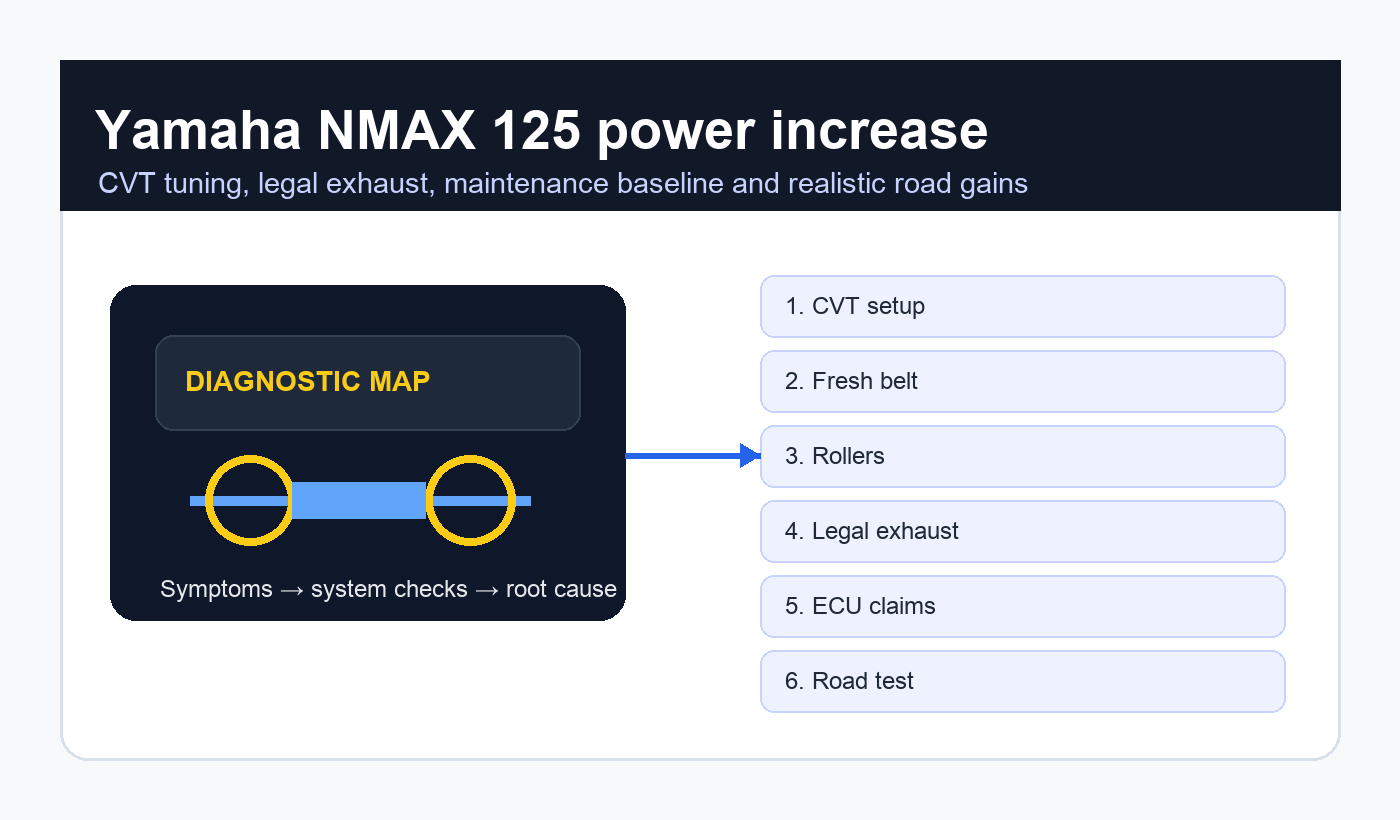
The best Yamaha NMAX 125 power increase order is maintenance, fresh belt if needed, CVT inspection, conservative rollers or sliders, tyre and brake check, legal exhaust if desired, then electronics only if hardware changes justify it. This order makes results measurable.
For a closely related Yamaha scooter guide, our Yamaha XMAX 125 chip tuning article explains why transmission health matters before electronic claims.
Similar scooter tuning examples
For a 300-class scooter comparison, our SYM Cruisym 300 tuning guide shows how CVT setup, exhaust and legal choices interact on a larger maxi scooter.
For another Yamaha three-wheel scooter, our Yamaha Tricity 300 tuning article offers a broader look at realistic road gains versus marketing claims.
Real-world rider scenarios
A commuter considering Yamaha NMAX 125 power increase should prioritize smooth launch, fuel economy and low heat. A noisy, high-revving setup may feel exciting for a week and tiring for months.
A heavier rider seeking Yamaha NMAX 125 power increase may benefit from careful CVT tuning because the scooter needs to stay in its useful rpm range under load.
A rider in hilly areas researching Yamaha NMAX 125 power increase should focus on midrange response rather than final top speed. Hill climbing exposes poor belt and roller condition quickly.
A used buyer asking about Yamaha NMAX 125 power increase should inspect service records, belt age, roller setup, original parts and whether modifications were documented.
A delivery rider interested in Yamaha NMAX 125 power increase should avoid aggressive setups that increase belt heat or fuel consumption. Reliability is performance when the scooter works every day.
A rider tempted by cheap electronics for Yamaha NMAX 125 power increase should ask for model-specific evidence. If the seller cannot explain the exact NMAX generation, walk away.
A touring owner looking for Yamaha NMAX 125 power increase should keep cruising rpm comfortable. A setup that screams at steady speed is not a good long-distance improvement.
A careful owner treats Yamaha NMAX 125 power increase as a setup process, not a shopping list. The best part is the one that solves the actual weak point.
A city rider planning Yamaha NMAX 125 power increase should also think about noise fatigue. A scooter that is pleasant every day is more valuable than one that only sounds faster.
A budget-minded owner considering Yamaha NMAX 125 power increase should spend first on service parts and tyres. Those basics often deliver more confidence than an unproven performance box.
Pre-upgrade checklist
Before ordering parts, write down the current condition of the scooter. Note mileage, belt age, roller age, tyre pressure, tyre date codes, recent oil service, spark plug age, air filter condition and whether the scooter has any warning lights. This record prevents guesswork later.
Then define the problem. Weak launch, poor hill climbing, lost top speed, vibration, high fuel consumption and harsh clutch engagement are different complaints. Each one points to a different area. Buying a louder exhaust for a flat-spotted roller problem is a classic waste of money.
Finally, decide how success will be measured. A route with a hill, a roll-on zone and a steady cruising section is more useful than a single speed run. Keep testing legal and safe. The most valuable improvement is the one you feel repeatedly in normal riding, especially during ordinary weekly urban use.
Keep every removed part, label roller weights, and write down installation dates. Future troubleshooting becomes much easier when the scooter’s setup history is clear.
| Before buying parts | Why it matters | What to record |
|---|---|---|
| Belt age | Controls ratio and grip | Mileage and width if measured. |
| Roller condition | Affects acceleration | Weight and visible flat spots. |
| Tyres | Influence grip and drag | Pressure, age and wear pattern. |
| Fuel economy | Shows efficiency changes | Baseline consumption. |
| Test route | Creates repeatable comparison | Same rider and conditions. |
Frequently asked questions
Can an NMAX 125 be made much faster?
Yamaha NMAX 125 power increase can improve response and acceleration feel, especially through CVT tuning, but large top-speed gains are unlikely.
What is the best first upgrade?
Maintenance first: belt, rollers, clutch inspection, air filter, spark plug, tyres and brakes. Then consider conservative CVT changes.
Is an exhaust worth it?
A legal exhaust can improve sound and style, but it usually gives modest performance gains on its own.
Do fuel modules work?
They can help in specific setups, but generic claims should be treated carefully. Look for exact-model testing.
Will tuning hurt reliability?
It can. Aggressive roller weights, cheap belts, poor filters and untested electronics can increase heat and wear.
How should I measure improvement?
Use the same route, rider, fuel load and tyre pressure. Track response, rpm, fuel use, belt heat and comfort.
Final verdict
Yamaha NMAX 125 power increase is worth doing when the goal is realistic: sharper response, healthier CVT behavior, better hill performance and a scooter that feels more eager without sacrificing reliability.
The smartest Yamaha NMAX 125 power increase strategy is service baseline first, conservative transmission tuning second and legal, documented parts afterward. That produces a better NMAX, not just a louder one.