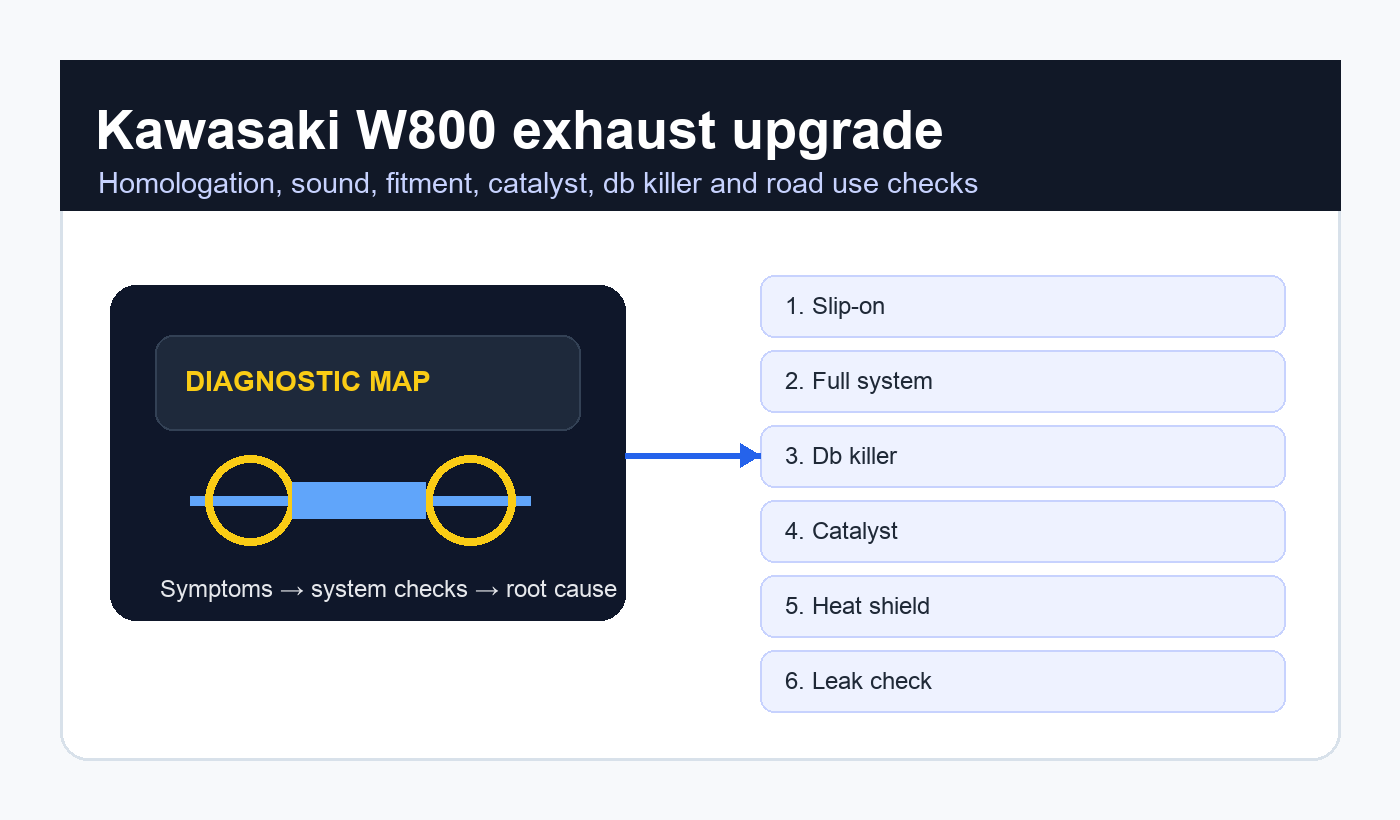
Kawasaki W800 exhaust upgrade: sound, fitment and legal buying guide

Kawasaki W800 exhaust upgrade is one of the most tempting changes for riders who love the W800 because the motorcycle already feels mechanical, simple and traditional. The 773 cc air-cooled vertical twin has real character, a long-stroke pulse and a relaxed road rhythm, yet the standard exhaust is designed around noise law, emissions law, durability, warranty expectations and global market compromises. A better exhaust can make the bike feel more alive, but the best choice is rarely the loudest pipe on the shelf.
This guide looks at the decision like a careful workshop would: sound first, then fitment, legality, fueling, heat, materials, maintenance and the kind of riding you actually do. The goal is not to sell one magic part. It is to help an owner choose a system that suits the W800’s retro personality without turning a pleasant motorcycle into a tiring one.
What owners need to know first
Most riders searching for Kawasaki W800 exhaust upgrade are not chasing superbike horsepower. They want a deeper idle, a cleaner classic twin note, a little less weight, better-looking silencers and confidence that the motorcycle will still pass road checks. Related searches usually include W800 slip-on exhaust, W800 full exhaust system, Kawasaki W800 muffler, W800 db killer, W800 catalytic converter, Euro 5 motorcycle exhaust, homologated motorcycle exhaust, retro motorcycle exhaust, stainless steel exhaust, titanium exhaust, exhaust heat shield, lambda sensor, O2 sensor, ECU remap, fuel controller, back pressure, exhaust leak, road legal exhaust, motorcycle noise limit and insurance after modification.
This guide is written for owners, buyers and technicians dealing with Kawasaki W800 exhaust upgrade in the real world. It focuses on symptoms, checks, realistic repair decisions, legal limits where relevant, and the points worth confirming before buying parts or trusting a seller’s claim.
| Searcher question | Real intent | Best answer |
|---|---|---|
| Will a slip-on fit my W800? | Fitment and year compatibility | Check model year, emissions version, hanger points, clamp diameter and center-stand clearance. |
| Is it road legal? | Homologation and inspection risk | Use an approved exhaust with markings, catalyst compatibility and db killer fitted where required. |
| Will it need tuning? | Reliability and running quality | Many mild slip-ons run acceptably, but full systems or catalyst changes may require fueling checks. |
| How much power will it add? | Performance expectation | Expect sound, feel and weight changes before large horsepower gains. |
What owners need to know first
A niche phrase around W800 exhaust modification normally has lower raw volume than broad terms such as motorcycle exhaust, but it has stronger buyer intent. A visitor using this phrase often owns the bike, is choosing between parts, or is checking whether a used W800 has been modified correctly. The long-tail value comes from the cluster around W800 exhaust, slip-on muffler, full system, exhaust sound, road legal exhaust and tuning after exhaust.
The related topic set is also important because the same owner may search in several ways before buying. Someone may begin with a broad W800 exhaust question, then move to Kawasaki W800 slip on exhaust, then ask whether a db killer is removable, then look for a fuel controller. A useful article should answer the whole journey in one place.
What the standard W800 exhaust is designed to do
The original system is not only a noise reducer. It supports emissions control, manages heat around the rider and passenger, preserves low-rpm smoothness, protects the engine from poor fueling decisions and keeps the motorcycle acceptable in different markets. Any W800 exhaust change has to respect those jobs if the owner wants a bike that remains pleasant for touring, commuting and weekend riding.
The W800 is not a high-revving race engine. It rewards torque, throttle smoothness and a mellow cadence. A pipe that sounds dramatic for five minutes in a video can become intrusive on a two-hour ride. That is why the best exhaust choice is usually one that deepens tone, trims weight and improves appearance while keeping the long-distance manners that make the W800 attractive in the first place.
Slip-on or full system: which Kawasaki W800 exhaust upgrade makes sense?
For most owners, a slip-on is the rational first step. A slip-on replaces the silencer section while retaining more of the factory header and emissions architecture. It is usually cheaper, easier to install, easier to reverse and less likely to create fueling surprises. A full system replaces more of the exhaust path and can offer a cleaner look, more weight reduction and a stronger tone, but it increases the need to verify catalyst position, lambda sensor compatibility and legal approval.
A serious exhaust decision should start with your tolerance for compromise. If you ride daily, carry a passenger, travel through noise-sensitive areas or want simple inspection paperwork, choose a homologated slip-on. If you are building a custom classic, understand emissions rules and can check fueling properly, a full system may be justified.
| Option | Main benefit | Main risk | Best for |
|---|---|---|---|
| Homologated slip-on | Better tone with manageable legality | Limited performance gain | Street riders and touring owners |
| Non-approved slip-on | Lower price and louder sound | Noise fines, inspection failure, insurance questions | Private land or track-only use where legal |
| Full exhaust system | Weight saving, visual transformation, stronger character | Fueling, catalyst and road legality complexity | Experienced modifiers and custom builds |
| Custom fabricated system | Unique appearance | Fitment, heat, quality and approval uncertainty | Show builds with expert fabrication |
Sound: the emotional reason riders start looking
The sound of a W800 matters because the motorcycle is bought with the heart as much as the spreadsheet. A good exhaust setup should add warmth and depth, not harshness. Listen for a rounded idle, a clean midrange pulse and a calm cruise tone. Avoid judging only by phone videos, because microphones compress bass, exaggerate sharpness and rarely show how the bike sounds after an hour at steady speed.
Db killer design is central. A removable baffle can make a pipe flexible, but removing it on public roads may make the exhaust illegal and unpleasant. The best systems sound composed with the baffle installed. If the exhaust only sounds good when stripped of its noise control, it is often the wrong choice for a road W800.
Legality, homologation and documents
Before buying any W800 exhaust part, check whether the part is approved for your exact model year and market. The manufacturer or seller should identify the applicable model, provide approval markings where relevant and state whether the catalyst and db killer must remain in place. In Europe, L-category vehicle rules are shaped by official regulation, so riders should treat road legality as a technical requirement, not a casual option. The European Union text on L-category approval is available through EUR-Lex Regulation 168/2013.
Keep receipts, approval documents and any supplied certificate with the motorcycle records. A roadside conversation or annual inspection is easier when the owner can show documentation instead of relying on memory. Also check local rules because the same pipe can be legal in one jurisdiction, restricted in another and unacceptable if the db killer or catalyst has been removed.
Fitment checks before ordering
Fitment is where many online exhaust mistakes happen. A Kawasaki W800 exhaust upgrade must match the frame, swingarm clearance, rear brake side, passenger peg position, center stand if fitted, heat shield mounts and header connection. Do not assume that every W800 part fits every W800 generation. Emissions changes, bracket revisions and market differences can matter.
Measure before ordering if the seller does not give precise compatibility. Confirm clamp diameter, hanger spacing, gasket needs and whether the kit includes springs, clamps, spacers and heat shields. If the bike has luggage racks, pannier frames or aftermarket rearsets, check those too. Exhausts live in the same crowded space as luggage, passenger boots and rear suspension movement.
Kawasaki W800 exhaust upgrade fitment checklist
| Checkpoint | Why it matters | Owner action |
|---|---|---|
| Model year | Approval and bracket design can change | Match the exact year and market code. |
| Header diameter | Wrong clamp size causes leaks | Measure or confirm seller specification. |
| O2 sensor | Fueling and warning-light risk | Ensure the bung location and wiring reach are correct. |
| Catalyst position | Emissions and legality | Do not remove legal emissions equipment unless the bike is used where that is allowed. |
| Heat shield | Rider comfort and passenger safety | Check coverage near boots and trouser legs. |
| Luggage clearance | Soft bags can melt | Test with suspension compressed and bags loaded. |
Fueling, ECU behavior and throttle feel
The W800’s injection system can adapt within limits, but that does not mean every exhaust change is automatically ideal. A mild Kawasaki W800 exhaust upgrade that keeps the catalyst and sensor arrangement close to factory usually creates fewer problems. A freer full system, catalyst delete or poorly baffled pipe can change exhaust flow enough to affect low-speed response, popping on overrun and combustion temperature.
Do not chase myths about back pressure. Engines do not need restriction for its own sake; they need the exhaust timing, diameter and flow behavior to work with the intake, cam timing and fuel map. Too little consideration can make a road twin feel weaker in the range where the owner rides most. If the bike surges, runs hot, smells unusually lean, loses smoothness or pops excessively after installation, inspect for leaks first and then consider a professional fueling check.
Installation process and workshop discipline
A careful Kawasaki W800 exhaust upgrade installation is not difficult, but it rewards patience. Work on a cold motorcycle, support the exhaust while loosening fasteners and avoid forcing brackets into alignment. If a system only fits by pulling hard against the frame, something is wrong: a spacer may be missing, the header may not be seated, or the part may not be correct for the bike.
Use new gaskets where required. Tighten gradually from the front connection toward the rear support so the system settles naturally. After the first heat cycle, let the motorcycle cool and recheck fasteners. Stainless systems can discolor, and that is normal; melting boots, rattles, exhaust gas smell near joints and ticking leaks are not normal.
After-installation checks
| Moment | Check | What to look for |
|---|---|---|
| First start | Leak check | Sharp ticking, soot marks or gas pulses at joints. |
| First ride | Throttle response | Flat spots, hesitation or unusual popping. |
| After cooling | Fasteners | Clamps, hangers and shield screws settling loose. |
| After 100 km | Clearance | Contact with stand, swingarm, luggage or passenger peg. |
Materials: stainless steel, titanium and classic chrome
The material decision affects appearance, price, durability and maintenance. Stainless steel is the sensible middle ground for many riders: strong, corrosion resistant and easier to live with than exotic materials. Titanium saves weight and looks purposeful, but it can clash visually with a traditional W800 unless the whole build leans custom. Chrome or polished finishes suit the bike’s classic style, but they demand careful cleaning and can show scratches or heat stains.
For a Kawasaki W800 exhaust upgrade on a bike used in rain or near coastal air, corrosion resistance is more important than a tiny weight saving. For a show-oriented cafe build, finish and silhouette may matter more. The right answer depends on whether the motorcycle is a daily companion, a weekend classic or a visual project.
Performance expectations: what changes and what usually does not
Owners should be honest about performance. A Kawasaki W800 exhaust upgrade may reduce weight, sharpen throttle feel and make the engine seem more responsive because the sound is clearer. It is unlikely to transform the motorcycle into something fundamentally faster. The W800’s charm is not peak horsepower; it is a broad, relaxed delivery.
If a seller promises dramatic gains from a simple muffler, ask for dyno charts with baseline, correction method and exact bike configuration. Even then, look at the torque curve rather than a single peak number. A small peak gain that weakens the low and midrange can make the bike worse in real riding.
Internal resources that help with exhaust decisions
The same principles appear across other motorcycle exhaust projects. For diameter, db killer and general fitment thinking, read the universal motorcycle exhaust buying guide. If you want a close look at link-pipe alignment and clamp logic, the Benelli TNT125 and TNT135 exhaust link pipe fitment guide is useful even though the motorcycle is different. For a scooter-side example of balancing sound, legality and real-world use, see the Piaggio Beverly 400 exhaust guide.
Those internal guides are not substitutes for W800-specific compatibility, but they explain the workshop logic behind exhaust diameter, clamps, baffles, heat management and owner expectations. That makes them helpful background before spending money on a Kawasaki W800 exhaust upgrade.
Using official information before modifying
Before changing parts, check official maintenance information and owner documentation. Kawasaki’s owner manual portal is a sensible starting point because it helps identify factory maintenance expectations, warning notes and the correct approach to the motorcycle as supplied by the manufacturer. You can search official documentation through Kawasaki owner manuals.
Official material will not tell you which aftermarket exhaust to buy, but it gives the baseline. Any Kawasaki W800 exhaust upgrade should be judged against that baseline: does it preserve safe operation, keep required emissions equipment, avoid warning lights and maintain adequate ground and heat clearance?
Common mistakes to avoid
The first mistake is buying by sound clip only. The second is ignoring homologation because the pipe looks period-correct. The third is assuming a part listed for a W800 in one market fits every W800 everywhere. The fourth is removing a db killer, catalyst or sensor and then being surprised by noise, smell, inspection failure or poor running. A responsible Kawasaki W800 exhaust upgrade avoids all four.
Another mistake is overtightening clamps to fix a poor fit. Exhaust joints need correct seating, not brute force. Crushed sleeves, stressed brackets and warped flanges create future leaks. If a system needs persuasion, stop and inspect the installation order.
Buying used: what to inspect on a modified W800
A used motorcycle with a Kawasaki W800 exhaust upgrade can be a good buy if the work is documented and reversible. Ask for the original exhaust, approval papers, receipts and any fueling notes. Inspect hanger brackets, heat shields, sensor wiring, soot around joints and signs that luggage or passenger boots have touched the silencer.
During the test ride, pay attention to low-rpm smoothness, steady throttle behavior and overrun noise. A little character is normal. Harsh popping, hesitation, warning lights or a hot smell after a short ride should prompt deeper inspection. Modified bikes are not automatically bad, but undocumented exhaust work lowers confidence.
Best choice for most riders
The best Kawasaki W800 exhaust upgrade for the average road rider is a homologated slip-on from a reputable manufacturer, installed with the supplied baffle, correct clamps and clear documentation. It should improve tone, preserve the W800’s manners and avoid creating a legal or fueling project. The best full system is one chosen by an owner who understands the extra checks and is willing to verify the bike properly afterward.
In other words, choose the pipe that makes the motorcycle better every day, not just louder on the first start. The W800 deserves restraint because its appeal is balance: classic looks, accessible pace, mechanical feel and a relaxed riding experience.
FAQ
Does Kawasaki W800 exhaust upgrade add horsepower?
Kawasaki W800 exhaust upgrade can add small gains in some configurations, but sound, weight and throttle feel are usually the main changes. Big horsepower claims should be treated carefully unless supported by credible dyno testing on the same model.
Will Kawasaki W800 exhaust upgrade need an ECU remap?
Kawasaki W800 exhaust upgrade with a mild homologated slip-on may not need mapping, but a full system, catalyst change or very free-flowing pipe can justify a fueling check. If the motorcycle runs poorly after installation, inspect for leaks before changing electronics.
Is Kawasaki W800 exhaust upgrade legal on public roads?
Kawasaki W800 exhaust upgrade is legal only when the selected exhaust, installation and retained components meet the rules in your country. Approval markings, catalyst status and db killer use matter. Keep the documents with the bike.
Can Kawasaki W800 exhaust upgrade damage the engine?
Kawasaki W800 exhaust upgrade should not damage the engine when it is properly designed, correctly installed and compatible with the bike. Problems are more likely when leaks, sensor errors, removed emissions parts or extreme fueling changes are ignored.
What is the safest Kawasaki W800 exhaust upgrade?
Kawasaki W800 exhaust upgrade is safest when it is a model-specific, homologated slip-on installed according to instructions with all required baffles, gaskets and heat shields in place. It keeps the bike close to factory behavior while improving tone.
Final owner advice
Kawasaki W800 exhaust upgrade should be chosen with the same taste that makes the motorcycle appealing: simple, durable, mechanical and usable. A beautiful pipe that drones, fails inspection or upsets fueling is not an upgrade in real life. A well-matched exhaust that sounds deeper, fits cleanly and keeps the bike reliable can make every ride feel more special without spoiling the W800’s calm nature.
For most owners, the winning formula is clear: buy for exact model compatibility, choose road approval when the bike is used on public roads, keep the db killer and catalyst where required, install carefully, recheck after heat cycles and judge the result after a long ride rather than a short video. That is how Kawasaki W800 exhaust upgrade becomes a lasting improvement instead of an expensive noise experiment.