
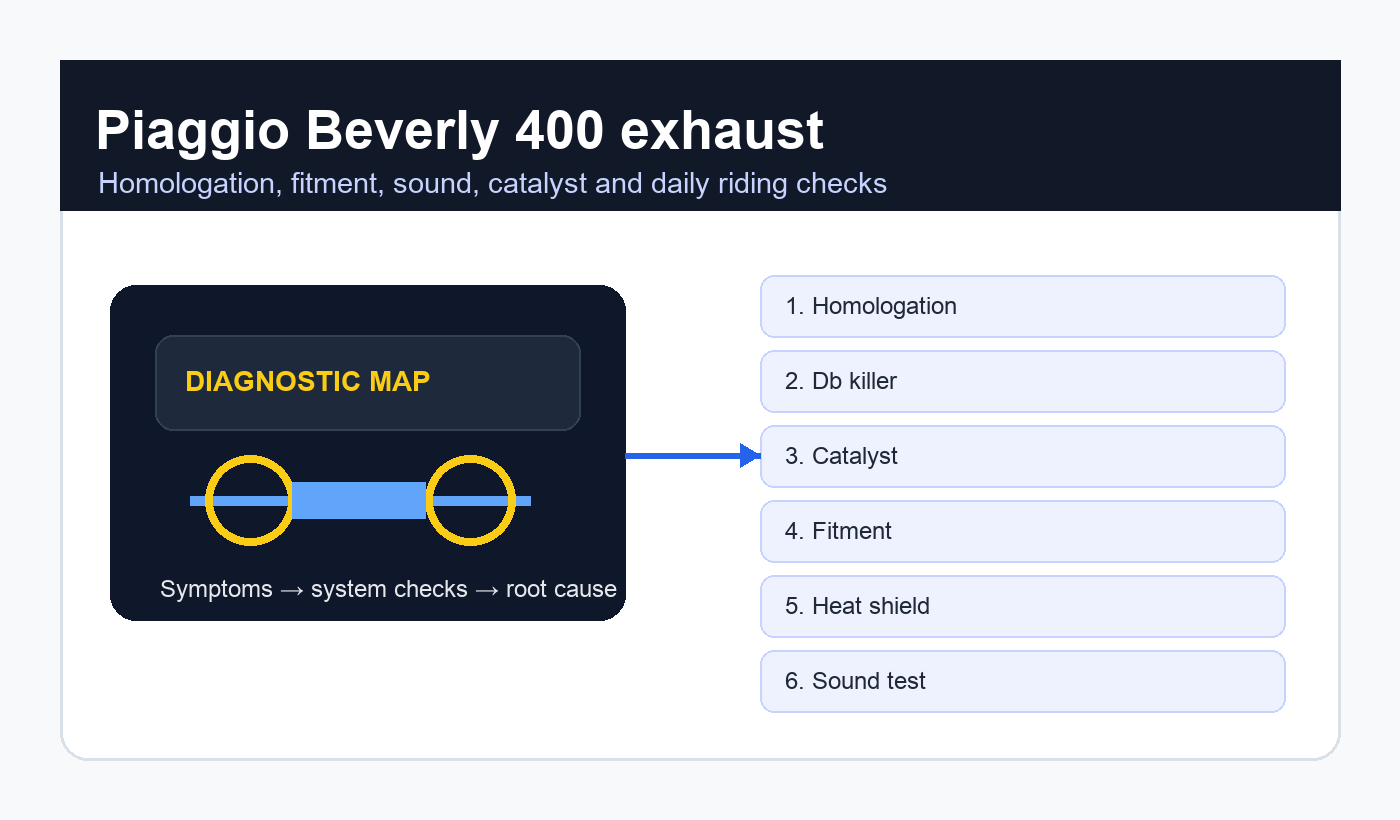
Piaggio Beverly 400 exhaust: how to choose a legal, good-sounding and reliable scooter exhaust
Piaggio Beverly 400 exhaust is a topic with a very practical reader need: the rider wants a better sound, a cleaner look, possibly less weight and maybe a sharper throttle feel, but does not want a daily maxi scooter turned into a noisy, unreliable or illegal project. The Beverly 400 is a premium urban and commuter scooter, so the exhaust decision should be made like an ownership decision, not like a quick cosmetic purchase.

This guide explains Piaggio Beverly 400 exhaust from the perspective of a rider, mechanic and used-scooter buyer. It covers homologation, slip-on versus full system choices, catalytic converters, db killers, sound, weight, heat shields, oxygen sensors, Euro standards, ECU behavior, insurance risk, installation checks, maintenance and whether an exhaust is actually worth buying.
Quick answer
The safest Piaggio Beverly 400 exhaust choice is a homologated slip-on or model-specific exhaust from a reputable manufacturer, installed with the correct link pipe, gasket, mounting hardware, heat shield and db killer. Expect better sound and appearance first, modest performance change second. Avoid universal parts that do not clearly state Beverly 400 compatibility, emissions compliance or road legality.
What owners need to know first
This guide is written for owners, buyers and technicians dealing with Piaggio Beverly 400 exhaust in the real world. It focuses on symptoms, checks, realistic repair decisions, legal limits where relevant, and the points worth confirming before buying parts or trusting a seller’s claim.
| Intent | Associated topics | Best answer |
|---|---|---|
| Sound | sport exhaust, db killer, deeper tone | Choose a homologated silencer and keep inserts installed. |
| Legality | Euro 5, homologation, catalyst, inspection | Buy parts certified for the exact model and market. |
| Fitment | link pipe, bracket, gasket, heat shield | Confirm year, engine, mounting points and sensor layout. |
| Performance | power, torque, ECU, back pressure | Expect modest gains unless the full setup is tested. |
| Buying | used Beverly, modified scooter, original exhaust | Value documentation and reversibility. |
Understand the Beverly 400 use case
A sensible Piaggio Beverly 400 exhaust plan starts with how the scooter is used. The Beverly 400 is commonly chosen for commuting, city riding, longer suburban trips and practical comfort. That means an exhaust should not make the scooter unpleasant in traffic, too loud at steady speed or difficult to pass inspection. The best upgrade respects the scooter’s mature character.
For brand context, Piaggio Group publishes official corporate information at Piaggio Group. For European vehicle approval context, EU Regulation 168/2013 is a high-authority reference for L-category vehicle type approval and market surveillance. Riders should still check local inspection and road-use rules.
Homologation is not a detail
The most important Piaggio Beverly 400 exhaust question is not whether the pipe looks good. It is whether the part is approved for the exact scooter, year and market. Homologation, E-marking, catalyst requirements and noise limits matter because a scooter used on public roads can be inspected, insured and resold. A loud part without paperwork can become expensive even if it bolts on.
Ask for the approval document before buying. Check whether the exhaust is legal only with the db killer installed, whether the catalytic converter is retained or included, and whether the part is approved for the exact Beverly 400 variant rather than a related Piaggio model.
Slip-on versus full exhaust system
Most Piaggio Beverly 400 exhaust buyers should start with a slip-on. A slip-on can improve sound, finish and weight while keeping the rest of the system closer to original. A full system changes more hardware and can create more questions about emissions, fueling, heat management and legality.
A full system may be appropriate for track-only use or a carefully documented build, but a daily scooter usually benefits from a conservative exhaust that preserves reliability and inspection confidence.
| Choice | Benefits | Risks |
|---|---|---|
| Homologated slip-on | Sound, looks, possible weight saving | Small power change; must retain legal inserts. |
| Full system | Greater hardware change | Legality, fueling and heat complexity. |
| Universal silencer | Cheap and widely listed | Fitment, leaks, noise and inspection risk. |
| Used exhaust | Lower price | Missing paperwork, damaged bracket, no db killer. |
| Stock exhaust | Quiet, legal, predictable | Heavier and less exciting. |
Sound quality versus loudness
A good Piaggio Beverly 400 exhaust upgrade should sound deeper and cleaner, not merely louder. Scooters spend a lot of time at steady throttle, where drone can become tiring. A pipe that sounds exciting for a short video may be annoying during a 40-minute commute or while riding through residential streets.
Listen for tone, not only volume. Keep the db killer installed if the approval depends on it. Removing inserts may create harsh sound, legal risk and neighbor problems without making the scooter meaningfully faster.
Performance expectations
Performance claims around Piaggio Beverly 400 exhaust should be handled carefully. A modern fuel-injected 400-class scooter does not usually gain dramatic power from a silencer alone. The rider may feel a quicker response because of sound and weight change, but real acceleration depends on engine health, CVT condition, belt, rollers, clutch, tires and rider load.
If a seller promises large horsepower gains, ask for dyno data on the exact Beverly 400 with the exact exhaust and legal configuration. A graph without model details is marketing, not evidence.
Fueling, ECU and lambda sensor issues
Electronic behavior matters in any Piaggio Beverly 400 exhaust decision. Many modern scooters use oxygen sensor feedback and emissions strategies that expect the exhaust system to behave within a designed range. A legal slip-on usually works without ECU changes, but decat pipes, airbox changes or full systems can create lean running, warning lights or poor low-speed behavior.
Do not unplug sensors to hide a problem. If the check engine light appears, diagnose it properly. A scooter that runs worse after the exhaust was installed is not tuned; it is unfinished.
Heat shields and passenger comfort
Heat is a practical Piaggio Beverly 400 exhaust topic because scooters carry passengers, luggage and city clothing. A replacement exhaust must protect legs, plastics, brake hoses and bodywork. Poor bracket alignment can move the silencer too close to panels or create vibration that damages mounts over time.
Check clearances with the suspension loaded, not only on the center stand. Confirm that the passenger foot area, side panel and rear brake line remain protected.
| Install check | Why it matters | What to inspect |
|---|---|---|
| Gasket seating | Prevents leaks and ticking | Joint alignment and fresh gasket. |
| Bracket position | Prevents cracking | No stress before tightening. |
| Heat shield | Protects rider and plastics | Clearance under load. |
| Sensor wiring | Avoids faults | No twisting or stretched harness. |
| Db killer | Maintains approval | Installed and secured. |
Installation mistakes
The most common Piaggio Beverly 400 exhaust mistakes are reusing a crushed gasket, tightening brackets in the wrong order, ignoring exhaust leaks, leaving sensor wiring under tension, losing the db killer, failing to recheck bolts after heat cycles and buying a pipe for the wrong year. None of these mistakes makes the scooter faster; all of them can make ownership worse.
After installation, let the scooter heat cycle, inspect for leaks, recheck torque after cooling and look for contact marks. A clean installation should not rattle, tick, melt panels or smell strongly after the first bedding-in period.
When the stock exhaust is better
Sometimes the best Piaggio Beverly 400 exhaust answer is to keep the original pipe. If the scooter is used for early-morning commuting, strict inspections, long rides, passenger comfort or resale value, the factory exhaust may be the smarter choice. A stock system is quiet, proven and easy to defend during inspection.
If the original exhaust is rusty or damaged, a replacement makes sense. If it is healthy and the rider only wants louder sound, the trade-off should be considered honestly.
Used Beverly 400 with an aftermarket exhaust
A used scooter with a Piaggio Beverly 400 exhaust modification should be inspected carefully. Ask for the original exhaust, homologation documents, receipts, db killer, catalyst information and installation date. A missing original pipe reduces reversibility. A seller who cannot explain the setup may not know whether it is legal.
On a test ride, check cold start, idle, throttle response, hot restart, warning lights, exhaust leaks, rattles, smell, heat and low-speed smoothness. A good exhaust should make the scooter more enjoyable, not suspicious.
| Used-bike check | Good sign | Warning sign |
|---|---|---|
| Paperwork | Approval and invoice included | No E-mark or unknown origin. |
| Original parts | Stock exhaust included | Irreversible changes. |
| Sound | Deep, controlled, no drone | Harsh volume or missing insert. |
| Running | Smooth idle and roll-on | Popping, faults, surging. |
| Fitment | Aligned brackets and shields | Contact marks, leaks, melted plastic. |
Best upgrade order
The best Piaggio Beverly 400 exhaust order is maintenance first: belt condition, rollers, clutch, air filter, spark plug, tire pressures and brakes. Then choose a legal exhaust. This order matters because a tired CVT can make a scooter feel slow even with a beautiful silencer installed.
For broader scooter performance context, our Piaggio MP3 500 power increase guide explains why exhaust expectations must be balanced with CVT health and realistic engine limits.
Universal exhausts and diameter matching
A risky Piaggio Beverly 400 exhaust shortcut is buying a universal exhaust because the diameter seems close. Scooter exhaust fitment is not only pipe diameter. It includes bracket geometry, hanger load, gasket style, oxygen sensor location, ground clearance, heat shield position, catalyst strategy and legal approval.
If you are comparing generic parts, read our universal motorcycle exhaust buying guide before buying. A universal pipe can be useful on some projects, but it is not automatically right for a Beverly 400 used on public roads.
Where a model-specific product category helps
For riders shopping Piaggio Beverly 400 exhaust options, a focused category can be safer than random marketplace listings. Model-specific pages help compare diameter, db killer, link pipe shape, mounting style and intended use before purchase.
You can also browse our motorcycle exhaust guides for related fitment and sound guidance across scooters, motorcycles and powersports machines.
Maintenance after fitting an exhaust
A finished Piaggio Beverly 400 exhaust installation still needs attention. Recheck bolts after the first heat cycles, inspect packing condition over time if the silencer uses repackable material, clean road salt, watch for cracks and listen for new ticking sounds. Exhaust leaks can change sound and may affect sensor readings.
Keep the approval paper with the scooter documents. If the db killer is removable, keep the retaining screw secure and do not treat the insert as optional unless the part is explicitly approved that way for your market.
Cost versus value
The value of Piaggio Beverly 400 exhaust depends on the rider. If you want style, controlled sound and weight saving from a legal part, a quality exhaust can be satisfying. If you expect dramatic acceleration, it may disappoint. If you ride in a strict inspection area, paperwork may be worth more than carbon fiber.
Budget for the full job: exhaust, gasket, hardware, possible professional installation and time to verify fitment. Cheap parts become expensive when they require custom brackets or fail inspection.
| Buyer priority | Best exhaust type | Why |
|---|---|---|
| Daily commuting | Quiet homologated slip-on | Comfort and inspection confidence. |
| Style | Quality branded silencer | Better finish and fitment. |
| Touring | Low-drone legal exhaust | Less fatigue on longer rides. |
| Budget repair | Stock or approved replacement | Lowest risk. |
| Maximum noise | Not recommended for road use | Legal and comfort risk. |
Rider scenarios for a Beverly 400 exhaust choice
A commuter choosing Piaggio Beverly 400 exhaust should prioritize low drone, clean idle and legal documentation. In traffic, a harsh exhaust becomes tiring quickly, especially when the scooter is used every day. A controlled tone is more valuable than maximum volume.
A touring rider considering Piaggio Beverly 400 exhaust should think about steady-speed comfort. Long rides expose resonance, heat near luggage and passenger fatigue. If the exhaust sounds aggressive in town but drones at cruise, it is not the right touring part.
A city rider buying Piaggio Beverly 400 exhaust should also consider neighbors, parking garages and early starts. A scooter can be enjoyable without becoming antisocial. Homologated parts with the db killer fitted usually make the best compromise.
A style-focused owner may see Piaggio Beverly 400 exhaust as a visual upgrade. Finish quality matters here: welds, carbon or stainless end cap, bracket coating, heat shield design and how naturally the silencer follows the Beverly bodywork.
A performance-minded buyer should treat Piaggio Beverly 400 exhaust as one piece of the scooter, not the whole answer. Belt condition, rollers, clutch response, tire pressure and service history can change acceleration more than a silencer alone.
A used-scooter shopper looking at Piaggio Beverly 400 exhaust modifications should value reversibility. The original exhaust, approval certificate and installation receipt are worth money because they make future inspection, resale and diagnosis easier.
A rider on a strict budget should approach Piaggio Beverly 400 exhaust carefully. It is better to keep a healthy stock system than buy an undocumented pipe that leaks, rattles, fails inspection or needs custom work to fit safely.
One final practical detail is storage. Keep the approval card, invoice, spare springs, removable insert screw and any original mounting spacers together in a labelled bag. Small hardware is easy to lose, and missing pieces can turn a simple future service into a frustrating search. Good documentation also helps a workshop understand what has been fitted without guessing.
Inspection-day preparation
Before any periodic inspection or roadside check, make the scooter boring in the best possible way. Clean the homologation markings so they can be read, reinstall every removable insert, check that the retaining screw is present, wipe away oil residue, and make sure the silencer does not move when pushed by hand. An inspector is less likely to become suspicious when the installation looks factory-level tidy.
Carry the approval sheet with the scooter documents rather than keeping it in a drawer at home. If the part was supplied with separate catalyst documentation, keep that too. Some riders also store digital copies on their phone, but paper is still useful when a battery is flat or a phone is unavailable. The goal is not to argue; it is to make compliance easy to verify.
Listen to the scooter when it is fully warm. Small leaks at the header or link pipe can sound like valve noise, create popping on deceleration and leave dark marks near the joint. A fresh gasket is cheap compared with the frustration of chasing a noise that appeared only after fitting a new silencer.
Frequently asked questions
Will an exhaust make the Beverly 400 much faster?
Piaggio Beverly 400 exhaust upgrades usually improve sound, appearance and sometimes weight. Large power gains from a silencer alone are unlikely without tested supporting changes.
Do I need an ECU remap?
A legal slip-on normally should not require a remap. Full systems, decat changes or intake modifications may need proper diagnosis and tuning evidence.
Is removing the db killer safe?
It may increase noise and legal risk, and it can invalidate homologation. Keep the insert installed if the approval requires it.
Can I fit a universal exhaust?
Only with caution. Diameter alone is not enough; brackets, sensors, catalyst, clearance and road approval all matter.
What should I ask before buying?
Ask for exact model-year compatibility, homologation documents, catalyst status, db killer details, warranty, included hardware and whether the stock exhaust should be retained.
Is a used exhaust a good idea?
It can be, if it includes paperwork, the db killer, undamaged brackets and clear compatibility. Avoid damaged or undocumented parts.
Final verdict
Piaggio Beverly 400 exhaust is worth doing when the goal is realistic: controlled sound, better style, possible weight saving and a more enjoyable scooter without sacrificing legality or reliability. The best part is usually the one that fits correctly, stays quiet enough for daily life and comes with documentation.
Approach Piaggio Beverly 400 exhaust as a complete ownership choice. Confirm the exact model, buy homologated hardware, install it cleanly, keep the original parts and test the scooter after heat cycles. That is how an exhaust upgrade becomes an improvement rather than a complication.