
Yamaha GP800 WaveRunner problems: a practical diagnosis guide for the two-stroke Yamaha personal watercraft
Yamaha GP800 WaveRunner problems is a search made by owners who usually have a very specific worry: the ski ran well last season, now it bogs, overheats, cavitates, refuses to idle, smokes heavily or feels unreliable on the water. The Yamaha GP800 and GP800R generation is old enough that most faults are no longer single-part mysteries. They are usually the result of age, fuel system neglect, cooling restriction, pump wear, oil-injection anxiety, electrical corrosion or a maintenance history that was never written down.

This guide treats Yamaha GP800 WaveRunner problems like a workshop investigation rather than a list of rumors. It explains the common symptoms, what they normally mean, how to inspect the machine safely, which failures are urgent, and how to decide whether a used GP800 is a bargain or a project that will become expensive once it touches water.
Quick answer
The short answer to Yamaha GP800 WaveRunner problems is that the most common trouble areas are stale fuel, dirty carburetors, weak fuel delivery, low compression, cooling restrictions, worn impeller or wear ring, cavitation, oil-injection uncertainty, old hoses, corroded electrical connectors, weak battery condition and poor winter storage. A strong GP800 should start predictably, idle cleanly, accelerate without hesitation, maintain cooling flow, rev under load and return with no water intrusion in the hull.
What owners need to know first
This guide is written for owners, buyers and technicians dealing with Yamaha GP800 WaveRunner problems in the real world. It focuses on symptoms, checks, realistic repair decisions, legal limits where relevant, and the points worth confirming before buying parts or trusting a seller’s claim.
| Reader need | Related topics | Best article answer |
|---|---|---|
| No start | battery, starter relay, spark, fuel, compression | Test electrical, ignition, fuel and compression in order. |
| Bogging | carburetor, fuel filter, reed valves, low-speed jets | Inspect fuel delivery before blaming ignition. |
| Overheating | cooling lines, sand blockage, pisser, thermostat | Confirm flow through every cooling circuit. |
| Poor acceleration | impeller, pump seal, wear ring, cavitation | Check pump condition and engine output together. |
| Used buying | compression, hull, service records, trailer | Water-test and inspect before purchase. |
Know the machine before diagnosing it
A realistic Yamaha GP800 WaveRunner problems diagnosis starts with model identity. The GP800 name is commonly used around late-1990s and early-2000s Yamaha personal watercraft, and many owners casually mix GP800 and GP800R language. Exact year, hull, engine code, carburetor specification and local market matter because parts, hose routing and manual procedures can vary.
For official service-support context, Yamaha publishes owner manual resources through Yamaha Motor owner manuals. For safety context on recreational boating, the U.S. Coast Guard boating safety resource is a high-authority starting point. Use those alongside the exact service manual for your model year.
Do not diagnose on a garden hose alone
One reason Yamaha GP800 WaveRunner problems can be frustrating is that a ski may sound healthy on the trailer and fail under load. A two-stroke personal watercraft can idle on a hose with weak compression, dirty carbs or pump damage, then bog the moment the impeller has to push water. Trailer running is useful for basic start, cooling and leak checks, but it cannot replace a controlled water test.
Keep hose running brief and follow the correct water-on and water-off sequence for the model. Never rev aggressively on the trailer. When the issue is acceleration, cavitation, cooling under load or top-speed loss, the real test has to happen in the water with safety gear and a plan to get home.
No-start and hard-start faults
Many Yamaha GP800 WaveRunner problems cases begin with a dead start button or a cranking engine that never fires. Start with the simple checks: battery voltage under load, clean terminals, lanyard switch, start/stop switch, starter relay, fuses, ground cables and visible corrosion inside connectors. Personal watercraft live in a wet electrical environment, so a connector that looks only slightly green can create intermittent faults.
If the starter turns the engine normally, move to spark, fuel and compression. Use fresh plugs of the correct type, verify spark on both cylinders, confirm fuel reaches the carburetors and run a proper compression test with the throttle open. Two cylinders should be close to each other; a large difference is more important than chasing one internet number from an unknown gauge.
| Symptom | Likely area | First check |
|---|---|---|
| No click | Battery, lanyard, switch, fuse | Load-test battery and inspect stop circuit. |
| Click but no crank | Starter relay, cables, starter motor | Check voltage drop and ground path. |
| Cranks but no fire | Spark, fuel, compression | Test spark and compression before parts. |
| Starts then dies | Fuel delivery, carburetor, idle circuit | Inspect fuel lines and carb cleanliness. |
| Hot restart issue | Compression, fuel vapor, ignition heat | Compare cold and hot behavior. |
Fuel system problems
Fuel is central to Yamaha GP800 WaveRunner problems because an older two-stroke can be damaged quickly by a lean condition. Old fuel, ethanol water absorption, cracked pickup lines, dirty filters, blocked tank venting, weak fuel pump pulse, hardened carb diaphragms and varnished jets can all make the ski hesitate or seize. A bog that feels electrical is often fuel delivery.
Do not keep riding a GP800 that falls flat at wide-open throttle. If the engine leans out at speed, the piston crown and cylinder can suffer before the rider has much warning. Rebuild carburetors with quality parts, replace aged fuel hoses, clean the tank if contamination is visible and confirm the fuel selector or shutoff system works correctly.
Carburetor and mixture issues
A common Yamaha GP800 WaveRunner problems pattern is clean idle, hesitation on takeoff and then a sudden surge. That can indicate dirty low-speed circuits, incorrect adjustment, air leaks, stiff diaphragms or fuel pump weakness. Carburetors on watercraft are not decorative; they are engine survival parts. A poor rebuild can be worse than no rebuild.
Use the correct carb specification for the year, keep pop-off pressure and jetting within service information, and avoid random screw settings from a different model. If the ski was stored for years, assume the carburetors need real service, not just a fuel additive.
Compression, pistons and crankcase sealing
Serious Yamaha GP800 WaveRunner problems investigations always include compression. Low compression can show up as hard starting, weak acceleration, poor idle or a ski that feels fine cold but fades when hot. Uneven readings point toward cylinder, ring, piston or sealing trouble. A compression test is not a full engine teardown, but it decides whether tuning and carb work make sense.
Crank seals and air leaks matter on two-strokes because unmetered air can create lean running. If a cylinder repeatedly fails, the question is not only what broke, but why it broke. Fuel restriction, oil delivery, cooling blockage, air leak and ignition timing must all be considered before rebuilding.
| Finding | What it may mean | Next step |
|---|---|---|
| Both cylinders strong and even | Engine base is promising | Move to fuel, cooling and pump checks. |
| One cylinder much lower | Top-end or sealing issue | Stop riding and inspect further. |
| Both low | Wear, gauge issue or test error | Repeat test and compare with leak-down. |
| Compression falls hot | Wear or heat-related sealing | Investigate before long rides. |
| Good compression but bogging | Fuel, ignition or pump load | Continue systematic checks. |
Oil injection and premix anxiety
Oil delivery is one of the most emotional Yamaha GP800 WaveRunner problems topics. Some owners trust the original oil-injection system if it is inspected and maintained; others convert to premix to remove uncertainty. The wrong answer is ignoring the system. Old oil lines, loose clamps, cracked fittings or an empty tank can destroy a two-stroke engine.
If the injection system stays, inspect line condition, pump operation, cable adjustment and clamps. If premix is chosen, label the ski clearly, remove ambiguity for future users and follow a ratio appropriate to the engine and riding style. A future owner who unknowingly fills straight fuel into a premix conversion can ruin the engine quickly.
Cooling and overheating
Overheating is another major Yamaha GP800 WaveRunner problems area because personal watercraft cooling passages can collect sand, weeds, scale or old debris. Weak pisser flow, warning buzzers, steam, power loss or hot exhaust components should be taken seriously. Do not assume water coming from one outlet proves every passage is clear.
Check intake grate, pump area, cooling hoses, fittings, tell-tale outlet, exhaust cooling and any temperature sensors. A ski that overheats only at speed may have a restriction that does not show during a quick hose run.
Jet pump, impeller and cavitation
Some Yamaha GP800 WaveRunner problems complaints are not engine problems at all. If rpm rises but speed does not, the jet pump may be cavitating. Damaged impeller blades, excessive clearance, air leaks around the pump shoe, worn seals, debris in the intake grate or a damaged wear surface can make a healthy engine feel weak.
Inspect the intake and pump carefully with the craft secure and the lanyard removed. Look for fishing line, rope, rock damage, bent edges, sealant gaps and loose hardware. Pump condition is especially important on an older ski that has lived near shallow ramps or sandy beaches.
| Water-test symptom | Engine clue | Likely direction |
|---|---|---|
| High rpm, poor thrust | Engine sounds free | Pump cavitation or impeller wear. |
| Low rpm, heavy bog | Engine struggles | Fuel, compression, ignition or exhaust restriction. |
| Vibration on launch | Shakes with load | Impeller damage or debris. |
| Good launch, poor top speed | Revs limited | Fuel delivery, compression or pump load. |
| Intermittent surge | Comes and goes | Fuel pickup, venting or electrical connection. |
Electrical corrosion and intermittent faults
Intermittent Yamaha GP800 WaveRunner problems faults can waste a lot of money. A GP800 may start at home, fail at the ramp, start again after drying, then die after bouncing across chop. That pattern often points toward wiring, grounds, stop switch, lanyard switch, ignition components or water entering a connector box.
Open electrical boxes carefully, inspect seals, look for moisture, clean grounds and protect connectors appropriately. A new battery can hide a voltage-drop issue for a few weekends, but corroded cables and weak relays eventually return.
Hull leaks and water intrusion
Water inside the hull is a practical Yamaha GP800 WaveRunner problems concern. Small leaks can come from drain plugs, driveshaft seals, exhaust couplers, cooling lines, through-hull fittings or cracked hoses. A little water after riding may be normal for some craft, but repeated accumulation deserves inspection before it reaches electrical parts or the engine intake.
After a ride, remove the seat, look for spray tracks, smell for fuel, check hose clamps and inspect the bilge area. A used ski should be water-tested long enough to reveal leaks, not merely started on the trailer.
Storage and winterization mistakes
Many Yamaha GP800 WaveRunner problems stories begin after storage. Stale fuel, dry carburetor internals, weak batteries, corroded terminals, rodents, cracked hoses and unprotected cylinders can all appear after months off the water. A ski that “ran when parked” may need fuel system work before it is safe to ride hard.
Good storage includes fresh stabilized fuel or proper draining strategy, battery maintenance, fogging when appropriate, cooling-system care, clean dry hull, greased fittings and a cover that does not trap moisture. The cost of winterization is usually smaller than one damaged cylinder.
Used GP800 buying checklist
A buyer researching Yamaha GP800 WaveRunner problems should treat every modified or neglected ski with caution. The asking price should reflect compression readings, water-test behavior, pump condition, trailer quality, registration status, service records and whether original parts are included. Avoid buying only from a cold-start video.
Ask when the carburetors were rebuilt, whether fuel lines were replaced, what oil system is used, whether compression was tested, whether the pump was serviced and why the owner is selling. If the seller refuses a water test, price the machine as a project.
| Buying check | Good sign | Warning sign |
|---|---|---|
| Compression | Even cylinders, documented test | One low cylinder or no test allowed. |
| Fuel system | Recent carb and hose service | Old gray lines, varnish smell, unknown work. |
| Pump | Clean impeller and strong thrust | Cavitation, vibration, damaged blades. |
| Hull | Dry bilge after ride | Standing water, fuel smell, loose fittings. |
| Paperwork | Manuals, receipts, registration | No history, vague ownership story. |
Repair priority order
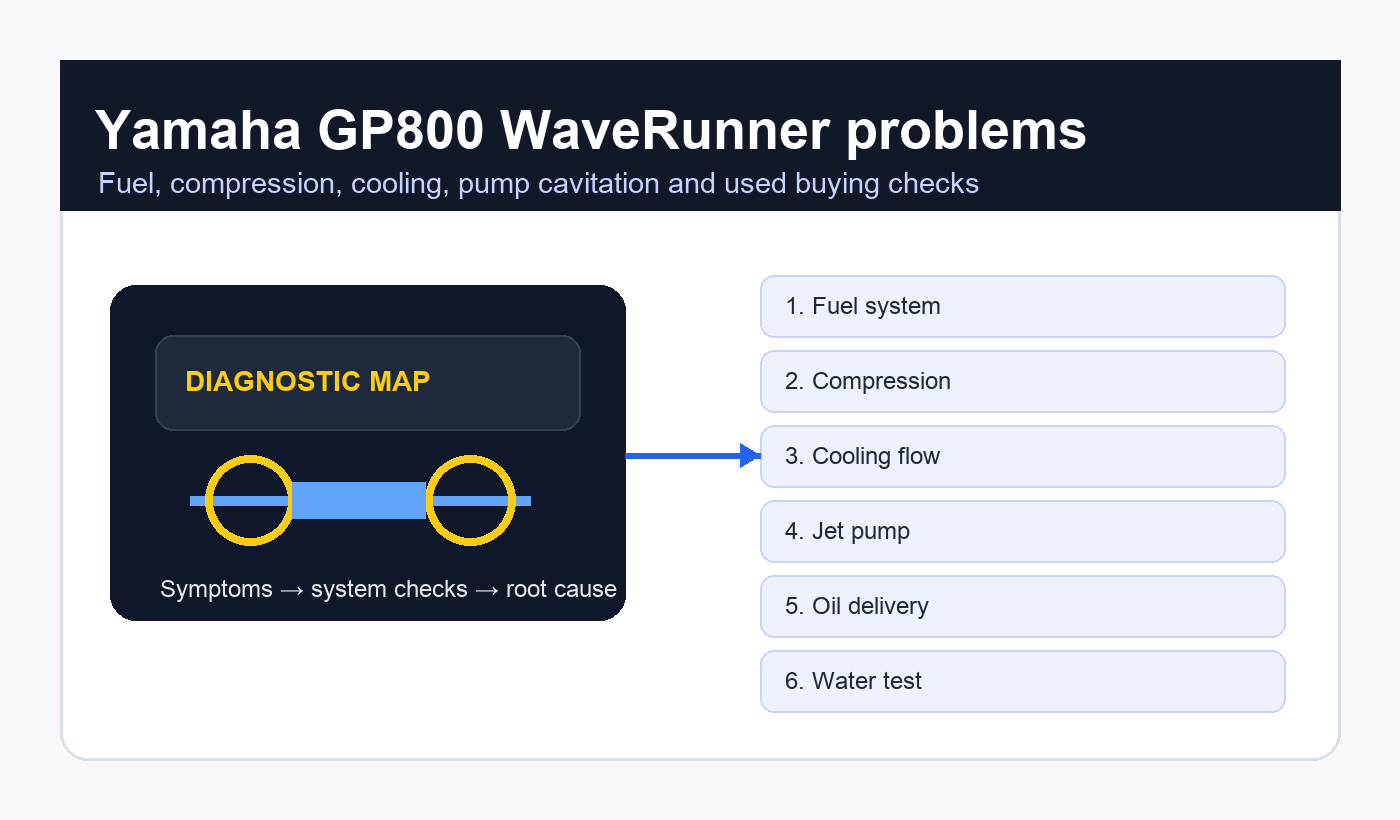
The safest Yamaha GP800 WaveRunner problems repair order is battery and electrical basics, compression test, fuel system inspection, carburetor service, oil-delivery verification, cooling-flow check, pump inspection and then water testing. That order prevents expensive parts-swapping and reduces the risk of damaging the engine during diagnosis.
If you also maintain side-by-side machines, our Yamaha RMAX 1000 problems guide shows the same diagnostic principle: separate engine output, drivetrain load, electrical condition and owner maintenance before blaming the most expensive component.
Performance complaints versus maintenance faults
A subtle Yamaha GP800 WaveRunner problems mistake is treating lost performance as a need for upgrades. A worn pump, dirty carburetor or low compression will not be fixed by random tuning parts. Restore the machine first. Then decide whether an impeller repair, carb refresh or handling setup is actually needed.
For a power-and-speed comparison in another powersports category, see our Can-Am Commander 1000 top speed guide. Different machine, same lesson: baseline condition controls real-world performance more than headline numbers.
Owner habits that prevent repeat failures
Preventing Yamaha GP800 WaveRunner problems is about habits. Use fresh fuel, keep the battery healthy, flush correctly, inspect the pump after shallow-water use, watch cooling flow, listen for changes, dry the hull, maintain the trailer and do not ignore small symptoms. Personal watercraft failures often become expensive because the first warning was ridden through.
For scooter owners who understand CVT wear and drive-load diagnosis, our Yamaha XMAX 125 chip tuning article offers a road-vehicle parallel: driveline health and maintenance baseline come before chasing performance claims.
Water-test notes for GP800 troubleshooting
A useful Yamaha GP800 WaveRunner problems water test should be short, planned and repeatable. Bring basic tools, a charged phone in a dry pouch, a tow plan, spare plugs and someone who knows where you are. Start close to the ramp, warm the engine gently, check cooling flow, then test idle, low-speed maneuvering, midrange acceleration and a brief full-throttle pull only if the ski feels clean and stable.
During a Yamaha GP800 WaveRunner problems water test, separate engine sound from hull behavior. A clean engine with cavitation will rev freely while the ski fails to hook up. A weak engine will sound loaded, flat or uneven. A cooling issue may appear only after several minutes. A fuel pickup issue may appear after turns, chop or low tank level. Those distinctions tell you where to inspect next.
After any Yamaha GP800 WaveRunner problems test ride, remove the seat immediately and inspect the hull. Look for water, fuel smell, loose hoses, exhaust leaks, hot fittings, belt-like rubber dust from couplers, oil drips and electrical moisture. The minutes immediately after riding often reveal faults that disappear once the craft dries or cools.
Do not use a Yamaha GP800 WaveRunner problems test as a long recreational ride. If the ski bogs, overheats, loses thrust, surges or fills with water, return slowly and stop. Continuing to ride through a lean fuel condition or cooling restriction can turn a repairable maintenance problem into a top-end rebuild.
For sellers, documenting Yamaha GP800 WaveRunner problems checks is valuable. Compression photos, carburetor receipts, pump-service notes, oil-line replacement dates and a calm water-test video make the craft easier to trust. For buyers, those records are more persuasive than claims that the ski is simply fast for its age.
The best outcome from Yamaha GP800 WaveRunner problems troubleshooting is confidence. You should know how it starts cold, how it restarts hot, how it accelerates, how the cooling behaves, how dry the hull stays and what parts were serviced. That knowledge is what makes an older two-stroke fun instead of stressful.
Frequently asked questions
Are Yamaha GP800 models unreliable?
Yamaha GP800 WaveRunner problems does not automatically mean the model is bad. It means the craft is old enough that fuel, cooling, electrical and pump maintenance decide reliability.
Why does my GP800 bog under load?
Bogging usually points toward fuel delivery, dirty carburetors, low compression, exhaust restriction, weak ignition or pump load. Do not keep riding until the cause is known.
Should I convert oil injection to premix?
Both approaches can work if done correctly. The danger is neglect: old oil lines, unclear labeling or a future owner who does not know how the system is configured.
Why does it rev but not accelerate?
High rpm with poor thrust often means cavitation, impeller damage, pump sealing problems or intake debris rather than an engine power fault.
Can I diagnose overheating on a hose?
A hose test can show basic flow, but many overheating faults appear only under load in the water. Inspect the complete cooling path.
What should I check before buying one?
Compression, water-test behavior, fuel system history, oil system condition, pump condition, hull leaks, electrical corrosion, trailer condition and paperwork.
Final verdict
Yamaha GP800 WaveRunner problems should be approached with patience and evidence. The GP800 can still be an enjoyable, lively two-stroke personal watercraft, but age punishes assumptions. Start with compression, fuel, oil delivery, cooling, pump condition and electrical integrity. Only then judge performance or value.
The owner who solves Yamaha GP800 WaveRunner problems properly ends up with more than a running ski. They understand the machine, know what was serviced, can spot early warnings and can enjoy the water with fewer unpleasant surprises at the ramp.