
SYM Cruisym 300 tuning: realistic CVT, exhaust and performance upgrades for the maxi scooter
SYM Cruisym 300 tuning is a tempting search because the Cruisym 300 already feels like a practical maxi scooter: comfortable, weather-friendly, useful for commuting and strong enough for city and ring-road riding. Owners usually want sharper acceleration, smoother overtaking, a better exhaust note or a little more top-end confidence. The smart approach is to tune the scooter as a complete system, not to chase a miracle part.

This guide explains SYM Cruisym 300 tuning from a practical owner and workshop perspective. It covers maintenance baseline, CVT variator tuning, roller and slider weights, belt health, clutch behavior, exhaust choices, air filters, ECU and fueling claims, tire pressure, brake condition, top speed expectations, reliability, warranty and how to test whether an upgrade actually worked.
Quick answer
The short SYM Cruisym 300 tuning answer is that the best real-world results usually come from a fresh maintenance baseline and conservative CVT tuning. A healthy belt, clean variator, correct roller or slider setup, good tires, serviced brakes and a legal exhaust can make the scooter feel more responsive. Big horsepower claims from generic chips, open filters or loud exhausts should be treated with caution.
What owners need to know first
This guide is written for owners, buyers and technicians dealing with SYM Cruisym 300 tuning in the real world. It focuses on symptoms, checks, realistic repair decisions, legal limits where relevant, and the points worth confirming before buying parts or trusting a seller’s claim.
| Intent | Associated topics | Best answer |
|---|---|---|
| Acceleration | variator, rollers, sliders, clutch | Optimize CVT response carefully. |
| Sound/looks | exhaust, sport silencer, homologated pipe | Use legal parts and realistic expectations. |
| Top speed | maximum speed, limiter, gearing | Expect modest changes; power and CVT range limit results. |
| Reliability | belt life, heat, maintenance, warranty | Keep setup mild and documented. |
| Used scooter | service history, worn CVT, old tires | Restore baseline before tuning. |
Understand the Cruisym platform
A realistic SYM Cruisym 300 tuning plan starts with the scooter itself. SYM is the scooter and motorcycle brand of Sanyang Motor, a Taiwanese manufacturer with a long history in two-wheel vehicles. The Cruisym 300 is a maxi-scooter style machine sold in different markets and years, so exact specifications and emissions equipment can vary. That matters when choosing exhausts, variator parts and electronic modules.
For official brand and distributor context, start from SYM Global. For manufacturer background, the SYM Motors reference explains Sanyang Motor and the SYM brand. Always verify the exact year and regional model before buying tuning parts.
Maintenance before performance parts
The most overlooked SYM Cruisym 300 tuning step is maintenance. A worn belt, flat-spotted rollers, dirty clutch, old spark plug, blocked air filter, low tire pressure or dragging brake can make the scooter feel slow. Owners sometimes buy tuning parts only to recover performance that was lost to normal wear.
Before modifying anything, check service history, engine oil, coolant, spark plug, air filter, belt width, roller condition, clutch bell, variator faces, brake drag, wheel bearings and tire age. A scooter that is not mechanically fresh cannot be tuned honestly.
| Baseline item | Why it matters | Symptom if neglected |
|---|---|---|
| CVT belt | Transfers all engine output | Slipping, high revs, weak drive. |
| Rollers/sliders | Control ratio change | Flat spots, vibration, lazy response. |
| Clutch | Controls takeoff | Judder, smell, delayed launch. |
| Air filter | Protects engine and airflow | Poor response or rich running. |
| Tires/brakes | Define grip and rolling resistance | Instability, drag, long stopping distance. |
CVT tuning is the main path
Most useful SYM Cruisym 300 tuning happens in the transmission. The variator, belt, rollers, sliders and clutch decide how quickly the engine reaches its useful rpm range. A good setup can make takeoff cleaner and mid-speed roll-on stronger without changing engine horsepower.
The goal is balance. Too-light rollers may make the engine rev loudly, increase belt heat and reduce fuel economy. Too-heavy rollers can make the scooter feel lazy. The right setup depends on rider weight, hills, passenger use, commuting style and whether the scooter is used on faster roads.
| CVT change | Possible benefit | Risk if wrong |
|---|---|---|
| Fresh belt | Restores lost drive | Cheap belt can wear quickly. |
| Slightly lighter rollers | Sharper acceleration | Noise, heat and fuel use. |
| Quality sliders | Smoother ratio movement | Wrong size or weight hurts response. |
| Variator kit | Broader performance change | Can shorten belt life if aggressive. |
| Clutch service | Smoother launch | Harsh springs can annoy in traffic. |
Rollers, sliders and variator kits
For many owners, SYM Cruisym 300 tuning means changing roller weights or fitting a performance variator. This can work, but it must be measured. Record the original roller weight, belt width and mileage. Change one variable at a time when possible. A setup that feels exciting for ten minutes can become tiring if it raises cruising rpm everywhere.
Sliders can sometimes improve ratio behavior more smoothly than basic rollers, but fitment and weight are critical. Do not assume a kit for another SYM or GTS model will match the Cruisym 300 perfectly.
Exhaust upgrades
Exhaust-based SYM Cruisym 300 tuning is usually about sound, appearance and sometimes small weight savings. A homologated exhaust can make the scooter more enjoyable, but a slip-on alone rarely creates dramatic power. On a fuel-injected scooter with emissions equipment, removing baffles or catalyst-related components can create legal, fueling and inspection problems.
Choose a road-legal exhaust for the exact year and market. Keep paperwork and original parts. If the scooter becomes louder but not smoother, the upgrade has not solved performance.
Air filter and intake changes
Air filters are another common SYM Cruisym 300 tuning topic. A clean, well-sealed filter is essential. A poor high-flow filter or modified airbox can let dust in, add intake noise and provide little real gain. The Cruisym is a road scooter that may see rain, city dust and storage; filtration quality matters.
If you fit a reusable filter, maintain it correctly and check that the airbox seals. More sound is not proof of more useful power.
ECU remap and fuel modules
Electronic SYM Cruisym 300 tuning claims should be treated carefully. A fuel module or remap can sometimes refine fueling after exhaust or intake changes, but a naturally aspirated 300-class scooter does not hide huge safe horsepower. More fuel alone does not create more displacement, compression or airflow.
Look for data from the exact model, not generic percentage claims. A good tune should keep cold start, idle, hot restart, fuel economy and warning lights under control.
Top speed expectations
Many riders begin SYM Cruisym 300 tuning because they want more top speed. That is the hardest result to improve. Maximum speed depends on power, CVT range, wind resistance, rider size, screen position, tire condition, belt health and road gradient. A good CVT setup may help the scooter reach cruising speed faster, while the final top speed changes only slightly.
If the scooter has lost top speed, inspect belt, rollers, clutch, brake drag, tire pressure and air filter before assuming it needs electronic tuning.
Tires, brakes and handling
Good SYM Cruisym 300 tuning is not only engine work. Premium tires, correct pressure, serviced brakes and healthy suspension can make the scooter feel faster because the rider trusts it more. A scooter that turns cleanly and stops straight is more useful than one that gained a tiny amount of speed but feels vague.
Check tire date codes, uneven wear, brake pad thickness, disc condition and steering feel. Do these basics before chasing power.
Legal and warranty considerations
Any SYM Cruisym 300 tuning involving exhaust, fueling, emissions or speed classification can affect legality, insurance and warranty. This is especially important if the scooter is used daily or must pass periodic inspection. A part sold for racing or closed-course use should not be assumed road legal.
Keep original parts, invoices and homologation documents. Reversibility is valuable when diagnosing issues or selling the scooter.
How to test an upgrade
A proper SYM Cruisym 300 tuning test uses the same route, same rider, similar fuel load, correct tire pressure and similar weather. Record takeoff feel, roll-on response, cruising rpm, fuel consumption, belt smell, vibration, warning lights and hot restart behavior. Noise alone is not a result.
Test one change at a time. If you install a variator, exhaust, filter and fuel module together, you will not know which part helped or hurt.
| Test area | What to record | Why it matters |
|---|---|---|
| Acceleration | Repeatable roll-on feel | Shows useful road improvement. |
| Cruising rpm | RPM at common speeds | Detects tiring CVT setups. |
| Fuel economy | Before/after consumption | Reveals inefficient tuning. |
| CVT heat | Belt smell or dust | Protects reliability. |
| Faults | Warning lights or codes | Prevents hidden problems. |
Best upgrade order
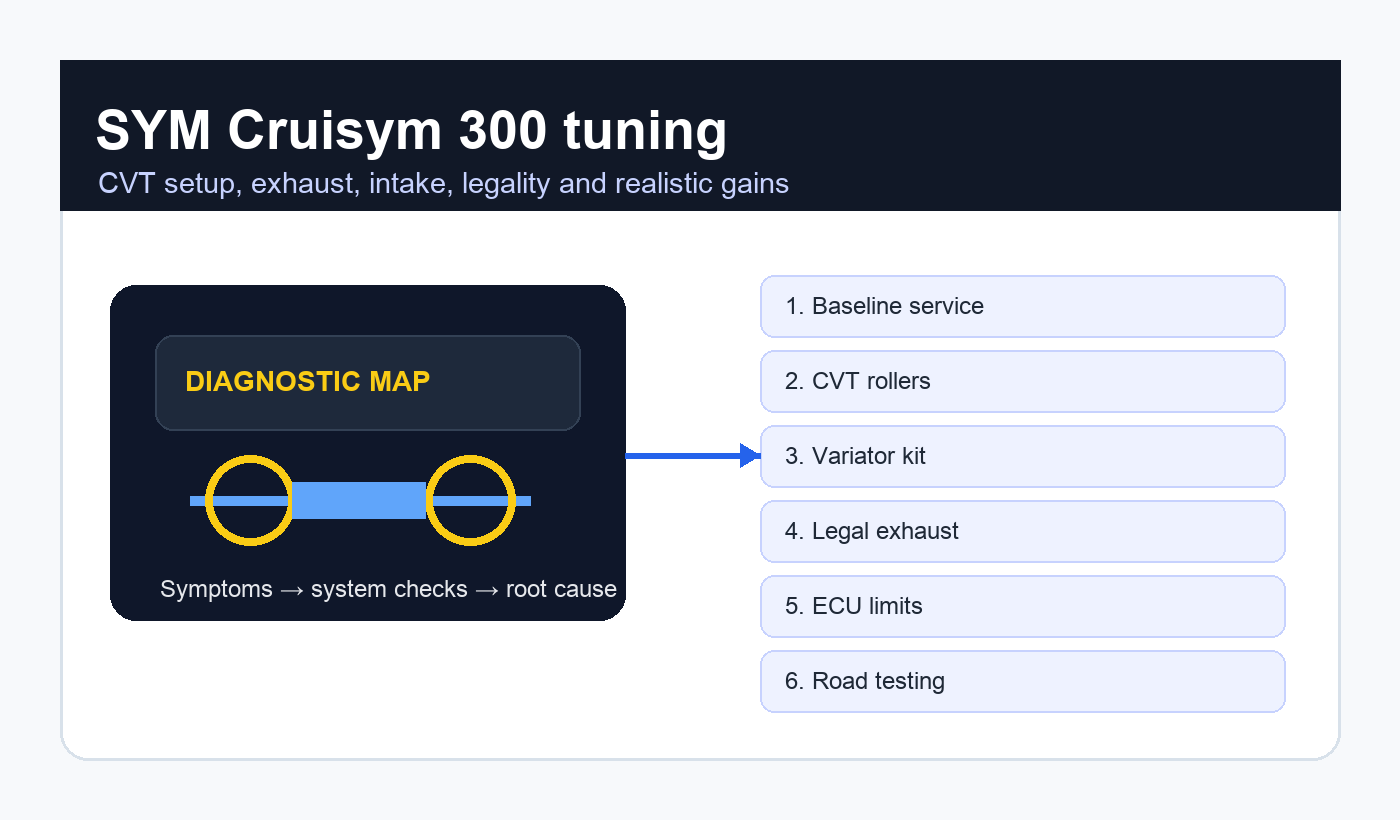
The safest SYM Cruisym 300 tuning order is service baseline, CVT inspection, fresh belt if needed, conservative roller or slider tuning, tires and brakes, legal exhaust if desired, and only then fueling checks if hardware changes justify them. This order makes each step measurable.
For another scooter CVT and performance guide, our Yamaha XMAX 125 chip tuning article explains why electronic claims should be measured against transmission and maintenance basics.
Used Cruisym 300 buying checks
A used buyer researching SYM Cruisym 300 tuning should inspect the scooter before valuing modifications. Ask for service records, belt age, roller setup, original exhaust, tire dates, brake service and whether any fuel module was installed. A modified scooter without documentation should be priced as a scooter that may need to be returned to stock.
For another larger scooter tuning example, our Peugeot Metropolis 400 tuning guide shows the same principle: restore the baseline before judging upgrades.
| Buying check | Good sign | Warning sign |
|---|---|---|
| CVT records | Belt and rollers documented | Unknown parts or rattles. |
| Exhaust | Homologation and original part included | Too loud or no paperwork. |
| Road test | Smooth launch and cruise | Judder, belt smell, warning lights. |
| Tires/brakes | Fresh, even, stable | Old tires, pulsing brakes. |
| Fueling | Clean idle and hot restart | Surging, fuel smell, flat spots. |
Common mistakes
The biggest SYM Cruisym 300 tuning mistake is modifying a worn scooter. The second is using random roller weights without recording the baseline. The third is fitting a loud exhaust and expecting big power. The fourth is ignoring belt heat. The fifth is trusting generic chip claims without model-specific evidence.
For a higher-displacement scooter performance comparison, our Piaggio MP3 500 power increase article shows why tuning works best as setup, not fantasy horsepower.
Workshop setup notes for SYM Cruisym 300 tuning
A careful SYM Cruisym 300 tuning workshop plan should begin with measurements, not parts. Note the current belt width, roller weight, clutch shoe condition, variator face wear, tire pressures, engine idle behavior and hot restart quality. Photograph the original setup before disassembly. That simple record makes it much easier to identify whether a later vibration, flat spot or cruising-rpm change came from the upgrade or from an unrelated wear item.
For daily riders, the best SYM Cruisym 300 tuning setting is often slightly conservative. A commuter scooter spends more time leaving junctions, filtering through traffic, climbing moderate hills and cruising at steady throttle than it spends chasing maximum speed. That means smooth engagement, predictable roll-on, low heat and normal fuel consumption should be treated as performance results. If the scooter becomes louder, thirstier and more nervous but does not shorten real journeys, the setup is probably moving in the wrong direction.
A dealer or independent scooter specialist will usually treat SYM Cruisym 300 tuning as a sequence: restore service items, inspect the CVT, test the scooter stock, choose a first roller or slider change, road test, then decide whether a variator kit or exhaust is justified. This feels slower than buying a full bundle of parts, but it avoids the classic problem of installing four modifications and having no idea which one caused belt dust, surging or poor cold running.
Owners who ride with a passenger need a different SYM Cruisym 300 tuning target from solo riders. Extra load can make a scooter feel flat at low and mid speed, so a transmission setup that holds the engine in its useful range may be worthwhile. At the same time, too aggressive a setup can raise heat when climbing hills two-up. Watch for belt smell after long gradients, harsh clutch engagement and an engine that sounds busy without adding road speed.
Urban riders should judge SYM Cruisym 300 tuning by control. A scooter that pulls cleanly from low speed, does not snatch when the throttle is opened, and stays calm over broken pavement will be faster across town than one with a peaky launch. Fresh tires, correct fork and shock condition, clean brake calipers and a well-maintained throttle body can transform the riding experience without touching peak horsepower.
Touring riders have another version of SYM Cruisym 300 tuning. For longer days, windscreen position, luggage weight, tire choice and cruising rpm matter as much as acceleration. If a variator setup makes the engine rev higher at every steady speed, it may feel sporty during a short test and tiring after an hour. The best touring setup should let the scooter pass safely, climb without strain and cruise without constant mechanical noise.
When evaluating aftermarket claims, keep SYM Cruisym 300 tuning grounded in physics. A 300-class single-cylinder scooter can be improved, but it is not hiding superbike levels of unused power. Look for dyno graphs from the correct model, transparent testing conditions, homologation documents and clear installation notes. Be suspicious of vague promises, universal electronic boxes and listings that never mention the exact model year.
The most durable Cruisym 300 tuning result is a scooter that remains easy to service. Use quality consumables, keep the stock parts, write down part numbers and service dates, and avoid irreversible cutting or wiring changes unless there is a very strong reason. A tidy, reversible setup protects resale value and makes future diagnosis far easier.
Frequently asked questions
Can a Cruisym 300 be made much faster?
SYM Cruisym 300 tuning can improve feel and response, especially through CVT setup, but large top-speed gains are unlikely without trade-offs.
What is the best first upgrade?
The best first step is maintenance: belt, rollers, clutch inspection, air filter, plug, tires and brakes. Then consider conservative CVT tuning.
Is an exhaust worth it?
A legal exhaust can improve sound and appearance, but it usually delivers modest performance gains. Keep original parts and paperwork.
Should I install a fuel module?
Only with evidence and a clear reason. A fuel module is not a substitute for CVT maintenance or correct exhaust fitment.
Can tuning reduce reliability?
Yes. Aggressive roller weights, cheap belts, poor filters and untested fueling can increase heat, wear and warning-light risk.
How do I know if tuning worked?
Measure the scooter before and after with the same route, tire pressure, fuel load and riding conditions. Smoothness, response and reliability matter more than noise.
Final verdict
SYM Cruisym 300 tuning is best approached as a careful setup process. The Cruisym 300 can feel sharper with a healthy CVT, sensible roller or slider choice, clean maintenance and legal parts. It will not become a different scooter because of a generic chip or loud exhaust.
Use SYM Cruisym 300 tuning to make the scooter better where it is used most: smoother launch, stronger midrange, confident braking, stable handling and reliable commuting. That is a far better goal than chasing a headline number at the expense of belt life and daily comfort.