Peugeot Metropolis 400 tuning: realistic performance upgrades for the three-wheel scooter
Peugeot Metropolis 400 tuning is a tempting search because the Metropolis looks like it should respond to the same tricks used on ordinary maxi-scooters: variator weights, exhausts, filters, ECU modules and “derestriction” claims. The reality is more nuanced. The Metropolis 400 is a heavy tilting three-wheel scooter with a CVT transmission, complex front suspension, strong commuting role and legal constraints that matter as much as peak speed.

This guide explains Peugeot Metropolis 400 tuning from a practical owner perspective. It covers realistic gains, CVT tuning, exhaust choices, air intake myths, fuel-injection limits, maintenance before upgrades, tires, braking, weight, safety, legal concerns, touring comfort and the difference between a scooter that feels sharper and one that is genuinely faster.
Quick answer
The short Peugeot Metropolis 400 tuning answer is that the best results come from restoring the scooter to perfect condition, then making conservative CVT changes, fitting quality tires, keeping the brakes and front suspension healthy, and choosing only road-legal exhaust or fueling parts where permitted. Big horsepower claims should be treated skeptically because the Metropolis is a 400-class single-cylinder three-wheeler with weight, emissions, noise and transmission limits.
What owners need to know first
This guide is written for owners, buyers and technicians dealing with Peugeot Metropolis 400 tuning in the real world. It focuses on symptoms, checks, realistic repair decisions, legal limits where relevant, and the points worth confirming before buying parts or trusting a seller’s claim.
| Reader need | Associated topics | Best answer |
|---|---|---|
| More acceleration | variator, rollers, sliders, CVT tuning | Optimize transmission response without overheating the belt. |
| More sound | exhaust, slip-on, homologated silencer | Choose legal, compatible parts and avoid fueling problems. |
| More top speed | derestrict, limiter, ECU, top speed | Be realistic; wind, weight and power limit the result. |
| Better handling | tires, suspension, front end, brakes | Improve confidence before chasing engine output. |
| Used scooter upgrade | service, belt, clutch, maintenance | Restore baseline condition before buying tuning parts. |
Understand the machine first
A serious Peugeot Metropolis 400 tuning plan starts with the Metropolis layout. It is a tilting three-wheel scooter produced by Peugeot Motocycles, using a front system that lets the two front wheels lean through a parallelogram-style arrangement. That front-end design gives stability and braking confidence, but it also adds weight and complexity compared with a normal two-wheel scooter.
For model context, the Peugeot Metropolis 400 reference describes it as a tilting three-wheeled scooter. For brand and official regional information, start from Peugeot Motocycles and then verify local manuals, warranty and homologation rules for your market.
Maintenance before tuning
The most overlooked Peugeot Metropolis 400 tuning step is maintenance. A worn belt, glazed clutch, old spark plug, dirty air filter, low tire pressure or dragging brake can make the scooter feel slow. Owners then buy tuning parts to recover performance that was lost to neglect. The first upgrade is to return the scooter to factory health.
Before spending money, check belt age, roller wear, clutch condition, variator faces, engine oil, coolant, spark plug, valve service history, air filter, wheel bearings, brake drag and tire condition. A fresh baseline makes every later change easier to judge.
That is why Peugeot Metropolis 400 tuning should begin with measurements and inspection, not a shopping cart full of parts.
| Baseline item | Why it matters | Symptom if neglected |
|---|---|---|
| CVT belt | Transfers all engine output | Slipping, high revs, weak acceleration. |
| Rollers/sliders | Control ratio change | Flat spots, vibration, lazy response. |
| Clutch | Launches the scooter | Judder, smell, poor takeoff. |
| Tires | Define grip and stability | Wandering, poor braking, harsh ride. |
| Brakes | Critical on a heavy three-wheeler | Drag, heat, longer stopping distance. |
CVT tuning: the most realistic gain
Most useful Peugeot Metropolis 400 tuning happens inside the CVT. Changing roller weight or using quality sliders can alter how quickly the engine reaches its stronger rpm range. The goal is not magic horsepower; it is better use of the power already available. Too light and the engine screams, fuel economy drops and belt heat increases. Too heavy and the scooter feels lazy.
A conservative CVT setup can make city acceleration and roll-on response sharper. It should be tested with belt temperature, smoothness and cruising rpm in mind. A Metropolis used for commuting needs reliability as much as launch feel.
For daily riders, Peugeot Metropolis 400 tuning succeeds when the scooter leaves junctions more cleanly without becoming tiring at motorway speed.
| CVT change | Possible benefit | Risk if overdone |
|---|---|---|
| Slightly lighter rollers | Quicker rev rise | Noise, heat, higher fuel use. |
| Quality sliders | Smoother ratio change | Wrong size/weight ruins response. |
| Fresh belt | Restores lost drive | Poor installation damages parts. |
| Clutch service | Smoother takeoff | Aggressive springs can feel harsh. |
| Variator kit | Broader setup change | Can shorten belt life if mismatched. |
Exhaust upgrades
Exhaust-based Peugeot Metropolis 400 tuning is often more about sound, weight and appearance than large power. A homologated slip-on may improve tone and save some weight, but it should not be treated as a guaranteed engine transformation. On a fuel-injected scooter with emissions equipment, removing restrictions blindly can create fueling errors, noise issues and inspection trouble.
Choose parts that are approved for your market, include the correct fittings and do not interfere with sensors or catalyst requirements. If a seller claims huge gains from a silencer alone, ask for dyno evidence on the same model and year.
Air filter and intake myths
Another common Peugeot Metropolis 400 tuning idea is the performance air filter. A clean, correct filter is important. An open or poorly sealed intake is risky. The Metropolis is a road scooter that sees rain, dust, city grime and storage. More intake noise does not automatically mean more usable power.
If you change the filter, keep filtration quality and airbox sealing as priorities. A slightly freer-flowing filter without fueling correction may not deliver measurable gains. Dust ingestion, however, can create very measurable engine wear.
ECU remap and fueling modules
Electronic Peugeot Metropolis 400 tuning sounds attractive because “remap” suggests hidden power. In practice, naturally aspirated single-cylinder scooter engines have limited safe headroom. A fueling module may help if exhaust and intake changes require correction, but it should be tuned with evidence, not installed because a product page promises a fixed percentage gain.
Modern emissions systems, oxygen sensors and inspection rules also matter. A road scooter used daily should start cleanly, idle well, pass local requirements and avoid warning lights. A rough-running tuned scooter is not an upgrade.
Top speed expectations
Owners searching Peugeot Metropolis 400 tuning often want more top speed. That is the hardest area to improve. Top speed is limited by power, gearing, CVT range, wind resistance, rider size, screen position, tire condition and road conditions. On a heavy three-wheeler, small changes rarely produce dramatic speed increases.
A good CVT setup may improve how quickly the scooter reaches cruising speed, while top speed changes remain modest. If the scooter has lost speed, diagnose belt wear, brake drag, tire pressure and engine health before assuming it needs derestriction.
Handling is performance
Good Peugeot Metropolis 400 tuning is not only engine work. Because the Metropolis has two front contact patches and a tilting mechanism, tire quality, pressure, steering condition and front suspension health make a major difference. A scooter that turns cleanly, brakes straight and holds a line feels faster and safer even if peak horsepower is unchanged.
Check front tire wear symmetry, steering play, suspension movement, brake balance and wheel alignment after any impact. Performance that cannot be controlled is not performance.
Braking upgrades and safety
A heavy three-wheel scooter needs brakes in excellent condition. For many riders, the smartest Peugeot Metropolis 400 tuning is fresh fluid, quality pads, clean calipers and good tires. Braided lines or higher-friction pads may be useful only if compatible and legal, but a neglected braking system should be restored before it is modified.
After any brake work, bed pads correctly and test progressively. The extra front-end confidence of a three-wheeler should not encourage late braking on worn tires or contaminated discs.
Weight and touring accessories
Touring accessories complicate Peugeot Metropolis 400 tuning. A tall screen, top box, passenger, leg cover and luggage all change acceleration, stability and wind load. Before chasing more power, ask whether the scooter is carrying unnecessary weight or aerodynamic drag.
For long rides, comfort upgrades may be more valuable than engine parts. A better screen setup, seat comfort and correct suspension/tire condition can make the scooter feel more capable without stressing the engine.
Legal and insurance concerns
Any Peugeot Metropolis 400 tuning that changes emissions, noise, speed classification or safety equipment can affect legality and insurance. This is especially important for three-wheel scooters that may be ridden under specific license rules in some countries. A modification that seems small mechanically can become large legally after an accident or inspection.
Keep invoices, homologation papers and original parts. If a part is sold for track use, assume it may not be road legal. If insurance requires declared modifications, declare them.
The safest Peugeot Metropolis 400 tuning plan is one you can explain to an insurer, a workshop and a roadworthiness inspector without hoping nobody notices.
| Modification | Road-use concern | Practical advice |
|---|---|---|
| Exhaust | Noise/emissions approval | Use homologated parts and keep documents. |
| ECU/fueling | Emissions and warranty | Verify legality before tuning. |
| CVT kit | Reliability and classification | Avoid extreme setups for daily use. |
| Brake changes | Safety certification | Use quality compatible parts. |
| Lighting/bodywork | Visibility and inspection | Do not compromise required equipment. |
Best upgrade order
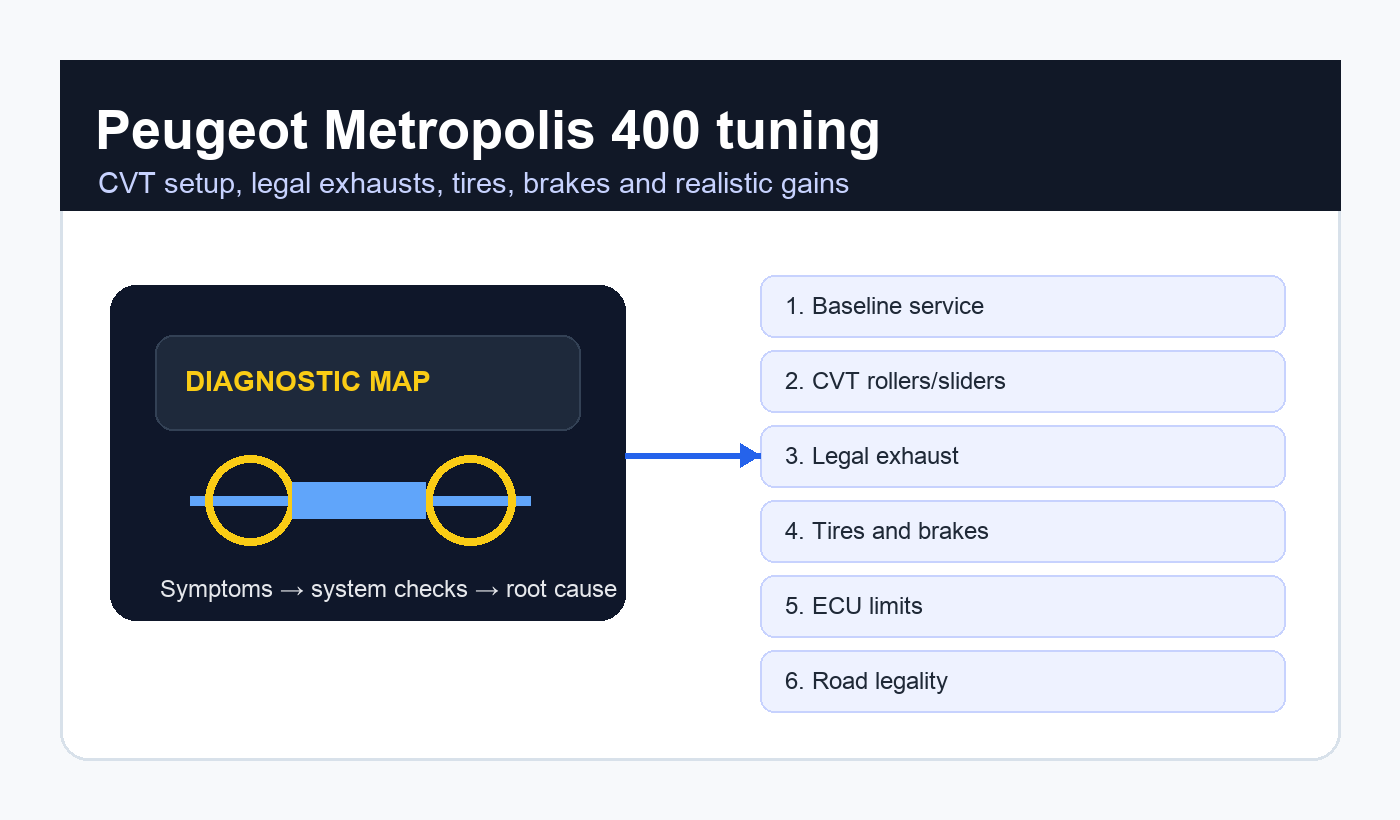
A sensible Peugeot Metropolis 400 tuning order is baseline service, tires, brakes, CVT refresh, conservative roller or slider tuning, legal exhaust if desired, then fueling checks only if hardware changes justify it. This order makes each step measurable and avoids blaming the wrong part when the scooter still feels slow.
For comparison with another three-wheel scooter topic, our Yamaha Tricity 300 tuning guide uses the same principle: improve the platform first, then make small changes that suit the vehicle’s weight and purpose.
What not to do
The worst Peugeot Metropolis 400 tuning approach is stacking cheap parts with no baseline: loud exhaust, open filter, random roller weights, no belt inspection and no fueling evidence. The result can be more noise, less refinement and no real speed. Another mistake is chasing a top-speed number while ignoring tires, brakes and front-end condition.
If the scooter is also used for commuting, poor cold running, higher fuel use and belt heat matter. A daily machine should be easy to live with.
A disciplined Peugeot Metropolis 400 tuning owner changes one variable at a time and keeps notes, because several simultaneous changes make diagnosis almost impossible.
Buying a modified Metropolis
Used-buying Peugeot Metropolis 400 tuning checks should be skeptical. Ask for original parts, invoices, exact roller weights, belt age, exhaust approval documents, service history and reason for modification. Test the scooter cold and hot. Listen for CVT noise, clutch judder, exhaust leaks and warning lights.
If you are comparing commuting features across bikes and scooters, our Motorcycle with cruise control guide can help frame comfort and long-distance priorities beyond engine tuning.
When paperwork is missing, treat Peugeot Metropolis 400 tuning parts as unknowns and price the scooter as if you may need to return it to standard.
Performance table: realistic expectations
| Upgrade path | Likely feel | Best for |
|---|---|---|
| Full service and fresh belt | Restored smoothness | Any used scooter. |
| CVT rollers/sliders | Sharper acceleration | City and hill riding. |
| Homologated exhaust | Sound/weight change | Owners wanting character. |
| Tires and brakes | Confidence and control | All riders, especially commuters. |
| Fueling module | Only useful with evidence | Specific hardware setups. |
How to test whether an upgrade worked
The best way to judge a modification is to create a repeatable route before changing anything. Use the same rider, similar fuel load, similar tire pressure and the same warm-up routine. Note launch smoothness, rpm at cruising speed, roll-on response from city speed, hill performance, belt smell, vibration and fuel consumption. A phone GPS can help with consistency, but do not turn road testing into unsafe speed runs.
For a commuter, the most valuable improvement may be a cleaner 0-50 km/h response, smoother junction takeoff or less clutch judder, not a higher maximum speed. For touring, lower vibration and stable cruising may matter more than aggressive roller weights. Write down the original setup, including belt brand, roller weight and mileage, so you can reverse the change if it makes the scooter worse.
After any transmission work, inspect again after a short bedding-in period. Check for belt dust, unusual heat, loose fasteners, oil seepage and changes in idle or starting behavior. A modification that feels exciting for ten minutes but makes the scooter noisy, hot or inconsistent is not a good setup for real roads.
It is also worth testing in the conditions where the scooter is normally used. A setup that feels lively on an empty back road may be irritating in stop-start traffic with a passenger and luggage. The right result is predictable throttle response, controlled rpm and no loss of confidence in slow turns, parking maneuvers or wet-road braking.
When a tuning part is worth it
A Peugeot Metropolis 400 tuning part is worth buying when it solves a defined problem, fits the exact model year, is legal for road use, does not shorten service life unreasonably and can be reversed if the result disappoints. A part is not worth buying because a listing says “more power” without data.
For smaller-scooter tuning context, our Honda Forza 125 chip tuning article explains why displacement, emissions rules and CVT behavior limit what electronic boxes can honestly deliver.
The best Peugeot Metropolis 400 tuning parts make the scooter feel more polished in the riding you actually do, not only louder during a short test ride.
Frequently asked questions
Can the Metropolis 400 be derestricted?
Peugeot Metropolis 400 tuning searches often use the word derestrict, but any limiter, emissions or road-classification change must be checked against local law. Many riders are better served by CVT optimization and maintenance than illegal derestriction.
Will a variator kit increase top speed?
It may improve acceleration and ratio behavior, but top speed depends on power, wind resistance and CVT range. A poorly chosen kit can reduce refinement or belt life.
Is an exhaust worth it?
An exhaust can improve sound and appearance, and sometimes save weight. It should be homologated, compatible and realistic. Do not expect a dramatic horsepower increase from a silencer alone.
Should I install a performance air filter?
Only if filtration and fit are excellent. A clean standard-style filter is often the better daily choice than an intake that adds noise and risk.
What is the safest first upgrade?
For most owners, the safest first Peugeot Metropolis 400 tuning step is a full CVT and maintenance refresh plus premium tires and brake service. That restores performance and improves control.
Can tuning damage reliability?
Yes. Extreme roller weights, cheap belts, non-approved exhausts, poor fueling and dirty intakes can reduce reliability. Conservative, documented changes are safer.
Final verdict
Peugeot Metropolis 400 tuning works best when the goal is a sharper, healthier and better-controlled scooter rather than a fantasy horsepower jump. The Metropolis 400 responds most sensibly to maintenance, CVT optimization, tires, brakes and legal parts chosen for the exact model.
Treat Peugeot Metropolis 400 tuning as a measured setup process: restore the baseline, improve the transmission carefully, protect legality, and prioritize handling and braking. Done that way, the Metropolis becomes more satisfying without turning a capable commuter into a noisy, unreliable experiment.