
Motorcycle with cruise control: the long-form buyer’s guide to comfort, safety, touring and real-world value
Motorcycle with cruise control is a phrase riders usually search when they are no longer asking whether cruise control is a gimmick. They are asking which bikes have it, whether it is worth paying for, how it works, and whether electronic throttle control changes the riding experience. The answer depends on the kind of riding you do. On a 20-minute city commute, cruise control may be irrelevant. On a 400-mile motorway day, it can become one of the most appreciated features on the entire motorcycle.
A modern Motorcycle with cruise control can be a luxury touring machine, an adventure bike, a sport-tourer, a bagger, a middleweight commuter in some markets, or a high-spec naked bike. The feature is no longer limited to the heaviest touring models. Ride-by-wire throttles, IMUs, radar sensors and increasingly sophisticated dashboards have pushed cruise control into more categories, including adaptive cruise control on premium motorcycles.
This guide is written for owners, buyers and technicians dealing with Motorcycle with cruise control in the real world. It focuses on symptoms, checks, realistic repair decisions, legal limits where relevant, and the points worth confirming before buying parts or trusting a seller’s claim.
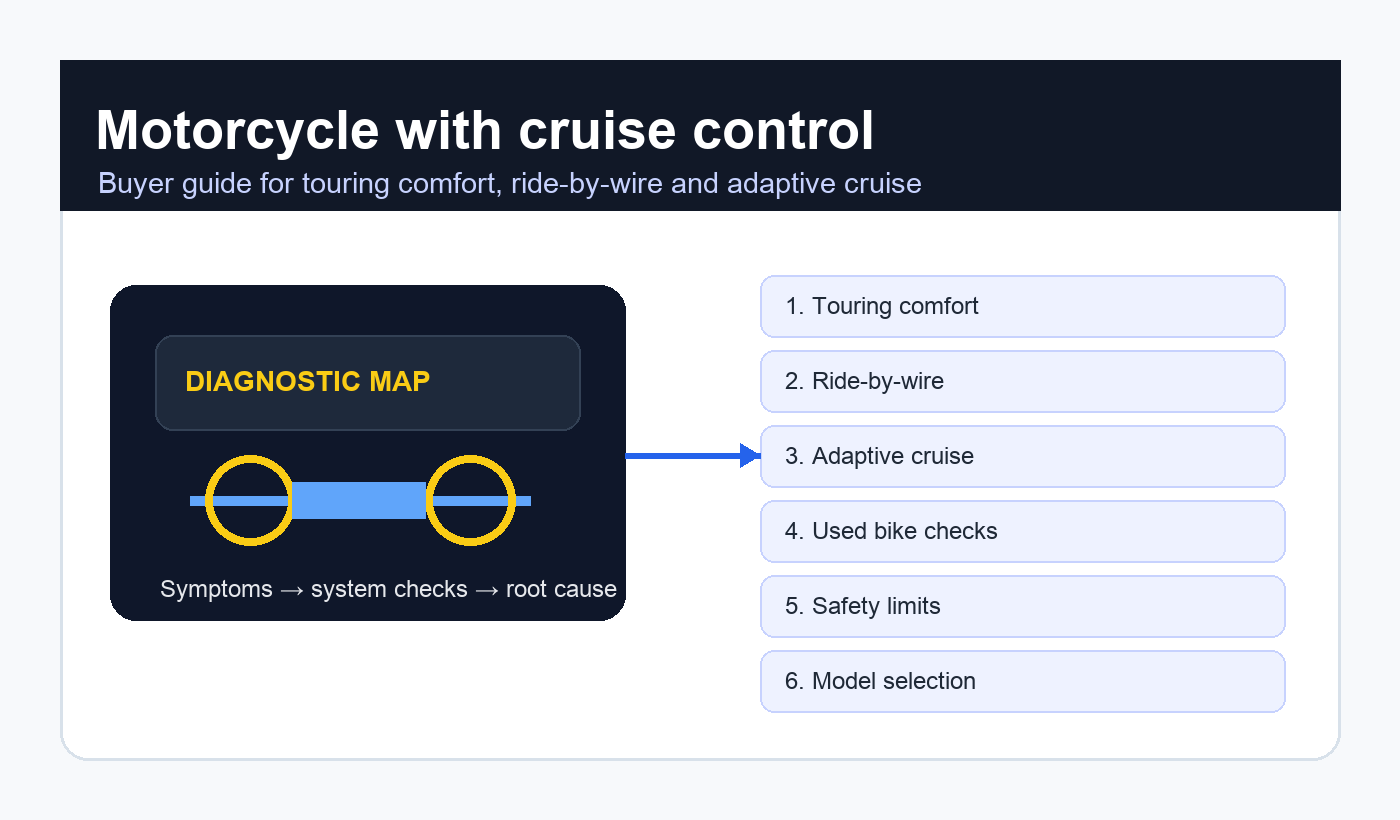
Quick answer: who should buy one?
A Motorcycle with cruise control makes the most sense for riders who spend meaningful time on open roads, motorways, long-distance tours, cross-country commuting or adventure travel with long paved transfers. It reduces right-hand fatigue, helps maintain steady speed, and can make a large motorcycle feel calmer over distance. It is less important for riders who mostly ride in dense city traffic, technical trails or short weekend loops.
The feature should not be confused with autopilot. Conventional motorcycle cruise control holds a set speed. Adaptive cruise control can adjust speed relative to traffic, but the rider remains responsible for steering, braking judgment, lane position, weather decisions and road hazards. A cruise-equipped motorcycle is still a motorcycle.
| Rider type | Value of cruise control | Best category to consider |
|---|---|---|
| Long-distance tourer | Very high | Touring, bagger, sport touring |
| Adventure traveler | High on paved transfers | Adventure touring |
| Daily motorway commuter | Medium to high | Sport touring, commuter, premium naked |
| Urban rider | Low | Not a priority |
| Track or aggressive sport rider | Low | Performance electronics matter more |
How motorcycle cruise control works
Most modern systems depend on ride-by-wire throttle. Instead of a purely mechanical cable directly controlling throttle plates, the rider’s grip position is read electronically and the ECU controls throttle opening. That architecture allows the motorcycle to hold speed through software while still respecting safety inputs such as brake, clutch, gear and throttle override.
Older or simpler solutions may use throttle locks. Those are not the same as true cruise control. A throttle lock holds the grip position; it does not actively maintain road speed uphill or downhill. A true Motorcycle with cruise control uses electronic control to adjust throttle as conditions change.
Conventional cruise control
Conventional cruise control holds a selected speed until the rider cancels it, brakes, pulls the clutch, closes the throttle past a cancel point or presses a switch. It is common on touring motorcycles and many modern adventure-tourers. It is the system most riders mean when they say they want a Motorcycle with cruise control.
Adaptive cruise control
Adaptive cruise control adds forward-sensing radar or similar sensor technology. It can reduce speed when approaching slower traffic and resume speed when the way clears. BMW, Ducati, KTM, Yamaha and other premium manufacturers have used radar-assisted rider aids on selected models. Adaptive systems are more expensive and more complex, but they are valuable for high-mileage road riders.
Best motorcycle categories for cruise control
The best Motorcycle with cruise control is usually found in one of four categories: touring, sport touring, adventure touring or premium cruisers/baggers. Each category delivers the feature with a different riding posture, wind protection, luggage capacity and engine character.
| Category | Strength | Trade-off | Typical buyer |
|---|---|---|---|
| Touring | Maximum comfort and wind protection | Weight and price | Cross-country riders |
| Sport touring | Comfort plus handling | Less lounge-like than full tourers | Fast road travelers |
| Adventure touring | Versatility and upright ergonomics | Seat height and tire compromise | Mixed-route travelers |
| Cruiser/bagger | Relaxed torque and style | Cornering clearance and weight | Highway riders |
| Premium naked | Technology in a lighter package | Wind exposure | Commuters and weekend riders |
Model examples riders commonly compare
Examples change by market and model year, so always confirm the exact trim before buying. Still, common examples include Honda Gold Wing, BMW R 1250 RT and R 1300 GS, BMW K 1600 models, Yamaha Tracer 9 GT/GT+, Ducati Multistrada V4, KTM 1290 Super Adventure, Harley-Davidson touring models, Indian Challenger and Roadmaster, Triumph Tiger 1200, Kawasaki Versys 1000 in some trims, and selected premium middleweights in certain markets.
A Motorcycle with cruise control may have cruise control standard, optional, package-based or absent depending on country. Two bikes with the same name can differ by year and trim. A used listing that says “loaded” is not enough. Check the switchgear, dashboard menu and VIN-specific specification.
Why cruise control matters on long rides
Fatigue changes decision-making. A rider with a cramped throttle hand may adjust posture, lose smoothness or become distracted by discomfort. Cruise control allows the right hand to relax briefly while the rider remains attentive. On open highways, that can reduce strain through the wrist, forearm, shoulder and neck.
This is why the phrase Motorcycle with cruise control often appears alongside searches for heated grips, adjustable windscreen, comfortable seat, panniers, backrest, highway pegs, touring tires and Bluetooth navigation. Riders looking for cruise control are often building an entire long-distance comfort package, not just chasing one button.
Safety limits riders must respect
Cruise control should be used only where conditions make sense. Avoid it in heavy traffic, rain, gravel, construction zones, twisty roads, urban riding, poor visibility, strong crosswinds, standing water or any place where speed needs constant small corrections. A Motorcycle with cruise control gives convenience, not permission to relax attention.
Adaptive cruise control also has limits. Sensors can be affected by weather, lean angle, road curvature, traffic behavior and detection boundaries. A radar-equipped motorcycle may feel advanced, but it still requires rider judgment. Manufacturers describe these systems as assistance, not autonomy.
Aftermarket cruise control and throttle locks
If a bike lacks factory cruise, riders often consider aftermarket options. Electronic aftermarket cruise systems exist for some models, but installation quality matters. Throttle locks and friction devices are cheaper, but they are not equivalent. They hold throttle position rather than vehicle speed, and they demand caution because the rider must cancel or roll off manually.
For a long-distance rider, a factory Motorcycle with cruise control is usually cleaner than a workaround. Factory systems integrate with brake switches, clutch switches, ECU logic, dashboard indicators and safety cancellation. Aftermarket systems can be excellent when well engineered, but they should be chosen carefully and installed by someone who understands the model.
Buying checklist
| Check | Why it matters | How to verify |
|---|---|---|
| Standard or optional | Same model may differ by trim | Check official spec and switchgear |
| Conventional or adaptive | Different capability and cost | Look for radar and ACC menu |
| Minimum activation speed | Some systems work only above a threshold | Read owner manual |
| Cancel inputs | Safety and feel | Test brake, clutch and throttle cancel |
| Ergonomics | Cruise does not fix a bad seat | Test ride at real speeds |
| Wind protection | Comfort depends on airflow | Evaluate helmet buffeting |
What to test on a used bike
When inspecting a used Motorcycle with cruise control, test cruise control during a safe ride. Confirm the system sets, holds, resumes, accelerates, decelerates and cancels correctly. Check whether dashboard warnings appear. Make sure brake lights work reliably because brake switches are part of cancellation logic. If the motorcycle has aftermarket levers, bar-end accessories or modified switchgear, inspect more carefully.
On adaptive systems, confirm radar hardware is undamaged and not blocked by accessories. A front-end impact, poorly mounted auxiliary lights or incorrect screen/bracket installation can affect advanced rider aids. If warning lights are present, scan the bike before purchase.
Cost and value
Cruise control is worth more when it is part of a complete touring package. A Motorcycle with cruise control with poor wind protection, harsh seat and cramped knees may still be tiring. Conversely, a well-designed touring motorcycle with cruise control, good screen, heated grips, luggage and relaxed engine character can transform long days.
Do not buy solely for the feature. Buy for the ride. The best motorcycle with this feature is the one whose ergonomics, weight, service network, reliability record, luggage, seat height, engine heat and maintenance costs fit your actual use.
Test ride protocol
A meaningful test ride should include the road type where the feature will actually be used. A five-minute loop around a dealership does not reveal much. Ask for a route with a steady open section, a few speed changes, and safe space to test set, cancel and resume behavior. Notice whether the switchgear is easy to use with gloves. Some systems are intuitive immediately; others require a few rides before the buttons become natural.
Pay attention to the transition when cruise engages. A refined system holds speed smoothly without a surge. Resume should not feel abrupt. Cancel should be predictable from brake, clutch and throttle inputs. If the motorcycle has ride modes, test whether cruise behavior changes between them or whether the system is restricted in certain modes.
Also test the rest of the motorcycle while cruise is active. Wind noise, buffeting, seat pressure, vibration through bars and footpeg position all matter. A cruise button cannot compensate for a helmet being shaken by turbulent airflow or knees being folded too tightly for your height.
Make the test ride realistic rather than polite. Wear the helmet, gloves, jacket and boots you actually use on longer trips. If you normally ride with luggage, ask whether a loaded demonstration is possible or at least consider how the bike feels with panniers fitted. Small ergonomic irritations that seem harmless during a short ride can become serious fatigue after two hours of steady speed.
Ergonomics matter more than the button
Long-distance comfort is a system. A relaxed throttle hand helps, but the rider also needs a neutral wrist angle, supportive seat, manageable reach to the bars, stable windscreen flow, sensible footpeg location and enough room to move. Riders sometimes overvalue electronics and undervalue basic fit. A motorcycle that fits poorly will still fatigue the body even with cruise engaged.
For taller riders, seat-to-peg distance and windscreen height may be decisive. For shorter riders, seat height, center of gravity and low-speed balance may matter more. For passengers, back support, heat management and luggage position can change the entire touring experience. Evaluate the motorcycle as a travel tool, not as a spec-sheet trophy.
Maintenance and reliability considerations
Factory cruise control is usually reliable because it is integrated into the motorcycle’s electronic architecture. Problems are more likely after switchgear damage, brake switch faults, clutch switch faults, ECU warnings, low battery voltage, aftermarket lever installation or wiring modifications. If cruise stops working on a used bike, do not assume the cruise module itself failed. The system may be refusing to activate because another input is not believable.
On any used purchase, inspect brake lights, clutch switch behavior, battery health and dashboard warnings. If the motorcycle has been fitted with aftermarket levers, bar risers, auxiliary controls or crash repairs near the switchgear, test everything carefully. Electronic convenience features depend on small switches that riders often forget exist.
Feature hierarchy for different buyers
| Buyer priority | More important than cruise? | Why |
|---|---|---|
| Daily city riding | Low-speed balance, heat, mirrors | Cruise will rarely be used |
| Long highway touring | Wind protection, seat, luggage | Cruise works best as part of a comfort package |
| Adventure travel | Fuel range, suspension, tire choice | Transfers matter, but off-road sections matter too |
| Two-up riding | Passenger comfort and load capacity | Electronics do not fix cramped passenger ergonomics |
| Used buying | Service records and condition | A working feature is less valuable than a healthy bike |
Official sources to confirm features
Because specifications change by market, confirm details with manufacturer pages. Honda’s touring lineup is a good reference point for traditional long-distance cruise-equipped motorcycles: Honda Powersports touring motorcycles. BMW Motorrad is a useful reference for premium rider-assistance technology and radar-assisted systems: BMW Motorrad USA.
Related internal reading
If you are comparing electronics, accessories and fitment decisions, read our motorcycle electronics guides, motorcycle buying guides, and fitment guides. Cruise control is only one part of a larger comfort and compatibility decision.
FAQ
Is cruise control worth it on a motorcycle?
Yes, if you ride long distances or spend time on open roads. A Motorcycle with cruise control can reduce fatigue and make speed management easier, but it is less useful for short urban riding.
Is adaptive cruise control better?
Adaptive cruise control is more advanced because it can respond to traffic ahead, but it costs more and has more limitations. Conventional cruise is simpler and still very useful.
Can I add cruise control to a motorcycle?
Sometimes. Some motorcycles have electronic aftermarket systems available, while others only support throttle-lock style devices. Factory integration is usually cleaner.
Does cruise control make riding safer?
It can reduce fatigue in the right conditions, but it is not a safety guarantee. The rider must still manage traffic, traction, road surface and braking.
Final buying strategy
The right Motorcycle with cruise control is not simply the bike with the most buttons. It is the motorcycle that matches your distance, body, roads and maintenance expectations. Treat cruise control as part of a system: throttle technology, ergonomics, wind protection, luggage, suspension and service support.
Motorcycle with cruise control for touring should be evaluated with luggage and passenger comfort in mind.
Motorcycle with cruise control for commuting should be tested at the exact speeds you ride daily.
Motorcycle with cruise control with adaptive cruise should be checked for sensor condition and warning lights.
Motorcycle with cruise control on the used market should be verified by switchgear, dashboard and road test.
Motorcycle with cruise control is most valuable when it supports real riding comfort rather than acting as a brochure feature.
Motorcycle with cruise control with poor wind protection may still leave the rider tired after a long highway day.
Motorcycle with cruise control with heated grips, luggage and an adjustable screen becomes a stronger touring package.
Motorcycle with cruise control should be compared by trim level because features vary between markets.
Motorcycle with cruise control with a throttle lock is not the same as a motorcycle with true electronic cruise.
Motorcycle with cruise control can help maintain steady pace, but it cannot judge traction or traffic for the rider.
Motorcycle with cruise control is a feature worth testing on the road, not just reading about in a spec sheet.
Motorcycle with cruise control for two-up touring should be assessed with passenger weight and luggage fitted.
Motorcycle with cruise control is ultimately about reducing fatigue while keeping the rider fully responsible.