
CFMoto ZForce 1000 problems: the long-form owner’s guide to symptoms, causes, fixes and buying decisions
CFMoto ZForce 1000 problems is a problem wording with a very clear intent: the rider is not browsing casually. They may already own the side-by-side, they may be shopping for a used ZForce, or they may be standing beside a machine that will not start, overheats on a slow trail, makes belt noise, shows an EFI light, or feels different after a hard weekend. The value of a good guide is not to scare people away from the vehicle. It is to separate normal side-by-side wear from patterns that deserve a careful inspection.
The CFMOTO ZForce 1000 sits in a world where people expect a lot from one machine. It may be used for forest roads, farm tracks, mud, hunting access, dunes, snow, towing light loads, and rough recreational riding. That variety matters because many complaints described as CFMoto ZForce 1000 problems are really usage patterns meeting maintenance gaps: a CVT belt that was cooked by slow high-load riding, a radiator packed with mud, suspension wear after rocky terrain, or a battery that has been drained by accessories.
This guide is written for owners, buyers and technicians dealing with CFMoto ZForce 1000 problems in the real world. It focuses on symptoms, checks, realistic repair decisions, legal limits where relevant, and the points worth confirming before buying parts or trusting a seller’s claim.
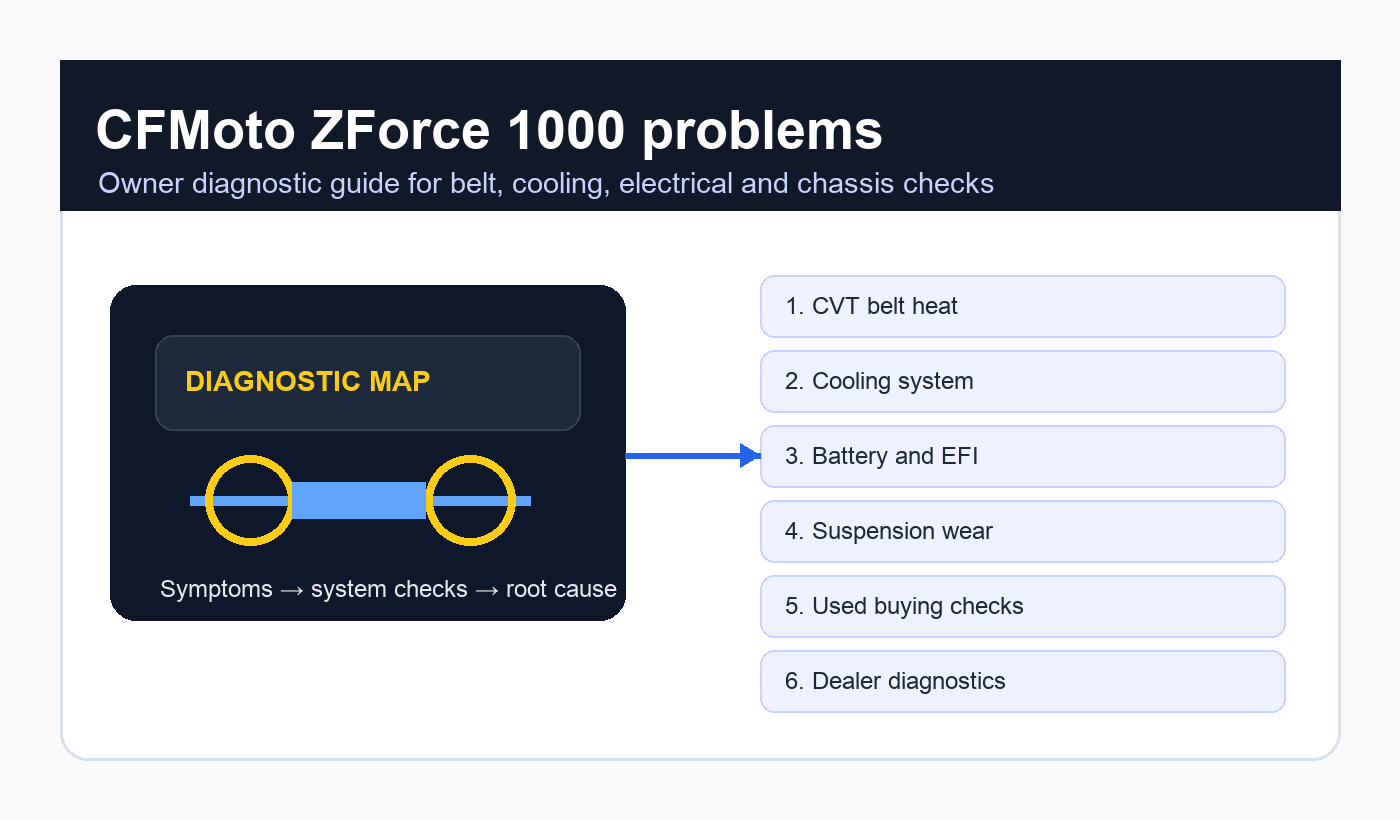
Quick verdict: are the problems serious?
CFMoto ZForce 1000 problems can be serious when the symptom points to overheating, repeated belt failure, loss of steering control, brake fade, electrical shutdown, fuel smell, or a warning light that returns after clearing. But many owner complaints are not catastrophic. The most common patterns tend to involve CVT belt heat, dirty cooling systems, weak batteries, connector corrosion, worn suspension bushings, brake wear, clutch calibration complaints, and accessory wiring that was added without enough planning.
The ZForce is not a passenger car. It is a powersports machine that lives in dust, water, vibration and heat. A fair diagnosis has to account for terrain, load, riding style, service intervals and modifications. A machine that spends its life on dry hardpack may have a very different problem history from one that crawls through mud with oversized tires and extra lighting wired into the battery.
| Symptom | Most likely area | First check | Risk level |
|---|---|---|---|
| Burning rubber smell or loss of drive | CVT belt and clutching | Inspect belt, sheaves, vents and riding history | High if repeated |
| Fan runs often, temperature climbs | Cooling system | Clean radiator, check coolant, inspect fan operation | High |
| Slow crank or no start | Battery, starter circuit, fuel/EFI | Load-test battery and scan codes | Medium |
| Clunks over bumps | Suspension bushings, ball joints, shocks | Lift and inspect play | Medium |
| Intermittent warning lights | Voltage, sensors, connectors | Check grounds, battery and stored codes | Medium to high |
What owners need to know first
The phrase CFMoto ZForce 1000 problems usually comes from three groups of people. The first group already owns the machine and wants to know whether a symptom is common. The second group is shopping used and wants to know what to inspect before handing over money. The third group is comparing CFMOTO with Polaris, Can-Am, Yamaha or Kawasaki and wants to understand reliability trade-offs.
That reader need is important because “problems” does not mean “bad vehicle.” It means the reader wants evidence. A serious article should explain what fails, what merely wears, what maintenance prevents, what a dealer should diagnose, and what a buyer should walk away from. That is the standard used here.
CVT belt and clutch complaints
Among the most common CFMoto ZForce 1000 problems conversations, CVT belt behavior sits near the top. A side-by-side CVT works hard. It manages engine torque through sheaves, belt tension, airflow and heat. Slow riding in high load, oversized tires, aggressive throttle, mud, sand, towing and poor break-in can push the belt beyond its comfort zone.
A belt problem may show up as a burning smell, jerky takeoff, high revs with poor movement, belt dust in the cover, vibration, squealing or sudden loss of drive. When a belt fails once, replacing it may solve the immediate issue. When belts fail repeatedly, the cause is usually deeper: clutch alignment, dirty sheaves, blocked CVT intake/exhaust, wrong belt, driving style, tire size, or contamination inside the clutch cover.
How to inspect the CVT system
Remove the cover only when the machine is safe, cool and supported correctly. Look for glazing, missing belt cogs, belt dust, rubber transfer on sheaves, oil contamination and signs of heat. Check whether vents are blocked by mud or debris. If the machine has oversized tires, ask whether clutching has been adjusted for the new load.
CFMoto ZForce 1000 problems related to belt heat should never be diagnosed from the belt alone. A new belt on dirty clutch faces can fail quickly. A perfect belt in a poorly vented cover can still overheat. A rider crawling in high gear can create heat that looks like a mechanical defect.
Overheating and cooling system issues
Overheating is one of the complaints that should be taken seriously. A ZForce that runs hot after mud riding may simply have a packed radiator. A ZForce that overheats on clean trails with normal airflow deserves deeper diagnosis. Cooling complaints can involve radiator blockage, low coolant, trapped air, fan failure, thermostat behavior, water pump problems, electrical fan control, damaged fins or coolant leaks.
When people discuss CFMoto ZForce 1000 problems in owner groups, overheating is often linked to real-world riding conditions. A radiator that looks acceptable from the front may be packed in the core. Mud dries like concrete. Grass seeds and dust reduce airflow. Slow technical riding gives the cooling system less natural air movement, leaving the fan to do more work.
| Cooling symptom | Likely cause | Owner-level check | Professional check |
|---|---|---|---|
| Hot only after mud | Radiator core blocked | Carefully clean fins from both sides | Pressure test if coolant loss appears |
| Hot at idle | Fan or fan control issue | Listen for fan operation | Check fan command and relay circuit |
| Coolant smell | Leak or overflow | Inspect hoses and cap area | Pressure test cooling system |
| Temperature spikes quickly | Air pocket, thermostat, water pump | Check coolant level when cold | Bleed/test system correctly |
Starting problems, battery drain and electrical faults
Electrical complaints are another major part of CFMoto ZForce 1000 problems. They can be frustrating because the same machine may start fine in the garage and fail at the trailhead. Many side-by-sides are fitted with winches, light bars, sound systems, GPS units, heated gear connectors and accessory panels. Each accessory adds potential current draw, wiring mistakes, ground problems and water-entry points.
Start with the battery. A weak powersports battery can show voltage but collapse under load. Loose terminals can mimic a failing starter. Corroded grounds can create intermittent sensor faults. A machine stored for weeks without a maintainer can develop low-voltage symptoms that look like ECU, injector or starter problems.
EFI and sensor warnings
EFI lights, rough idle, hesitation and limp behavior should be scanned instead of guessed. Possible causes include low voltage, dirty air filter, fuel quality, sensor connector problems, throttle position issues, intake leaks, exhaust oxygen sensor faults, or wiring damage. A code is not a part number. It is a direction for testing.
Suspension, steering and chassis wear
Side-by-side suspension lives a hard life. Clunks, looseness, wandering steering and uneven tire wear may be described online as CFMoto ZForce 1000 problems, but many of these issues are wear inspections rather than brand-specific failures. Bushings, ball joints, tie rods, wheel bearings, shock mounts and control-arm hardware should be checked after hard riding.
If a used ZForce has been lifted, fitted with larger tires, driven in deep mud or jumped, inspect the chassis more carefully. Modifications can increase leverage on suspension parts. A machine with clean plastics can still have play in the front end. A careful buyer lifts the vehicle safely, rocks the wheels, checks steering joints and inspects skid plates for impact history.
Brakes, drivetrain noise and transmission feel
Brakes on off-road vehicles wear differently from road vehicles. Mud, grit and water can shorten pad life. Squeal is not always failure, but grinding, pulling, low pedal feel or fluid leaks are urgent. Drivetrain noise can come from normal gear whine, worn U-joints, CV joints, wheel bearings, differential issues, loose mounts or tire noise. The context matters: a click while turning under power is different from a clunk when shifting from park to drive.
CFMoto ZForce 1000 problems related to drivetrain feel should be inspected early because small issues can become expensive. A torn CV boot can lead to joint failure. A loose mount can stress surrounding components. Contaminated gear oil can reveal water entry or neglected service.
Used buying inspection checklist
A buyer searching CFMoto ZForce 1000 problems before purchasing is doing the right thing. The best used ZForce is not necessarily the cleanest one in photos. It is the one with maintenance records, a cold-start video, honest disclosure, matching tires, clean fluids, working fan, healthy battery, good belt history and no hidden electrical modifications.
| Inspection area | What to look for | Walk-away sign |
|---|---|---|
| Cold start | Starts cleanly without throttle tricks | Seller warms it before arrival |
| CVT | No burning smell, smooth engagement | Fresh belt plus unresolved slipping |
| Cooling | Fan cycles, temp stable | Coolant loss or repeated overheating |
| Electrical | Clean accessory wiring and terminals | Twisted wires, random switches, dead battery |
| Suspension | No excessive joint play | Loose steering or bent arms |
| Fluids | Correct levels and clean appearance | Milky oil or metal debris |
Maintenance that prevents many complaints
The best answer to CFMoto ZForce 1000 problems is often disciplined maintenance. Clean the radiator after dirty rides. Inspect and break in belts correctly. Keep the air filter serviced. Use a battery maintainer during storage. Check fasteners after hard riding. Inspect CV boots. Change fluids on schedule. Keep accessories fused and grounded properly. Do not ignore small noises just because the machine still drives.
For official model documents and specifications, start with the manufacturer’s site: CFMOTO USA. For safety recalls in the United States, use the official government recall search: U.S. Consumer Product Safety Commission recalls. These are stronger references than anonymous posts when safety or model documentation matters.
How terrain changes the diagnosis
A side-by-side that lives on smooth fire roads does not fail in the same pattern as one used in deep mud or tight technical crawling. Terrain changes temperature, airflow, belt load, suspension impact, brake wear and contamination. This is why a symptom that sounds identical online can have two different causes in the workshop.
On slow rocky climbs, the CVT may spend more time slipping and building heat. In mud, the radiator and CVT vents are exposed to blockage. In sand, the belt and clutch face sustained load. In snow, moisture and freeze-thaw cycles can affect linkages, switches and connectors. On farm tracks, repeated low-speed hauling can stress cooling and drivetrain components even if the machine never looks abused.
When interviewing an owner or seller, ask where the machine was used, not only how many hours it has. Hours are useful, but hour quality matters. A low-hour machine that was repeatedly submerged can be less attractive than a higher-hour machine maintained carefully on dry trails.
Dealer diagnosis versus home diagnosis
There is a point where home inspection becomes guesswork. Owners can inspect belts, clean radiators, test batteries, check fluids and look for loose joints. But warning lights, sensor faults, intermittent EFI behavior and repeated electrical failures are better handled with diagnostic software and service data.
A good dealer or independent powersports technician should not simply clear codes and return the machine. They should record codes, inspect related wiring, reproduce the symptom if possible, check battery voltage under load, inspect connectors for water intrusion and verify the repair after the machine reaches operating temperature. If a fault appears only after heat soak or rough riding, a stationary garage test may miss it.
| Problem pattern | Home diagnosis is enough? | Why a shop may be needed |
|---|---|---|
| One worn belt after hard use | Often yes | Inspecting belt and vents may solve it |
| Repeated belt failures | No | Clutch alignment, sheave condition and setup need deeper checks |
| Radiator packed with mud | Often yes | Cleaning and coolant check may restore operation |
| Overheats on clean trails | No | Fan control, thermostat, water pump and pressure tests may be needed |
| Random EFI warning | Usually no | Codes and live sensor data are needed |
Cost thinking: repair the cause, not the complaint
The cheapest repair is not always the lowest-priced part. A belt replacement is cheaper than clutch diagnosis, but if the belt fails again the owner has paid twice and still has the same root problem. A battery is cheaper than electrical diagnosis, but if a parasitic draw from accessories keeps draining the new battery, the real repair was never completed.
Think in systems. A hot CVT is a system problem involving belt, clutch, airflow, load and rider behavior. A hot engine is a system problem involving coolant, airflow, fan control, pump movement and combustion load. A no-start complaint is a system problem involving battery, fuel, spark, sensors, starter circuit and security logic. This mindset keeps the diagnostic path honest.
How to document the issue before asking for help
Good documentation saves time. Before calling a dealer or posting in an owner group, write down the year, mileage, hours, modifications, tire size, recent service, terrain, ambient temperature, fuel age and exact symptom. Take photos of warning lights and short videos of noises or starting behavior. If a belt failed, keep the belt and photograph the clutch cover before cleaning everything.
Document whether the symptom happens cold, hot, uphill, after water, after storage, under load or only at idle. That timeline often matters more than a vague description. “It overheats” is not as useful as “the temperature climbs after ten minutes of slow mud riding, the fan runs, and the radiator was recently cleaned.”
Related internal reading
For more model-specific powersports diagnostics, read our CF Moto CForce 625 exhaust fitment guide, our fitment guides, and our motorcycle electronics guides. The platforms differ, but the diagnostic habit is the same: inspect power, heat, fitment, wear and service history before replacing parts.
FAQ
Are CFMOTO ZForce 1000 machines unreliable?
Not automatically. The phrase CFMoto ZForce 1000 problems often reflects hard use, maintenance gaps or used-buying concerns. Reliability depends heavily on service, terrain, modifications and how the CVT and cooling system are treated.
What is the first thing to check?
Start with the symptom. For drive issues, inspect the CVT belt and clutch area. For heat, inspect the radiator and fan. For no-start, test the battery under load. For warning lights, scan codes before replacing parts.
Is belt failure always the vehicle’s fault?
No. Belt life depends on break-in, load, gear selection, clutch condition, tire size, ventilation and riding style. Repeated belt failure needs root-cause diagnosis.
Should I avoid a used ZForce 1000 with accessories?
No, but inspect accessory wiring carefully. Poorly installed lights, audio systems and winches can cause battery drain and intermittent electrical issues.
Final owner strategy
The smartest approach to CFMoto ZForce 1000 problems is calm evidence. Do not treat every forum complaint as a defect, and do not dismiss every symptom as normal wear. Start with the visible system: belt, cooling, battery, connectors, suspension and fluids. Then move to scan data and dealer-level checks when needed.
CFMoto ZForce 1000 problems after a hard mud ride often points toward cleaning and cooling checks.
CFMoto ZForce 1000 problems after storage often starts with battery and fuel checks.
CFMoto ZForce 1000 problems after oversized tires may involve clutch load and drivetrain stress.
CFMoto ZForce 1000 problems before buying should lead to a full used-vehicle inspection, not just a price negotiation.
CFMoto ZForce 1000 problems that repeats after repairs deserves professional diagnosis with codes, live data and physical inspection.
CFMoto ZForce 1000 problems with a burning smell should be treated as a CVT heat warning until proven otherwise.
CFMoto ZForce 1000 problems with coolant odor should trigger a cooling-system pressure check.
CFMoto ZForce 1000 problems with slow cranking should begin with a battery load test.
CFMoto ZForce 1000 problems with steering play should be inspected before the next fast trail ride.
CFMoto ZForce 1000 problems with a repeated EFI light should be scanned, not guessed.
CFMoto ZForce 1000 problems on a modified machine should include a review of tire size, clutching and accessory wiring.
CFMoto ZForce 1000 problems on a low-hour used machine can still be real if the machine was abused.
CFMoto ZForce 1000 problems is best solved by matching the symptom to the system instead of replacing parts in hope.