
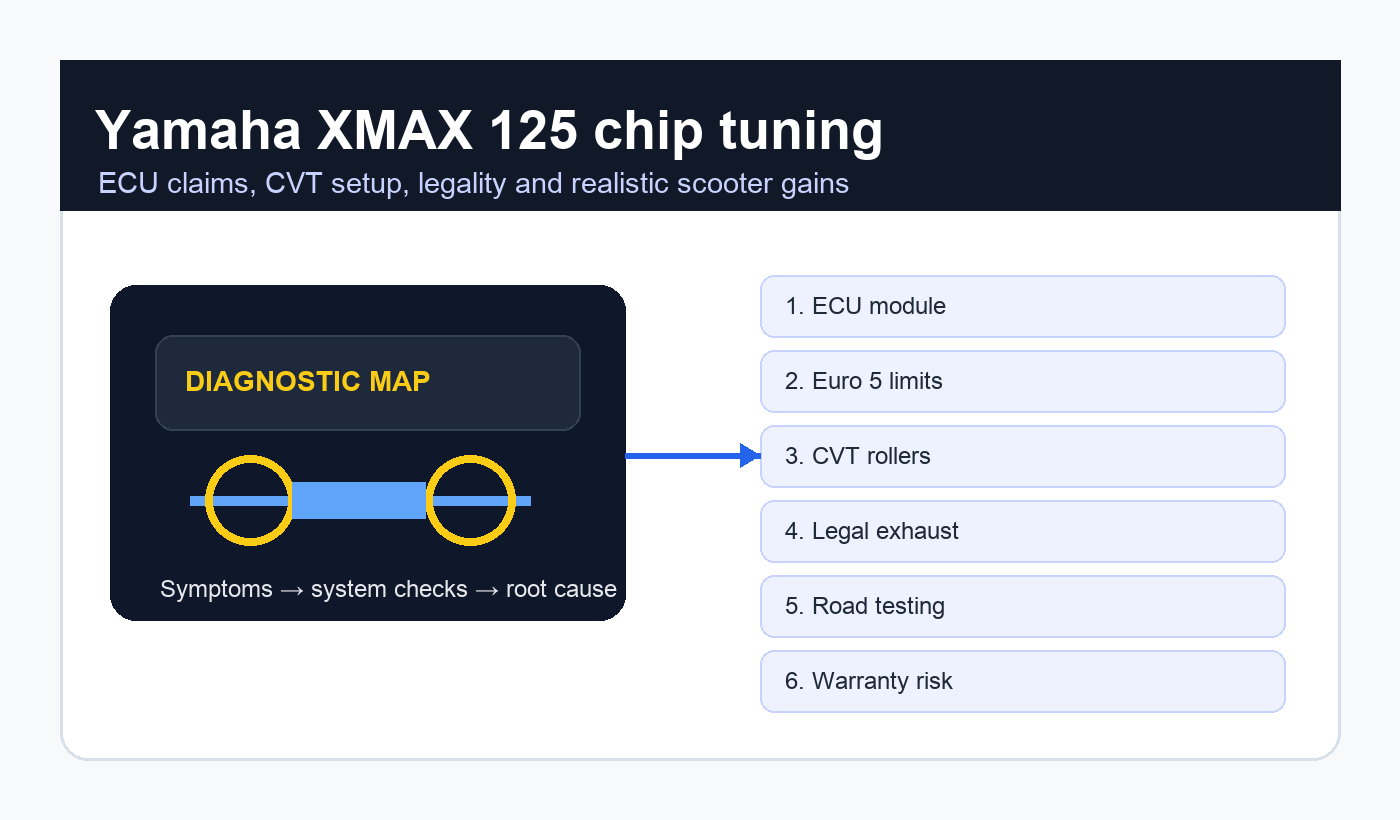
Yamaha XMAX 125 chip tuning: realistic ECU, CVT and performance advice for the 125 scooter
Yamaha XMAX 125 chip tuning is a phrase that promises a lot: more acceleration, more top speed, a sharper throttle and perhaps a hidden reserve of power inside Yamaha’s 125 maxi-scooter. The truth is more measured. The XMAX 125 is a modern small-displacement scooter shaped by licensing rules, emissions standards, fuel injection, CVT transmission and reliability expectations. Useful improvements are possible, but not every plug-in box or remap claim deserves trust.

This guide explains Yamaha XMAX 125 chip tuning like a practical owner and workshop analysis. It covers what a chip module can and cannot do, Euro 5 limits, ECU remap claims, CVT variator tuning, rollers, sliders, exhausts, air filters, throttle feel, legal issues, warranty risk, maintenance baseline and how to test whether a modification actually made the scooter better.
Quick answer
The short Yamaha XMAX 125 chip tuning answer is that a plug-in chip or generic fuel box is unlikely to transform an XMAX 125 into a much faster scooter. The most noticeable real-world gains usually come from perfect maintenance, a healthy belt, correct rollers or sliders, clean intake, good tires and a conservative CVT setup. ECU or fueling changes should be treated carefully because emissions, legality, engine protection and warranty matter.
What owners need to know first
This guide is written for owners, buyers and technicians dealing with Yamaha XMAX 125 chip tuning in the real world. It focuses on symptoms, checks, realistic repair decisions, legal limits where relevant, and the points worth confirming before buying parts or trusting a seller’s claim.
| Intent | Associated topics | Best answer |
|---|---|---|
| Electronic tuning | chip, ECU, fuel box, remap | Demand evidence and understand emissions limits. |
| Acceleration | variator, rollers, sliders, CVT | Transmission setup is usually more noticeable. |
| Top speed | derestrict, limiter, maximum speed | Expect small gains; power and law limit results. |
| Sound/appearance | exhaust, air filter, sport kit | Choose legal, compatible parts. |
| Reliability | warranty, belt life, engine wear | Keep changes conservative and documented. |
Understand the XMAX 125 platform
A realistic Yamaha XMAX 125 chip tuning discussion starts with the scooter itself. Yamaha’s XMAX line is a maxi-scooter family, and the 125 version serves markets where licensing and insurance make small displacement attractive. It is designed for commuting, comfort, fuel economy and legal accessibility, not for large hidden horsepower reserves.
Yamaha’s official European pages identify the XMAX 125 as part of the brand’s scooter range through Yamaha Motor’s XMAX 125 page. For broader model history, the Yamaha XMAX reference summarizes the XMAX family and the 125’s place in the range.
What chip tuning can actually change
Most Yamaha XMAX 125 chip tuning products claim to alter fueling, throttle response, sensor signals or ECU behavior. On a naturally aspirated 125 scooter, the possible window is small. More fuel alone does not create more air, more displacement or a stronger camshaft. A poorly designed module can make the engine run rich, waste fuel, trigger warning lights or shorten catalyst life.
A good electronic tune should be measured on the exact scooter, with air-fuel data, temperature behavior, fault-code checks and real road testing. A generic percentage claim is not enough.
| Claim | Reality check | Owner question |
|---|---|---|
| More horsepower | Likely modest on a 125 | Is there dyno data for this exact model? |
| Better throttle | Possible, but may be perception | Does it improve real acceleration? |
| More top speed | Usually limited by power and CVT | Was speed measured safely and repeatably? |
| No risk | Every fueling change has risk | What happens to warranty and emissions? |
| Plug and play | Fitment is only part of the job | Can faults be read and reversed? |
Euro 5 and legal limits
Modern Yamaha XMAX 125 chip tuning must respect emissions rules. Euro 5 scooters are calibrated for noise, emissions, fuel economy and durability. Changing fueling or exhaust behavior can affect legal compliance and inspection status. In some countries, modifications can also affect insurance or license-class assumptions.
If a part is sold for racing use, assume it is not meant for public roads unless documentation proves otherwise. Keep original parts and invoices.
The safest Yamaha XMAX 125 chip tuning plan is one that can be explained to an insurer, a dealer and an inspection station without hiding the modification.
CVT tuning is often more useful
For most riders, the most noticeable Yamaha XMAX 125 chip tuning alternative is not a chip but CVT tuning. The variator, belt, rollers, sliders and clutch decide how the engine’s limited power is delivered. A careful roller or slider change can help the engine stay closer to its useful rpm range, improving takeoff and mid-speed response.
The goal is not maximum noise. Very light rollers can make the engine rev high, feel busy and reduce economy. The right setup balances acceleration, cruising rpm, belt temperature and daily comfort.
Heat management is the part many riders ignore. The CVT works by friction, belt tension and pulley movement, so every change that raises rpm or increases slip also changes temperature. After a roller or slider change, ride the scooter normally, then check for belt smell, new vibration, rattles or black dust inside the cover at the next inspection. A setup that feels lively but cooks belts is not a good setup for a commuter.
| CVT item | Possible benefit | Risk if wrong |
|---|---|---|
| Fresh belt | Restores lost drive | Cheap belt can wear quickly. |
| Roller weight change | Sharper acceleration | Too light causes noise and heat. |
| Sliders | Smoother ratio behavior | Wrong size hurts performance. |
| Variator kit | Broader setup change | Can reduce reliability if aggressive. |
| Clutch service | Smoother takeoff | Harsh springs can annoy in traffic. |
Maintenance before performance parts
The best Yamaha XMAX 125 chip tuning baseline is a scooter in perfect condition. Check belt age, rollers, clutch, air filter, spark plug, valve service where applicable, tire pressure, brake drag and fuel quality. A tired belt or dirty filter can make the scooter feel slow, and a tuning part may only mask neglect.
Before buying electronics, restore factory performance. Many owners are surprised how much better a small scooter feels after a proper CVT refresh and service.
That is why Yamaha XMAX 125 chip tuning should start with measurements and maintenance, not with the most aggressive product listing.
Pre-tuning diagnostic checklist
Before any performance part is fitted, create a baseline. Check that the scooter starts easily cold and hot, idles steadily, accelerates without flat spots, reaches normal operating temperature and has no stored faults. Inspect tire pressure, brake drag, belt age, rollers, variator faces, clutch bell, air filter, spark plug and fuel quality. If any of these are wrong, a chip module will not solve the real problem.
A baseline also protects the owner from false expectations. If the scooter is already down on performance because of a worn belt, a new electronic module may feel better only because the rider wants it to. A recorded baseline makes the result honest.
| Baseline check | Good sign | Warning sign |
|---|---|---|
| Cold start | Starts cleanly and idles steady | Hunting idle, long cranking, fuel smell. |
| CVT | Smooth takeoff and no belt smell | Judder, vibration, high rpm with low speed. |
| Air filter | Clean and properly sealed | Dirty, wet, poorly fitted or modified. |
| Brakes/tires | No drag, correct pressure | Dragging brake or old tires. |
| Fault memory | No active warning lights | Stored or current injection faults. |
Exhaust and air filter choices
Exhaust-based Yamaha XMAX 125 chip tuning is often more about sound and appearance than large power. A homologated exhaust can improve character and sometimes save weight, but it should not be expected to transform a 125. Removing baffles or catalyst equipment can create legal and fueling problems.
Air filters deserve the same caution. A clean, well-sealed filter is essential. A loud intake that lets dust pass is not a performance upgrade; it is future engine wear.
Top speed expectations
Many riders search Yamaha XMAX 125 chip tuning because they want more top speed. A 125 scooter’s maximum speed is limited by power, CVT range, rider size, wind, screen position, road gradient and legal design. Small gains may be possible, but dramatic claims should be treated skeptically.
A setup that improves 0-50 km/h or 30-70 km/h response may be more valuable for daily riding than a tiny increase in maximum speed.
In daily traffic, Yamaha XMAX 125 chip tuning is most successful when the scooter feels smoother and more confident rather than merely louder.
The hard limit of 125 cc
A 125 scooter is working with limited displacement, small valve area, modest torque and a transmission designed for broad usability. Tuning cannot remove those physics. It can only help the engine spend more time in its useful range, reduce losses, improve response or correct fueling after compatible hardware changes. That is why honest performance discussions focus on feel, not miracle power.
This does not make tuning pointless. It means the target should be realistic: cleaner launch, steadier hill response, less lazy midrange and better maintained factory performance. Those are worthwhile improvements for an everyday scooter, especially when the owner rides in city traffic.
Warranty and diagnostic risk
Any Yamaha XMAX 125 chip tuning module that alters sensor signals or fueling can affect warranty conversations. Even if a part is reversible, fault history, wiring marks or non-standard behavior can create questions. A dealer may not treat a tuned scooter the same way as a standard one.
Keep documentation, know how to return to stock and scan for faults after installation. Do not leave warning lights unresolved.
A reversible Yamaha XMAX 125 chip tuning setup is still not invisible if it causes stored faults, poor running or altered wiring.
Cost versus benefit
Money spent on a 125 should be prioritized carefully. A premium belt, quality rollers, fresh tires and brake service may improve the whole ride more than a mysterious electronic box. A legal exhaust may make the scooter more enjoyable, but it should not consume the budget needed for essential maintenance. The best value is the change that improves the riding you actually do.
| Upgrade | Best case | Value warning |
|---|---|---|
| Maintenance refresh | Restores lost performance | Not glamorous, but often best value. |
| CVT setup | Sharper response | Needs correct weights and inspection. |
| Chip/fuel module | May refine fueling in specific cases | Weak value without data. |
| Exhaust | Sound, looks, possible weight saving | Can be expensive for little speed gain. |
| Air filter | Easy service item | Poor filtration is costly later. |
How to test a tuning claim
A proper Yamaha XMAX 125 chip tuning test should be repeatable. Use the same route, same rider, same fuel load, similar weather and correct tire pressure. Record acceleration feel, GPS speed, cruising rpm, fuel use, engine temperature behavior, warning lights and hot restart quality. Noise is not proof of speed.
Test one change at a time. If you install a chip, exhaust, filter and rollers together, you will not know which part helped or hurt.
Good Yamaha XMAX 125 chip tuning testing also includes a few days of normal commuting, because heat, cold starts and stop-start traffic reveal problems a short test ride can miss.
Do not ignore comfort during testing. A scooter that revs higher everywhere may feel quicker on the first ride but become tiring on longer commutes. A good setup should make normal riding easier, not turn every journey into a noisy test session.
Keep a simple log after each change: date, mileage, part fitted, roller weight, belt condition, fuel consumption and any new vibration or warning light. This is not bureaucracy; it is how an owner avoids chasing the same problem twice. It also helps a future buyer understand whether the scooter was tuned carefully or simply modified by trial and error.
| Test area | What to record | Why it matters |
|---|---|---|
| Acceleration | Repeatable roll-on feel or timed runs | Shows useful road improvement. |
| Top speed | GPS reading, same road and wind | Reduces speedometer illusion. |
| Fuel economy | Consumption before/after | Detects rich or inefficient setup. |
| Faults | Warning lights or stored codes | Protects reliability. |
| CVT heat | Belt smell, dust, vibration | Prevents belt damage. |
Best upgrade order
The safest Yamaha XMAX 125 chip tuning order is service baseline, CVT inspection, fresh belt if needed, conservative roller or slider tuning, quality tires, brake service, legal exhaust if desired, and only then electronic changes if there is real evidence. This order keeps the scooter reliable and makes improvements measurable.
For another 125 scooter tuning topic, our Honda Forza 125 chip tuning guide explains why small-displacement electronic tuning needs conservative expectations.
Buying a used tuned XMAX 125
A used buyer researching Yamaha XMAX 125 chip tuning should ask what was fitted, who installed it, whether original parts are included, whether the scooter has fault codes, what roller weight is installed and whether the exhaust is legal. A modified scooter with no documentation should be priced as a project.
For broader Yamaha scooter tuning context, our Yamaha Tricity 300 tuning article shows why CVT setup and platform limits matter more than generic performance claims.
If a seller cannot explain the Yamaha XMAX 125 chip tuning setup clearly, assume you may need to return the scooter to standard before trusting it.
During a viewing, ride the scooter from cold if possible. Listen for rattles from the CVT cover, check that the engine settles into idle, confirm the dashboard is clean and make sure the scooter pulls smoothly without surging. A tuned 125 that only behaves well once fully warm may be hiding fueling or transmission compromises.
Common mistakes
The biggest Yamaha XMAX 125 chip tuning mistake is believing a cheap plug-in module will create large power on a 125 without trade-offs. The second is modifying before servicing. The third is using non-legal exhaust or intake parts on a daily road scooter. The fourth is ignoring belt heat and CVT wear after changing rollers.
For a three-wheel performance comparison, our Piaggio MP3 500 power increase guide shows the same principle at larger displacement: setup matters more than hype.
A disciplined Yamaha XMAX 125 chip tuning owner keeps notes on parts, mileage and results so every change can be reversed or understood later.
Frequently asked questions
Can a chip make the XMAX 125 much faster?
Yamaha XMAX 125 chip tuning can potentially change fueling or response, but a large speed increase is unlikely on a naturally aspirated 125. CVT setup often feels more noticeable.
Is ECU remapping safe?
It depends on the tuner, data and legality. A map without proper testing can harm drivability, emissions compliance or warranty.
Safe Yamaha XMAX 125 chip tuning means stable fueling, no warning lights, legal road use and clear documentation, not just a sharper throttle.
What is the best first upgrade?
The best first Yamaha XMAX 125 chip tuning step is a complete maintenance baseline, then CVT inspection and conservative roller/slider tuning if needed.
Will an exhaust add power?
A legal exhaust may improve sound and save weight, but large power gains from a slip-on alone are unlikely. Keep emissions and noise rules in mind.
Can tuning damage the belt?
Yes. Aggressive roller weights or poor clutch setup can increase heat and wear. Inspect the CVT after changes.
Any Yamaha XMAX 125 chip tuning plan that changes how the engine revs should include CVT inspection after the first rides.
Should I keep original parts?
Yes. Keep the original ECU setup, exhaust, rollers and documentation. Reversibility is valuable for warranty, resale and troubleshooting.
Final verdict
Yamaha XMAX 125 chip tuning should be approached with realistic expectations. The XMAX 125 can be made sharper and more satisfying, but the best gains come from maintenance, CVT setup, tires, brakes and carefully chosen legal parts rather than miracle electronics.
Use Yamaha XMAX 125 chip tuning as a measured process: restore the scooter, test one change at a time, demand evidence from chip claims, protect legality and keep reliability first. That makes the XMAX 125 better where it matters most: daily acceleration, smooth response and confidence on real roads.