Piaggio MP3 500 power increase: realistic ways to make the three-wheel scooter feel stronger
Piaggio MP3 500 power increase is a popular idea because the MP3 500 has the size, weight and road presence of a serious commuter, yet many riders still want sharper acceleration, better hill response, more confident overtaking and a little more character from the engine. The important truth is that the MP3 500 is a heavy three-wheel scooter with CVT transmission, emissions equipment and a specific safety role, so useful gains come from careful setup rather than fantasy horsepower claims.

This guide explains Piaggio MP3 500 power increase like a practical workshop and owner roadmap. It covers maintenance first, CVT variator tuning, belts, rollers, sliders, clutch setup, exhaust choices, fueling limits, air filters, weight, tire pressure, braking, legal rules, reliability risks and how to judge whether a modification truly improved the scooter.
Quick answer
The short Piaggio MP3 500 power increase answer is that the best real-world improvement usually comes from restoring the scooter to perfect service condition and then tuning the CVT conservatively. A fresh belt, correct roller or slider setup, clean clutch, quality tires and a legal exhaust can make the MP3 500 feel more responsive. Big engine power gains are limited unless you accept cost, legality, noise, emissions and reliability compromises.
What owners need to know first
This guide is written for owners, buyers and technicians dealing with Piaggio MP3 500 power increase in the real world. It focuses on symptoms, checks, realistic repair decisions, legal limits where relevant, and the points worth confirming before buying parts or trusting a seller’s claim.
| Reader need | Associated topics | Best answer |
|---|---|---|
| More acceleration | variator, rollers, sliders, CVT kit | Optimize rpm and ratio change without overheating the belt. |
| More sound/character | exhaust, auspuff, slip-on, homologated silencer | Use legal parts and realistic expectations. |
| More top speed | derestrict, limiter, ECU, top speed | Expect small gains; wind, gearing and power dominate. |
| Reliability concern | belt life, clutch heat, service interval | Keep setup conservative for daily commuting. |
| Used scooter tuning | maintenance, belt age, rollers, tires | Restore baseline before modifying. |
Understand the MP3 500 platform
A serious Piaggio MP3 500 power increase plan begins by respecting what the MP3 is. The Piaggio MP3 is a tilting three-wheel scooter with two front wheels and one rear wheel, produced by Piaggio since 2006. The 500-class models use large single-cylinder engines and automatic V-belt CVT transmission, with the front end adding grip and stability but also weight.
For official brand and model context, start from Piaggio’s official site. For technical history and the MP3 layout, the Piaggio MP3 reference summarizes the three-wheel design, engine families and CVT transmission.
Maintenance before modification
The most overlooked Piaggio MP3 500 power increase step is not a tuning part. It is maintenance. A tired belt, flat-spotted rollers, dirty air filter, dragging brake, weak spark plug, old coolant, incorrect tire pressure or glazed clutch can make a healthy 500 feel lazy. Many riders buy performance parts just to recover power that was lost to neglect.
Before tuning, confirm service history, belt age, variator condition, clutch shoes, air filter, spark plug, valve service, oil, coolant, brake drag, wheel bearings and tire age. A scooter that is not mechanically fresh cannot be tuned honestly.
That is why Piaggio MP3 500 power increase should start with evidence: measurements, service records and a short road test before any part is ordered.
| Baseline check | Why it matters | Symptom if poor |
|---|---|---|
| CVT belt | Transfers all engine output | Slipping, high rpm, weak drive. |
| Rollers/sliders | Control ratio change | Flat spots, vibration, lazy response. |
| Clutch | Controls takeoff | Judder, smell, delayed launch. |
| Air filter | Protects engine and airflow | Rich running, poor response, wear risk. |
| Brakes/tires | Define control and rolling resistance | Drag, instability, long stops. |
CVT tuning is the main realistic path
Most useful Piaggio MP3 500 power increase happens in the transmission, not inside the cylinder head. The variator, rollers, sliders, belt and clutch decide how quickly the engine reaches its useful rpm range. A better setup can make the scooter pull harder from lights and respond more cleanly in mid-speed traffic without adding engine horsepower.
The key is moderation. Very light rollers may make the engine rev dramatically but create noise, heat and fuel use. Too heavy and the scooter feels slow. The right setup depends on rider weight, passenger use, terrain, commuting style and whether the scooter is used on motorways.
Rollers, sliders and variator kits
For many owners, Piaggio MP3 500 power increase means fitting lighter rollers, premium sliders or a performance variator. These parts can be worthwhile when chosen carefully. They change how the CVT shifts, which can improve acceleration and roll-on feel. They do not turn the MP3 500 into a different engine.
Measure the old parts before changing them. Note original roller weight, belt width, mileage and any wear pattern. Change one variable at a time where possible. A dramatic change that feels exciting for five minutes may become tiring on a long commute.
| CVT part | Likely benefit | Risk if wrong |
|---|---|---|
| Slightly lighter rollers | Quicker rpm rise | Noise, heat, high fuel use. |
| Quality sliders | Smoother ratio behavior | Wrong size or weight hurts response. |
| Performance variator | Broader tuning change | Can shorten belt life if mismatched. |
| Fresh belt | Restores lost drive | Cheap belt may fail early. |
| Clutch service | Smoother launch | Aggressive springs can be harsh. |
Exhaust upgrades
Exhaust-based Piaggio MP3 500 power increase is common because the part is visible and the sound change is immediate. A homologated exhaust can reduce weight, improve tone and add character. It may help slightly with response when paired with correct setup, but a slip-on alone rarely produces a large measurable gain on a modern fuel-injected scooter.
Choose road-legal parts for your market, keep documents and avoid removing emissions equipment where that is illegal. A louder scooter that attracts inspection problems is not a successful daily upgrade.
A sensible Piaggio MP3 500 power increase exhaust choice is one that keeps cold starts, idle quality and inspection compliance as clean as the sound.
Air filter and intake changes
Air filter claims are another Piaggio MP3 500 power increase trap. A clean, properly sealed filter is essential. A poorly filtered intake is dangerous. The MP3 500 lives in rain, city dust and road grime, so filtration quality matters more than intake noise.
A high-quality replacement filter may be reasonable if it fits perfectly and is maintained correctly. An open intake without fueling proof can reduce drivability and increase engine wear risk.
ECU remap and fueling modules
Electronic Piaggio MP3 500 power increase products should be judged with evidence. A fueling module or remap may help if intake and exhaust changes move the mixture outside ideal range, but naturally aspirated single-cylinder scooter engines do not hide huge safe power reserves. Emissions rules, oxygen sensors, catalyst requirements and inspection laws also matter.
If a device promises a large percentage gain without dyno data on the exact MP3 500 model and year, be skeptical. Smooth throttle and correct fueling are more valuable than an advertising number.
Top speed expectations
Many riders begin Piaggio MP3 500 power increase because they want more top speed. That is the hardest result to achieve. Maximum speed depends on power, gearing, CVT range, wind resistance, rider size, screen height, tire condition and road gradient. A heavier three-wheel scooter faces more drag and mass than a lighter two-wheel maxi-scooter.
A well-set CVT may help the scooter reach speed more quickly. It may not raise the final number much. If the MP3 has lost top speed, inspect belt, rollers, clutch, brake drag and tire pressure before assuming it needs derestriction.
For most commuters, Piaggio MP3 500 power increase is more valuable when it improves roll-on response than when it chases a rarely used maximum-speed figure.
Weight, wind and commuting reality
Practical Piaggio MP3 500 power increase must account for how the scooter is used. A top box, tall screen, leg cover, passenger, luggage and winter gear all add weight or drag. Removing unnecessary load, choosing the right screen position and keeping tire pressure correct can make the scooter feel more lively without stressing the engine.
For commuting, instant smooth response from 0-70 km/h is usually more valuable than a small top-speed change. A scooter that is predictable in traffic is faster in real life than one that only sounds aggressive.
This makes Piaggio MP3 500 power increase partly a setup problem: the same engine can feel very different with correct tire pressure, clean CVT parts and sensible luggage weight.
Rider habits matter as well. A CVT scooter responds best when the throttle is used smoothly enough to let the transmission settle into the right ratio. Repeated full-throttle launches from cold, long climbs with an overloaded scooter and slow traffic with a dragging rear brake all add heat. Heat is the enemy of belts, clutch shoes and consistent performance, so a stronger-feeling MP3 also depends on treating the transmission as a service item rather than a sealed mystery.
Brakes and tires are performance parts
Good Piaggio MP3 500 power increase includes control. The MP3’s two front wheels give real braking confidence, but only if tires, pads, fluid and suspension are healthy. Old tires or dragging brakes can ruin acceleration and safety at the same time.
Fit quality tires, maintain correct pressure, service calipers, renew brake fluid and inspect the front suspension. If the scooter pulls, wanders or feels vague, fix that before engine tuning. Power that cannot be controlled is not useful.
Legal and insurance considerations
Any Piaggio MP3 500 power increase involving exhaust, emissions, speed limitation, ECU changes or road classification must be checked against local law. MP3 models are often bought because their licensing rules are convenient in certain markets. A modification can affect insurance, inspection, emissions compliance and resale value.
Keep original parts, invoices and homologation documents. If a part is marked for racing or closed-course use, assume it may not be legal on public roads.
Insurance is worth checking before installation, not after a claim. Some insurers do not care about a maintenance belt or equivalent tire, but they may care about exhaust, ECU, intake or braking changes. A quick written confirmation can prevent a small tuning decision from becoming a large paperwork problem later.
| Modification | Legal concern | Owner action |
|---|---|---|
| Exhaust | Noise/emissions approval | Use homologated parts and keep papers. |
| ECU/fueling | Emissions and warranty | Verify road legality before fitting. |
| Variator kit | Reliability and classification | Avoid extreme commuter setups. |
| Intake | Noise/filtration/emissions | Keep sealing and filtration quality. |
| Lighting/body parts | Inspection and visibility | Do not compromise required equipment. |
Best upgrade order
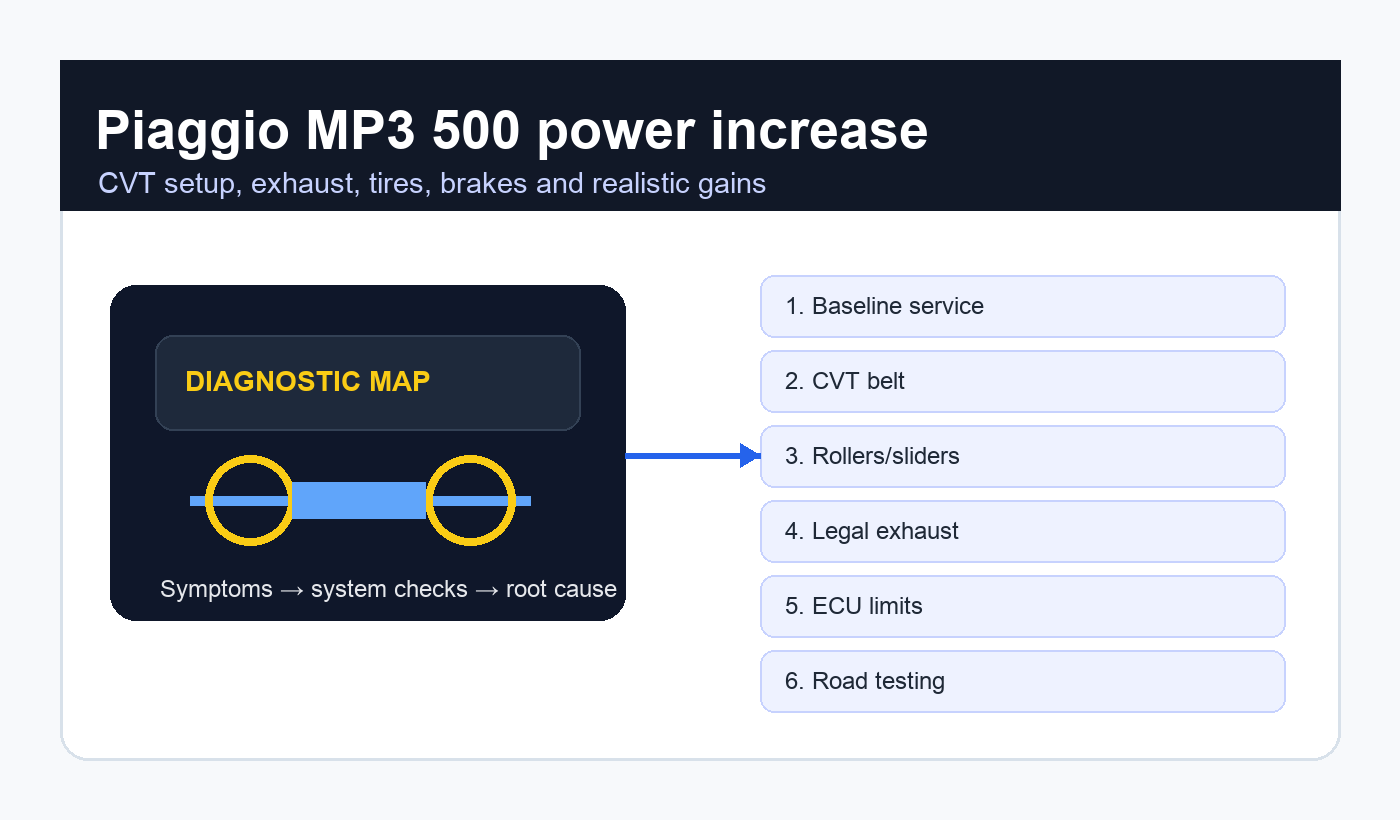
The safest Piaggio MP3 500 power increase order is baseline service, tires and brakes, CVT refresh, conservative roller or slider adjustment, legal exhaust if desired, then fueling checks only if hardware changes justify it. This order gives measurable results and avoids blaming the wrong part when the scooter still feels slow.
For a similar three-wheel scooter tuning topic, our Peugeot Metropolis 400 tuning guide follows the same logic: restore the platform first, then tune conservatively.
How to test results
A good Piaggio MP3 500 power increase test is repeatable. Use the same route, same fuel level, same rider, similar weather and the same tire pressures. Record takeoff smoothness, rpm at cruising speed, hill response, vibration, belt smell, fuel consumption and hot restart behavior. Do not rely only on noise or first early signals.
After CVT work, inspect the belt and cover after a short bedding-in period. Belt dust, unusual heat or new vibration means the setup deserves attention before a long ride.
If Piaggio MP3 500 power increase makes the scooter harsher, hotter or less predictable, the numbers on the product page do not matter.
Use the same judgment after exhaust or fueling changes. The scooter should still start cleanly when cold, idle without hunting, pull smoothly from low speed and restart when hot after a short stop. If a modification creates flat spots, warning lights or fuel smell, return to a known baseline before adding more parts.
Keep a small log after each change: date, mileage, part number, roller weight, belt width, fuel consumption and any new noise. That log makes future diagnosis faster and helps a buyer understand the scooter if it is sold. It also protects the owner from repeating the same experiment months later because the original setup was forgotten.
What not to do
The worst Piaggio MP3 500 power increase approach is stacking a loud exhaust, unknown roller weights, an open filter and a cheap fuel box onto a scooter with an old belt and neglected brakes. The result can be more noise, worse refinement and no real gain. Another mistake is chasing a top-speed number while ignoring the daily use that made the MP3 appealing in the first place.
If you are also comparing broader scooter tuning choices, our Yamaha Tricity 300 tuning article explains why three-wheel scooter setup must respect weight, CVT behavior and stability.
Used modified MP3 500 checklist
Used buyers researching Piaggio MP3 500 power increase should be skeptical of modified scooters. Ask for original parts, receipts, exact roller weight, belt age, exhaust approval documents, fuel-module settings and service history. Test cold start, hot restart, CVT smoothness, braking, steering and warning lights.
If paperwork is missing, value the scooter as if you may need to return it to standard. A cheap modified MP3 can become expensive if the CVT, belt, exhaust, tires and brakes all need correction.
| Used-buying check | Good sign | Warning sign |
|---|---|---|
| CVT receipts | Known parts and mileage | “Performance kit” with no details. |
| Exhaust documents | Homologation paperwork present | Too loud, missing baffle, no papers. |
| Road test | Smooth launch and cruise | Judder, vibration, belt smell. |
| Original parts | Included with sale | Cannot return to standard. |
| Warning lights | None after full ride | Engine or traction messages present. |
When a part is worth buying
A Piaggio MP3 500 power increase part is worth buying when it fits the exact model year, solves a defined problem, is legal for road use, can be reversed, and does not sacrifice reliability for a tiny gain. A part is not worth buying simply because it claims more power in generic advertising.
For smaller-displacement tuning context, our Honda Forza 125 chip tuning article explains why CVT behavior, emissions systems and engine size set hard limits on electronic tuning claims.
Frequently asked questions
Can the MP3 500 gain real horsepower?
Piaggio MP3 500 power increase can produce modest improvements, especially in feel, but large horsepower gains are unlikely without expensive and potentially illegal engine work. CVT setup usually gives the most noticeable daily result.
Will a variator kit make it faster?
It can improve acceleration and response if chosen correctly. It may not dramatically raise top speed, and a poor setup can increase belt heat or cruising rpm.
Is an exhaust worth it?
An exhaust can reduce weight and improve sound. Choose a homologated part and do not expect a slip-on alone to transform performance.
Should I use a performance air filter?
Only if filtration and fit are excellent. A clean standard-quality filter is often better for daily reliability than a noisy intake with poor sealing.
What is the safest first upgrade?
The safest first Piaggio MP3 500 power increase step is a full service baseline: belt, rollers, clutch inspection, tires, brakes, oil, filter and spark plug. Then consider conservative CVT tuning.
Can tuning hurt reliability?
Yes. Extreme roller weights, cheap belts, non-legal exhausts, poor fueling and open intakes can shorten service life. Mild, documented changes are safer.
Final verdict
Piaggio MP3 500 power increase is best approached as setup work, not a search for hidden superbike power. The MP3 500 responds most usefully to maintenance, CVT optimization, quality tires, healthy brakes and legal parts chosen for real commuting conditions.
Treat Piaggio MP3 500 power increase as a measured process: restore the baseline, tune the transmission carefully, keep the scooter legal, test results honestly and protect reliability. Done that way, the MP3 500 can feel stronger and more satisfying without becoming noisy, fragile or difficult to insure.