
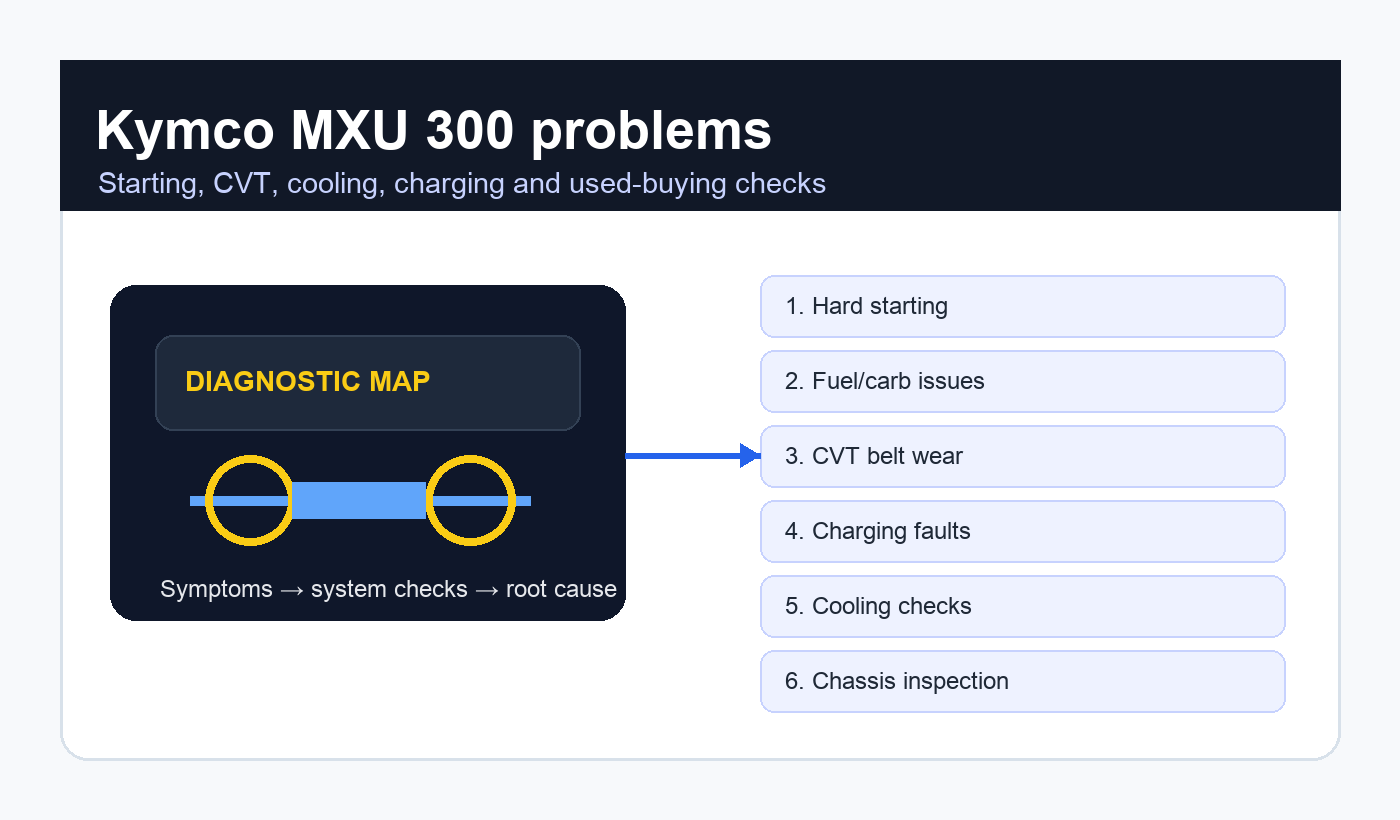
Kymco MXU 300 problems: the real weak points, symptoms and fixes owners should know
Kymco MXU 300 problems is a practical search because the MXU 300 sits in a difficult middle ground: more capable than a small farm quad, lighter and simpler than a big-bore utility ATV, but often bought used by riders who expect it to work hard with little attention. Most complaints are not dramatic engine failures. They are starting issues, carburetor or fuel delivery problems, CVT wear, charging faults, overheating, brakes, steering joints, neglected suspension and damage from mud, water or poor storage.

This guide explains Kymco MXU 300 problems like a workshop inspection, not a forum argument. It covers symptoms, likely causes, diagnostic order, maintenance traps, used-buying checks, repair priorities and the difference between a genuinely weak model and a machine that has simply been run for years without correct service.
Quick answer
The short Kymco MXU 300 problems answer is that the most common weak points are dirty fuel systems, old batteries, starter relay or charging faults, worn CVT belts and rollers, neglected air filters, sticky brakes, cooling system neglect, loose steering or suspension joints and wiring corrosion. A clean, serviced MXU 300 can be a useful light utility ATV, but a neglected one can feel underpowered, hard to start and expensive because several small faults arrive together.
What owners need to know first
This guide is written for owners, buyers and technicians dealing with Kymco MXU 300 problems in the real world. It focuses on symptoms, checks, realistic repair decisions, legal limits where relevant, and the points worth confirming before buying parts or trusting a seller’s claim.
| Intent | Related topics | What the owner wants |
|---|---|---|
| No-start diagnosis | battery, starter relay, spark, fuel, CDI | Find why the quad will not fire. |
| Weak performance | belt slipping, carb jet, air filter, rollers | Recover normal acceleration. |
| Reliability research | weak points, forum, common faults | Know whether to buy or avoid one. |
| Farm/utility use | towing, mud, cooling, brakes | Understand real working limits. |
| Used purchase | inspection checklist, service history, parts | Avoid a cheap ATV with hidden repair costs. |
Model context
A fair discussion of Kymco MXU 300 problems starts with KYMCO itself. The company is a long-established Taiwanese powersports manufacturer, and its global site routes buyers to official regional distributors and service networks. The wider Kymco model family has included scooters, motorcycles, ATVs and UTVs, with MXU models forming part of the ATV range.
For brand and regional support context, the official KYMCO international site is the best starting point. For broad manufacturer and ATV family context, the Kymco reference page lists Kymco as a powersports manufacturer and includes the MXU ATV line.
Starting problems
The first cluster of Kymco MXU 300 problems is starting. Owners often describe a quad that cranks slowly, visits, starts only with throttle, runs for a few seconds, or refuses to restart hot. The temptation is to blame the carburetor immediately, but the diagnostic order should begin with battery voltage, terminals, ground cable, starter relay, fuse condition, spark quality and fuel flow.
Small ATVs are sensitive to storage. A battery can be weak even if the lights work. Old fuel can varnish jets. A cracked intake boot can lean the mixture. A dirty air filter can make the engine rich and lazy. A good Kymco MXU 300 problems diagnosis separates electrical cranking speed from fuel and ignition.
| Starting symptom | Likely cause | First check |
|---|---|---|
| Click only | Weak battery, relay, cable corrosion | Load-test battery and inspect terminals. |
| Cranks but no fire | No spark, no fuel, blocked jet | Check spark plug and fuel flow. |
| Starts with throttle only | Idle jet, choke/enricher, air leak | Clean carb and inspect intake boot. |
| Hot restart difficult | Valve clearance, mixture, weak spark | Check service history and plug color. |
| Starts then dies | Fuel cap vent, carb bowl supply, vacuum line | Test fuel delivery under running conditions. |
Fuel and carburetor issues
Many Kymco MXU 300 problems complaints are actually old-fuel complaints. If the ATV sits through winter or is used occasionally around a property, the carburetor can gum up. The pilot jet is small, so idle quality and cold starting suffer first. A dirty float needle can flood the engine. A restricted tank vent can mimic fuel starvation after several minutes of riding.
The repair is not to turn random screws. Remove and clean the carburetor properly, replace cracked fuel lines, check the petcock or fuel tap, install a fresh plug, and set idle after the engine is warm. If the airbox has been opened or the exhaust changed, jetting may need to be returned to a sensible baseline.
For that reason, Kymco MXU 300 problems diagnosis should document fuel age and storage conditions before expensive parts are ordered.
Battery and charging faults
Another common Kymco MXU 300 problems group is charging. A quad may start fine after charging overnight, then become weak again after several rides. Causes include an aged battery, corroded connectors, stator output problems, regulator/rectifier failure or accessory wiring that drains the battery.
Use a multimeter before replacing parts. Measure resting voltage, cranking voltage and charging voltage at a fast idle. Inspect grounds and connectors because ATVs live in vibration, mud and water. Electrical parts are often blamed when the real fault is a green connector or loose ground.
CVT belt and transmission wear
Performance-related Kymco MXU 300 problems often comes from the CVT. A worn belt, glazed clutch, dirty variator, flat-spotted rollers or contaminated cover can make the quad rev without moving strongly. Riders describe weak pull, belt smell, jerky takeoff or poor hill climbing.
The MXU 300 is not a big-bore towing machine. If it is overloaded, used in deep mud or ridden with a dragging brake, the belt works harder. Inspect belt width, clutch faces, rollers, cover sealing and air intake path. A new belt on dirty pulleys is not a complete repair.
| CVT symptom | Likely issue | Repair direction |
|---|---|---|
| High revs, low speed | Worn belt or glazed clutch | Measure belt and clean clutch faces. |
| Jerky launch | Clutch shoe contamination | Inspect clutch and cover sealing. |
| Poor hill climbing | Belt, rollers, overload, brake drag | Check CVT and rolling resistance. |
| Belt smell | Heat from slipping | Reduce load and inspect belt path. |
| Rattle in cover | Rollers or loose components | Open cover before more damage occurs. |
Cooling and overheating
Some Kymco MXU 300 problems reports involve heat, fan operation or coolant loss. Mud packed into the radiator, old coolant, a weak cap, air trapped after service, a failing fan switch or a tired water pump can all create trouble. A small ATV doing slow work has less airflow than one cruising on open ground.
Do not ignore steam smell, coolant stains or a fan that never turns on. Clean the radiator carefully from the back side when possible, check coolant level cold, inspect hoses and confirm fan operation. Overheating can turn a modest maintenance job into a head-gasket diagnosis.
Any Kymco MXU 300 problems case with repeated overheating deserves a pressure check and fan test, not just another top-up of coolant.
Brake drag and wheel-end problems
Brake and wheel-end issues are underrated Kymco MXU 300 problems. Sticky calipers, seized parking brake mechanisms, old brake fluid, worn pads, wheel bearing play and damaged CV boots can make the quad feel slow and noisy. A dragging brake also overheats the CVT because the engine must fight resistance.
After a short ride, carefully compare wheel temperature without burning yourself. One hot wheel points to drag. Lift each corner safely and check bearing play, pad movement and axle boot condition. A rider may complain of engine weakness when the real problem is friction.
Steering and suspension wear
Used-buying Kymco MXU 300 problems checks should include steering and suspension. Tie-rod ends, ball joints, bushings, shocks and wheel bearings wear faster when a quad is used on rough land. Excess play makes the machine wander, rattle and feel unsafe. Bent racks or arms are common signs of hard impact.
Put the ATV on a safe stand, move the wheels by hand, watch every joint and listen for knocks. Check that the handlebars sit straight and that both front wheels point evenly. Alignment complaints after an impact may hide bent parts rather than a simple adjustment.
Air filter and dust damage
A serious Kymco MXU 300 problems inspection always opens the airbox. A dirty or poorly seated filter can let dust reach the engine. Dust ingestion causes poor compression, oil consumption and hard starting. It is one of the most expensive forms of neglect because the early symptom can look like ordinary tuning trouble.
Look for dirt on the clean side of the airbox, missing seals, oil-soaked foam or evidence that the lid was not seated. If dust passed the filter, do a compression or leak-down test before buying the ATV.
This is why experienced buyers treat Kymco MXU 300 problems as an inspection topic, not only a repair topic.
Electrical corrosion and lighting faults
Because ATVs work outdoors, Kymco MXU 300 problems also includes wiring. Corroded connectors can cause intermittent lights, fan faults, charging errors, ignition cutouts and starter problems. Pressure washing makes this worse if water is driven into switches and connectors.
Inspect the harness around the steering head, battery, regulator, starter relay, fan wiring and rear lights. Clean and protect connectors instead of twisting wires together. The goal is reliability, not just making the fault disappear for one ride.
Used MXU 300 inspection checklist
A used buyer researching Kymco MXU 300 problems should not judge only by plastics and tire shine. Start cold, listen to the engine, test charging voltage, ride slowly and at speed, test brakes, check 2WD/drive behavior where applicable, inspect CV boots, examine the airbox, check coolant, look under the CVT cover if the seller allows it, and scan service receipts.
Compare this article with our Kymco MXU 500 problems guide if you are choosing between small and larger MXU models. The same neglect patterns appear, but the bigger machine can hide wear differently because it has more torque.
| Inspection area | Good sign | Warning sign |
|---|---|---|
| Cold start | Starts without drama and idles cleanly | Needs throttle, choke tricks or jump pack. |
| CVT | Smooth takeoff, no belt smell | Jerks, slips or rattles. |
| Airbox | Clean sealed filter | Dust past filter or missing parts. |
| Cooling | Fan works, coolant clean | Mud-packed radiator or coolant stains. |
| Chassis | Tight joints, straight steering | Play, knocks, bent arms. |
Maintenance that prevents most faults
The best cure for Kymco MXU 300 problems is boring maintenance. Fresh oil, clean air filter, correct valve clearance, fresh fuel, charged battery, clean CVT cover, inspected belt, greased points, brake service and coolant checks prevent most complaints. The ATV is not complicated, but it punishes owners who store it wet, run old fuel and skip filters.
For a broader powersports reliability comparison, our CFMoto ZForce 1000 problems article shows the same pattern on a different type of machine: many “model problems” are actually maintenance, usage and inspection problems.
A maintenance-first approach to Kymco MXU 300 problems also makes later upgrades or repairs easier because the baseline condition is known.
When the engine really is tired
Not every Kymco MXU 300 problems case is carburetor or battery. Low compression, smoking, heavy crankcase breathing, metallic noise, oil consumption and poor hot starting after valve checks can point to engine wear. A quad used in dust, mud and short trips can wear faster than mileage suggests.
Do not rebuild blindly. Compression testing, leak-down testing, valve clearance checks and oil inspection should come first. If the bottom end is noisy or the cylinder is worn, price the repair against the value of the ATV before buying parts.
Parts availability and repair economics
One reason Kymco MXU 300 problems searches matter is repair economics. A cheap used ATV can become expensive if it needs tires, brakes, battery, belt, carb rebuild, wheel bearings, ball joints and plastics at the same time. Individually, those jobs are manageable. Together, they can exceed the price difference to a better machine.
Before purchase, make a parts list and price it honestly. Include fluids, filters and small hardware. A seller’s “just needs a tune-up” often means the owner stopped diagnosing when the first easy fix did not work.
Good Kymco MXU 300 problems budgeting includes both obvious parts and the hidden labor of cleaning, testing and undoing previous poor repairs.
A practical estimate should also separate safety parts from convenience parts. Tires with deep cracks, brakes that drag, loose steering joints, leaking fuel lines and damaged wheel bearings come before cosmetic plastics or accessories. If the machine needs several safety repairs, negotiate as if the ATV cannot be used until those jobs are complete. That approach protects the buyer from paying a running-machine price for a vehicle that still needs immediate workshop time.
Diagnostic order that saves money
A disciplined Kymco MXU 300 problems workflow starts with basics: battery, terminals, fuel quality, air filter, spark plug, compression clues and visible wiring. Then move to carburetor cleaning, charging tests, CVT inspection, cooling checks and chassis inspection. Replacing random electrical modules before doing voltage and connector tests is expensive guesswork.
If you also own a scooter from the same brand, our Kymco X-Town 300i problems guide is useful because it separates brand reputation from model-specific diagnosis in the same way.
Frequently asked questions
Is the MXU 300 unreliable?
Kymco MXU 300 problems does not mean every MXU 300 is unreliable. It means buyers need to inspect age, maintenance and use carefully. A well-serviced machine is very different from one stored outside with old fuel and a dirty air filter.
Why does my MXU 300 feel weak?
Weak acceleration can come from a worn CVT belt, dirty carburetor, blocked air filter, brake drag, low compression, poor fuel or simply expecting big-bore performance from a 300-class utility ATV.
Why will it not start after sitting?
The usual suspects are weak battery, stale fuel, blocked pilot jet, poor spark plug, corroded terminals or a stuck fuel valve. Diagnose in order instead of replacing parts randomly.
Can overheating be fixed by cleaning the radiator?
Sometimes, yes. Mud-packed radiators are common, but fan operation, coolant level, cap condition and water pump health also need checking.
Should I buy a cheap non-running one?
Only if you price it as a project. Kymco MXU 300 problems can stack quickly when a non-runner needs battery, carburetor, belt, brakes, tires and chassis parts at once.
What is the first maintenance job after buying one?
Change oil, clean or replace the air filter, inspect fuel, check battery and charging, inspect CVT belt, service brakes and look for play in wheel bearings and steering joints.
Final verdict
Kymco MXU 300 problems is best understood as a set of predictable age, use and maintenance issues rather than a single fatal flaw. The MXU 300 can be a useful light ATV if it is serviced, kept clean, stored properly and not asked to do the work of a much larger machine.
The smart owner or buyer handles Kymco MXU 300 problems with a checklist: start with battery, fuel, air, spark and compression clues, then inspect CVT, cooling, brakes, chassis and wiring. That method turns vague forum warnings into clear repair decisions and helps you decide whether a particular MXU 300 is a good buy or someone else’s neglected project.