
Kymco MXU 500 problems: the complete ATV owner’s guide to common faults, diagnosis, maintenance and used buying
Kymco MXU 500 problems is a practical search, not a casual one. People type it because they are hearing a noise, fighting a no-start condition, comparing a used ATV, seeing overheating, smelling belt heat, or trying to decide whether a KYMCO utility quad is dependable enough for work and trail use. A useful answer needs more than a list of complaints. It needs to explain which symptoms are normal wear, which are maintenance-related, and which should stop a purchase or ride.
The KYMCO MXU 500 is typically used as a utility ATV: farm work, hunting access, snow plowing, light hauling, trail riding and muddy property use. Those jobs are hard on CVT belts, cooling systems, bushings, batteries, brakes and electrical connectors. Many conversations around Kymco MXU 500 problems are not proof that the ATV is fundamentally flawed. They often show how a utility quad ages when it is worked hard, stored outside, modified, or serviced irregularly.
This guide is written for owners, buyers and technicians dealing with Kymco MXU 500 problems in the real world. It focuses on symptoms, checks, realistic repair decisions, legal limits where relevant, and the points worth confirming before buying parts or trusting a seller’s claim.
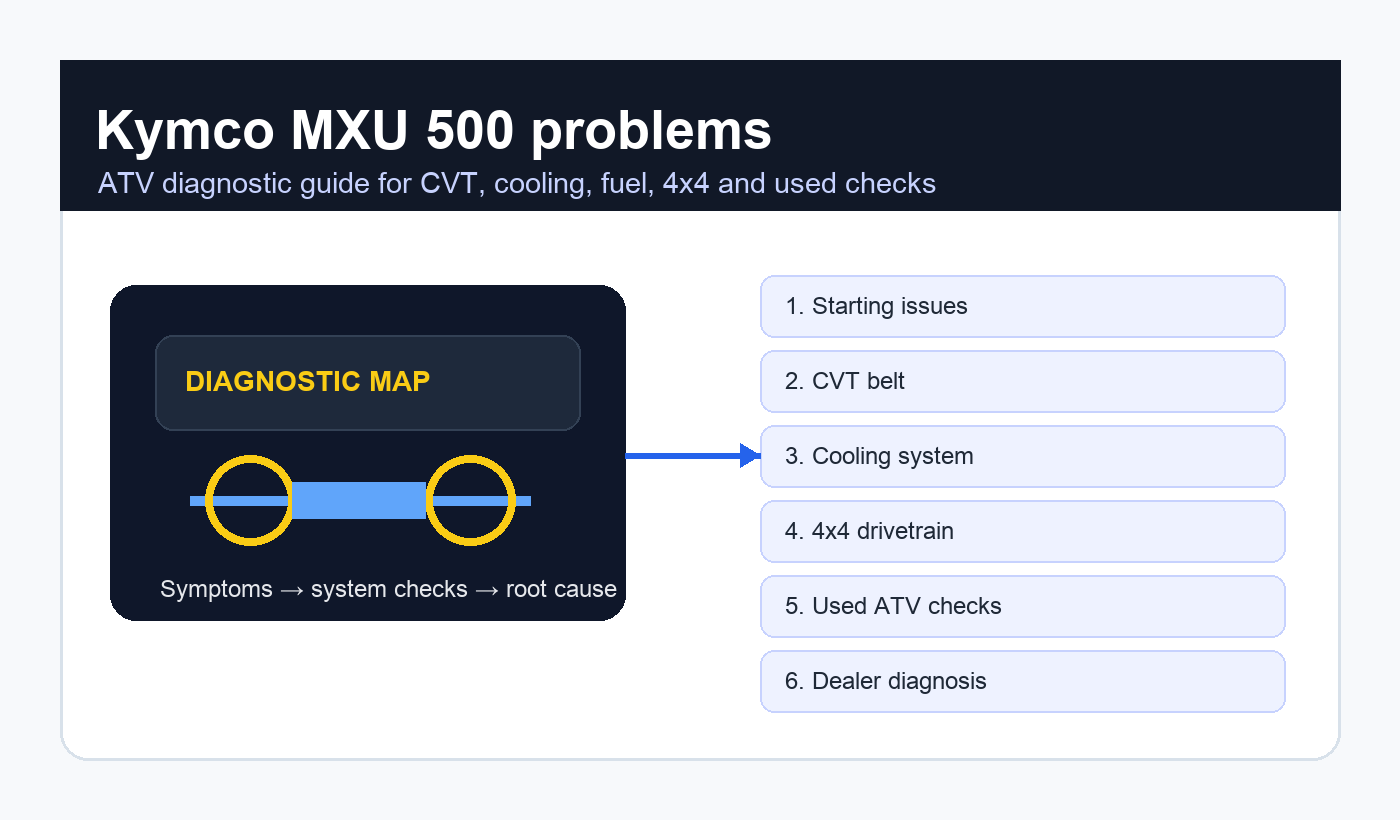
Quick answer: what owners usually mean
Kymco MXU 500 problems usually means one of five areas: starting and battery trouble, CVT belt or clutch complaints, overheating after work or mud, suspension/steering wear, or fuel/electrical issues from age and storage. The MXU 500 is often judged as a work ATV, so symptoms appear when it is loaded, idled, crawled, plowed or ridden in messy conditions.
The smart approach is to diagnose by system. If the ATV will not start, begin with battery, fuel, spark and safety switches. If it smells hot or loses drive, inspect the CVT. If it overheats, clean and test the cooling system. If it clunks or wanders, inspect suspension and steering. If it has intermittent faults, look at grounds, connectors and water intrusion.
| Symptom | Likely system | First check | Urgency |
|---|---|---|---|
| No start or slow crank | Battery, starter, fuel, spark | Load-test battery and check fuel delivery | Medium |
| Belt smell or slipping | CVT belt/clutch | Inspect belt, cover and sheaves | High if repeated |
| Runs hot | Cooling system | Clean radiator and check fan | High |
| Hard shifting | Idle speed, linkage, CVT drag | Check idle and shift linkage | Medium |
| Clunking front end | Bushings, ball joints, wheel bearings | Lift and inspect play | Medium |
Starting problems and weak battery symptoms
One of the most common Kymco MXU 500 problems patterns is a machine that cranks slowly, visits, starts only with a jump, or runs fine once warmed up. ATV batteries are small, often exposed to vibration and temperature swings, and frequently left sitting. A weak battery can make the starter sound bad, confuse ignition diagnosis and create intermittent electrical behavior.
Check voltage under load, not only at rest. Inspect terminals, grounds, starter relay connections and fuse holders. If the ATV has accessories such as a winch, heated grips, sprayer, light bar or plow control, inspect wiring quality and parasitic draw. Utility ATVs often accumulate wiring additions over years, and those additions can become the real fault.
Fuel and ignition checks
If cranking speed is healthy but the engine will not fire, move to fuel, spark and air. Old fuel, dirty filters, clogged jets on carbureted versions, injector issues on fuel-injected versions, weak spark, bad plug caps and restricted air filters can all produce owner complaints. Storage history matters. An ATV that sits through seasons with stale fuel can become a diagnostic puzzle.
CVT belt, clutch and shifting complaints
Another major part of Kymco MXU 500 problems is the CVT system. The belt works hardest when the ATV is used slowly under load: towing, plowing, climbing, mud riding or hauling. A burning smell, belt dust, poor takeoff, high revs with weak movement, jerky engagement or repeated belt failure should be inspected immediately.
A belt can fail because it is old, but repeated failures point deeper. Check clutch faces, belt alignment, cover sealing, intake/exhaust vents, idle speed, one-way bearing behavior and rider usage. A machine used for work should be operated in the correct range. Lugging or slipping the CVT under heavy load creates heat.
Hard shifting
Hard shifting can come from high idle, linkage adjustment, CVT drag, worn mounts or drivetrain load. Do not force the lever. If the ATV creeps at idle or resists gear selection, inspect the idle speed and clutch behavior before assuming the transmission is failing.
Overheating and cooling system complaints
Overheating appears often in discussions of Kymco MXU 500 problems, especially with machines used in mud, tall grass, snow plowing or slow work. The radiator may look acceptable from the outside while the core is packed with fine debris. A fan that works intermittently can also cause temperature rise at low speed.
Check coolant level when cold, radiator cleanliness, fan operation, cap condition, thermostat behavior, hose condition and leaks. Never keep riding an overheating ATV to “see if it clears.” Heat can turn a small cleaning job into a head gasket or engine damage problem.
| Cooling clue | Likely cause | Check |
|---|---|---|
| Hot after mud | Blocked radiator | Clean fins gently and thoroughly |
| Hot at idle | Fan/relay/sensor issue | Confirm fan cycles |
| Coolant loss | Leak, cap, hose, overflow | Pressure test if possible |
| Fast temperature spike | Air pocket or circulation issue | Bleed/test system |
4×4, differential and drivetrain issues
A utility ATV’s drivetrain works hard. Clicking on turns, grinding, binding in 4×4, torn CV boots, differential noise and vibration may be described as Kymco MXU 500 problems. Some noises are normal gear or tire sound; others are warnings. A torn boot that is ignored can quickly destroy a CV joint. Water-contaminated differential oil can create expensive damage.
Inspect boots, axle play, differential fluid, driveshaft joints, mounts and wheel bearings. If 4×4 engagement is electrical, check the switch, actuator, wiring and fuse before condemning the mechanical differential. If a used machine has oversized tires, remember that added tire mass stresses CV joints, bearings, steering and belt drive.
Suspension, steering and brake wear
Suspension complaints are common on older utility ATVs. Worn bushings, ball joints, tie rods and wheel bearings can make the machine wander, clunk or feel vague. Brakes suffer from mud, water and grit. A good inspection includes pad thickness, rotor condition, caliper movement, brake fluid, parking brake operation and wheel bearing play.
Kymco MXU 500 problems on a used machine should always include a chassis check. Lift the ATV safely, rock each wheel, inspect steering joints and look for bent arms or damaged skid plates. Cosmetic plastics tell only a small part of the story.
Used buying checklist
A buyer researching Kymco MXU 500 problems should inspect cold-start behavior, belt smell, cooling fan, fluids, 4×4 engagement, electrical accessories, brakes, steering play and service records. A seller who refuses a cold start or test ride is giving you information. A machine that starts only when warm may be hiding fuel, choke, compression or battery problems.
| Area | Good sign | Warning sign |
|---|---|---|
| Cold start | Starts without drama | Seller pre-warms it |
| CVT | Smooth takeoff | Burnt smell or slipping |
| Cooling | Fan cycles, temp stable | Coolant stains or overheating |
| Drivetrain | 4×4 engages cleanly | Grinding, binding, torn boots |
| Electrical | Clean wiring | Random switches and dead battery |
Maintenance habits that prevent most issues
The best answer to Kymco MXU 500 problems is preventive work. Keep the air filter clean, change fluids on schedule, inspect the CVT belt, clean the radiator after dirty use, keep the battery maintained, grease service points where applicable, inspect boots and bushings, and store the ATV with stable fuel practices.
For official model and dealer information, start with KYMCO USA. For U.S. product safety recalls, use the official Consumer Product Safety Commission recall database. Official sources are essential when safety, recalls or model-specific documentation matter.
Home diagnosis versus dealer diagnosis
Home diagnosis is useful for batteries, visible belt damage, dirty radiators, loose terminals, torn boots, worn pads and obvious play. Dealer diagnosis is better for repeated no-starts, recurring warning lights, charging faults, 4×4 actuator problems, internal clutch issues or suspected engine damage.
A good technician should ask about use. Plowing snow, towing, long idle time, mud riding and storage all change the likely cause. Diagnosis without usage history is incomplete.
Cost thinking
Do not measure repair cost only by the first part replaced. A belt is cheap compared with clutch diagnosis, but three belts are not cheap. A battery is cheap, but replacing it repeatedly without fixing a draw is waste. A radiator cleaning is cheap, but ignoring heat is expensive.
Write down the symptom, when it appears, what changed recently and what has already been replaced. That record prevents circular diagnosis and helps a shop avoid repeating failed guesses.
How to separate normal wear from a real defect
Utility ATVs live harder lives than most road vehicles. They tow, idle, crawl, carry tools, climb wet ground, sit through winter and then get asked to start instantly in spring. That means some complaints are not evidence of a bad model; they are evidence of age, use and incomplete service. The useful question is whether the symptom appears under a predictable condition and whether it changes after basic maintenance.
Normal wear usually has a trail. A belt that slowly becomes noisy, a battery that weakens after storage, bushings that loosen after years of trail use and brake pads that wear after mud riding all make mechanical sense. A real defect or serious fault is different. It returns immediately after repair, affects safety, creates heat, causes loss of drive, drains the battery repeatedly or leaves the ATV unreliable even after service items are corrected.
The owner should also compare the machine against its job. An ATV used for gentle property work can tolerate ordinary maintenance intervals. A machine that has pulled trailers, worn aggressive tires, pushed snow or spent weekends in deep mud needs a stricter schedule. When the use is severe, the inspection must be severe too.
| Pattern | Likely meaning | Best response |
|---|---|---|
| Symptom appears only after sitting | Fuel, battery, corrosion or storage issue | Service fuel system, charge/load-test battery, clean terminals |
| Symptom appears only when hot | Cooling, clutch heat, ignition or electrical expansion issue | Check temperature, airflow, fan operation and heat-sensitive parts |
| Symptom appears under load | CVT belt, clutch, drivetrain or engine power issue | Inspect belt, sheaves, rollers, intake and fuel delivery |
| Symptom appears after modification | Load or compatibility problem | Review tire size, accessories, wiring and gearing effect |
Questions to ask before buying parts
Before ordering parts, ask a few disciplined questions. Did the issue begin suddenly or gradually? Was the ATV stored recently? Was the battery replaced without being tested? Were larger tires installed? Was the radiator packed with dirt? Was the belt cover opened after water riding? Did a warning light appear with the symptom, or did the symptom happen alone?
Parts replacement without questions can become expensive very quickly. A weak battery can imitate a bad starter. A restricted vent can imitate a fuel problem. A dirty radiator can imitate a thermostat fault. A worn bushing can imitate a shock problem. Slow diagnosis feels less dramatic than buying parts, but it usually costs less and creates a more reliable machine.
Service records that matter most
For a used ATV, service history is more valuable than polished plastics. The records that matter most are oil changes, air-filter service, coolant maintenance, brake service, belt inspection, differential fluids, battery replacement date and any work on the 4×4 system. A seller who can explain when those items were done gives you a better starting point than a seller who only says the machine “runs great.”
Photographs also help. A picture of the odometer, underside, tires, brake rotors, radiator face, battery area, belt cover and fluids can reveal the machine’s real life. Look for mismatched fasteners, stripped drain plugs, silicone where gaskets should be, non-factory wiring and missing clips. Small clues often predict large ownership costs.
Terrain and riding style
Terrain changes diagnosis. Dust attacks filters and intake boots. Mud attacks cooling systems, brakes and electrical connectors. Water crossings attack bearings, fluids and CVT housings. Steep terrain exposes weak belts and clutch heat. Snow plowing stresses charging systems, idle time, battery health and front-end components.
A machine used on clean farm lanes can have very different problems from one used in wet trails every weekend. This is why forum advice can be useful but incomplete. Two owners can report the same symptom while the root cause is completely different because one ATV lives in dust and the other lives in water.
When the repair should stop and diagnosis should restart
There is a point where repeating the same repair becomes a sign that the diagnosis is wrong. A second battery in a short period demands charging and parasitic draw testing. A second belt demands clutch alignment, venting and riding-load checks. Repeated overheating demands airflow, coolant circulation, fan trigger and possible engine checks. Repeated brake noise demands caliper slide and bearing inspection, not only new pads.
The best shops know when to pause. They reproduce the symptom, record readings, inspect related systems and explain the logic before selling another part. Owners can do the same on a smaller scale: take notes, change one variable at a time and verify the result before moving to the next part.
Related internal reading
For more practical powersports diagnostics, see our fitment guides, motorcycle electronics guides, and CF Moto CForce 625 fitment guide. The vehicle types differ, but the same logic applies: check heat, power, wear, compatibility and service history.
FAQ
Is the KYMCO MXU 500 unreliable?
Not automatically. Many Kymco MXU 500 problems searches come from age, storage, utility use or maintenance gaps rather than a single fatal design issue.
What should I check first?
Start with the symptom. No-start means battery/fuel/spark. Slipping means CVT. Heat means cooling. Clunks mean chassis and drivetrain inspection.
Is overheating common on utility ATVs?
It is common when radiators are blocked by mud or debris. Repeated overheating on a clean radiator needs deeper diagnosis.
Should I buy a used MXU 500?
Yes if it starts cold, drives smoothly, has clean fluids, stable temperature, good 4×4 function and clear maintenance history. Walk away from hidden overheating, major electrical chaos or drivetrain grinding.
Final owner strategy
The best way to handle Kymco MXU 500 problems is to diagnose the system, not the rumor. Utility ATVs age by use pattern. Belt, cooling, battery, fuel, drivetrain and chassis checks solve more problems than guessing.
Kymco MXU 500 problems after storage usually begins with battery and fuel quality.
Kymco MXU 500 problems after mud usually begins with radiator and CVT cleaning.
Kymco MXU 500 problems after oversized tires should include drivetrain and belt load checks.
Kymco MXU 500 problems on a used ATV should trigger a full cold-start and chassis inspection.
Kymco MXU 500 problems that repeats after basic service deserves professional diagnosis.
Kymco MXU 500 problems with hard shifting should be checked for idle speed and CVT drag.
Kymco MXU 500 problems with electrical accessories should include wiring and parasitic draw inspection.
Kymco MXU 500 problems with cooling symptoms should never be ignored.
Kymco MXU 500 problems with brake noise should include pad, rotor and caliper checks.
Kymco MXU 500 problems with 4×4 engagement trouble should include actuator and switch testing.
Kymco MXU 500 problems with fuel smell should be inspected before further riding.
Kymco MXU 500 problems with repeated belt dust should lead to clutch and vent inspection.
Kymco MXU 500 problems with front-end wander should not be dismissed as tire pressure only.
Kymco MXU 500 problems with old fuel should start with cleaning and fresh fuel before deeper repairs.
Kymco MXU 500 problems is best approached with maintenance records, careful inspection and calm troubleshooting.