Description
Aprilia SR GT 125 chip tuning: reversible module fitment, setup and real-world checks
Aprilia SR GT 125 chip tuning should be approached like a small, careful calibration aid, not like a magic horsepower claim. The SR GT 125 is a modern urban-adventure scooter with a liquid-cooled i-get engine, electronic injection and emissions equipment designed to work as a complete system. A plug-in module can help refine response only when the product is matched correctly, installed cleanly and adjusted with restraint.
This product page explains what to check before ordering the Aprilia SR GT 125 Chip Tuning Module, how to inspect the scooter before installation, how to start with conservative settings and what signs tell you to reduce the setting or stop and recheck the fitment.
Why the SR GT 125 needs a careful tuning approach
The SR GT 125 is not an old carbureted scooter where every change is mechanical and visible. Aprilia describes the current SR GT 125 as using a 4-valve, liquid-cooled Euro 5+ engine with an optimized exhaust manifold, oxygen sensors, a calibrated ECU and start-stop technology. You can read the manufacturer context on the official Aprilia SR GT 125 specifications page.
That matters because modern scooter tuning is about small adjustments around a controlled system. The right question is not “how high can I turn it?” The right question is “does the scooter start, idle, accelerate and cruise smoothly in the real conditions where I ride?”
Compatibility checklist before ordering
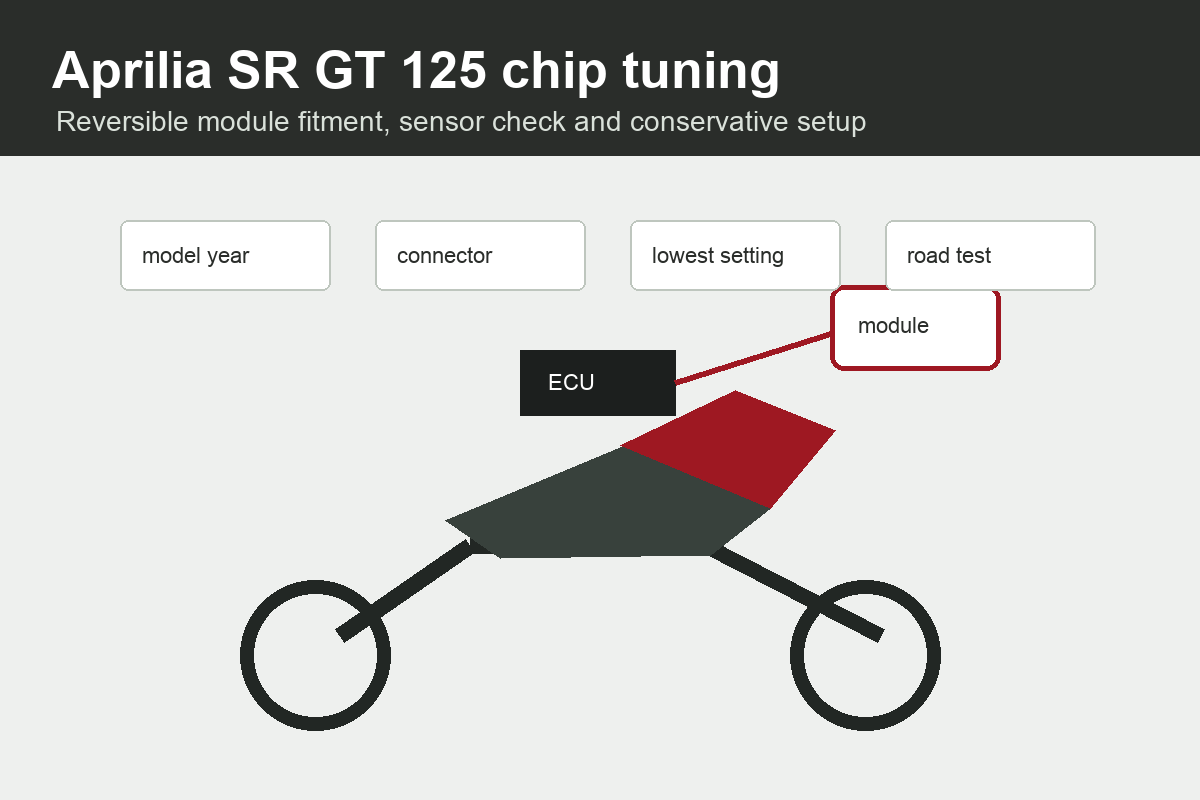
Aprilia SR GT 125 chip tuning works best when the scooter is identified precisely. Confirm the model year, market version, engine type, connector access and whether the scooter is still stock. A module intended for one sensor layout should not be forced onto another. If the connector shape, wire colors or sensor location do not match the expected layout, stop and ask before installing.
| Check | Why it matters | What to do before ordering |
|---|---|---|
| Model year | SR GT versions can change by market and emissions generation | Send the exact year and registration market if unsure |
| Engine condition | A weak spark plug, dirty filter or fault code can hide behind tuning symptoms | Service the scooter before judging performance parts |
| Sensor connector | The module must match the correct plug style | Compare photos before installation |
| Other upgrades | Exhaust, variator and intake changes can affect response | Tell us what has already been changed |
What the module can and cannot do
A chip tuning module is mainly about throttle feel, pickup and smoother response in the range where the scooter is used most often. It cannot change the physical limits of a 125 cc engine, replace poor maintenance or guarantee top-speed improvements against gearing, rider weight, wind and road gradient.
For riders comparing broader scooter setup options, our Aprilia SR GT 125 tuning guide explains the difference between CVT setup, airflow, exhaust expectations and electronic response. If your real goal is legal speed restriction research, the Aprilia SR GT 125 derestriction guide is a better starting point.
Installation method for a clean result
Install with the ignition off and the key removed. Let the scooter cool if you have just ridden it. Work in good light, route wiring away from heat and movement, and never pull on wires to separate a connector. Use the connector housing, check the locking tab and make sure the harness sits naturally once reconnected.
- Confirm the scooter is off and stable on its stand.
- Locate the correct sensor area without forcing plastics.
- Compare the module connector with the scooter connector before joining anything.
- Connect the module only when the plug shape and locking direction match.
- Secure the harness away from the exhaust, fan, steering movement and sharp edges.
- Start from the lowest setting and warm the engine fully before judging response.
Setup notes after installation
Aprilia SR GT 125 chip tuning should be tested gradually. Start low, ride the same route, listen for hesitation and pay attention to hot starts, idle quality and part-throttle smoothness. The correct setting is the one that feels clean and repeatable, not necessarily the highest number on the module.
If the scooter feels rich, flat, inconsistent or worse after a change, reduce the setting. If a warning light appears, return to the base setup and inspect the connector. A tuning module should not be used to mask service problems such as an old spark plug, contaminated filter, low battery or stored ECU fault.
| Ride symptom | Likely meaning | Practical response |
|---|---|---|
| Cleaner pickup from low speed | Setting may suit the scooter | Keep testing in normal riding conditions |
| Flat response after adjustment | Setting may be too high or unsuitable | Step back to the previous setting |
| Irregular idle | Connector, service or calibration issue | Stop, inspect and return to a conservative setup |
| Warning light | The ECU has detected a fault condition | Remove the change and diagnose before riding further |
Maintenance before judging performance
A 125 scooter is sensitive to small maintenance issues. Before evaluating any electronic module, make sure the air filter is clean, the spark plug is healthy, the battery is strong, the tyres are correctly inflated and the CVT is not worn. Rollers, belt condition and clutch behavior can change acceleration more obviously than many riders expect.
The official Aprilia material also highlights the SR GT’s everyday equipment such as LCD dashboard, USB charging point, all-surface tyres, long-travel suspension and optional connectivity through Aprilia MIA. You can explore the broader official Aprilia ecosystem from the Aprilia electronics and app page.
How this product fits with other upgrades
Do not treat the module as an isolated part if the scooter already has a sport exhaust, variator kit, intake changes or worn CVT components. Every change affects how the scooter feels. If you plan to compare the 125 with the larger model, our Aprilia SR GT 200 tuning parts guide gives useful context on how different displacement, CVT setup and touring expectations change the tuning conversation.
Aprilia SR GT 125 chip tuning is most sensible when the scooter is mechanically healthy and the rider wants a reversible, measured way to refine response. It is not the right answer when the scooter has unresolved faults, unclear connectors or a legal restriction question that needs local regulatory advice.
Responsible road use
Performance products may be intended for competition, private-road or off-road use depending on local law. Regulations vary by country, insurance policy and vehicle category. Check road legality before use on public roads, and use a qualified workshop if you are not comfortable working near fuel injection sensors or scooter bodywork.
FAQ
Will this module guarantee more top speed?
No. Top speed depends on gearing, CVT condition, rider weight, wind, road gradient and the engine’s physical output. The realistic aim is cleaner response and better feel when set up correctly.
Can I install it on a stock scooter?
Yes, provided the connector and model version match. A stock scooter is often easier to evaluate because there are fewer other changes affecting the result.
Should I change the setting immediately?
No. Start at the lowest setting, warm the engine and test gradually. Make only one change at a time.
What if my scooter already has an exhaust?
Tell us before ordering. Exhaust and CVT changes can affect how the scooter responds, and the setup should be judged as a complete package.
Final buying advice
Buy this product if you want a reversible module and you are willing to install, test and adjust it carefully. Do not buy it expecting unrealistic power figures. The best result comes from a healthy scooter, correct fitment, conservative setup and a rider who pays attention to how the SR GT 125 behaves on real roads.