Description
Yamaha Tricity 300 chip tuning: module fitment for Blue Core, CVT and LMW riding
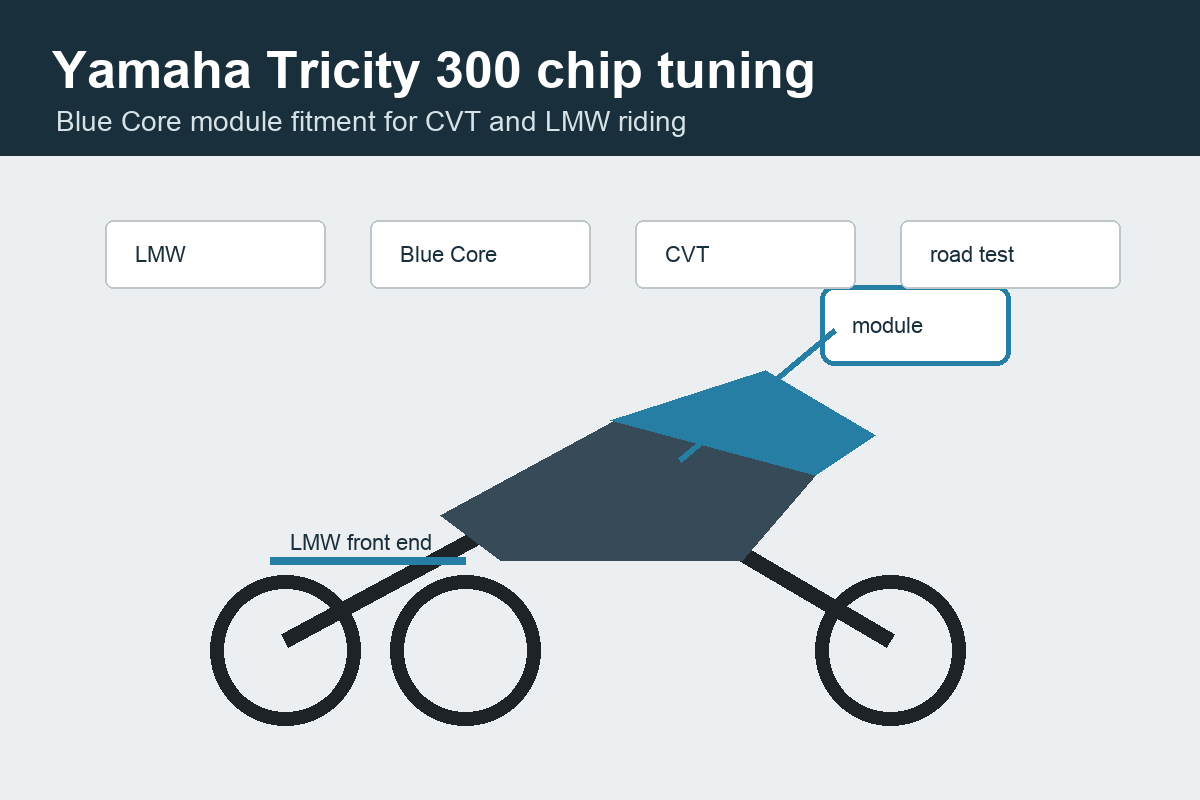
Yamaha Tricity 300 chip tuning needs a more thoughtful approach than a normal scooter tuning page because the Tricity is not just an XMAX with a different badge. It has a 292 cc Blue Core engine, V-belt automatic transmission and Yamaha’s Leaning Multi Wheel front end. That combination gives stability and everyday confidence, but it also means the rider must judge performance changes with the scooter’s weight, CVT condition and three-wheel dynamics in mind.
This product page explains how to evaluate the Yamaha Tricity 300 Chip Tuning Module, what to check before buying, how to install it cleanly and how to test the result without chasing unrealistic power claims.
Understand the Tricity 300 platform first
Yamaha lists the European Tricity 300 with a 292 cc liquid-cooled SOHC four-valve single-cylinder engine, fuel injection and V-belt automatic transmission. The official Yamaha Tricity 300 specifications page is useful because it shows the scooter as a complete system, not just an engine number.
Yamaha Tricity 300 chip tuning should therefore be evaluated around response, smoothness and load behavior. It cannot remove the effect of worn rollers, an old belt, tyre pressure, passenger weight or a CVT that needs service.
Why LMW changes the way you judge tuning
The Tricity’s Leaning Multi Wheel layout gives a stable front-end feel, especially on rough or slippery urban surfaces. Yamaha’s Japanese feature material explains how LMW technology uses a parallelogram link and independent front suspension arrangement to preserve natural leaning while improving stability. You can review that official technical context on Yamaha’s Tricity 300 LMW feature page.
That stable feeling can make the scooter seem calmer than a conventional two-wheeler, so riders sometimes expect more acceleration than the platform is designed to deliver. A module should be judged by clean pickup and repeatable response, not by whether the scooter suddenly feels like a lighter motorcycle.
Compatibility checks before ordering
Confirm the exact year, market and version before ordering. Tricity models can differ by region, licensing category and equipment. If the scooter has exhaust changes, variator changes, intake work or previous wiring modifications, mention them before choosing a setup.
| Check | Why it matters | Owner action |
|---|---|---|
| Model year and market | Connector and emissions equipment can vary | Confirm registration year and country version |
| CVT condition | Belt and rollers affect take-off more than many riders expect | Inspect service history before judging tuning |
| Battery and warning lights | Modern scooters rely on stable electrical behavior | Fix faults before installing performance parts |
| Existing modifications | Variator, exhaust and intake changes alter response | List every change before setup advice |
What the module is meant to improve
The realistic aim is smoother roll-on response, more willing pickup and cleaner feel in normal city and suburban riding. It is not a fixed horsepower guarantee and it should not be used as a shortcut around maintenance. The Tricity’s extra front-end hardware and touring practicality mean weight and transmission condition matter a lot.
For platform-specific tuning context, read our Yamaha Tricity 300 tuning guide. If your scooter has hesitation, starting issues or transmission symptoms, our Yamaha Tricity 300 problems guide is the better first step. Riders comparing the shared 300-class scooter logic can also read the Yamaha X-Max 300 tuning guide.
Installation method
Install with the ignition off and the scooter stable. Remove only the bodywork needed for proper access. Do not pull wires, force connectors or leave a module loose inside the body. The harness should be secured away from heat, steering movement, suspension travel and sharp plastic edges.
- Identify the correct sensor area before disconnecting anything.
- Compare connector shape and locking-tab direction.
- Connect the module without stretching the loom.
- Secure the wiring with enough slack for normal movement.
- Start from the lowest setting.
- Warm the engine and test in normal riding conditions.
Setup and road testing
Yamaha Tricity 300 chip tuning should be tested with patience. Use the same route for each setting: low-speed take-off, traffic roll-on, steady cruise and a gentle uphill if available. Make one adjustment at a time. If the scooter becomes less smooth, step back.
Do not confuse a CVT symptom with an electronic response symptom. Judder from a stop, inconsistent clutch engagement or a sudden change in rpm can come from belt, roller or clutch wear. A module should not be blamed or credited until the transmission is known to be healthy.
| Ride behavior | Likely area to inspect | Practical response |
|---|---|---|
| Cleaner midrange response | Module setting may suit the scooter | Keep testing over several normal rides |
| Shudder leaving traffic lights | CVT or clutch condition | Inspect transmission before changing module settings |
| Heavy feel two-up | Load, tyre pressure, CVT ratio | Check basics before expecting tuning to solve it |
| Warning light | Connector or ECU fault condition | Return to stock and diagnose before riding further |
Who should buy this module
This product suits riders who have a healthy Tricity 300 and want a reversible way to refine engine feel. It is a good match for commuters, delivery-style urban users and riders who use the scooter for mixed city and ring-road riding. It is not ideal for a scooter with unresolved faults, unknown wiring repairs or a CVT that is overdue for service.
Yamaha Tricity 300 chip tuning works best when the owner understands the complete machine. The three-wheel front end gives confidence; the CVT controls how acceleration is delivered; the module can only help if it is fitted and adjusted correctly.
Responsible use
Performance products may be restricted to private-road, track or competition use depending on local law. Check road legality, inspection rules and insurance conditions before using tuning parts on public roads. If you are not comfortable removing bodywork or working around sensors, use a qualified workshop.
FAQ
Will this make the Tricity feel like a lighter two-wheeler?
No. The Tricity has its own LMW character and weight. The realistic aim is better response, not changing the nature of the scooter.
Should I service the CVT first?
If mileage is high or take-off feels rough, yes. Belt, rollers and clutch condition strongly affect how the scooter accelerates.
Can I use it with an exhaust?
Possibly, but tell us which exhaust and whether the intake or variator has also been changed.
What setting should I use first?
Start from the lowest setting, warm the engine fully and increase only if the scooter remains smooth and consistent.
Final buying advice
Choose this module if you want a careful, reversible response upgrade for a well-maintained Tricity 300. Check the model version, respect the CVT, keep the wiring clean and test settings gradually. That is the route to a better scooter, not aggressive adjustment for its own sake.