Brixton 125 power increase: what actually works on Cromwell, Felsberg, Rayburn, Sunray and Crossfire 125 models
Brixton 125 power increase is a search with a very specific promise hidden inside it: the rider wants a Brixton 125 that pulls harder, holds speed better and feels less breathless without turning a simple learner-friendly motorcycle into an unreliable project. The honest answer is that there are gains to be found, but they come from service condition, gearing, intake and exhaust compatibility, ECU behavior, weight, tires and riding technique rather than one miracle part.
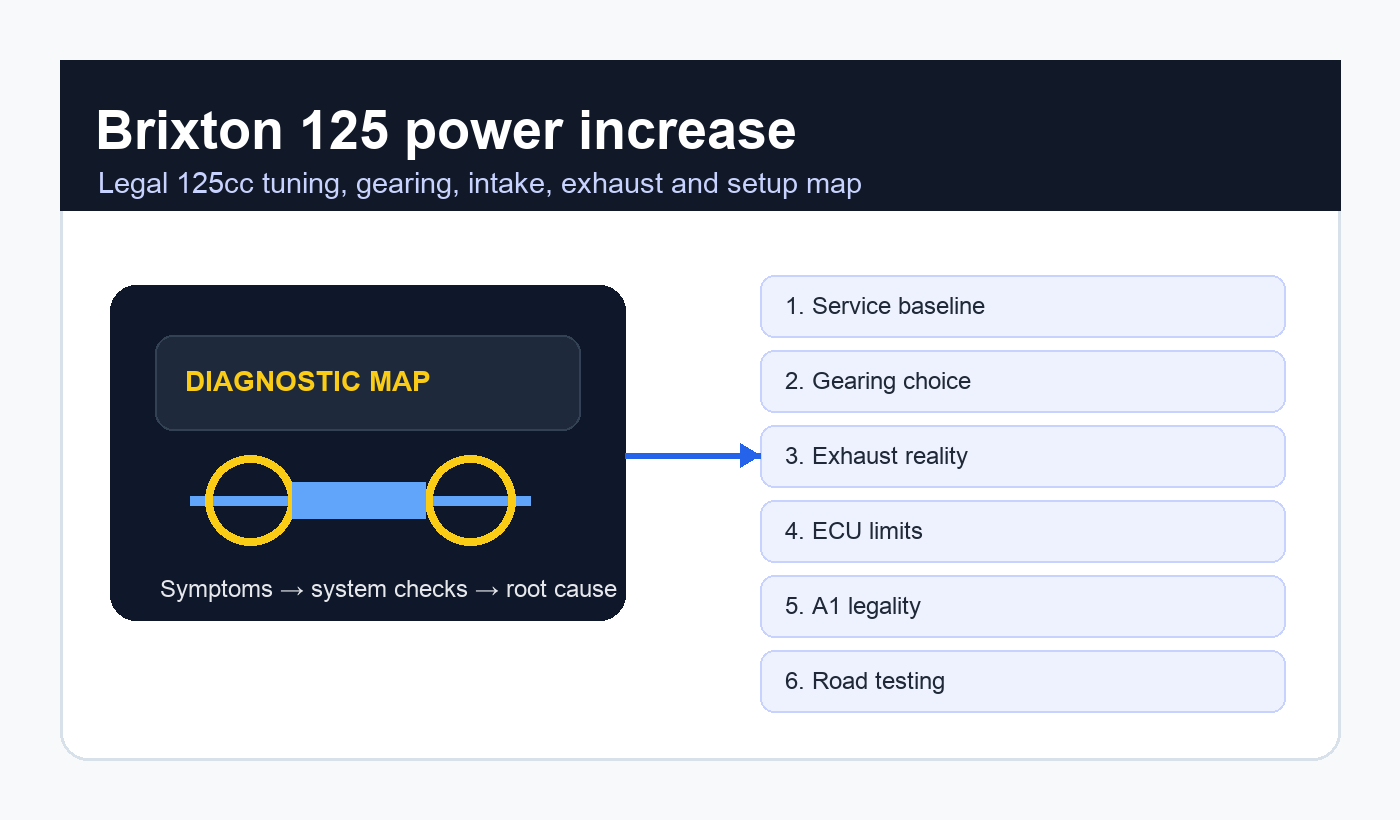
Most air-cooled Brixton 125 models sit close to the familiar A1/learner category reality: modest power, usable torque, five-speed gearing and retro styling. Official Brixton specifications for models such as the Cromwell 125 and Felsberg 125 list a 125 cc single-cylinder, four-stroke, air-cooled engine with ECU ignition, 5-speed transmission, around 8.4 kW and 9.7 Nm, plus a listed top speed around 99 km/h. That matters because the engine is not being artificially held back by a giant hidden restriction; it is a small road engine built for accessibility, economy and style.
What owners need to know first
This guide is written for owners, buyers and technicians dealing with Brixton 125 power increase in the real world. It focuses on symptoms, checks, realistic repair decisions, legal limits where relevant, and the points worth confirming before buying parts or trusting a seller’s claim.
The best article for Brixton 125 power increase should therefore separate practical improvements from unrealistic claims. A rider may not need a dramatic horsepower claim; they may need the bike to climb a hill in fourth instead of third, recover speed after a corner, start more cleanly, run cooler, or feel sharper at town speeds. That is a different problem, and it is solvable with better diagnosis.
| Searcher intent | What the rider probably wants | Best answer |
|---|---|---|
| More acceleration | Stronger launch and roll-on response | Service baseline, gearing, exhaust/intake only if matched |
| More top speed | Less struggle near 90-100 km/h | Realistic aero, rider weight, sprocket and engine health checks |
| Derestriction | Remove a suspected limiter | Explain that many 125s are capacity/power limited, not simply locked |
| Buying parts | Know which upgrades are worth paying for | Rank parts by return, risk and road legality |
The legal ceiling matters before the spanners come out
Brixton 125 power increase should always be discussed with the licensing context in view. In the UK, GOV.UK explains that after CBT, a rider aged 17 or over can ride a motorcycle up to 125 cc and up to 11 kW while using L plates. Other countries have similar A1-style boundaries. That 11 kW figure is important because some tuning ideas may move a machine outside the category the rider is licensed or insured to use.
This does not mean every improvement is forbidden. A cleanly serviced engine, correct tire pressure, healthy chain, right sprocket choice, smoother fueling and quality consumables can make the motorcycle feel better without pretending it is a different displacement. But any big-bore kit, emissions defeat, non-road exhaust or ECU alteration should be viewed through legality, insurance and inspection risk, not only performance.
Useful external references are the official model data from Brixton Cromwell 125 specifications and GOV.UK CBT motorcycle guidance. The first anchors expectations in factory hardware; the second anchors the legal context for 125 cc road use.
Start with the health of the bike
The most overlooked Brixton 125 power increase path is maintenance. A 125 with a tight chain, old spark plug, dirty air filter, dragging brake, underinflated tire, stale fuel or incorrect valve clearance can feel dramatically slower than a healthy one. Owners often buy performance parts to hide a service problem, then wonder why the result is disappointing.
This guide is written for owners, buyers and technicians dealing with Brixton 125 power increase in the real world. It focuses on symptoms, checks, realistic repair decisions, legal limits where relevant, and the points worth confirming before buying parts or trusting a seller’s claim.
A compression test and fault-code scan are sensible if the bike has high mileage, rough idle, poor cold starting or sudden loss of top speed. EFI 125s can run acceptably while still being slightly unhappy. Do not tune around a fault; find the fault first.
| Baseline check | Why it affects performance | What good looks like |
|---|---|---|
| Valve clearance | Tight valves hurt starting, compression and hot running | Measured and adjusted to service spec |
| Air filter | Restriction reduces breathing | Clean, sealed and appropriate for road dust |
| Chain and sprockets | Friction and wrong tension waste power | Clean, lubricated, aligned and not hooked |
| Brake drag | Small engines cannot hide rolling resistance | Wheels spin freely with no heat build-up |
| Tire pressure | Low pressure slows acceleration and steering | Set for rider/load and checked cold |
Gearing: the cheapest way to change the feel
Brixton 125 power increase often becomes a sprocket conversation because gearing is one of the few changes the rider can actually feel on every ride. A smaller front sprocket or larger rear sprocket can improve acceleration and hill response, but it may raise cruising rpm and reduce theoretical top speed. A taller gearing choice may calm cruising but can make the bike weaker into wind or on hills.
For a Brixton Cromwell 125, Felsberg 125, Rayburn 125 or Sunray 125 used in town, slightly shorter gearing can make the motorcycle feel more eager. For a rider who spends time on faster roads, too-short gearing may become irritating. The best choice depends on rider weight, terrain, typical speed and whether the motorcycle carries luggage.
Gearing also reveals engine health. If a stock bike cannot pull standard gearing properly, do not gear it taller. If the bike is strong but feels lazy leaving junctions, a modest sprocket change may be more honest than chasing an exhaust claim.
| Change | Likely effect | Trade-off |
|---|---|---|
| Shorter gearing | Better launch and hill pull | Higher rpm at cruise, possible lower top speed |
| Taller gearing | Lower rpm at steady speed | Weaker acceleration and worse hill response |
| Fresh chain/sprockets | Restores lost efficiency | Costs more than a single sprocket |
| Correct chain slack | Smoother delivery and less wear | Needs regular checking |
Air filter, intake and exhaust reality
Brixton 125 power increase is frequently sold through intake and exhaust parts. A road-legal exhaust can save weight, change sound and sometimes improve response, but a 125 four-stroke will not double its output because the silencer looks sportier. A good exhaust should fit correctly, keep the oxygen sensor and catalyst strategy where required, avoid leaks and come with a clear road-use status.
Air filters require the same restraint. A clean quality filter in the standard airbox is often better than a noisy open filter exposed to water and dirt. The airbox is part of the fueling system, and removing it can make the bike louder, leaner and less consistent. On a daily Brixton 125, filtration and drivability matter more than induction noise.
If intake and exhaust are changed together, fueling has to be considered. Some bikes tolerate mild changes; others run poorly because the ECU strategy is not designed around random airflow changes. Spark plug reading, temperature, idle quality and throttle response should be checked after any modification.
ECU remap, fuel controllers and derestriction claims
Brixton 125 power increase becomes risky when sellers imply that every Brixton 125 is hiding a large electronic lock. Many 125s are limited by displacement, cam timing, head flow, emissions calibration and the legal category itself. An ECU remap or piggyback module may sharpen response or support other parts, but it cannot turn an 8-10 kW 125 into a mid-size motorcycle.
A fuel controller is most defensible when the bike has a matched exhaust and intake, the product is model-specific, and the installer can verify results. A vague universal box with no map data, no support and no diagnostic process is not a serious performance solution. The same caution applies to de-restriction services that do not explain what restriction is being removed.
There is also warranty and insurance. Even when a remap works, it may affect coverage. Keep original settings if possible, save receipts, and avoid changes that make the motorcycle hard to diagnose later.
Big bore kits and engine internals
Brixton 125 power increase sometimes leads to big bore kits, camshafts and internal engine work. Those parts can increase output in theory, but they change the nature of the project. Once displacement rises above 125 cc, the bike may no longer fit the 125/A1 category. Heat, fueling, clutch durability, crank load and inspection risk all increase.
A big-bore build can make sense for an off-road, track or private-use project with a competent builder, but it is rarely the first recommendation for a daily road Brixton 125. The cost of parts, labor and tuning can approach the price difference to a larger licensed motorcycle. For many riders, the smarter answer is to keep the 125 healthy, learn momentum riding and plan a future upgrade to a bigger bike.
Weight, aerodynamics and riding technique
The least glamorous Brixton 125 power increase method is reducing wasted effort. A 125 responds strongly to rider position, luggage, wind, clothing and tire choice. A bulky jacket, tall rider, loaded backpack and strong headwind can erase any tiny engine gain. A smoother tuck on faster roads, lighter luggage, correct tire pressure and clean chain can produce a more repeatable top-speed improvement than a cheap part.
This is not about riding dangerously; it is about understanding why small bikes vary so much. If the same motorcycle reaches different speeds on different days, wind and gradient are probably bigger factors than the engine. Time acceleration on the same road in the same direction, then repeat in the opposite direction before judging a modification.
Build paths for different Brixton 125 riders
The right Brixton 125 power increase route depends on the model and the rider. Cromwell owners often want classic road manners. Felsberg owners may value rough-road confidence. Crossfire 125 owners may be more interested in a sharper modern feel. Rayburn and Sunray riders may care about style as much as speed. The parts list should match that reality.
| Rider type | Best first upgrades | What to avoid |
|---|---|---|
| City commuter | Service baseline, chain, tires, brake pads, mild gearing | Loud exhausts that create inspection or neighbor problems |
| Hilly-road rider | Shorter gearing, clean filter, valve check | Taller gearing and heavy luggage |
| Style-focused owner | Road-legal exhaust, quality mirrors, lightweight accessories | Cheap cosmetic parts that vibrate loose |
| Performance experimenter | Dyno-supported exhaust/intake/fueling package | Universal ECU boxes and unsupported big bore kits |
Internal guides worth reading next
For a broader 125 tuning comparison, read the internal guide on Husqvarna Svartpilen 125 derestriction, because it explains the limits of a modern 125 with a more performance-oriented chassis. The Rieju Century 125 derestriction guide is useful for retro-styled 125 expectations. For a Honda comparison, Honda CB125R ECU remap shows why electronics should be treated as part of a complete setup, not as a magic switch.
Mistakes that make a Brixton 125 slower
The first mistake in Brixton 125 power increase projects is changing parts before measuring the bike. Use GPS speed, note wind and road direction, record sprocket sizes and document rpm if available. Without a baseline, every change becomes a feeling, and feelings are easily influenced by a louder exhaust.
The second mistake is ignoring reliability. A small air-cooled engine asked to run harder for longer needs clean oil, correct valve clearance, good cooling airflow and sensible gearing. If the bike spends more time near full throttle after a modification, maintenance matters more, not less.
The third mistake is making the motorcycle unpleasant. A harsh clutch, noisy exhaust, nervous gearing or poor idle can make the bike feel modified but not better. A successful 125 build is smoother, sharper and easier to ride, not simply louder.
Pre-purchase checklist for parts
Before buying anything, treat Brixton 125 power increase as a checklist. A part should name the exact Brixton 125 model, the correct model years, the road-use status, the installation hardware and the maintenance effect. If a seller cannot answer those points, Brixton 125 power increase becomes guesswork.
The second checklist item for Brixton 125 power increase is reversibility. Keep the standard exhaust, airbox, sprockets, mirrors and brackets, because a reversible Brixton 125 power increase project is easier to inspect, sell and diagnose later.
The third checklist item for Brixton 125 power increase is compatibility. A sport exhaust, high-flow filter and fuel controller should be chosen as one package, not as random parts from three catalogs. That is where Brixton 125 power increase becomes a measured setup instead of a collection of claims.
The fourth checklist item for Brixton 125 power increase is proof. Look for before-and-after GPS testing, dyno data where relevant, clear installation photos and a support channel. If Brixton 125 power increase is advertised only with vague words like racing, unlimited or universal, slow down.
The final checklist item for Brixton 125 power increase is daily usability. The bike still has to start cold, idle cleanly, pass traffic calmly, cruise without strain and stop safely. If a proposed Brixton 125 power increase part makes the motorcycle worse at those jobs, it is the wrong part.
FAQ
Is Brixton 125 power increase possible without breaking the law?
Yes, if the goal is response, efficiency and setup rather than pushing the motorcycle outside its licensed power class. Service, gearing, tires and quality road-legal parts can improve how the bike rides while keeping the project sensible.
What is the best first step for Brixton 125 power increase?
Start with a full service baseline: valves, plug, air filter, chain, brakes and tire pressure. Then consider gearing if the bike is healthy but feels too lazy for the rider’s roads.
Will an exhaust give a real Brixton 125 power increase result?
A good exhaust may improve weight, sound and response, but large power gains are unlikely unless it is part of a matched package. Road legality and fueling matter more than volume.
Is a big bore kit the answer to Brixton 125 power increase?
Usually not for a daily road bike. It may create legal, insurance, heat and reliability problems, and the money may be better saved for a larger motorcycle licence and a bigger bike.
Can sprockets help with Brixton 125 power increase?
Yes. Sprocket changes can alter acceleration and cruising feel immediately, but they trade one behavior for another. Shorter gearing helps pull; taller gearing may reduce rpm but can weaken the bike on hills.
Final verdict
Brixton 125 power increase is best treated as a careful setup project, not a hunt for a secret limiter. A healthy Brixton 125 with correct service, smart gearing, good tires, clean brakes and compatible intake or exhaust parts can feel much better than a neglected bike with expensive accessories. The rider gets stronger response, better consistency and more confidence, even if the headline horsepower number barely moves.
A final road test should be calm and repeatable: same fuel level, same tire pressure, same road, same direction, then the opposite direction to cancel wind and gradient. Note engine temperature, idle quality, clutch feel, chain noise and braking feel after the ride. The best modification is the one that still feels composed after the excitement of fitting the part has faded.
The realistic formula for Brixton 125 power increase is simple: restore lost performance first, reduce friction second, choose gearing for your roads third, then add road-legal breathing and fueling parts only when they fit the whole package. That approach respects the 125 category and gives the rider a motorcycle that is genuinely nicer to ride.