
Aixam speed increase: the realistic guide to making an Aixam feel quicker without ruining legality or reliability
Aixam speed increase is one of those searches where the honest answer matters more than the exciting one. Many Aixam owners want a microcar that feels less slow in traffic, holds speed better on slight hills and accelerates more confidently from junctions, but most Aixam models are light quadricycles built around legal category limits rather than ordinary small-car performance targets.
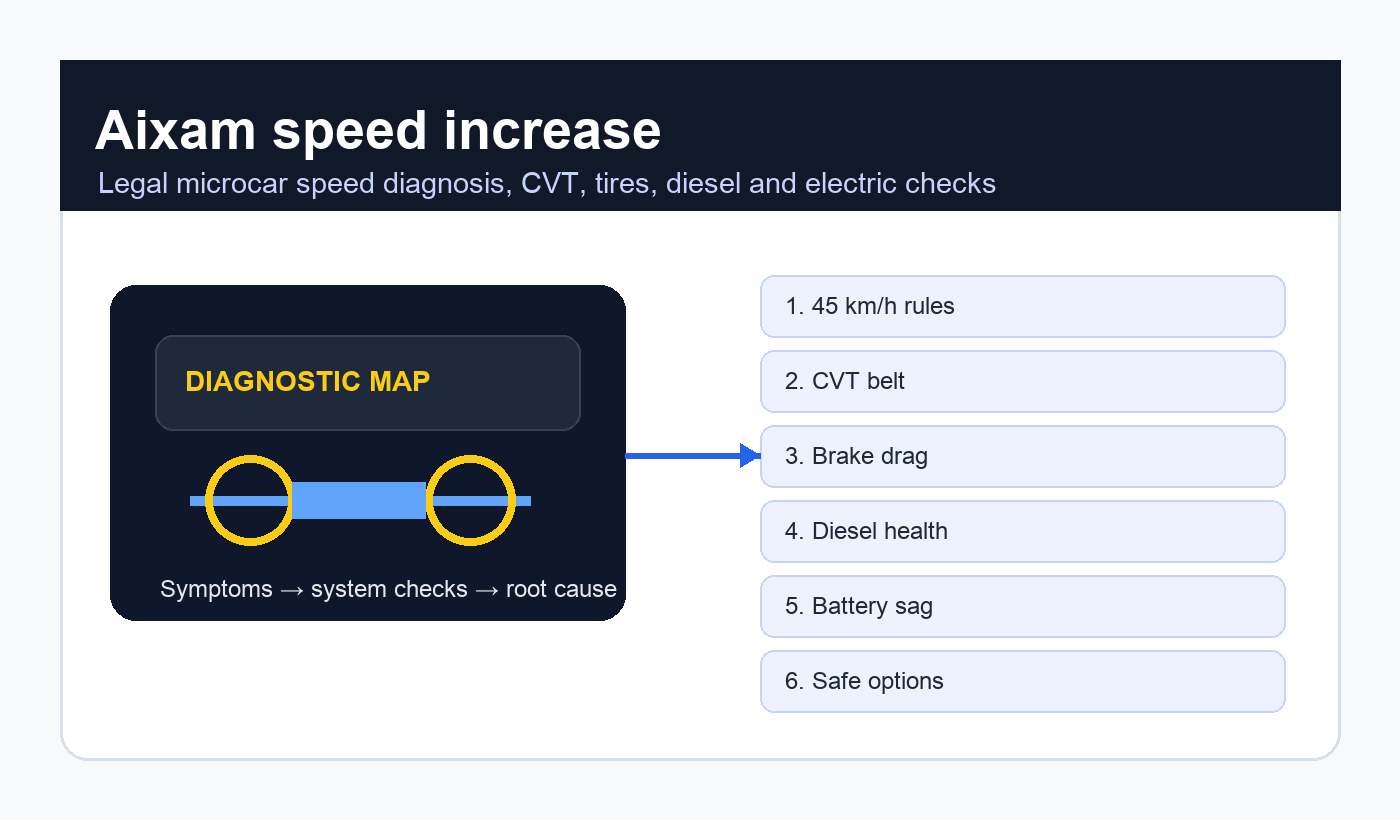
The useful approach is not to search for a hidden button that turns a voiture sans permis into a normal car. The useful approach is to understand the legal speed limit, the condition of the engine or electric drivetrain, the belt transmission, rolling resistance, brakes, tire pressure, vehicle weight and the roads where the vehicle is used. Some improvements restore lost performance; some change how lively the car feels; some modifications may make the vehicle illegal, uninsured or unsafe.
What owners need to know first
This guide is written for owners, buyers and technicians dealing with Aixam speed increase in the real world. It focuses on symptoms, checks, realistic repair decisions, legal limits where relevant, and the points worth confirming before buying parts or trusting a seller’s claim.
Common related topics include Aixam derestriction, Aixam limiter removal, Aixam 45 km/h, Aixam top speed, Aixam CVT tuning, Aixam variator, Aixam drive belt, Aixam Kubota engine, Aixam diesel tuning, Aixam electric tuning, Aixam ECU, Aixam speed limiter, voiture sans permis tuning, microcar speed increase, L6e quadricycle, light quadricycle speed limit, Aixam performance parts, Aixam acceleration, Aixam slow uphill, Aixam clutch adjustment, Aixam tire pressure, Aixam brake drag, Aixam service, Aixam gearbox oil, Aixam battery health, Aixam motor controller and Aixam legal speed.
The core intent behind Aixam speed increase is split into two groups. One group is trying to recover normal performance because the car has become slower than it should be. The other group wants to exceed the design category. A responsible guide has to help the first group thoroughly and warn the second group clearly.
| Intent | Typical owner question | Best answer |
|---|---|---|
| Restoration | Why does my Aixam no longer reach normal speed? | Check belt, variator, brakes, engine health, tires and weight. |
| Acceleration | Can it pull away better without illegal tuning? | Service the CVT, reduce rolling resistance and verify drivetrain condition. |
| Derestriction | Can I remove the 45 km/h limiter? | Explain legal, insurance and type-approval consequences before hardware. |
| Electric model | Can battery or controller health affect speed? | Yes; diagnose voltage sag, motor controller faults and tire load first. |
The 45 km/h reality
Aixam speed increase must begin with the legal framework. Many Aixam vehicles are sold as light quadricycles, commonly associated with the European L6e category. EUR-Lex Regulation (EU) No 168/2013 lists L6e criteria including a maximum design vehicle speed of 45 km/h and mass/power limits. Aixam’s own website presents its vehicles as cars without a licence in France, with mobility from age 14 in that market. That is not marketing trivia; it is the reason these vehicles exist in their particular form.
For that reason, a vehicle that has been altered to exceed the certified maximum design speed may no longer match the category under which it was registered, insured and driven. The exact consequences vary by country, but the general risks are obvious: insurance refusal after a crash, failed inspection, fines, licensing problems and liability if the modified vehicle is judged unsafe.
Two external sources should be kept in view: the official Aixam website for manufacturer context, and EUR-Lex Regulation (EU) No 168/2013 for EU quadricycle type-approval context.
First question: is the Aixam actually underperforming?
The safest Aixam speed increase path is often a diagnosis, not a modification. An Aixam that used to reach its normal speed but now struggles on flat roads may have a worn belt, dirty variator, dragging brake, low tire pressure, weak battery, fuel restriction, clogged air filter, poor compression, injector issue or excessive load. Fixing those problems does not create a modified vehicle; it restores the vehicle to the way it should work.
Measure speed with GPS on a flat road in both directions, with correct tire pressure and normal load. Do not judge performance only by the dashboard speedometer, wind, slope or a single trip. A microcar with limited power is extremely sensitive to headwind, passenger weight, cargo and road surface. The same vehicle can feel acceptable one day and hopeless the next if conditions change.
| Symptom | Likely area | What to inspect first |
|---|---|---|
| Slow pull away | CVT/variator or clutch | Belt width, pulley movement, rollers, clutch engagement. |
| Will not hold speed uphill | Engine output or rolling resistance | Air filter, fuel delivery, brake drag, tire pressure. |
| Top speed suddenly lower | Belt wear, limiter fault or engine health | Drive belt, variator, diagnostic codes, compression. |
| Electric model slows under load | Battery or controller | Voltage sag, state of charge, thermal protection, connectors. |
| Feels heavy and noisy | Transmission friction | Bearings, gearbox oil, belt alignment, pulley faces. |
CVT belt and variator condition
Aixam speed increase often starts and ends in the transmission. Many Aixam diesel microcars use a continuously variable transmission style setup where belt condition and pulley behavior decide how efficiently limited engine power becomes road speed. A narrow, glazed, cracked or incorrect belt can keep the vehicle from reaching its proper ratio. Dirty pulleys or sticking variator parts can make the car feel lazy even if the engine is healthy.
The first service step is to inspect the drive belt against the correct specification, not simply look at it. Belt width matters. So does pulley surface condition, dust accumulation, alignment and clutch operation. If the belt slips, the owner may smell heat, hear flare, feel weak acceleration or see inconsistent top speed.
Some owners install different variator weights or performance transmission parts. These can change acceleration feel, but the wrong setup can increase wear, raise noise and make the vehicle worse at steady speed. On a legal road vehicle, the better goal is smooth, consistent transfer of existing power rather than forcing the car outside its category.
| CVT item | Why it matters | Good practice |
|---|---|---|
| Drive belt | Determines effective ratio and grip | Measure width and replace with correct quality part. |
| Variator pulleys | Control how engine speed becomes vehicle speed | Clean, inspect faces and confirm free movement. |
| Rollers/weights | Change shift behavior | Use model-specific data and avoid extreme changes. |
| Clutch | Affects launch and low-speed smoothness | Inspect glazing, springs and engagement behavior. |
Diesel Aixam: engine service before tuning
On diesel models, Aixam speed increase usually depends on a small industrial-style engine working at the edge of what the vehicle category allows. Owners should check oil quality, air filter, fuel filter, injector condition, throttle cable or actuator travel, cooling system, engine mounts and exhaust restriction before thinking about more aggressive changes.
A partially blocked fuel filter or tired injector can make a diesel Aixam feel dramatically slower. So can a dirty air filter, sticky throttle linkage or poor compression. Because power is limited, a small loss is not hidden. The car simply becomes unable to recover speed after a hill or junction.
Turning fuel screws, altering governors or bypassing limits is a different matter. It can increase smoke, heat, noise and mechanical stress, and may alter the certified behavior of the vehicle. That is not a normal maintenance recommendation. A workshop that understands Aixam should distinguish between restoring factory output and changing the vehicle’s approved characteristics.
Electric Aixam: battery health and controller behavior
Aixam speed increase on an electric Aixam is a different problem. The motor controller, battery state of charge, pack health, temperature and voltage sag can all affect acceleration and ability to hold speed. If the vehicle is slow only when the battery is low, cold or hot, the issue may be protection logic rather than a mechanical restriction.
Check battery diagnostics, charging behavior, connector condition, cooling airflow, tire pressure and brake drag. A weak cell or degraded pack can cause voltage sag under load, which makes the controller reduce available power. The result feels like a speed problem even though the real issue is energy delivery.
Controller modifications should be treated with caution. Raising current or speed limits without understanding motor temperature, cable capacity, braking ability and approval status can create serious risk. For a daily road vehicle, restoring battery health and reducing rolling resistance are safer than forcing more current through the system.
Rolling resistance: the hidden speed thief
A practical Aixam speed increase plan should look at tires, brakes and bearings. Low tire pressure, old tires, wrong tire size, damaged wheel bearings and sticky brake calipers can steal speed from a vehicle that has very little power to spare. This is especially true for urban cars that do many short trips and spend time parked in wet conditions.
After a short drive, carefully check whether any wheel or brake area is unusually hot. That can indicate drag. Make sure the parking brake fully releases, calipers slide, drums are adjusted correctly and wheel bearings are quiet. These fixes can make the vehicle feel more eager without changing the engine or controller.
| Rolling resistance source | How it feels | Fix |
|---|---|---|
| Low tire pressure | Heavy steering and slow acceleration | Inflate cold to specification. |
| Brake drag | Hot wheel, poor coasting, reduced top speed | Service calipers, drums, cables or parking brake. |
| Wheel bearing wear | Noise, rough rotation, wasted energy | Inspect and replace before further tuning. |
| Wrong tires | Higher drag or poor stability | Use correct size and suitable load/speed rating. |
Weight and aerodynamics
Because the vehicle is light and low powered, Aixam speed increase can be influenced by cargo weight and aerodynamic drag. Roof accessories, open windows, unnecessary luggage and poorly fitted body panels can all reduce speed. Even passenger weight matters more than it would in a normal car.
Remove unnecessary cargo, keep bodywork secure, check underbody panels and avoid adding heavy audio equipment or styling parts if speed is the priority. The goal is not to strip the car in an unsafe way; it is to stop carrying needless weight every day.
What not to do
The dangerous version of Aixam speed increase is limiter bypassing without a full understanding of braking, tires, suspension, steering, crash protection and legal category. Aixam vehicles are designed and approved within a specific performance envelope. Making one faster does not automatically make it capable of stopping, swerving or protecting occupants like a conventional car at higher speeds.
Do not fit mystery electronic boxes, modify wiring blindly, remove safety devices, disable warning lights, overfuel a diesel until it smokes, or install parts that make the vehicle impossible to insure. Also avoid internet advice that gives a single screw position or wire color as if all Aixam models were identical. Model year, engine, ECU, transmission and country specification matter.
Legal alternatives if 45 km/h is no longer enough
Sometimes the most honest Aixam speed increase conclusion is that the owner needs a different vehicle category. If the regular route includes faster roads, hills, long commutes or heavy traffic, a light quadricycle may simply be the wrong tool. Moving to a vehicle that is legally designed for higher speed is usually safer than trying to make a 45 km/h vehicle behave like one.
That may mean an L7e heavy quadricycle where legal and suitable, a small city car, a scooter, a motorcycle or public transport depending on licence, age and location. It is less glamorous than tuning, but it is often the better long-term answer.
Owner case notes: how to think through common scenarios
Case one is the owner who asks for Aixam speed increase because the vehicle has gradually become slower. That is a maintenance case first. Compare current GPS speed with previous behavior, then inspect belt wear, tire pressure, brake temperature and filters before assuming a limiter problem.
Case two is the owner who wants Aixam speed increase because the car is used on roads that feel too fast for a 45 km/h vehicle. That is a route and category problem. A modification may create more risk than benefit if surrounding traffic is moving far beyond the vehicle’s approved performance envelope.
Case three is the owner considering Aixam speed increase after seeing a video online. The video may show a different engine, older registration class, private-road test, removed limiter or unsupported claim. Do not copy that setup without knowing the exact model, country rules and insurance position.
Case four is the workshop receiving a request for Aixam speed increase from a young driver or parent. The professional answer should begin with safety, legal status and a health check, not with bypass instructions. That protects the customer and the workshop.
Case five is the buyer researching Aixam speed increase before purchasing a used Aixam. In that situation, choose the cleanest, best-serviced vehicle rather than the one advertised as modified. A healthy standard car is often faster in real traffic than a neglected modified one.
Internal guides for related diagnostics
If you are researching Aixam speed increase, the diagnostic mindset overlaps with other Xmotoparts guides. The OBD2 protocol list guide is useful when thinking about scan tools and vehicle communication. The Fuel color guide helps with basic diesel and fuel-quality checks. The 07E8 code / 07E8 engine code article is a good reminder that generic scan labels need proper context before parts are replaced.
Practical workshop checklist
A careful Aixam speed increase inspection should follow a sequence. First, confirm legal category and model specification. Second, measure real speed by GPS in both directions on a safe flat road. Third, inspect tires, brakes and bearings. Fourth, service the CVT belt and variator. Fifth, diagnose engine or battery health. Only after those steps should any owner discuss modification parts.
| Step | Action | Why it comes in this order |
|---|---|---|
| 1 | Confirm model and category | Prevents illegal or incompatible advice. |
| 2 | Measure real GPS speed | Separates perception from evidence. |
| 3 | Remove rolling resistance | Often restores speed cheaply. |
| 4 | Inspect CVT/belt | Transmission losses are common and visible. |
| 5 | Check engine or battery health | Finds root causes before modifications. |
| 6 | Discuss legal options | Keeps insurance and safety in view. |
FAQ
Is Aixam speed increase legal?
Restoring lost performance through maintenance is normally different from modifying a vehicle beyond its approved design speed. Removing or bypassing a legal speed limit can create licensing, insurance and inspection problems.
What is the safest Aixam speed increase starting point?
Start with tire pressure, brake drag, belt condition, variator cleanliness, filters and diagnostics. Those areas often explain why an Aixam feels slower than expected.
Can a worn belt affect Aixam speed increase results?
Yes. Belt width and grip directly affect the transmission ratio and the ability to turn limited engine power into road speed.
Does Aixam speed increase work differently on electric models?
Yes. Battery health, voltage sag, temperature and controller protection can reduce performance even when the motor itself is not faulty.
Is a limiter removal the best Aixam speed increase solution?
Usually no. It may make the vehicle non-compliant with its registration or insurance category, and it does not upgrade brakes, tires, crash protection or stability.
Should I ask a garage for Aixam speed increase or for diagnosis?
Ask for diagnosis first. A clear fault report gives better decisions than asking a garage for Aixam speed increase before anyone knows why it feels slow.
Can better maintenance feel like Aixam speed increase?
Yes. On a low-powered microcar, removing friction and restoring transmission efficiency can feel like a real improvement even when the legal top speed stays unchanged.
Final verdict
Aixam speed increase should be treated as a disciplined diagnostic project. If the Aixam is slower than it should be, restore it: tires, brakes, bearings, belt, variator, filters, fuel delivery, compression or battery health. Those steps can make a meaningful difference without pretending the car is something it is not.
The responsible formula for Aixam speed increase is simple: confirm the legal category, measure the real problem, remove mechanical losses, repair the drivetrain and avoid changes that put the driver outside the approved speed, licence or insurance envelope. When 45 km/h is not enough for the route, the safer answer is often a different vehicle, not a hidden shortcut.