
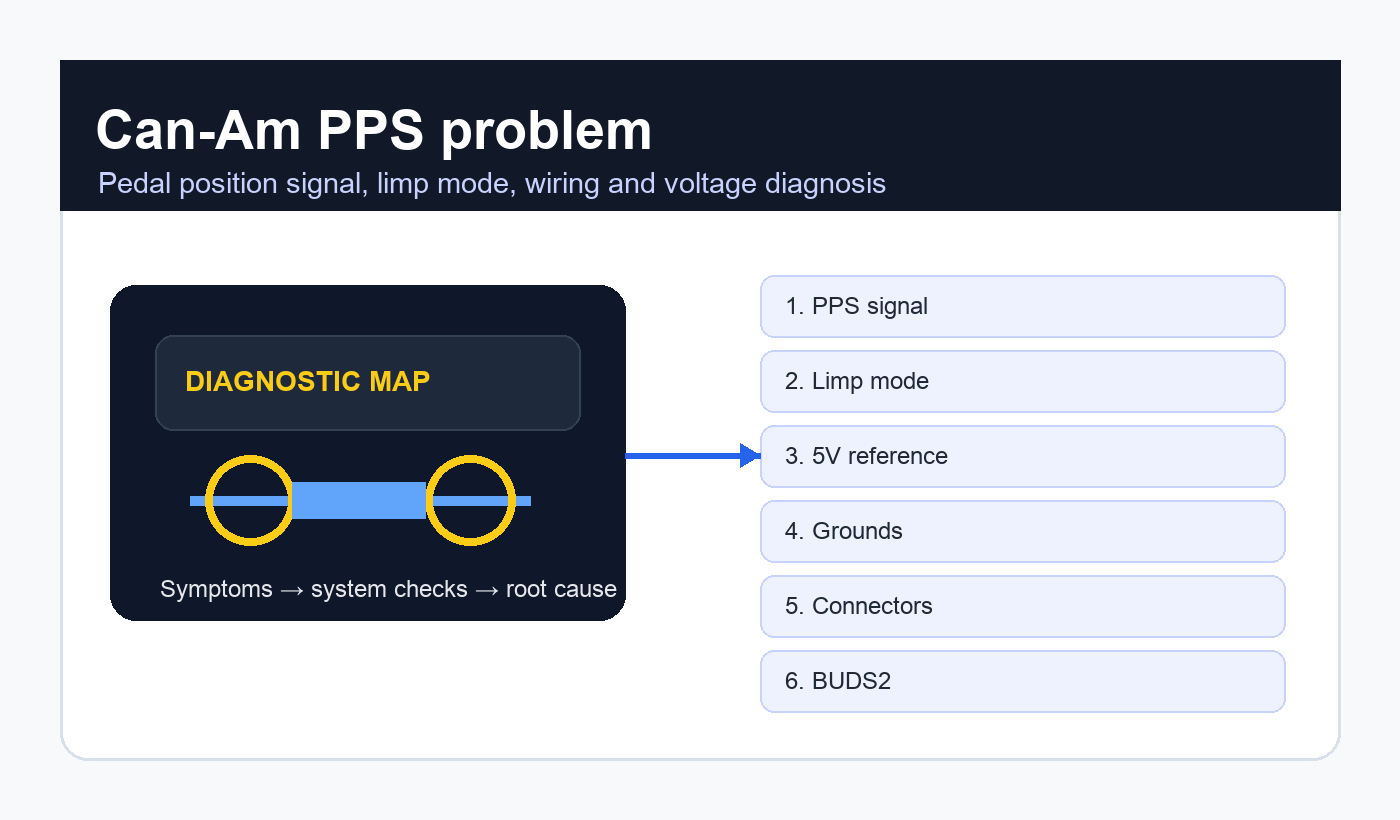
Can-Am PPS problem: diagnostic guide for pedal position, throttle signal and limp-mode faults
Can-Am PPS problem is a confusing search because “PPS” is not always used the same way by riders, scanners and forum posts. In practical Can-Am diagnosis, the phrase usually points toward a pedal position sensor, pedal position signal, throttle-by-wire input, accelerator pedal plausibility fault, or a related limp-mode complaint on Maverick, Commander, Defender or other BRP off-road vehicles. The first rule is simple: do not replace the pedal assembly until the exact fault code, voltage supply, ground and wiring condition have been verified.

This guide treats Can-Am PPS problem as a diagnostic workflow rather than a single magic part. It explains what PPS-style complaints usually mean, how throttle pedal sensors work, why low battery voltage can imitate sensor failure, how wiring and connectors fail, what to check before buying a replacement pedal, and when a Can-Am dealer or BRP diagnostic tool becomes necessary.
Quick answer: what a PPS-style fault usually means
A Can-Am PPS problem usually means the ECU is seeing an implausible, missing or inconsistent accelerator pedal signal, or riders are using “PPS” as shorthand for a pedal/throttle input fault. Symptoms can include limp mode, check engine light, limited rpm, throttle delay, no throttle response, rough response, fault codes after washing, intermittent failures on bumps, or a machine that works after key cycling and then fails again. The cause may be the pedal sensor, but it may also be wiring, connector corrosion, weak voltage, ground faults, software calibration or a related throttle body issue.
What owners need to know first
This guide is written for owners, buyers and technicians dealing with Can in the real world. It focuses on symptoms, checks, realistic repair decisions, legal limits where relevant, and the points worth confirming before buying parts or trusting a seller’s claim.
| Intent cluster | Related topics | What the owner needs |
|---|---|---|
| Signal fault | pedal position sensor, accelerator pedal, throttle signal, plausibility | Understand whether the ECU trusts pedal input. |
| Limp mode | limited rpm, no throttle, check engine, fault code, key cycle | Separate temporary protection from a real failure. |
| Electrical | connector corrosion, ground, battery, 5V reference, wiring harness | Test power and signal before replacing parts. |
| Model context | Maverick X3, Defender, Commander, Outlander, Renegade | Use the correct manual and code list. |
| Safety | recall, service bulletin, dealer diagnostic, BUDS2 | Know when professional scan tools are required. |
Why “PPS” can be ambiguous
The most important point in a Can-Am PPS problem is terminology. Some owners say PPS when they mean pedal position sensor. Others may be describing a scanner label, a translated fault description, a pedal position signal, or a power steering-related acronym they saw elsewhere. On a modern Can-Am, guessing from the acronym alone is risky.
Use the official BRP operator guide portal to match the exact model and year before interpreting warnings, maintenance notes or instrument-cluster messages: BRP operator guides. The article can guide the logic, but the machine’s year, model and code define the repair.
That model-year discipline matters because a Maverick, Defender, Commander, Outlander or Renegade can use different harness routing, different warning messages and different service procedures. A translated owner post may describe the same rider experience with different words, while the factory diagnostic path may be much more precise.
How the pedal position system works
A Can-Am PPS problem often involves an electronic accelerator pedal that sends position information to the ECU. Many drive-by-wire systems use redundant signal tracks, so the control unit can compare two sensor values. If the signals disagree, drop out, lose reference voltage or fall outside expected range, the ECU may limit throttle for safety.
| System part | What it does | What can fail |
|---|---|---|
| Pedal sensor | Reports accelerator request | Worn track, internal fault, water intrusion. |
| 5V reference | Powers sensor circuits | Shorted sensor, damaged wire, ECU reference issue. |
| Ground | Completes sensor circuit | Corrosion, loose terminal, voltage drop. |
| Signal wires | Carry position values | Rub-through, connector spread, intermittent open. |
| ECU logic | Compares plausibility | Software protection, fault memory, related throttle issue. |
Because the system is safety-related, a Can-Am PPS problem should not be bypassed or “tricked” to keep riding. If the ECU does not trust pedal input, it may reduce power because uncontrolled throttle would be dangerous.
For that reason, a Can-Am PPS problem should be handled with the same seriousness as a brake or steering warning, even when the machine still starts and moves.
Symptoms riders notice
The symptom pattern behind a Can-Am PPS problem matters. A permanent no-throttle condition is different from a failure that appears only after washing, heat, vibration or water crossings. A fault that clears after key cycling may point toward intermittent wiring or voltage drop. A fault that returns immediately may point to a hard sensor or circuit failure.
| Symptom | Possible direction | First diagnostic step |
|---|---|---|
| Limp mode with check engine | Pedal signal, throttle body, voltage or ECU protection | Read exact fault code before clearing it. |
| No throttle response | Pedal sensor, wiring, connector, throttle body | Check live pedal values if scan tool allows. |
| Fault after washing | Water in connector or harness | Inspect, dry and protect connectors properly. |
| Fault on bumps | Loose pin, broken wire, harness rub | Wiggle-test harness while watching data. |
| Fault during cranking | Battery voltage drop | Load-test battery and check grounds. |
Code reading before parts replacement
A serious Can-Am PPS problem diagnosis starts by reading and recording the exact code, freeze-frame or occurrence conditions if available. Do not clear the code first. Once cleared, the most useful evidence may be gone, and the next failure may take time to reproduce.
Generic scanners can be limited on powersports vehicles. A dealer-level BRP diagnostic platform may show pedal percentage, sensor correlation, throttle body data, stored faults and update information that a basic tool cannot. Our 07E8 engine code guide explains the same principle in automotive diagnostics: a module label or generic code is only a starting point, not a conclusion.
Battery voltage and grounds
Low voltage is a common hidden cause of a Can-Am PPS problem. Electronic throttle and pedal systems need stable reference voltage and clean ground. A weak battery, loose terminal, corroded ground, failing regulator or winch/stereo wiring can make the ECU distrust sensor values even when the pedal itself is fine.
| Electrical check | Why it matters | Warning sign |
|---|---|---|
| Battery load test | Finds voltage collapse during cranking | Voltage drops sharply or recovers slowly. |
| Ground voltage drop | Shows resistance under load | More drop than expected on main ground path. |
| Charging voltage | Confirms regulator/stator health | Undercharging, overcharging or unstable output. |
| Accessory circuits | Finds poor add-on wiring | Unfused splices, water-filled relays, loose grounds. |
If a Can-Am PPS problem appears after installing accessories, disconnect the new circuit safely and retest. Many pedal and throttle complaints are really power-quality complaints.
A voltage-related Can-Am PPS problem can disappear after charging the battery and still return later if the root cause is a weak regulator, corroded ground or parasitic draw.
Connector corrosion and harness rub
Water, mud and vibration make connector inspection central to a Can-Am PPS problem. The pedal connector, throttle body connector, ECU plugs, ground points and harness sections near heat or moving parts should be inspected carefully. Look for green corrosion, moisture, spread terminals, broken locks, chafed insulation and previous repair splices.
Do not attack connectors with random tools. Use proper electrical contact cleaner, dry thoroughly, inspect pins with light and magnification, and apply the correct dielectric protection where appropriate. A damaged terminal can create intermittent faults that mimic a failing pedal assembly.
When a Can-Am PPS problem appears after mud or washing, connector inspection should happen before parts replacement because moisture is often the trigger.
Pedal sensor testing
Testing a Can-Am PPS problem at the pedal requires caution. If service information gives pinouts and expected values, compare both signal tracks through a slow pedal sweep. A good signal should change smoothly, without dropouts or spikes. If the two tracks disagree beyond expected relationship, the ECU may trigger plausibility protection.
| Test | Good pattern | Bad pattern |
|---|---|---|
| Live data sweep | Smooth pedal percentage change | Jumping, flat spots, impossible values. |
| Reference voltage | Stable supply within spec | Missing, shorted or unstable reference. |
| Ground integrity | Low resistance and low voltage drop | Corrosion or intermittent continuity. |
| Wiggle test | No change when harness moves | Signal cuts out or fault returns. |
When a Can-Am PPS problem is intermittent, live-data testing is more useful than a single resistance reading. The failure may exist for one second while the harness vibrates.
Throttle body and related faults
Not every Can-Am PPS problem is caused by the pedal. The throttle body, throttle position feedback, intake leaks, ECU strategy, wiring shared with other sensors, and engine protection logic can all create a similar rider experience. If the ECU sees pedal request but cannot control throttle response correctly, limp mode may still occur.
This is why fault-code wording matters. A code for pedal correlation is different from a code for throttle actuator performance. The rider may feel both as “no throttle,” but the diagnostic path is not the same.
Also consider whether the engine is protecting itself for another reason. Overheating, severe misfire, intake leaks or sensor reference faults can limit response and create the impression that the pedal has failed. A complete scan and basic mechanical check keep the diagnosis honest.
Model-specific context: Maverick, Defender, Commander and ATV platforms
A Can-Am PPS problem on a Maverick X3 used in dunes may have a different cause than one on a Defender used for farm work. Sand, heat, washing, mud, winch use, accessory wiring and long idle time all change the failure pattern. The exact platform matters because pedal assemblies, harness routing and diagnostic access may vary.
For comparison across side-by-side diagnostic logic, our Yamaha RMAX 1000 problems guide covers similar electrical, throttle-response and accessory wiring themes on a different brand. The parts differ, but the discipline is the same: voltage first, wiring second, component replacement last.
Safety recalls and official support
Safety information belongs in every Can-Am PPS problem article because throttle and pedal input affect vehicle control. Can-Am maintains an official off-road safety recalls page where owners can check relevant notices: Can-Am off-road safety recalls. Use VIN-specific dealer support when the fault could affect safe operation.
If a Can-Am PPS problem is paired with a safety campaign or dealer notice, follow the official repair path instead of adapting a forum workaround.
If a pedal or throttle fault happens while riding, stop in a safe place and avoid high-speed testing. Limp mode is frustrating, but it is designed to reduce risk. Do not bypass safety logic to finish a ride.
For work vehicles, document the failure before the next job. A farm or utility machine that loses throttle control intermittently can create risk around trailers, gates, slopes and livestock, even if the fault seems minor during a short test.
Used buying checklist
A used vehicle with a Can-Am PPS problem history should be priced carefully. Ask for fault-code records, dealer invoices, replaced parts, battery age, accessory installation details and whether the problem happens hot, wet or on rough terrain. A seller who says “it just needs a pedal” should be able to prove the wiring and voltage were tested.
| Buying check | Good sign | Warning sign |
|---|---|---|
| Fault history | Exact code recorded with repair invoice | Cleared codes and vague explanation. |
| Battery and charging | Recent test and stable voltage | Weak battery, slow crank, accessory drain. |
| Wiring | Clean harness, sealed accessories, no rubbed wires | Twisted splices, water intrusion, missing clips. |
| Pedal response | Smooth live data and no limp mode | Intermittent throttle cut or warning light. |
| Recall status | VIN checked and documented | No dealer records or unknown campaign history. |
Repair priority order
The best repair order for a Can-Am PPS problem is evidence-based. Record codes first. Confirm battery and charging health. Inspect grounds and connectors. Check harness routing and water intrusion. Watch live pedal data. Only then replace the pedal sensor, throttle body or ECU-related parts if the evidence supports it.
A practical home diagnostic routine is to photograph the cluster warning, write down the riding condition, check battery voltage before and during cranking, inspect the pedal connector, then repeat the test after the machine is hot. If the warning changes with heat, moisture or harness movement, the pattern is more valuable than the part number of the last component someone replaced online.
When dealer help is needed, arrive with notes instead of only saying that the throttle failed. Date, temperature, wet or dry conditions, recent washing, accessory changes, battery age and whether the warning cleared after key cycling all shorten the diagnostic path. Good notes can save labor time because the technician can reproduce the scenario instead of starting from a blank complaint.
| Priority | Action | Reason |
|---|---|---|
| 1 | Record exact codes and conditions | Preserves evidence before clearing faults. |
| 2 | Test battery, charging and grounds | Power faults imitate sensor faults. |
| 3 | Inspect connectors and harness | Water and vibration create intermittent failures. |
| 4 | Use live data or dealer diagnostics | Shows pedal plausibility and signal behavior. |
| 5 | Replace parts only after proof | Prevents expensive guessing. |
Mistakes to avoid
The biggest mistake with a Can-Am PPS problem is ordering a pedal assembly because someone online had a similar symptom. The second mistake is clearing codes before recording them. The third is ignoring battery voltage because the engine still cranks. Electronic throttle systems can be more sensitive than the starter motor suggests.
Another mistake is pressure-washing connectors and then riding immediately. Water can sit inside a connector and create a fault after vibration or heat. Drying and inspection matter more than hoping the warning light goes away.
A recurring Can-Am PPS problem deserves a written diagnostic log, because intermittent electrical faults are much easier to solve when conditions and test results are recorded.
Internal diagnostic resources
For broader powersports fault diagnosis, our Polaris RZR 570 problems article explains how battery, EPS and accessory wiring issues can imitate more expensive failures. The brand differs, but the testing hierarchy is useful for Can-Am owners too.
Frequently asked questions
What does PPS mean on a Can-Am?
In owner searches, PPS often refers to pedal position sensor or pedal position signal, but the exact meaning depends on the code, scanner and model. A Can-Am PPS problem should always be matched to the exact BRP fault description.
Can a weak battery cause this fault?
Yes. Low voltage, poor grounds or unstable charging can create pedal/throttle plausibility symptoms. Test the battery under load before replacing sensors.
Can I keep riding in limp mode?
No, not as normal operation. Limp mode means the ECU is limiting performance for a reason. Stop safely, record the fault, and diagnose before riding hard again.
Is the pedal sensor always bad?
No. A Can-Am PPS problem can come from the pedal, but it can also come from connector corrosion, wiring damage, reference voltage, ground issues, throttle body faults or ECU logic.
Do I need a dealer scan tool?
Sometimes. If basic voltage, ground and connector checks do not reveal the problem, BRP-specific diagnostics may be needed to view live values, stored faults and software-related information.
Final verdict
Can-Am PPS problem should be treated as an electrical and safety diagnosis, not a parts-shopping phrase. The pedal may be bad, but the evidence must prove it. Record the exact code, test voltage, inspect grounds, check connectors, watch live data and verify model-specific service information before replacing components.
Handled methodically, a Can-Am PPS problem becomes manageable. Handled by guessing, it becomes expensive and frustrating. If throttle response or limp mode affects control, stop riding, check official information, and use proper diagnostics before trusting the machine again.