
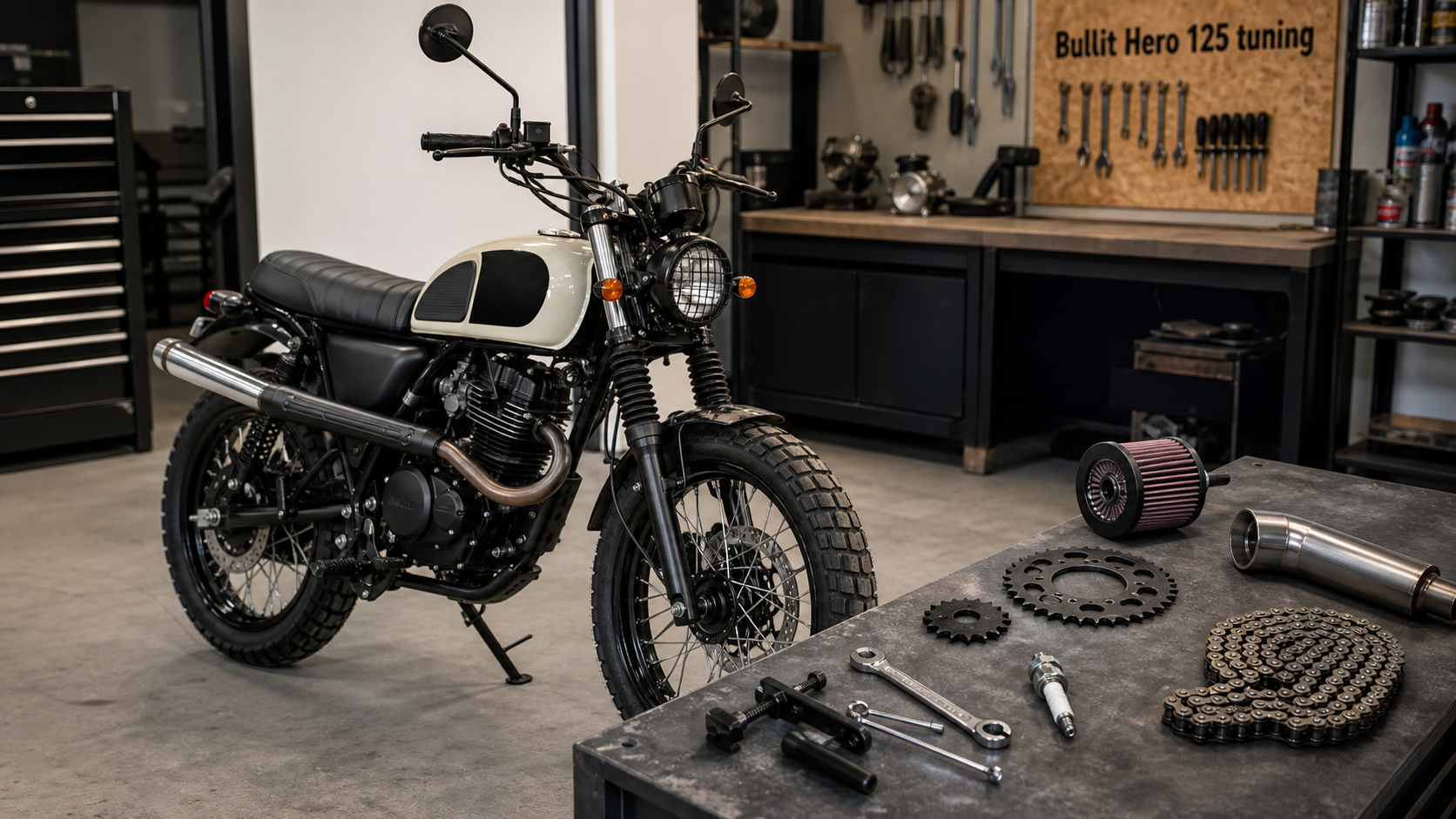
Bullit Hero 125 tuning: a practical mechanic’s guide to safe power, exhaust, gearing and reliable retro 125 setup
Bullit Hero 125 tuning should start with honest expectations. The Hero 125 is a small retro-style 125, not a hidden race engine waiting for one magic part. The best improvements come from making the motorcycle healthier, sharper and better matched to the rider: clean fueling, correct gearing, a sealed intake, a sensible exhaust, fresh tyres and no wasted power from a tight chain or dragging brakes.

The riders searching for Bullit Hero 125 tuning usually want more acceleration, a better sound, stronger hill climbing and a bike that feels less flat at road speed. Those are realistic goals if the work is done carefully. What is not realistic is expecting a 125 cc four-stroke to become a middleweight motorcycle because of a loud exhaust, open filter or random electronic module.
A good Bullit Hero 125 tuning plan has a sequence: service the bike, remove hidden drag, confirm intake and fueling health, choose gearing for your roads, then consider exhaust, filter and fuel correction as a matched package. If the bike is still under warranty or inspection rules are strict in your country, keep every original part and make changes reversible.
What owners are really asking
The search cluster around this topic includes Bullit Hero 125 tuning, Hero 125 performance, Bullit Hero 125 exhaust, Bullit Hero 125 power increase, 125cc tuning, retro 125 tuning, air filter upgrade, sprocket change, carburettor jetting, fuel injection module, road-legal exhaust, top speed, acceleration and motorcycle derestriction. The intent is practical: riders want to know what is worth doing, what is legal, and what creates problems.
This is why Bullit Hero 125 tuning has to be treated like workshop work rather than shopping. A bike that feels slow may not need a performance part. It may need a valve check, fresh plug, correctly adjusted chain, clean air filter or brake service. Small losses matter on a 125 because there is not much spare torque to hide them.
| Owner goal | Likely best starting point | Common mistake |
|---|---|---|
| More acceleration | Gearing, chain, service condition | Fitting a loud exhaust first |
| Better throttle response | Filter, plug, intake seal, fueling | Using electronics to hide a fault |
| More sound | Road-legal exhaust with correct bracketry | Removing baffles and losing low rpm pull |
| Higher cruising speed | Reduce drag and choose gearing carefully | Overgearing the bike until top gear is weak |
Legal limits before performance parts
Every Bullit Hero 125 tuning decision has to respect the motorcycle’s registration, insurance and licence category. In many European markets, 125 cc motorcycles sit near A1 licence and type-approval limits. The EU framework for L-category vehicles is described in Regulation (EU) No 168/2013. If you ride in the UK, official motorcycle licence and training rules are explained by GOV.UK motorcycle CBT guidance.
That does not mean tuning is forbidden. It means the owner must be realistic. A road bike still needs lights, emissions equipment where required, safe noise levels and insurance compliance. If a modification changes the bike’s legal classification or makes it fail inspection, it is not a clever upgrade. Responsible Bullit Hero 125 tuning keeps paperwork, original parts and a clear record of what was fitted.
Baseline service: the first upgrade
The first stage of Bullit Hero 125 tuning is a full check. Inspect oil level and age, spark plug, valve clearance, air filter, battery voltage, charging system, chain slack, sprocket teeth, brake drag, wheel bearings, tyre pressure and intake rubbers. If the engine is carburetted, clean jets and confirm float height. If it is fuel injected, scan for faults when possible and inspect sensor wiring.
A tight chain can make a 125 feel lazy. A dirty filter can soften throttle. Low tyre pressure can make the bike feel heavy. Tight valves can reduce compression when hot. Old fuel can create hesitation. These are not glamorous fixes, but they are the foundation of every useful Bullit Hero 125 tuning result.
Compression and valve clearance
If the bike starts poorly, feels weak when warm or has unknown service history, check valve clearance and compression before buying tuning parts. A small engine with tight valves can feel flat and become hard to diagnose once parts are added.
Chain and sprocket health
Adjust the chain at the tightest point, not the loosest. Inspect sprocket teeth for hooking. Lubricate properly. A rough or overtight chain steals power and can make the bike feel harsh. Good Bullit Hero 125 tuning starts at the rear wheel as much as at the engine.
Air filter and intake setup
A clean standard-style filter is often the best first intake step. Open pod filters look simple, but they can make a small engine harder to tune, especially in rain and changing temperatures. For mild Bullit Hero 125 tuning, keep filtration strong and the intake tract sealed.
If you fit a freer-flowing filter, test the bike through the full range: cold start, idle, slow traffic, steady cruise and full throttle. More air without the right fuel can create hesitation or heat. A filter that does not seal properly is worse than no upgrade at all because dust damage is permanent.
Exhaust tuning without losing rideability
A retro 125 often looks and sounds better with a tasteful exhaust. That makes exhaust work a common Bullit Hero 125 tuning upgrade. The key word is tasteful. A pipe should fit correctly, clear the frame and swingarm, use solid brackets, keep heat away from the rider and remain road legal where required.
A very open exhaust can reduce low-rpm torque. On a 125, that matters more than peak sound. If the bike pops excessively, smells hot, hesitates or feels hollow after the exhaust change, stop and check for leaks and fueling. The right pipe should make the bike more pleasant, not more tiring.
| Exhaust result | What it suggests | What to do |
|---|---|---|
| Deeper sound and clean pull | Likely good match | Recheck fasteners after heat cycles |
| More noise but weaker launch | Pipe may be too open | Use baffle or different system |
| Popping and hot smell | Leak or lean condition possible | Inspect joints and fueling |
| Rattle after fitting | Bracket stress or loose hardware | Refit before riding hard |
Carburettor, injection and fueling
Model year and market matter. Some small retro 125s are carburetted; later emissions versions may be fuel injected. Before planning Bullit Hero 125 tuning, confirm what system your motorcycle uses. Carburettor work means jets, needle position, float height, idle mixture and intake sealing. Fuel injection work means sensor health, ECU strategy, possible module compatibility and fault-code checks.
Do not make the mixture rich everywhere because it feels safer. Rich running can feel soft, waste fuel and foul plugs. Lean running can hesitate and create heat. A careful setup is tested in stages: idle, low throttle, mid-range cruise, hill load and full throttle. The best fuel setup feels boringly clean.
For practical Bullit Hero 125 tuning, make one change at a time. If you change exhaust and filter together, then alter jets or module settings immediately, you will not know which part caused a problem. Start with the motorcycle healthy, change one item, test, then move to the next. Slow work is faster than chasing three faults at once.
Symptoms after tuning and what they mean
After Bullit Hero 125 tuning, new symptoms should be treated as clues. A bike that revs louder but does not accelerate better may have gearing or mixture wrong. A bike that hesitates at steady throttle may have an intake leak or lean transition. A bike that feels heavy after a sprocket change may be overgeared. A bike that smells hot after an exhaust change may need immediate inspection.
| Symptom | Likely area | First check |
|---|---|---|
| Flat mid-range | Fueling or intake leak | Check filter seal, jets/module setting and plug |
| Weak top gear | Gearing too tall | Return closer to stock ratio |
| Hot smell | Lean running or exhaust leak | Inspect joints and mixture before riding hard |
| Chain vibration | Slack or alignment issue | Adjust at tightest point and check sprockets |
Sprocket gearing: cheap and honest
Gearing is one of the most noticeable forms of Bullit Hero 125 tuning. Shorter gearing can improve launch and hill climbing. Taller gearing can lower cruising rpm but may make top gear weak. On a 125, too tall is often worse than stock because the engine cannot pull through wind and gradients.
Count the teeth already fitted before ordering. Used bikes are not always stock. If you ride hills, carry a passenger or commute in town, slightly shorter gearing may make the bike happier. If your roads are flat and you want calmer cruising, a small taller change may work. Make small changes and test honestly.
| Use case | Gearing direction | Trade-off |
|---|---|---|
| Town riding | Slightly shorter | More rpm at open-road speed |
| Hills or passenger | Slightly shorter | More shifting but better pull |
| Flat commuting | Stock or slightly taller | May weaken top-gear acceleration |
| Top-speed chasing | Service first | Wind may remain the real limit |
Ignition and spark plug choices
A fresh correct-spec spark plug is a small but important part of Bullit Hero 125 tuning. Do not choose an incorrect heat range because it is advertised as racing. The plug should match the engine’s needs. Inspect the cap, lead and ground connections. A weak or inconsistent spark can feel like poor fueling.
After intake or exhaust changes, reading the plug can help, but it should be done with care. Short idle time can mislead colour. If you are not confident, use a workshop that understands small-capacity four-strokes.
Suspension, tyres and brakes
Performance is not only engine work. Old tyres, weak pads, tired shocks or poor fork condition can make a small bike feel slower because the rider cannot trust it. A serious Bullit Hero 125 tuning plan includes tyres, brakes and suspension.
Choose tyres that match the bike’s real use. Retro tread may look good, but grip and carcass quality matter. Check brake pads, brake fluid if hydraulic, cable adjustment if mechanical and wheel bearing smoothness. If the bike dives badly or feels vague, suspension service may be more useful than engine parts.
Stage plan for a sensible build
A staged Bullit Hero 125 tuning plan prevents wasted money. Stage 0 restores the motorcycle. Stage 1 sharpens response. Stage 2 matches breathing and fueling. Stage 3 is only for owners who accept cost, legality and reliability compromises.
Stage 0: restore
Service oil, plug, filter, valves, chain, sprockets, brakes, tyres and wiring. Fix intake leaks and fuel problems. Ride the bike after service before deciding it needs more parts.
Stage 1: sharpen
Choose gearing for your roads, fit a quality filter if needed, clean the chain setup and make sure throttle response is crisp. Most owners get the best value from this stage of Bullit Hero 125 tuning.
Stage 2: exhaust and fueling
Fit a road-legal exhaust if desired, then support it with correct carburettor or fuel-injection adjustment. Test the whole bike, not only the sound.
Stage 3: engine work
Big-bore kits, camshaft work and internal modifications can become expensive and legally complicated. For most riders, a well set up 125 is a better answer than a fragile one.
Testing after modifications
After any Bullit Hero 125 tuning, use the same test route. Include a town start, a hill, a steady cruise and a hot restart. Listen for exhaust leaks, chain noise, pinging, hesitation and new vibration. Recheck fasteners after the first heat cycle.
Keep notes. Record sprocket sizes, jet sizes or module settings, filter type, exhaust model, fuel consumption and plug condition. If the bike later feels different, those notes make diagnosis faster.
Maintenance after the upgrades
A tuned 125 should not be ignored after the first successful ride. Recheck exhaust nuts, bracket bolts, chain slack, cable routing, fuel hose position, filter seating and any wiring added for a module. Small motorcycles vibrate, and new parts settle. A careful Bullit Hero 125 tuning job includes the second inspection, not only the installation.
After a few tanks of fuel, compare consumption and plug condition. If fuel use rises sharply without a clear performance benefit, the setup may be too rich or mechanically inefficient. If the bike becomes harder to start hot, do not blame the weather immediately. Go back through the last changes and test calmly.
Keep the original exhaust, intake parts, sprockets, jets and brackets when possible. If inspection rules change, if you sell the motorcycle, or if a problem appears, returning to a known baseline is valuable. Reversible Bullit Hero 125 tuning is easier to live with than a build that traps you with unknown parts.
That habit also helps any future mechanic understand the bike quickly, especially if the motorcycle changes hands or returns for seasonal servicing.
Riding position and small-bike efficiency
On a 125, the rider is a large part of the performance equation. A bulky jacket, upright posture, luggage, wide mirrors and soft tyres can all reduce road speed. Before chasing more engine output, make sure the motorcycle is cleanly set up for the rider. Adjust lever position, check mirror placement, remove unnecessary weight and make sure luggage is not acting like a sail.
This does not mean turning the bike into something uncomfortable. It means understanding that small-capacity motorcycles respond strongly to drag and rolling resistance. A tidy, well-adjusted bike with correct pressure and smooth controls often feels more eager than one loaded with accessories and poor setup.
Common mistakes
The first mistake in Bullit Hero 125 tuning is buying parts before servicing the bike. The second is fitting a noisy exhaust and ignoring mixture. The third is overgearing the motorcycle. The fourth is using an intake filter that does not seal. The fifth is forgetting brakes and tyres.
Another mistake is copying settings from a different 125. Two bikes can look similar but have different exhausts, gearing, carburettors, ECU versions and rider loads. Tune your motorcycle, not someone else’s internet comment.
Internal guides worth reading next
If you are comparing retro 125 builds, read the Brixton Cromwell 125 tuning guide. The Mash Seventy 125 tuning article is useful for another simple retro platform. If you want a cruiser-style comparison, see UM Renegade Commando 125 tuning. For a sportier 125 approach, the Keeway RKF 125 tuning guide helps explain different priorities.
FAQ
What is the best first upgrade?
The best first Bullit Hero 125 tuning upgrade is a full service and setup check. A clean filter, correct valve clearance, good plug, adjusted chain and free brakes can restore a lot of lost response.
Does an exhaust add power?
An exhaust can improve sound and may support response when matched correctly, but it can also reduce low-rpm pull if it is too open. Always check fitment and fueling.
Should I change sprockets?
Yes, if your roads demand it. Shorter gearing can help hills and town riding. Taller gearing only works if the engine can pull it.
Is a performance air filter worth it?
Only if it seals well and the fueling remains correct. A poorly sealed filter is not performance; it is future engine wear.
Can the Hero 125 become much faster?
Bullit Hero 125 tuning can make the bike more responsive and better suited to your roads, but it will still be a 125. The best gains are usually rideability gains.
Final verdict
Bullit Hero 125 tuning works when it is honest and methodical. Service the motorcycle, remove drag, choose gearing carefully, keep the intake sealed, use a sensible exhaust and correct fueling only when the bike needs it.
The smartest Bullit Hero 125 tuning result is a bike that starts cleanly, pulls better on real roads, sounds tasteful, stays legal and remains reliable enough for daily riding. That is better than a loud 125 that only feels fast for the first week.