
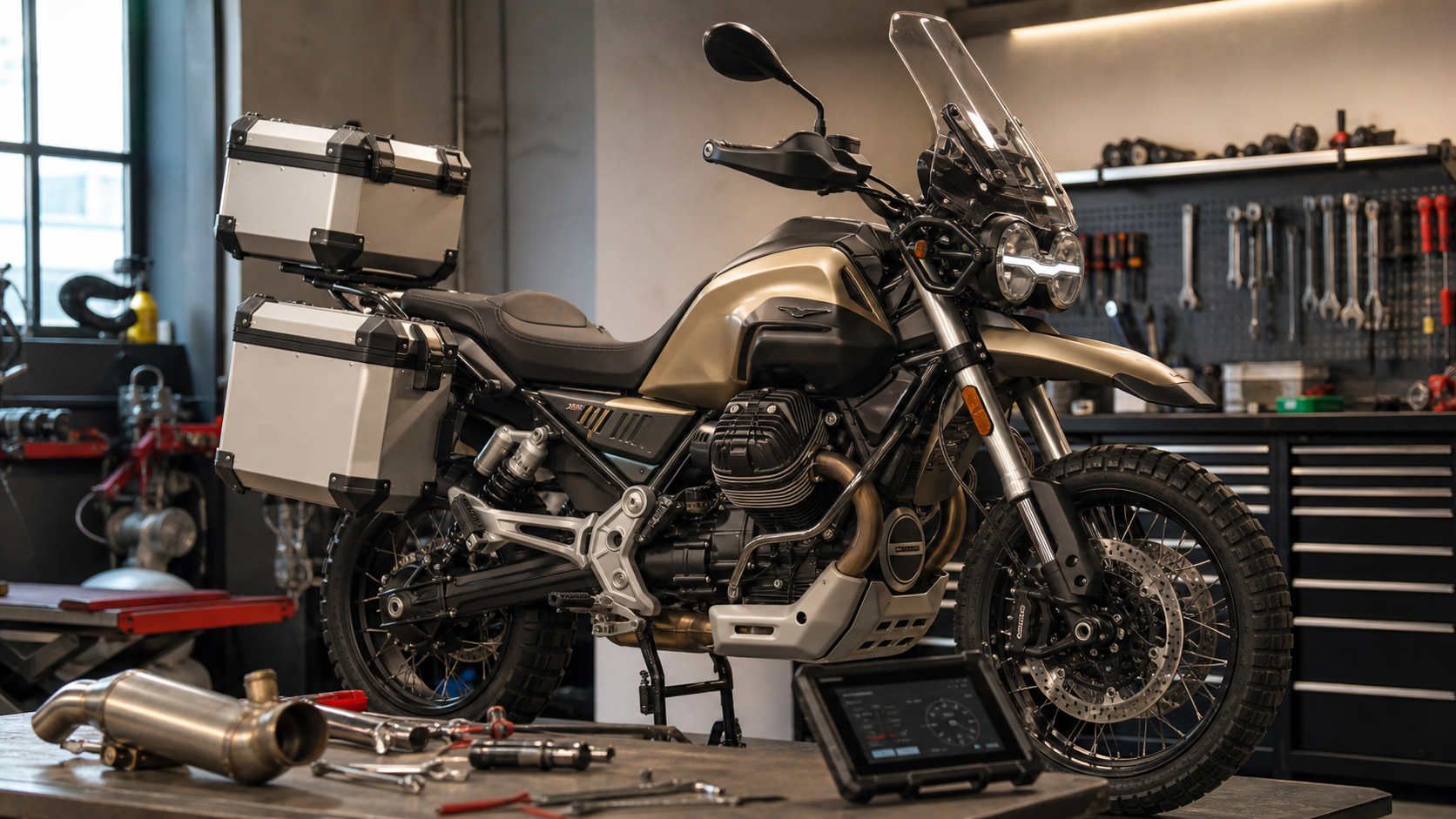
Moto Guzzi V85TT power increase: mechanic’s guide to real touring performance
Moto Guzzi V85TT power increase is not about turning the transverse V-twin adventure bike into a superbike. It is about making a characterful touring motorcycle pull cleaner, respond better with luggage, hold hills with less effort and remain reliable when the road gets long. The right approach starts with diagnosis, then moves through exhaust flow, fueling, ECU strategy, gearing, maintenance and chassis setup as one complete package.

Most V85TT performance searches come from riders who already like the bike but want more authority when overtaking, climbing mountain roads, riding two-up or carrying panniers. That is a sensible goal. The V85TT has a strong identity: air-cooled feel, shaft-drive touring manners, simple service access and enough electronics to be modern without feeling sterile. The mistake is expecting one part to fix every weakness.
This guide is written like a workshop conversation, not like a list of tuning promises. We will look at what gives real gains, what only adds noise, what should be measured before buying parts and how to avoid making the bike worse. For broader Guzzi context, compare this page with the Moto Guzzi V7 850 power increase guide, because many of the same air-cooled V-twin lessons apply, but the V85TT has its own adventure-bike load, gearing and exhaust considerations.
What riders really mean by Moto Guzzi V85TT power increase
Moto Guzzi V85TT power increase can mean several different things. Some riders want a stronger dyno number. Others want less hesitation at low rpm. Many simply want the bike to feel less loaded when climbing with luggage. Before changing parts, define the complaint. A touring bike that feels weak on a motorway overtake needs a different solution from one that feels snatchy in town or flat after an exhaust change.
The V85TT is not a high-revving race engine. It rewards smooth torque, correct fueling and mechanical sympathy. When the setup is right, the bike should roll on cleanly from the midrange, stay composed in heat, restart without drama and keep its relaxed touring character. Moto Guzzi V85TT power increase should make the motorcycle easier to ride, not more nervous.
Search Console signals behind this article show the same intent in several languages: Moto Guzzi V85TT tuning, V85TT horsepower increase, aggiornamento centralina Moto Guzzi V85TT, rimappatura centralina Moto Guzzi V85TT, boitier additionnel Moto Guzzi V85TT, préparation moteur Moto Guzzi V85TT, Moto Guzzi V85TT leistungssteigerung, Moto Guzzi V85 TT tuning, V85TT exhaust, Moto Guzzi V85TT auspuff, scarico Moto Guzzi V85TT, quickshifter, decat opinions and GuzziDiag checks. Those phrases all point to one practical question: how do you make the V85TT stronger without spoiling it?
Start with the official baseline
Before chasing Moto Guzzi V85TT power increase, confirm the exact model year and equipment. The V85 family has evolved through different Euro emissions versions, graphics, travel variants and equipment packages. Use the official Moto Guzzi model information as the starting point, such as the current Moto Guzzi V85 model page, then compare it with your registration document, service record and local market specification.
Do not tune from memory. One owner may be talking about an earlier Euro 4 bike, another about a Euro 5 version, another about a restricted market bike, and another about a machine with a different exhaust already fitted. The hardware, emissions equipment and ECU calibration matter. The more precise the baseline, the fewer wrong parts you buy.
| Baseline item | What to check | Why it matters |
|---|---|---|
| Model year | VIN, registration, workshop records | ECU and emissions versions can differ |
| Current exhaust | Stock, slip-on, full system, catalyst status | Fueling and legality depend on exhaust layout |
| Air intake | Stock filter, performance filter, airbox condition | Incorrect intake changes can reduce rideability |
| Service state | Valve clearances, plugs, filters, throttle balance | Maintenance faults can feel like poor mapping |
| Load use | Solo, two-up, panniers, touring screen | Wind and weight change the power you feel |
Service condition before tuning
Moto Guzzi V85TT power increase should never be used to hide a maintenance problem. A V-twin with tight valves, old plugs, dirty filters, weak battery voltage, poor earths, intake leaks or old fuel can feel lazy even with expensive parts installed. The first workshop step is a health check. If the bike is not clean mechanically, tuning data becomes misleading.
Check valve clearances according to the service schedule, inspect spark plugs, confirm the air filter is clean, look for exhaust leaks at joints, verify there are no stored faults and make sure the throttle bodies are clean and properly synchronized where applicable. A shaft-drive touring bike also needs final-drive oil, wheel bearings, tyre condition and brake drag checked. Drag steals performance just as surely as a weak map.
A proper Moto Guzzi V85TT power increase plan starts with a bike that rolls freely. Spin the wheels, check tyre pressures cold, inspect chain-free shaft-drive components for leaks or play, and make sure luggage racks or crash bars are not hiding loose fasteners or wiring issues. This may sound basic, but many “tuning problems” are ordinary maintenance problems wearing a better jacket.
ECU remap, chip module or stock ECU?
There are three common routes for Moto Guzzi V85TT power increase: leave the ECU stock and improve the bike around it, use an external fueling module, or perform an ECU remap. Each route has strengths. A stock ECU with a well-chosen road-legal exhaust and perfect maintenance can feel excellent. A module may offer reversible correction for a specific setup. A remap can be more complete, but it requires skill, equipment and respect for emissions and safety systems.
An ECU remap can adjust fueling and ignition strategies more deeply, but it is only as good as the person doing it and the data used. A generic file installed without road testing is not magic. An external module can be easier to remove and can suit riders who want reversible changes. The important point is not the label on the product; it is whether the final bike starts cleanly, idles steadily, pulls smoothly, runs at safe temperatures and does not show fault codes.
| Option | Best for | Risk if done badly | Workshop advice |
|---|---|---|---|
| Stock ECU and maintenance | Riders wanting reliability and legal simplicity | May not correct exhaust-related flat spots | Always do this baseline first |
| External module | Reversible fueling support for mild changes | Wrong setting can make throttle heavy or rich | Start conservative and test hot |
| ECU remap | Complete setup after exhaust/intake changes | Poor map can create heat, faults or emissions issues | Use a specialist with model-specific experience |
| Dyno tune | Measuring before and after under load | Chasing peak power over road manners | Ask for air-fuel and rideability notes, not only a graph |
Exhaust upgrades: sound, torque and legality
Moto Guzzi V85TT power increase often begins with an exhaust. A lighter silencer can improve sound and reduce weight. A better-flowing system can help the engine breathe. But an adventure-tourer is not judged only by noise. The best exhaust setup keeps low and midrange torque, avoids harsh resonance on long rides, does not cook luggage or passenger boots, and remains legal for the road where the bike is used.
Be careful with decat setups. Removing catalyst equipment may be illegal on public roads and can change fueling enough to create heat, smell, poor low-rpm control or warning lights. In Europe, road-going motorcycles are covered by type-approval rules, including Regulation (EU) No 168/2013. Riders should check local law before changing emissions hardware.
If your goal is a practical Moto Guzzi V85TT power increase, judge the exhaust over a full day, not in a car park. Listen at cruising rpm, check heat around panniers, feel roll-on in top gear and inspect for leaks after the first heat cycles. A tiny leak at a header joint can upset readings and make the bike feel rough, especially after other tuning changes.
Air intake and filtration
Air intake work is easy to oversell. A clean, properly seated filter is more important than an aggressive intake that lets heat, dust or water into the wrong places. The V85TT is an adventure-style bike; it may see rain, dust, gravel roads and long service intervals. Moto Guzzi V85TT power increase should not sacrifice filtration just to make an induction noise at the edge of town.
A performance filter may make sense if it is high quality, correctly oiled where required and maintained. An open intake is a different decision. It can change fueling, increase intake roar and reduce protection. If intake changes are combined with an exhaust, the bike may need module adjustment or a proper remap. Do not install intake parts first and diagnose later from guesswork.
Gearing, shaft drive and why the bike feels loaded
Moto Guzzi V85TT power increase is sometimes really a gearing complaint. The rider feels the bike needs more drive because it is asked to pull tall gearing, a large screen, panniers, top case, passenger and headwind. Shaft-drive ratios are not as casually changed as chain sprockets, so the solution is often better torque delivery, correct tyre size, reduced drag and realistic load management.
Make sure the rear tyre matches the intended size and profile. A worn or squared tyre changes how the bike rolls and steers. Overloaded panniers and a high top case increase aerodynamic drag. A touring screen can add comfort but also wind resistance. None of these are “engine tuning” parts, but each one changes how much power reaches the road in the rider’s hands.
Dyno numbers versus road performance
A dyno is useful, but Moto Guzzi V85TT power increase should not be reduced to one peak number. The area under the curve matters more than a small headline gain near the top. On a road-going V85TT, the most valuable improvement is usually cleaner midrange: the zone used for overtakes, loaded climbs, bends and relaxed touring.
Ask for before-and-after runs on the same dyno, same tyre pressure, same gear and similar temperature. Ask whether the operator checked air-fuel ratio, throttle transitions and heat soak. A graph that shows a gain at one rpm but hides a dip where you actually ride may not be a real upgrade. A mechanic should care about repeatability.
| Measurement | Useful sign | Misleading sign |
|---|---|---|
| Peak power | Small gain with no losses below | Headline number hiding midrange dip |
| Torque curve | Smoother pull from lower rpm | Sharp spike that feels abrupt on road |
| Throttle response | Clean roll-on without surging | Feels sharp cold but rough hot |
| Hot restart | Normal restart after heat soak | Long crank or rich smell after tuning |
| Fuel economy | Similar consumption during normal riding | Big fuel increase for little usable gain |
How to road-test after changes
The best Moto Guzzi V85TT power increase test route is boring on purpose. Use the same road before and after. Include a cold start, slow traffic, a steady cruise, a hill, a loaded roll-on and a hot restart. If the bike is used for touring, test it with panniers fitted. If it is used two-up, do not judge the setup only solo.
Change one thing at a time. Fit the exhaust, check for leaks, ride. Add fueling correction, ride. Adjust setting, ride again. If everything is changed at once, diagnosis becomes messy. Keep notes: ambient temperature, fuel, setting, load, symptoms and fuel consumption. A rider who writes down details solves problems faster than a rider who only remembers that the bike “felt better yesterday.”
Warm engine checks
Moto Guzzi V85TT power increase work must be judged warm. Many bikes feel fine cold because enrichment masks the issue. Once the engine is fully hot, listen for pinging, hesitation, unstable idle, fan behavior, fuel smell and warning lights. Roll the throttle on gently from lower rpm in a tall gear, then test a normal overtake. The goal is smooth strength, not drama.
Loaded touring checks
Adventure-tourer tuning should be checked with real load. Panniers, crash bars, auxiliary lights and a passenger change the job the engine must do. If a setting only feels good on an empty bike, it may not be the right setting for touring. Moto Guzzi V85TT power increase is successful when the bike feels relaxed under the load you actually carry.
Common mistakes that make the V85TT worse
The first mistake is chasing sound and calling it power. A louder exhaust can make the bike feel faster because the rider hears more engine, but the stopwatch and road manners may disagree. The second mistake is installing an aggressive map without checking maintenance. The third is deleting equipment without understanding legality, heat and fueling consequences. The fourth is tuning around the wrong fuel quality.
Another common Moto Guzzi V85TT power increase mistake is ignoring suspension. A loaded bike that squats too much can feel sluggish because steering and weight transfer are wrong. Set sag, check preload and damping, and make sure the tyre pressures suit the load. A motorcycle that sits correctly often feels more powerful because it puts its existing torque to the road better.
Best upgrade order for a reliable V85TT
If a rider asked me in the workshop where to start, I would not begin with the most expensive part. I would begin with service, then test, then choose upgrades. Moto Guzzi V85TT power increase works best as a staged plan. Each step should earn its place by improving the bike without adding new faults.
| Stage | Action | Reason | Stop if |
|---|---|---|---|
| 1 | Full service baseline | Removes false tuning symptoms | Fault codes or mechanical issues appear |
| 2 | Tyres, brakes, suspension setup | Improves real road performance | Bike still feels unstable or overloaded |
| 3 | Road-legal exhaust or silencer | Can reduce weight and improve character | Low rpm pull gets worse |
| 4 | Fueling module or remap | Matches engine response to hardware | Hot restart, idle or warning lights suffer |
| 5 | Dyno/road validation | Confirms gains are real | Graph improves but road manners decline |
Internal guides that help with the same decision
Moto Guzzi V85TT power increase sits in the same family of realistic tuning decisions as other middleweight and touring bikes. The Himalayan 450 tuning guide is useful because it explains why adventure-bike tuning must respect heat, load and torque rather than chasing peak figures. The Honda CB500X tuning guide gives another practical example of mild touring performance, exhaust choices and reliability.
For riders comparing classic air-cooled character with tuning expectations, the Benelli Imperiale 400 power increase guide is also relevant. Different engine, different market, same lesson: stronger road performance comes from balance, not from one magic part.
FAQ
Is Moto Guzzi V85TT power increase worth it?
Moto Guzzi V85TT power increase is worth it when the rider wants smoother torque, cleaner response and better loaded road manners. It is not worth it if the expectation is superbike acceleration from a touring V-twin.
What is the safest first upgrade?
The safest first upgrade is not a part; it is a complete service and setup check. After that, a quality road-legal exhaust or carefully chosen fueling support can make sense. A stronger V85TT should always start from a healthy motorcycle.
Does a decat give the biggest gain?
A decat can change flow and sound, but it can also create legal, fueling, heat and smell issues. It is not automatically the best route. For a road bike, Moto Guzzi V85TT power increase should be judged by usable torque and legality, not only noise.
Should I remap after fitting an exhaust?
It depends on the exhaust, model year and symptoms. If the bike starts cleanly, pulls smoothly and shows no lean hesitation or warning lights, a remap may not be urgent. If fueling clearly changed, a module or remap may be useful. Moto Guzzi V85TT power increase decisions should be based on testing, not guesswork.
Can a V85TT be tuned for two-up touring?
Yes, but the setup should include suspension preload, tyre pressure, luggage weight and throttle smoothness, not only engine parts. Moto Guzzi V85TT power increase for two-up use is about relaxed torque and stability.
Will tuning hurt reliability?
Bad tuning can. Sensible tuning usually protects reliability by staying conservative, keeping heat under control and avoiding poor fueling. Moto Guzzi V85TT power increase should never require ignoring warning lights, hard starting or rough hot running.
Final mechanic’s advice
Moto Guzzi V85TT power increase works best when it respects what the bike is. The V85TT is a charismatic touring machine, not a race replica. Give it a clean service baseline, choose road-appropriate exhaust and fueling changes, test it hot and loaded, and measure the result by how it rides on the roads you actually use.
If the motorcycle pulls more cleanly, overtakes with less effort, starts normally, runs without warning lights and still feels like a Moto Guzzi at the end of a long day, the setup is doing its job. The best Moto Guzzi V85TT power increase is the one you stop thinking about because the bike simply feels right.