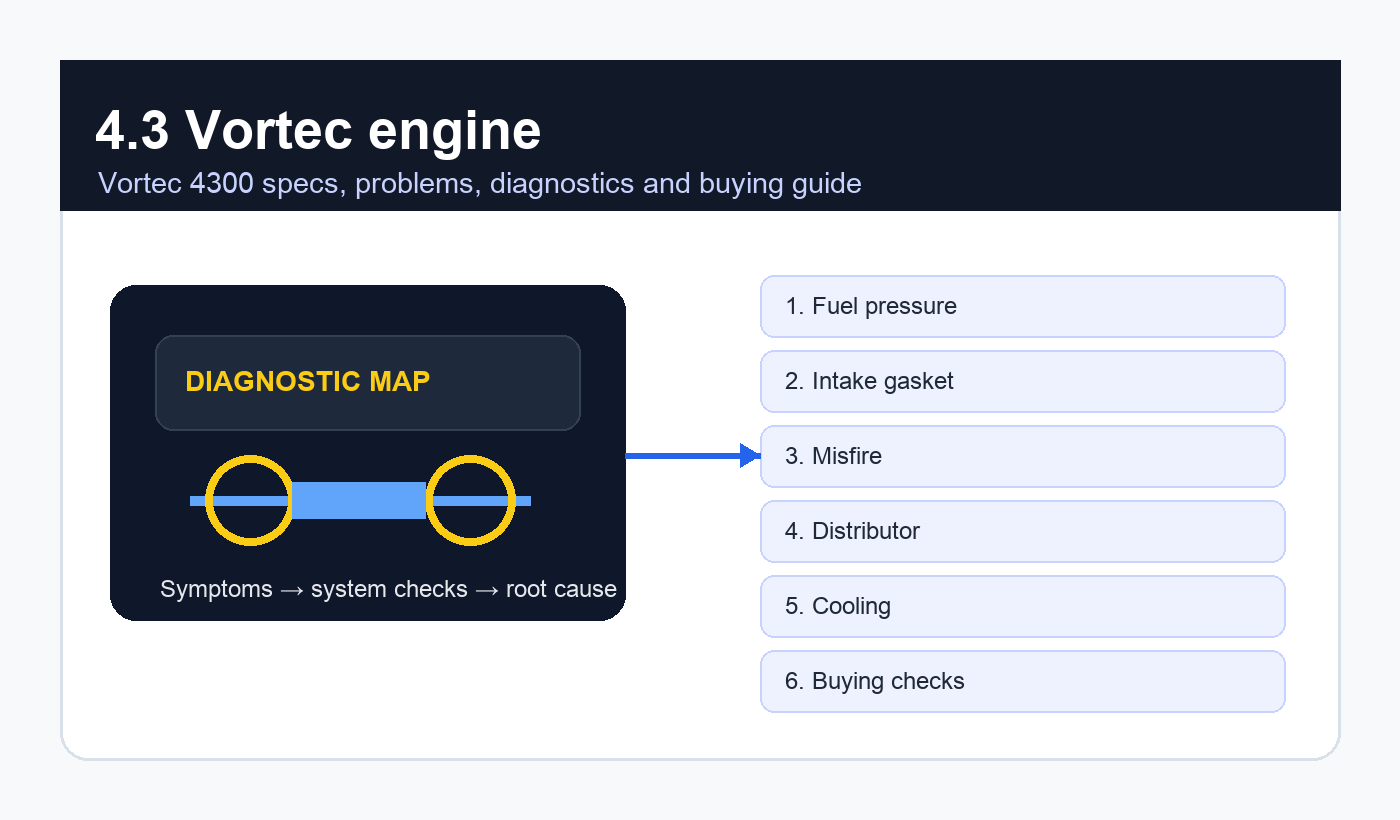
4.3 Vortec engine: complete V6 guide for specs, problems, reliability and buying
4.3 Vortec engine is one of General Motors’ most familiar truck V6 names, but the badge covers more than one mechanical story. For many owners it means the iron-block Vortec 4300 used in S-10, Blazer, Astro, Safari, Silverado, Sierra and Express applications. For newer truck buyers it may also point toward the later 4.3-liter EcoTec3 V6 used in 2014-up Silverado and Sierra trucks. This guide separates those generations, explains the common problems, and gives practical checks for people repairing, buying or swapping one.

The reason the 4.3 Vortec engine remains searched today is simple: millions of GM trucks and vans used it, many are still working, and a rough-running Vortec can be cheap or expensive depending on whether the diagnosis is disciplined. A spider injector, intake gasket, distributor drive issue, vacuum leak or fuel pressure problem can all look similar from the driver’s seat. The value is in knowing what to test before replacing parts.
Quick answer: what the 4.3 Vortec is
The 4.3 Vortec engine most commonly refers to GM’s 4.3-liter 90-degree V6 truck engine, often called the Vortec 4300. Older versions are pushrod, two-valve, iron-block engines derived from the small-block Chevrolet architecture, while the later 2014-up EcoTec3 4.3 is an aluminum, direct-injected Gen V design with modern controls. The classic Vortec 4300 is prized for torque, simplicity and parts availability, but it is also known for intake manifold gasket leaks, fuel injection issues, distributor wear, CPI/CSFI problems and age-related cooling or ignition faults.
What owners need to know first
This guide is written for owners, buyers and technicians dealing with 4.3 Vortec engine in the real world. It focuses on symptoms, checks, realistic repair decisions, legal limits where relevant, and the points worth confirming before buying parts or trusting a seller’s claim.
| Intent cluster | Related topics | What the reader needs |
|---|---|---|
| Identification | Vortec 4300, L35, LF6, LU3, LV3, LV1, VIN W, VIN X | Know which engine generation and injection system they have. |
| Problems | rough idle, hard start, misfire, intake gasket leak, fuel pressure | A diagnostic path before spending money. |
| Specifications | horsepower, torque, firing order, bore stroke, oil capacity | Clear baseline data for repair and comparison. |
| Buying | S10 4.3, Silverado 4.3, Astro van 4.3, used Vortec engine | Inspection points and red flags. |
| Swaps | 4.3 V6 swap, marine 4.3, manual transmission, 4L60E | Compatibility warnings and realistic expectations. |
Generation map: classic Vortec 4300 versus later EcoTec3
The 4.3 Vortec engine should not be discussed as one single unit. The old 4.3 Vortec 4300 and the newer 4.3 EcoTec3 share displacement and truck duty, but they are mechanically different. The older engine uses the familiar 90-degree pushrod layout with distributor-era or later coil-style ignition depending on year. The Gen V EcoTec3 version introduced for modern Silverado and Sierra trucks uses direct injection, variable valve timing, Active Fuel Management on some applications, and much newer engine management.
| Engine family | Typical years | Common vehicles | Why it matters |
|---|---|---|---|
| LB4/TBI 4.3 | Late 1980s-early 1990s | S-10, full-size trucks, vans | Simpler throttle-body injection and older diagnostics. |
| L35 Vortec 4300 | 1990s | S-10, Blazer, Jimmy, Astro/Safari, pickups | Strong torque, CPI/CSFI injection issues, classic Vortec head era. |
| LF6/LU3 4.3 | Late 1990s-2000s | Silverado, Sierra, Express, Savana, vans | More OBD-II diagnostics, common work-truck engine. |
| LV3/LV1 EcoTec3 4.3 | 2014-up applications | Silverado/Sierra 1500, Express/Savana | Direct injection, aluminum architecture, modern controls. |
Core specifications owners look for
The classic 4.3 Vortec engine is a 262 cubic inch, 4.3-liter V6 with a 90-degree bank angle. It became popular because it offered V8-like low-speed torque in smaller and lighter-duty applications. Output varies by year and vehicle: S-10 and Blazer versions, full-size truck versions and van calibrations do not always share the same horsepower rating, intake hardware or emissions equipment.
For repair planning, the 4.3 Vortec engine should always be identified by VIN code, emissions label and visual hardware, because two trucks with the same displacement can need different sensors, injectors, gaskets or calibration details.
For the later EcoTec3 4.3, GM moved to a modern architecture with features such as direct injection and variable valve timing. Chevrolet’s official support portal is the best starting point for model-specific manuals and owner data: Chevrolet manuals and guides.
Why the Vortec 4300 became so common
The 4.3 Vortec engine worked because it fit the jobs GM needed it to do. It could pull compact trucks, full-size base trucks, vans and utility vehicles without the fuel consumption or cost of a V8. It was never glamorous, yet for plumbers, delivery drivers, farm owners and daily commuters, the engine’s low-rpm torque mattered more than high-rpm excitement.
That work-truck background is also why many examples today have hard lives. A used S-10, Astro or Silverado with a 4.3 Vortec engine may have spent years idling, towing, carrying tools, making short trips or missing coolant changes. The engine can tolerate abuse, but the attached systems age: fuel pumps weaken, intake gaskets shrink, caps corrode, grounds rot and vacuum lines crack.
Common problems: the honest list
The 4.3 Vortec engine is reliable when healthy, but its common problems are well known. On older CPI/CSFI versions, the central injection unit and fuel pressure regulator can cause hard starts, rich running, fuel smell and misfires. Intake manifold gaskets can leak coolant externally or internally. Distributor caps and rotors can create misfires, especially in damp conditions. Worn distributor gears or incorrect distributor installation can trigger cam/crank correlation codes.
| Symptom | Likely area | First test |
|---|---|---|
| Long crank after sitting | Fuel pump, pressure regulator, leaking injector poppets | Fuel pressure leakdown test. |
| Random misfire | Cap, rotor, wires, spider injector, vacuum leak | Scan misfire counters, inspect ignition and fuel trims. |
| Coolant loss | Intake manifold gasket, radiator, heater hose, head gasket | Pressure test and inspect intake valley. |
| Rough idle | Vacuum leak, EGR, IAC, injector balance, worn ignition | Smoke test and fuel trim review. |
| P1345 or timing correlation | Distributor position, gear wear, timing chain slack | Cam retard reading with scan tool. |
Fuel system issues on CPI and CSFI versions
Fuel diagnosis is where the 4.3 Vortec engine often separates careful mechanics from parts throwers. Older Vortec central injection can fail in ways that do not look like a single dead injector. A pressure regulator can leak into the intake, poppet nozzles can stick, and a weak pump may make just enough pressure to run poorly but not enough to start cleanly.
When a 4.3 Vortec engine starts only with throttle input, smells rich after cranking, or sets lean codes under load, the fuel system deserves measured testing before the oxygen sensors or mass airflow sensor are blamed.
Before replacing the spider assembly, test key-on pressure, running pressure, leakdown and injector balance if equipment allows. A scan tool showing rich trims on one bank or misfire concentration can guide you, but a fuel gauge is still essential. If the truck also shows a generic module code, our 07E8 engine code guide explains why scan-tool labels must be followed by real diagnostic trouble codes.
Intake manifold gaskets and coolant leaks
The 4.3 Vortec engine is famous for intake gasket concerns, especially as gasket materials age and cooling systems are neglected. A small external seep can become a bigger problem if coolant reaches the oil or if the engine is repeatedly overheated. Milky oil is a late warning, not an early diagnostic strategy.
Good inspection starts with a clean engine, pressure tester and patience. Look at the front and rear intake corners, thermostat housing, heater fittings, radiator side tanks and water pump weep hole. If coolant loss is paired with overheating, misfire on startup or exhaust gas in coolant, the diagnosis must expand beyond the intake gasket.
Ignition, firing order and distributor details
The classic 4.3 Vortec engine uses ignition hardware that can create very convincing engine problems. A cracked distributor cap, corroded terminal, weak coil, bad wire or moisture intrusion can cause misfires under load. The common firing order for the older 4.3 V6 is 1-6-5-4-3-2, but always verify the exact year and cap orientation before moving wires.
If you want a comparison of how firing order mistakes create rough running across engine families, our Dodge 318 firing order article is useful. The brand is different, but the diagnostic lesson is identical: one crossed wire can make a mechanically healthy engine feel broken.
OBD-II diagnostics and live data priorities
The 4.3 Vortec engine responds well to live-data diagnosis. Fuel trims, misfire counters, coolant temperature, oxygen sensor switching, MAP readings and cam retard values tell a story before parts are removed. Long-term positive trims suggest unmetered air or low fuel delivery. Negative trims suggest rich running, leaking fuel or sensor bias. A cold engine that reports warm can overfuel or underfuel depending on the failure mode.
Do not evaluate scan data only in the driveway. A short road test at idle, light cruise and moderate load can reveal faults that never appear while parked. Record the numbers, make one change at a time, and confirm the result before moving to the next suspect. That habit keeps a simple repair from turning into an expensive experiment.
| Data point | Normal idea | What to suspect when abnormal |
|---|---|---|
| Fuel trims | Near zero after warm idle and cruise | Vacuum leaks, low fuel pressure, leaking injector, biased sensor. |
| Misfire counters | No steady cylinder accumulation | Ignition, injector, compression or vacuum distribution issue. |
| Coolant temperature | Rises smoothly to thermostat range | Bad thermostat, sensor, wiring or cooling fault. |
| Cam retard | Within specification at proper rpm | Distributor indexing, gear wear or timing chain slack. |
What owners need to know first
On high-mileage trucks, a 4.3 Vortec engine can sound worse than it is because of accessory noise. Idler pulleys, tensioners, alternators, power steering pumps and A/C compressors can whine or rattle. Remove the belt briefly only when safe and appropriate, then listen carefully to separate internal engine noise from accessory noise.
For belt-routing thinking and accessory-drive inspection, see the Dodge Avenger 2.4 serpentine belt diagram guide. The layout is different, but the method of reading belt path, tensioner behavior and pulley alignment carries over.
Buying a truck or van with this engine
A used vehicle with a 4.3 Vortec engine should be bought by condition, not reputation. Start it cold, watch the exhaust, listen for timing chain rattle, scan for stored and pending codes, check readiness monitors, inspect coolant level, examine oil condition and drive long enough for full operating temperature. A seller who cleared codes five minutes before your arrival is telling you something.
A clean-running 4.3 Vortec engine in a rusty truck may still be a poor buy, while a cosmetically tired van with documented intake gasket, fuel pump and ignition work can be a better long-term tool.
| Buying check | Good sign | Warning sign |
|---|---|---|
| Cold start | Starts quickly without fuel smell. | Long crank, raw fuel odor, black smoke. |
| Coolant system | Stable level, clean tank, no pressure loss. | Low coolant, sludge, intake valley stains. |
| Idle quality | Smooth warm idle with stable trims. | Hunting idle, misfire counters, vacuum hiss. |
| Transmission pairing | Clean shifts, no flare, service history. | Delayed reverse, burnt fluid, slipping under load. |
| Frame and body | Rust manageable and structural points solid. | Severe frame rot that exceeds engine value. |
Swaps, marine use and performance expectations
The 4.3 Vortec engine has been used in swaps because it is compact for its torque output and shares some Chevrolet small-block logic. Still, a swap is not automatically easy. Wiring, ECU, emissions rules, oil pan, accessory brackets, exhaust routing, transmission choice and cooling capacity determine whether the project feels clever or exhausting.
Performance expectations should remain realistic. A healthy Vortec 4300 can make a light truck pleasant, but naturally aspirated gains are limited unless you spend heavily. Forced induction and marine-style builds exist, yet the budget often approaches the cost of a V8 swap. For most owners, the best upgrade for a 4.3 Vortec engine is restoring the fuel, ignition, cooling and exhaust systems to full health.
Classic 4.3 Vortec versus modern 4.3 EcoTec3
The later EcoTec3 4.3 Vortec engine is a different ownership proposition. Direct injection improves control and efficiency, but it brings high-pressure fuel components, carbon-management concerns and more complex diagnostics. The old Vortec 4300 is heavier and less refined, but it is friendlier to traditional repair habits. Buyers should not assume that advice for a 1998 S-10 applies to a 2018 Silverado.
For a high-level technical overview of Chevrolet’s 90-degree V6 lineage and application differences, the Chevrolet 90-degree V6 engine reference is useful when cross-checking variants, years and naming.
Maintenance priorities for a long-lasting engine
A 4.3 Vortec engine lasts longest when the boring work is done on time. Keep the cooling system clean, use quality ignition parts, replace vacuum hoses before they crack, monitor oil leaks, check fuel pressure when symptoms appear, and do not ignore intermittent misfires. Old trucks often die from accumulated neglect rather than one dramatic design flaw.
Owners who treat the 4.3 Vortec engine as a system, not just a long block, usually spend less because they catch weak pumps, bad grounds, tired caps and coolant seepage before those faults cascade.
| Priority | Service item | Why it matters |
|---|---|---|
| 1 | Cooling system pressure test and coolant service | Protects intake gaskets, heads and long-term reliability. |
| 2 | Fuel pressure and leakdown testing | Prevents blind replacement of injectors or sensors. |
| 3 | Cap, rotor, wires and plugs on older versions | Solves many misfires before deeper work. |
| 4 | Vacuum and PCV inspection | Stabilizes idle and fuel trims. |
| 5 | Grounds and charging system | Old electrical faults can imitate sensor failures. |
Frequently asked questions
Is the 4.3 Vortec engine reliable?
Yes, the 4.3 Vortec engine is generally reliable, especially the classic Vortec 4300, when fuel pressure, ignition and cooling systems are maintained. Its reputation suffers mostly when old trucks are diagnosed by guessing.
What is the most common problem?
On older versions, the most common trouble areas are intake manifold gaskets, spider injector or fuel pressure regulator faults, distributor cap and rotor issues, vacuum leaks and weak fuel pumps. Age and vehicle use matter as much as design.
Is the 4.3 Vortec basically a 350 with two cylinders removed?
The older 4.3 Vortec engine shares Chevrolet small-block architecture ideas, including the 90-degree layout and bore/stroke relationship often discussed by builders, but it has its own crankshaft, balance behavior, parts details and calibration needs.
Can a 4.3 Vortec be tuned for more power?
It can, but mild restoration usually gives better value than chasing peak horsepower. Intake and exhaust changes may help response, while serious forced-induction or cam work needs engine management, fuel and drivetrain planning.
Which vehicles used the engine?
The 4.3 Vortec engine appeared across Chevrolet and GMC trucks, SUVs and vans, including S-10, Blazer, Jimmy, Astro, Safari, Silverado, Sierra, Express and Savana applications, with year-specific differences in injection and controls.
Final verdict
The 4.3 Vortec engine earned its reputation by doing ordinary truck work for a very long time. It is strong enough to be useful, simple enough to repair on older versions, and common enough that parts and knowledge remain available. Its weakness is not mystery; it is age, neglected cooling systems, fuel delivery faults, worn ignition components and owners who skip testing.
If you are buying, repairing or swapping a 4.3 Vortec engine, treat the exact year and engine code as the starting point. Identify the injection system, test fuel pressure, inspect intake leaks, verify ignition health, read live data and respect the difference between classic Vortec 4300 and later EcoTec3 engines. Do that, and this V6 stops being a confusing old truck motor and becomes what it always was: a practical, durable work engine that rewards methodical care.
Workshop notes before condemning the engine
A final useful habit with the 4.3 Vortec engine is to separate engine faults from vehicle faults. Many trucks with this V6 are now old enough that battery cables, grounds, fuel pump wiring, vacuum hoses, exhaust leaks and transmission behaviour can imitate a weak engine. Before replacing major parts, test fuel pressure under load, inspect the distributor area on older versions, check coolant loss over several heat cycles and read live data rather than only stored codes. If the problem is a misfire, compare the diagnostic approach with our 07E8 engine code guide. If the issue is belt noise or accessory drag, the Ford Fusion serpentine belt diagram article shows the same methodical pulley-check mindset on another vehicle.
Why documentation matters on old trucks
For buyers, a folder of receipts can matter as much as one good test drive. Cooling-system work, fuel pump replacement, intake gasket repair, ignition service and transmission maintenance all change the value of an old truck with this V6. Lack of paperwork does not make the engine bad, but it means the next owner must budget for verification.