
Dodge 318 firing order: Complete Small-Block V8 Distributor and Spark Plug Wire Guide
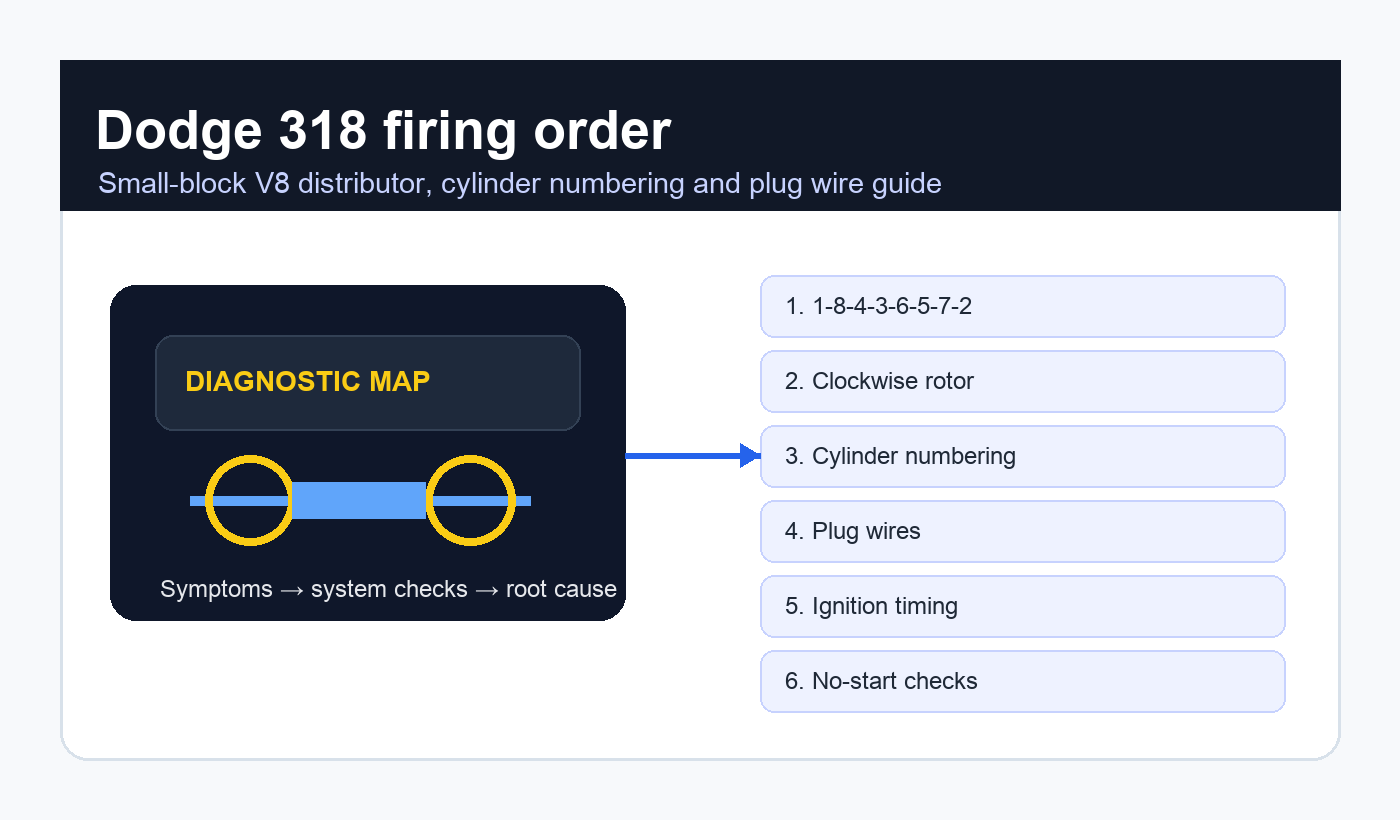
Dodge 318 firing order is one of those searches that looks simple until the hood is open, the distributor cap is off, and the plug wires no longer feel obvious. For most Chrysler LA 318 and many related Dodge small-block V8 applications, the firing order is 1-8-4-3-6-5-7-2. The distributor rotor turns clockwise, and the cylinders are numbered with odd cylinders on the left bank and even cylinders on the right bank when viewed in normal engine orientation.
The problem is not usually memorizing the numbers. The problem is putting the numbers on the correct cylinders, identifying number one on the distributor cap, understanding engine orientation, and avoiding a plug-wire routing mistake that creates a rough idle, backfire, no-start, poor power or glowing exhaust. This guide explains the firing order like a mechanic would: order, cylinder numbering, cap layout, symptoms, checks and mistakes to avoid.
This article treats Dodge 318 firing order as a practical repair reference for Dodge trucks, vans, classic Mopar cars, Chrysler small-block swaps, LA 318 engines, 5.2 Magnum family questions and distributor-cap service. It is not a substitute for the correct factory service manual for a specific year, but it will help you understand the system before you move one wire.

What owners need to know first
This guide is written for owners, buyers and technicians dealing with Dodge 318 firing order in the real world. It focuses on symptoms, checks, realistic repair decisions, legal limits where relevant, and the points worth confirming before buying parts or trusting a seller’s claim.
Related terms include Dodge 318 distributor rotation, 318 V8 firing order, Mopar 318 firing order, Chrysler LA 318, Dodge small block firing order, 5.2 Magnum firing order, Dodge 360 firing order, distributor cap numbering, spark plug wire routing, cylinder numbering, number one cylinder, top dead center, ignition timing, rough idle, engine backfire, no start after plug wires, small-block Mopar, Dodge Ram 318, Dodge Dakota 318, Plymouth 318 and Chrysler 318 engine.
| Reader need | What the owner needs | Best answer |
|---|---|---|
| Wire replacement | Correct order and cap direction | 1-8-4-3-6-5-7-2, clockwise rotor |
| No-start | Recover from crossed wires | Find TDC on cylinder one and rebuild routing |
| Misfire | Check adjacent or swapped wires | Verify cylinders, cap, plugs and wire condition |
| Engine swap | Confirm Chrysler numbering | Use engine family and service manual, not guesswork |
The short answer
Dodge 318 firing order for the classic Chrysler/Dodge 318 small-block V8 is 1-8-4-3-6-5-7-2. The distributor rotor rotates clockwise. Cylinder numbering normally places 1-3-5-7 on the driver-side/left bank from front to rear, and 2-4-6-8 on the passenger-side/right bank from front to rear in typical U.S. longitudinal installations.
That short answer solves only half the job. The number one plug wire can be placed in different physical positions on the cap depending on distributor installation, previous service and whether the distributor has been removed. If you are not sure where number one is, find top dead center on compression for cylinder one before routing wires.
Firing order and cylinder numbering table
The best way to handle Dodge 318 firing order is to separate two ideas: firing order and cylinder numbering. Firing order is the sequence of combustion events. Cylinder numbering tells you which physical cylinder each number represents. Mixing those two concepts is how plug wires end up crossed.
| Item | Typical Dodge/Chrysler 318 small-block value | Why it matters |
|---|---|---|
| Firing order | 1-8-4-3-6-5-7-2 | Sequence for plug wires around the cap |
| Distributor rotation | Clockwise | Determines direction from terminal to terminal |
| Left/driver bank | 1-3-5-7 front to rear | Identifies odd cylinders |
| Right/passenger bank | 2-4-6-8 front to rear | Identifies even cylinders |
| Number one reference | Verify with TDC compression if uncertain | Prevents a full-cap indexing mistake |
Why firing order matters
A V8 engine fires one cylinder at a time in a sequence chosen to balance smoothness, crankshaft loading, intake distribution and engine vibration. The general firing order concept is simple, but each manufacturer has its own cylinder numbering and firing sequence. That is why Ford, Chevrolet and Chrysler V8 habits should not be mixed.
Dodge 318 firing order becomes important any time spark plug wires, distributor cap, rotor, ignition timing, intake work, engine swap wiring or tune-up service is performed. One crossed wire can make the engine run badly. Several crossed wires can make it refuse to start.
Chrysler LA 318 and 5.2 Magnum context
The 318 name is most commonly associated with Chrysler’s small-block family, including LA engines and later 5.2 Magnum relatives. The basic firing order relationship is widely associated with Chrysler small-block V8s, but vehicle year, ignition system, distributor setup and service history still matter. For vehicle-specific documentation, the official Mopar owner resource is the proper starting point: Mopar owner manuals and vehicle resources.
Dodge 318 firing order should be treated differently from a generic “V8 firing order” search. The Chrysler cylinder numbering convention is not the same as every other brand. If you use the right firing order with the wrong cylinder numbering, the engine will still be wrong.
Distributor cap direction
For Dodge 318 firing order, the distributor rotation is normally clockwise. Once the number one terminal is identified, the next wire around the cap in the rotor direction goes to cylinder 8, then 4, then 3, then 6, then 5, then 7, then 2, returning to 1.
The trap is assuming number one is always in the same clock position on every cap. If the distributor has never been disturbed and the cap/wire set is original-style, diagrams may match. If someone previously removed the distributor and reinstalled it in a different index position, the engine can still run with number one at a different cap terminal as long as timing and wire sequence match the rotor position.
How to find number one safely
If Dodge 318 firing order is needed because all wires are already off, do not guess. Remove the number one spark plug, rotate the engine by hand, feel for compression at cylinder one, and bring the timing mark to top dead center on the compression stroke. The rotor should point toward the number one cap terminal. From there, route the remaining wires clockwise in firing-order sequence.
Use safe workshop habits. Disable ignition/fuel as appropriate, keep hands clear of moving belts, use the correct socket on the crank bolt and never rely on the starter motor while fingers are near plug holes, fan blades or belts. If you are unsure, use a service manual or a technician.
Common symptoms of wrong plug wire order
When Dodge 318 firing order is wrong, the symptoms can be dramatic. The engine may crank but not start, start only with throttle, backfire through the intake, pop through the exhaust, shake at idle, smell rich, lack power or overheat the exhaust. A two-wire swap can feel like a dead cylinder or random misfire.
| Symptom | Possible wire/order issue | First check |
|---|---|---|
| No start after tune-up | Wrong number one or wrong rotation | Find TDC compression and rebuild order |
| Backfire through intake | Spark firing with intake valve open | Check adjacent cap terminals and timing |
| Rough idle | One or two crossed wires | Trace every wire from cap to plug |
| Power loss under load | Misfire or weak wire | Inspect wire resistance, routing and plug condition |
| Glowing exhaust | Late or wrong combustion event | Stop running and correct ignition fault |
Wire routing matters
Dodge 318 firing order is not only about the cap sequence. Spark plug wires should be routed cleanly, away from hot exhaust manifolds, sharp edges and moving parts. Use separators where needed. Avoid bundling wires tightly for long distances if crossfire is a concern. Replace cracked, oil-soaked or burned wires rather than forcing them back into service.
On older V8s, neat routing is not cosmetic. Heat damage and induction between wires can create intermittent misfire that looks like carburetor or fuel trouble. A good tune-up leaves the engine easier to diagnose later.
Ignition timing and firing order are related but not identical
A correct Dodge 318 firing order does not automatically mean ignition timing is correct. Firing order places wires in sequence. Timing decides when spark happens relative to piston position. If the distributor has been moved, timing must be checked with the correct procedure for the engine and ignition system.
Do not use timing adjustment to hide wrong wiring. If the engine only runs with the distributor turned far from normal, stop and verify TDC, rotor position and wire routing. A mistake at the cap can make timing marks meaningless until the basic layout is corrected.
LA 318 versus other Mopar V8s
Dodge 318 firing order is often searched alongside Dodge 360 firing order. Many Chrysler small-block V8s share the same 1-8-4-3-6-5-7-2 sequence, but assumptions are still dangerous when engines have been swapped or modified. Confirm the engine family, distributor type and service information.
Do not confuse Chrysler small-block wiring with big-block, aftermarket ignition conversions, computer-controlled systems or custom engine builds. A classic distributor-cap job is simple only when the engine identity is known.
Step-by-step wire installation
The clean way to apply Dodge 318 firing order is to replace one wire at a time if the engine currently runs. Match length, route the wire cleanly, click both boots fully into place and move to the next cylinder. If all wires are off, identify cylinder one at TDC compression, mark the number one cap terminal and install the rest clockwise.
| Step | Action | Why it prevents mistakes |
|---|---|---|
| 1 | Confirm engine identity | Avoids using the wrong family diagram |
| 2 | Find cylinder one | Creates a real reference point |
| 3 | Confirm rotor direction | Prevents reverse sequencing |
| 4 | Route 1-8-4-3-6-5-7-2 clockwise | Applies the actual order |
| 5 | Check timing and idle | Verifies the repair under running conditions |
What if the distributor was removed?
If the distributor was removed, Dodge 318 firing order alone is not enough. The distributor drive gear and rotor position must be installed so the rotor points to the intended number one terminal at top dead center on compression. If it is off by a tooth or indexed differently, the engine may not start or may require abnormal distributor rotation to run.
In a practical repair, you can either reinstall the distributor correctly or adapt the cap wiring so number one matches the rotor position, then set timing. Factory-style indexing is usually cleaner for future service because diagrams and wire lengths make more sense.
Carburetor symptoms that are actually ignition symptoms
Owners sometimes chase carburetor adjustments when Dodge 318 firing order is wrong. A crossed wire can make the engine pop, stumble, smell rich or refuse throttle. Turning mixture screws will not fix a spark event happening in the wrong cylinder. Verify ignition layout before tuning carburetor, choke or fuel delivery.
Likewise, a vacuum leak can imitate ignition trouble, and a weak coil can imitate fuel trouble. Diagnosis works best when basics are checked in order: mechanical condition, ignition order, timing, vacuum leaks, fuel delivery and carburetor adjustment.
Misfire diagnosis after the wires are correct
If the wires are confirmed and the engine still misfires, move from layout to component testing. Inspect spark plugs for fuel fouling, oil deposits, cracked porcelain and incorrect gap. Check plug wire resistance if specifications are available. Inspect the cap for carbon tracking, moisture, cracked towers and worn contacts. Look at the rotor tip for burning or looseness. A correct sequence cannot compensate for weak spark parts.
Compression also matters. A dead cylinder with correct spark routing may have a burned valve, worn rings, flat cam lobe, intake leak or valvetrain problem. Older small-block engines can have multiple age-related issues at once, so avoid assuming every rough-running complaint is still a wire-order problem after the basic layout is proven.
Safety and workshop habits
Ignition systems can bite. Use insulated tools, avoid loose clothing around belts and fans, and do not pull plug wires off a running engine unless you understand the risk. Mark wires with tape before removing them. Take photos from several angles. Work in good light. Keep the old cap until the new cap is installed correctly, because the old part may preserve clues about previous indexing.
On a classic truck or project car, battery cables, fuel hoses and grounds may be as old as the ignition parts. If you smell fuel, see cracked hoses or find brittle wiring, pause the tune-up and fix the safety issue first. A backfire and a fuel leak are a bad combination.
Used vehicle and project-car checklist
A project vehicle with a Dodge 318 may have decades of previous repairs. Before trusting Dodge 318 firing order diagrams online, inspect what is actually installed. Look for aftermarket ignition boxes, non-original distributor, swapped intake, engine replacement, mixed plug wires, damaged cap terminals and improvised grounds.
| Area | Good sign | Warning sign |
|---|---|---|
| Distributor | Clean cap, tight shaft, known part | Wobble, corrosion, unknown conversion |
| Wires | Correct lengths and separators | Burn marks, loose boots, tangled routing |
| Timing | Can be set within normal range | Distributor rotated to extreme position |
| Engine ID | Known LA/Magnum family | Swap history with no documentation |
| Grounds | Clean engine/body grounds | Random electrical behavior |
Related internal reading
For more diagnostic logic, read our 07E8 engine code guide, Opel Service StabiliTrak warning guide, and automotive electronics guides. The systems differ, but the repair discipline is the same: identify the system, verify the reference point and avoid guessing.
FAQ
What is the firing order on a Dodge 318?
The common Dodge 318 firing order is 1-8-4-3-6-5-7-2 for the Chrysler/Dodge small-block 318 family.
Which way does the 318 distributor turn?
The distributor rotor normally turns clockwise. That direction matters when routing plug wires around the cap.
Where is cylinder number one?
On typical Dodge/Chrysler small-block V8 layouts, cylinder one is at the front of the left/driver-side bank. Verify engine orientation and service information on unusual swaps.
Can wrong firing order damage the engine?
Running briefly with crossed wires usually causes poor running, but prolonged backfire, misfire or overheating can damage exhaust, plugs, catalyst-equipped systems or other components.
Final practical verdict
The practical answer to Dodge 318 firing order is 1-8-4-3-6-5-7-2, clockwise at the distributor, with odd cylinders on one bank and even cylinders on the other in Chrysler small-block convention. The professional answer is to verify cylinder one, rotor position and engine identity before trusting any diagram.
Dodge 318 firing order should be applied clockwise around the distributor cap.
Dodge 318 firing order should begin by identifying cylinder one correctly.
Dodge 318 firing order can be wrong even when the numbers are memorized if the cap is indexed differently.
Dodge 318 firing order mistakes often show up as backfire, rough idle or no-start after tune-up.
Dodge 318 firing order belongs with timing checks after wires are installed.
Dodge 318 firing order on a swapped engine should be confirmed against the actual engine family.
Dodge 318 firing order is easiest when old wires are replaced one at a time.
Dodge 318 firing order is best treated as a reference system: cylinder numbering, rotor direction and cap position must all agree.
Dodge 318 firing order is simple once the reference points are correct, and maddening when even one of them is assumed.