Nissan Primera P11 tuning: a serious guide to making the chassis, brakes and engines work together
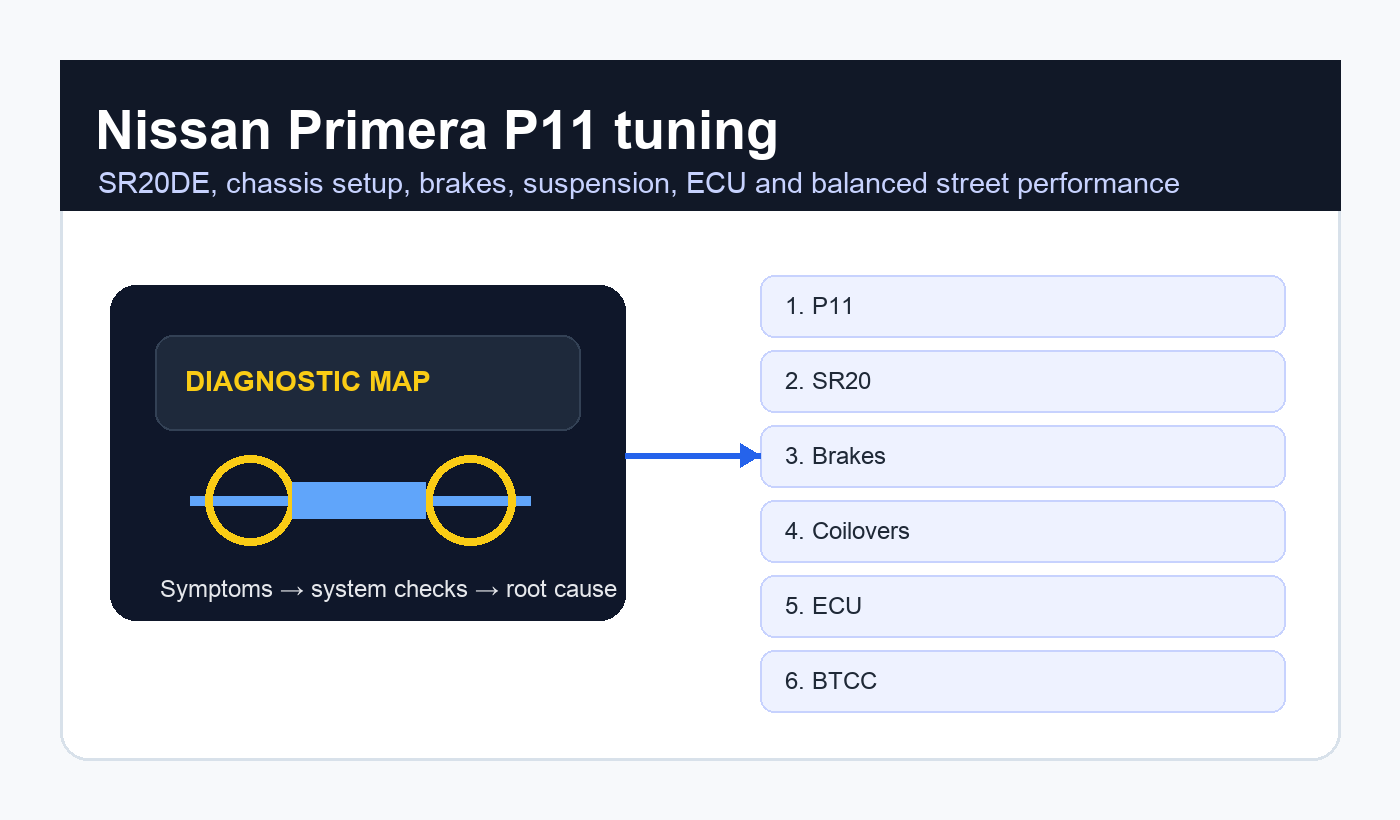
Nissan Primera P11 tuning is interesting because the car was never only an ordinary family saloon. Under the sensible body sits a chassis with genuine motorsport DNA, multi-link front suspension and a strong connection to Nissan’s 1990s touring car success. The best builds respect that balance instead of chasing random power.
This guide is written for owners, buyers and technicians dealing with Nissan Primera P11 tuning in the real world. It focuses on symptoms, checks, realistic repair decisions, legal limits where relevant, and the points worth confirming before buying parts or trusting a seller’s claim.
This guide treats Nissan Primera P11 tuning as a complete car project. A good P11 is not built by bolting a loud exhaust to a tired engine. It is built by restoring the baseline, sharpening the chassis, improving braking, choosing the right engine path and keeping the car usable on real roads.
What owners need to know first
Most people searching Nissan Primera P11 tuning already own the car or are considering one because prices remain more approachable than many Japanese performance icons. They want to know whether the platform is worth saving, which engine is best, what parts interchange, and how far the chassis can go before the project stops making financial sense.
The associated topic field includes Nissan Primera GT, Infiniti G20, SR20DE, SR20VE, P11-144, GA16DE, QG18DE, CD20T, Primera suspension, multi-link front suspension, Eibach springs, KYB dampers, coilovers, strut brace, brake upgrade, stainless exhaust, cold air intake, ECU tune, lightweight flywheel, limited slip differential, touring car, BTCC and STCC edition.
| Problem wording | Owner intent | Best answer |
|---|---|---|
| Primera P11 SR20DE tuning | Wants reliable naturally aspirated power | Intake, exhaust, cams, ECU and condition first |
| Primera P11 coilovers | Wants sharper handling | Explain spring rate, damping and alignment |
| Primera P11 brake upgrade | Needs more confidence | Start with pads, fluid, discs and tyres |
| SR20VE swap P11 | Wants JDM-style performance | Discuss wiring, ECU, gearbox and budget realism |
Why the P11 is worth tuning
A Nissan Primera P11 tuning project starts with a platform that was unusually sophisticated for its segment. The second-generation Primera used multi-link front suspension and a multi-link beam rear layout, giving it a level of steering accuracy and composure that made the car successful in touring car racing.
The model range included European petrol engines such as the 1.6 GA16DE, 2.0 SR20DE and later 1.8 QG18DE, with diesel options in some markets. Japanese versions added interesting engines such as SR18DE and SR20VE. The Primera also has motorsport credibility: the P11 shape became famous through British Touring Car Championship success in the late 1990s.
For background on the chassis and model history, the Nissan Primera model history is useful. For engine-family context, the Nissan SR engine overview helps explain why SR20 cars are the most popular base for performance work.
Start with restoration, not modification
The first stage of Nissan Primera P11 tuning is getting the car back to health. Many P11s are now old enough to suffer from tired bushes, corroded brake lines, weak dampers, oil leaks, old ignition components, rusty exhaust joints, worn engine mounts and neglected alignment. Modifying a tired car only makes its faults louder.
Before buying performance parts, inspect compression, oil pressure behavior, coolant condition, suspension bushes, wheel bearings, brake calipers, subframes, tyres and rust areas. A stock P11 in good condition often drives better than a modified P11 with loose joints and bargain suspension.
| Baseline area | Why it matters | Recommended first action |
|---|---|---|
| Suspension bushes | Controls steering precision | Replace worn arms and bushes before lowering |
| Brakes | Old fluid and sticking calipers ruin confidence | Service calipers, fluid, pads and discs |
| Engine health | Tuning cannot fix compression loss | Check leaks, ignition, sensors and service history |
| Rust | Structural condition decides project value | Inspect sills, arches, floor and suspension mounts |
Suspension tuning: the heart of the car
The smartest Nissan Primera P11 tuning usually begins underneath the car. The P11 rewards good dampers, sensible spring rates, quality tyres and accurate alignment. Lowering alone is not tuning. Too low and too stiff can make the car slower on rough roads, less predictable in the wet and unpleasant to drive daily.
A mild spring-and-damper package works well for road cars. Coilovers make sense when they are high quality and set up correctly, not when they are chosen only because they look aggressive. The Primera’s steering accuracy depends on geometry, so alignment after any suspension work is mandatory.
Alignment targets
A road-focused Nissan Primera P11 tuning setup should use modest negative camber, stable toe settings and ride height that preserves suspension travel. Track-focused cars can go more aggressive, but a daily-driven P11 should not be turned into a car that tramlines and wears tyres for fashion.
Brakes before horsepower
No serious Nissan Primera P11 tuning build should ignore braking. Start with quality pads, fresh high-temperature brake fluid, healthy discs, rebuilt calipers if needed and good tyres. Many owners feel a major improvement from restoring the braking system before installing bigger hardware.
If the car is used hard, larger front brakes or performance discs can help, but brake balance and wheel clearance matter. A brake upgrade that locks too easily or overheats rear components is not progress. For spirited road use, pad compound and fluid are often the best first spend.
Engine paths: GA16DE, QG18DE and SR20DE
A Nissan Primera P11 tuning plan depends heavily on the engine. The GA16DE is robust and economical, but naturally aspirated gains are limited. The QG18DE offers useful everyday torque but is not the classic tuning choice. The SR20DE, especially in GT-style cars, is the most attractive base because it has better aftermarket knowledge and stronger performance heritage.
For GA16DE and QG18DE cars, focus on maintenance, exhaust condition, intake health, lightweight wheels, suspension and gearing feel rather than expensive engine work. For SR20DE cars, intake, header, exhaust, cams, ECU tuning and a lightweight flywheel can create a sharper naturally aspirated package. Expect refinement, not miracles.
| Engine | Character | Tuning advice |
|---|---|---|
| GA16DE 1.6 | Reliable and modest | Keep it healthy, improve chassis and reduce weight |
| QG18DE 1.8 | Good low-rev response | Mild bolt-ons only unless building a project |
| SR20DE 2.0 | Best mainstream tuning base | Intake, exhaust, cams, ECU and drivetrain setup |
| SR20VE | High-rev JDM appeal | Swap path needs wiring, ECU and budget discipline |
Intake, exhaust and ECU tuning
A basic Nissan Primera P11 tuning package for an SR20DE often includes a proper panel filter or cold-air intake, a good exhaust manifold, free-flowing exhaust and ECU calibration where available. The aim is to improve breathing while preserving midrange. A huge pipe and hot engine-bay intake can make noise without improving the car.
ECU tuning depends on market and model. Some cars are easier to tune than others. Avoid generic promises and look for evidence from the same engine, same intake style, same exhaust layout and similar fuel. Naturally aspirated tuning is detail work; small mismatches can erase gains.
Header and exhaust sizing
Exhaust sizing matters. A Nissan Primera P11 tuning exhaust should be large enough to reduce restriction but not so large that gas speed and midrange response suffer. For road cars, tone, drone and ground clearance matter as much as peak flow.
SR20VE swaps and bigger projects
The exciting end of Nissan Primera P11 tuning is the SR20VE swap. The idea is attractive because the SR20VE brings Nissan’s Neo VVL variable valve lift system and stronger high-rpm performance. In the right hands, it creates the car many enthusiasts imagine when they think of a fast P11.
The reality is cost and complexity. A proper swap needs engine, ECU, wiring, sensors, gearbox compatibility, mounts, exhaust work, fuel system checks and diagnostic skill. It also needs legal consideration if the car remains road registered. A cheap swap without documentation can become difficult to insure, inspect or sell.
Turbocharging: possible but not casual
Turbo Nissan Primera P11 tuning is possible, especially around SR engines, but it is not the natural first step. Forced induction adds heat, traction problems, gearbox stress, clutch load, fueling demands and tuning risk. A front-wheel-drive road P11 with too much boost can become less enjoyable than a balanced naturally aspirated build.
If turbocharging is the goal, budget for management, injectors, fuel pump, intercooler, manifold, downpipe, exhaust, clutch, cooling, brakes, tyres and dyno time. The engine is only one part of the bill. Many owners would be happier with a sharp SR20DE or SR20VE-style build than a half-finished turbo project.
Wheels and tyres
A Nissan Primera P11 tuning project can be transformed by wheels and tyres. Lightweight wheels reduce unsprung mass and help the suspension work. The right tyre compound improves braking, steering and corner exit more than many engine bolt-ons. Oversized wheels may look dramatic but can add weight and reduce ride quality.
Choose wheel width, offset and tyre size carefully. Avoid rubbing, poor scrub radius and stretched tyres on a road car. The P11’s appeal is precision; do not ruin that with wheels chosen only for stance.
Interior, weight and daily usability
Weight reduction can support Nissan Primera P11 tuning, but a road car should stay civilised. Removing unnecessary clutter, choosing lighter wheels and avoiding heavy audio installs makes sense. Stripping sound deadening, seats and interior panels is a bigger decision because it changes comfort, resale and safety.
Good seats, steering wheel position and fresh shifter bushings can make the car feel more special without making it worse daily. A tuned Primera that starts, idles, brakes and rides properly is more satisfying than a loud car that only works on perfect weekends.
Parts sourcing and compatibility
A Nissan Primera P11 tuning build often succeeds or fails during parts sourcing. The car was sold across different markets, and names such as Primera, Primera Camino, Primera GT, P11-144 and Infiniti G20 can lead owners into a confusing world of similar-looking parts. Some components interchange easily, while others depend on engine, body style, model year, market and braking package.
Before buying suspension or brake parts, identify the exact chassis, engine and production year. A European hatchback, a Japanese sedan, a wagon and a North American Infiniti G20 may not share every detail. This matters for hubs, calipers, brackets, ABS sensors, exhaust routing, ECU plugs and interior trim. The most expensive mistake in Nissan Primera P11 tuning is buying rare imported parts before confirming fitment.
OEM-quality parts are sometimes better than fashionable aftermarket parts. Fresh genuine-style arms, ball joints, engine mounts and dampers can make an old P11 feel tight again. Aftermarket performance parts make sense when they solve a defined problem: better damping, stronger braking, more supportive seating, improved cooling or a known SR20 upgrade path. Random parts from unrelated Nissan models may need fabrication, and fabrication should be planned rather than discovered halfway through the job.
Used performance parts deserve caution. Coilovers may be seized, springs may be mismatched, brake calipers may need rebuilds, and old exhausts may have cracked welds. If the budget is limited, spend on condition first. A clean, well-aligned car with fresh tyres will beat a neglected car wearing rare badges. That is the quiet truth behind successful Nissan Primera P11 tuning: the boring details create the confidence that makes the exciting parts work.
Documentation also matters. Keep part numbers, alignment sheets, dyno sheets, wiring diagrams, receipts and photos of installation work. A documented build is easier to troubleshoot, insure and sell. The P11 is now old enough that the next owner may be an enthusiast, not just a commuter. Clear records show that the car was improved deliberately rather than modified impulsively.
One more practical point is climate and use. A car that lives on salted winter roads needs corrosion protection and brake service more urgently than a dry-climate weekend car. A car used for track days needs temperature control, better fluid and regular nut-and-bolt checks. A daily driver needs quiet mounts, sensible exhaust volume and parts availability. The right build is the one that survives its real life, not the one that only photographs well after installation.
When comparing advice from forums, separate measured experience from nostalgia. Period touring cars were highly developed machines with professional budgets, custom fabrication and constant maintenance. A road P11 can borrow the philosophy of balance and precision, but it does not need to copy race parts to become enjoyable. Measured restraint usually builds the better car over time, reliably enough.
For related Xmotoparts reading, compare this approach with Honda CB125R power increase, the more electronics-focused Honda CB125R ECU remap, and practical workshop discipline in motorcycle bolt torque specs.
Build stages for a balanced P11
A sensible Nissan Primera P11 tuning path starts with condition, then moves to chassis, then brakes, then mild engine work. Stage one is service, bushes, fluids and rust. Stage two is tyres, dampers, springs and alignment. Stage three is pads, fluid and brake service. Stage four is intake, exhaust and ECU. Stage five is cams, limited slip differential, swap or turbo work.
| Stage | Work | Result | Risk |
|---|---|---|---|
| 1 | Restoration and service | Reliable baseline | Low |
| 2 | Tyres, suspension and alignment | Sharper handling | Low to medium |
| 3 | Brakes and fluid | More confidence | Low |
| 4 | Engine breathing and ECU | Better response | Medium |
| 5 | Swap, cams or turbo | Major performance change | High |
FAQ
Is the SR20DE the best P11 engine for tuning?
For most owners, yes. Nissan Primera P11 tuning is easiest and most rewarding with the SR20DE because support, knowledge and performance potential are stronger than the smaller engines.
Can a 1.6 Primera P11 be tuned?
Yes, but expectations should be modest. A 1.6-focused Nissan Primera P11 tuning plan should prioritise condition, suspension, brakes, tyres and weight rather than expensive horsepower parts.
Are coilovers worth it?
Good coilovers can be worthwhile if they are set up properly. Cheap coilovers can make the car harsh and slower. A balanced Nissan Primera P11 tuning setup values damping quality over low ride height.
Is an SR20VE swap better than turbocharging?
For many road cars, yes. An SR20VE swap can preserve naturally aspirated response, while turbocharging adds complexity. The better Nissan Primera P11 tuning route depends on budget, legality and mechanical skill.
What should I do first?
Inspect the car thoroughly. Service, rust repair, tyres, suspension bushes, brakes and alignment should come before engine modifications. A healthy chassis makes every later upgrade more effective.
Final verdict
Nissan Primera P11 tuning works best when the car is treated as a chassis-first project. The platform has real ability, but age means restoration is part of performance. Start with condition, sharpen the suspension, upgrade braking, then choose engine work based on the motor you actually have.
The most satisfying Nissan Primera P11 tuning builds are not necessarily the loudest or most powerful. They are the cars that steer cleanly, brake hard, pull consistently, remain reliable and still feel like a Primera. That balance is why the P11 remains worth tuning decades after its launch.