
CF Moto 450 MT power increase
CF Moto 450 MT power increase is best treated as a careful setup job, not a promise that a 450 adventure bike can suddenly behave like a litre-class machine. The 450MT already sits in a useful place for many UK and European riders: light enough for real back-road and gravel work, strong enough for commuting and weekend travel, and close enough to the A2-friendly power window that every modification should be chosen with care.
Owners usually ask about more power after noticing one of three things. The bike may feel a little soft when loaded with luggage, the throttle may feel muted in the middle of the rev range, or the rider may be comparing chip modules, exhausts, air filters and sprocket changes without knowing which one should come first. CF Moto 450 MT power increase makes sense only when the motorcycle is healthy, the parts fit the exact model, and the owner understands the difference between sharper response and measured horsepower.
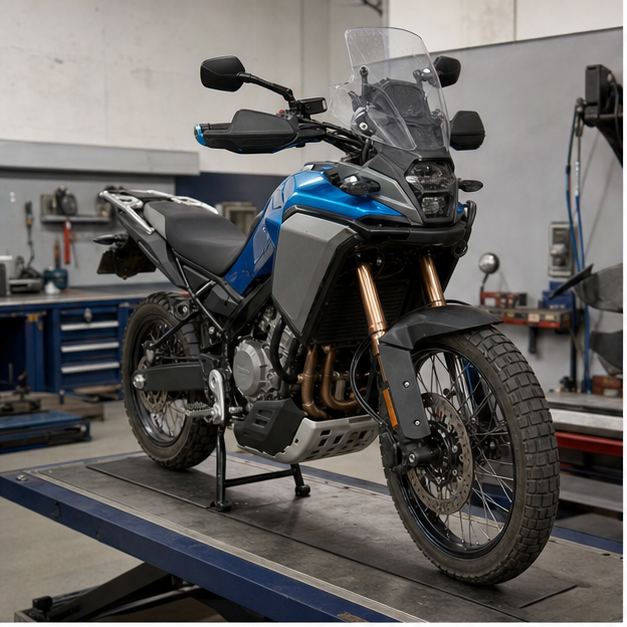
What more power really means on the 450MT
CF Moto 450 MT power increase should be judged by how the bike pulls out of bends, how it climbs with luggage, how it responds at steady throttle and whether it remains calm when hot. A dyno sheet can be useful, but most owners live with the motorcycle between town speeds, fast A-roads, broken lanes and occasional light off-road sections. A louder silencer or aggressive marketing number is not automatically a better motorcycle.
CFMOTO UK describes the 450MT as a 449 cc parallel-twin adventure motorcycle in the A2-compatible class. That matters because the platform is not an unlimited blank canvas. The bike is built around balance, manageable weight, accessible torque and travel-friendly manners. Official model data should always be checked against the exact market version before ordering tuning parts: CFMOTO UK 450MT model information.
For many riders, CF Moto 450 MT power increase is less about peak output and more about smoothing weak areas. A reversible fuel module may sharpen response. A correct exhaust can reduce weight and improve sound. A clean air filter can restore lost pull. A suitable sprocket choice can make the bike feel stronger in the gears you actually use. None of those changes should make the machine unreliable, excessively noisy or awkward to ride in traffic.
| Owner complaint | First checks | Likely useful upgrade | What not to assume |
|---|---|---|---|
| Feels flat with luggage | Chain slack, tyre pressure, load weight, air filter | Gearing review, service baseline, careful fuelling support | That the engine needs a major remap immediately |
| Wants better exhaust sound | Pipe diameter, bracket position, catalyst and DB-killer | Road-appropriate silencer with proper support | That louder means faster |
| Throttle feels lazy | Throttle free play, fault codes, sensor connectors, battery voltage | Reversible module or professional ECU work | That every 450 CFMOTO uses the same connector |
| Needs stronger overtakes | Rider weight, luggage, gearing, tyre drag and service condition | Balanced exhaust/fuelling/gearing approach | That a single plug-in part can change the whole bike |
| Uses gravel and trails | Airbox sealing, cooling, sprocket wear, tyre choice | Protection, tyres and smoother low-speed fuelling | That road-only tuning advice fits adventure use |
Workshop baseline checks before buying parts
CF Moto 450 MT power increase starts with the unglamorous checks that separate a healthy bike from a bike that simply needs maintenance. Warm the engine fully, listen for intake leaks, check idle quality, inspect the air filter, confirm there are no warning lights, look for stored fault codes if diagnostic access is available, and measure chain slack with the motorcycle loaded as it is normally ridden.
Service condition changes the result
A dirty air filter, tired spark plugs, stretched chain, underinflated tyres or dragging brake can make a modern 450 feel weaker than it is. Before spending money, check engine oil level, coolant level, radiator fins, clutch free play, throttle return, battery voltage and tyre pressure. A bike used on dust and wet roads can lose crispness long before it needs performance parts.
Good CF Moto 450 MT power increase work creates a repeatable baseline. Note cold start, hot restart, idle, steady 30 mph running, 50-70 mph roll-on, hill starts, fan behaviour and fuel economy. Make one change at a time. If a new exhaust is fitted on the same day as a filter, module and sprocket, the owner cannot know which part created a problem or improvement.
Measure instead of guessing
Before ordering parts, photograph the ECU area, intake air temperature sensor, oxygen sensor, exhaust bracket, mid-pipe diameter, silencer mount, chain pitch and sprocket tooth count. Compatibility is often lost in small details. Two bikes with the same name can differ by market year, emissions equipment, accessories or previous owner modifications.
For final-drive work, use the motorcycle chain tension adjustment guide before changing sprockets. Chain condition and axle alignment can make the motorcycle feel sharper or rougher without any engine part being touched.
ECU, chip module and throttle response
CF Moto 450 MT power increase often leads owners towards chip tuning, ECU remap searches, fuel controllers and plug-in modules. The important distinction is simple: a module can influence sensor signals or fuelling behaviour within a defined range, while a true ECU remap changes software calibration. Each route has different risks, warranty implications and compatibility requirements.
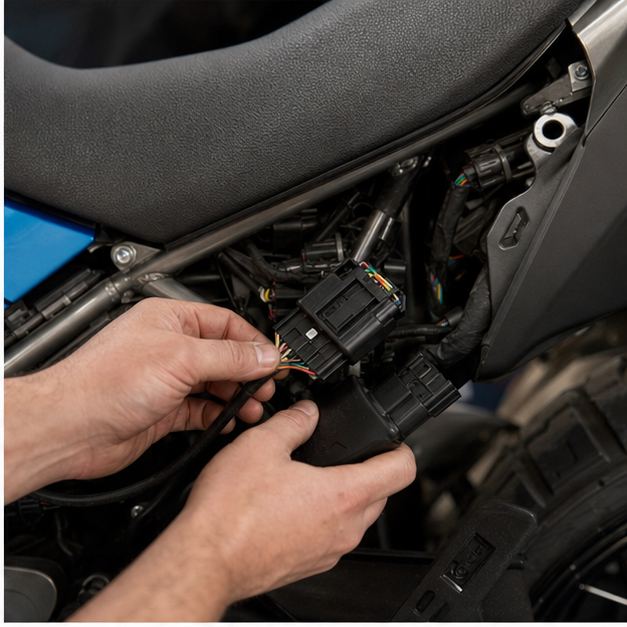
When a reversible module makes sense
A reversible module can make sense when the bike is mechanically sound, the connector type is confirmed, the rider wants cleaner throttle response, and the installation can be removed without cutting the loom. CF Moto 450 MT power increase through a module should start on the lowest sensible setting, with a fully warm engine and a short road test before any adjustment.
The correct approach is conservative. Check for smooth idle, clean hot restart, no warning lights, no fuel smell, no hesitation, no detonation sound and no abnormal heat. If the bike becomes snatchy, smells rich, loses low-speed control or shows a fault, reduce the setting or remove the part and diagnose properly.
When professional ECU work is the better route
Professional ECU work is more appropriate when exhaust and intake changes are substantial, when a dyno operator can measure air-fuel behaviour, or when the owner needs a calibrated result rather than a simple response adjustment. It is also the area where warranty and insurance questions become more serious. Keep invoices and declare material performance modifications to the insurer.
For a comparable dual-sport performance path, the Honda CRF300L power kit guide explains why small adventure and trail bikes need measured, reliable improvements rather than exaggerated claims.
Exhaust, catalyst, DB-killer and fuelling
CF Moto 450 MT power increase is commonly linked to exhaust changes because owners want better sound, lower weight and a livelier feel. A good exhaust can improve the riding experience. A poor exhaust can leak, drone, lose midrange torque, overheat soft luggage, interfere with pannier racks or create MOT and insurance problems.
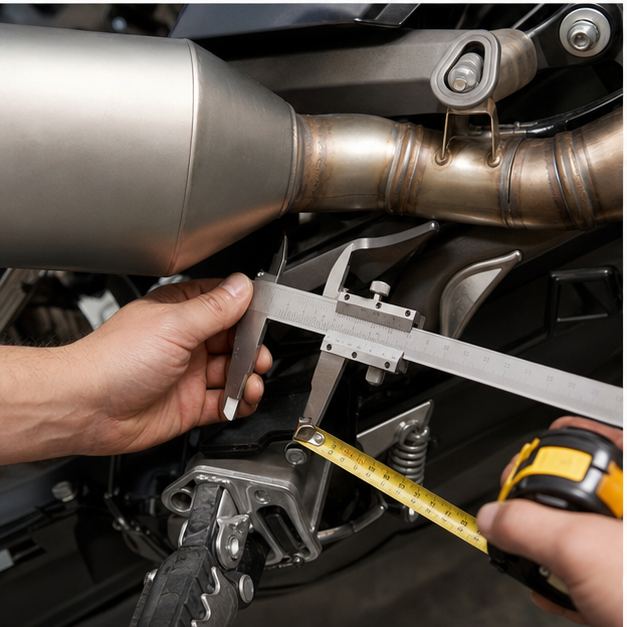
Pipe diameter and mounting points
Measure the outside diameter of the pipe where the silencer or link pipe will fit, the mounting centre distance, available space around the rear subframe, heat shield position and clearance to the rear brake hose, passenger peg and luggage rack. Do not rely only on a product photo. Adventure bikes carry soft bags, panniers and straps; heat and clearance matter.
A quality exhaust for CF Moto 450 MT power increase should retain good gas speed, support the silencer properly and respect sensor location. If the oxygen sensor, catalyst or emissions equipment is removed or moved incorrectly, the bike may run poorly and may not be legal for road use.
Sound, torque and fuelling
The 450MT does not need an exhaust that empties the midrange. A very open pipe may sound stronger but feel weaker where adventure riders need drive. After fitting an exhaust, check hot idle, part-throttle cruising, overrun popping, fuel smell, heat and vibration. If symptoms appear, do not mask them with more parts; find the cause.
Anyone comparing exhaust options should start with dimensions, mounting system and road-use status before ordering. The motorcycle exhausts category is the right internal starting point when the next step is fitment rather than guesswork.
Air filter, airbox and adventure use
CF Moto 450 MT power increase should be cautious around intake modifications. The 450MT is an adventure bike, which means dust, rain, puddles, gravel spray and long-distance heat are part of real use. A high-flow filter is useful only if it seals correctly and protects the engine. An open or poorly sealed intake can destroy reliability faster than it creates performance.
Filtration matters more than marketing
Before fitting any performance filter, inspect the airbox rim, sealing surface, drain, intake snorkel and filter seating. Dust marks after the filter are a warning sign. A slightly freer-flowing element is not worth dirt ingestion. For most owners, keeping the airbox intact and serviceable is the sensible path.
Good CF Moto 450 MT power increase work treats intake and exhaust as a pair. If airflow changes at both ends, fuelling should be checked. If the bike is used off-road, clean the filter more often than a pure road bike and avoid modifications that expose the intake to splash or dust.
Chain, sprockets and road feel
CF Moto 450 MT power increase does not always require more engine output. Final-drive gearing can change how strong the bike feels. A slightly shorter setup can improve low-speed control, loaded hill starts and gravel-road response. A taller setup can reduce revs on open roads but may make the bike feel lazier into wind or with panniers.
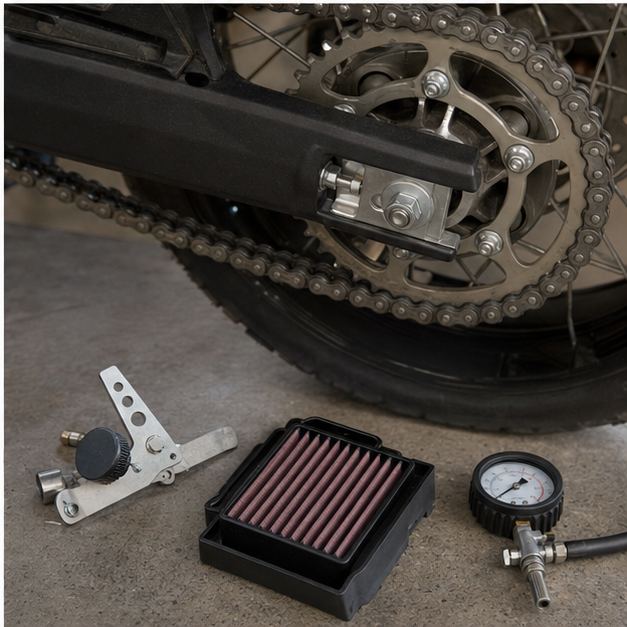
Gearing is not free horsepower
A sprocket change does not create power; it changes leverage. Shorter gearing can make the engine feel more eager but may raise cruising revs and fuel use. Taller gearing can calm the bike at speed but may hurt overtaking. Choose based on normal roads, rider weight, luggage and tyre size.
A realistic CF Moto 450 MT power increase plan should also consider tyres. Aggressive adventure tyres can add rolling resistance and noise. Heavy luggage, crash bars and tools increase load. Sometimes the bike feels weaker because it is carrying too much weight or wearing tyres that suit a different job.
Compatibility table for 450MT tuning parts
Compatibility is the part of CF Moto 450 MT power increase that saves money. The 450MT, 450SR, 450NK, 450CL-C and CFMOTO ATVs may share brand language, but they are not the same vehicle. Engine family, exhaust routing, wiring access, emissions equipment and intended use can differ.
| Vehicle or part area | Compatibility | Important note |
|---|---|---|
| CFMOTO 450MT motorcycle | Yes, with exact year and market checks | Confirm ECU connector, sensor layout, emissions version and accessories |
| CFMOTO 450SR / 450NK | Not automatically | Road-sport models can use different bodywork, exhaust routing and access points |
| CFMOTO 450CL-C | Not automatically | Cruiser layout changes exhaust clearance, brackets and luggage considerations |
| CFMOTO CForce / ATV 450 | No direct assumption | ATV CVT, chassis, airbox and use case are very different |
| Universal exhaust | Possible only with measurements | Check pipe diameter, bracket, DB-killer, catalyst, E-mark and heat clearance |
| Fuel module or chip tuning unit | Only with matching connector and sensor logic | Never cut or force wiring; confirm return policy and support before ordering |
Practical comparison of tuning routes
The best route depends on whether the rider wants road touring comfort, stronger midrange feel, better gravel control or a more satisfying exhaust note. CF Moto 450 MT power increase should be built in stages, not as a pile of unrelated parts.
| Solution | Main advantage | Possible disadvantage | Best for |
|---|---|---|---|
| Full service and baseline | Restores lost response and reliability | Less exciting than visible upgrades | Every owner before tuning |
| Reversible fuel module | Can sharpen throttle feel without permanent wiring | Must match connectors and be adjusted conservatively | Owners wanting a removable setup |
| Professional ECU calibration | Best measured support for major changes | Higher cost and stronger warranty/insurance implications | Exhaust and intake combinations |
| Road-appropriate exhaust | Sound, weight and appearance improvement | Legality, noise and fuelling must be checked | Riders wanting character and fitment quality |
| Sprocket change | Changes real-world pull and low-speed control | Can make cruising worse if chosen badly | Loaded touring or gravel use |
| Tyres and suspension setup | Improves confidence more than many engine parts | Wrong tyres can add drag or nervous steering | Adventure riders and commuters |
UK road legality and anglophone markets
CF Moto 450 MT power increase for UK public-road use must be considered alongside licence category, insurance, MOT condition, noise, emissions and vehicle roadworthiness. GOV.UK lists motorcycle licence categories and power limits, including the A2 framework that many mid-capacity bikes are designed around: GOV.UK motorcycle licence categories.
The UK MOT is not a tuning approval certificate, but it can expose obvious problems. An insecure exhaust, major leak, excessive noise, missing required equipment or a marking such as “not for road use” can cause trouble. The GOV.UK motorcycle MOT manual is the right reference for inspection context: GOV.UK motorcycle MOT inspection manual.
Road, track, private land and off-road use
A part described as track-use-only, race-use-only or off-road-use-only should not be treated as road legal. A silencer without an E-mark or with the DB-killer removed may be unsuitable for UK road use depending on the product, markings, noise and emissions impact. A catalytic converter may also be relevant where emissions compliance depends on it.
Outside the UK, the United States, Canada, Australia, New Zealand and Ireland all have their own approach to exhaust noise, emissions equipment, inspections and insurance disclosure. CF Moto 450 MT power increase advice must therefore be tied to the market where the bike is registered, not copied from a forum in another country.
Workshop experience: what to check during and after installation
A careful mechanic does not judge a performance part on the paddock stand. After CF Moto 450 MT power increase work, the bike must be ridden, warmed, cooled and inspected again. Check all connectors, zip-tie positions, wiring clearance near the subframe, exhaust joint leaks, silencer bracket stress, chain slack, axle alignment and tyre pressure. Then inspect again after the first longer ride.
The difference between theoretical and real compatibility
Theoretical compatibility means the part claims to suit the model. Real compatibility means the connector clicks without force, the exhaust clears the frame, the heat shield protects the rider, the wiring does not rub, no warning lights appear, and the bike still starts cleanly when hot. This is where many low-quality modifications fail.
For owners planning a similar middleweight adventure setup, the Himalayan 450 tuning guide is a useful comparison because it shows how exhaust, ECU, gearing, tyres and luggage interact on another modern 450 adventure platform. The Aprilia Pegaso 650 tuning guide is also relevant for single-cylinder adventure-road tuning logic, especially around exhaust and fuelling expectations.
Common mistakes with the 450MT
The first mistake is confusing the 450MT with the 450SR, 450NK, 450CL-C or a CForce ATV. The second is buying a module because the plug looks similar in a photo. The third is fitting a loud exhaust without checking catalyst, DB-killer, E-mark, bracket strength and oxygen sensor position. The fourth is expecting a huge horsepower gain from one inexpensive part. The fifth is ignoring warranty and insurance disclosure.
Another common 450MT upgrade mistake is changing several parts at once. Fit one part, test it, then move on. If a bike develops hesitation after an exhaust, filter, module and sprocket are fitted together, diagnosis becomes slow and expensive. Keep the original parts, keep photos of the installation and keep a record of settings.
| Mistake | Why it causes trouble | Better workshop habit |
|---|---|---|
| Buying by model name only | Market versions and connectors can differ | Photograph and measure the exact bike |
| Removing the DB-killer for road use | Can create noise, MOT, police and insurance problems | Use a road-appropriate exhaust setup |
| Ignoring the airbox seal | Dust ingestion can damage the engine | Inspect sealing surfaces after every filter change |
| Over-tightening the chain | Loads bearings, output shaft and suspension movement | Measure slack correctly with load in mind |
| Expecting remap miracles | The engine and licence category still define the platform | Aim for rideability and measured improvement |
| Not declaring modifications | Insurance problems can be more costly than the part | Tell the insurer about material changes |
When to use a professional mechanic
CF Moto 450 MT power increase should involve a professional when the work touches ECU calibration, fuel mapping, exhaust fabrication, oxygen sensor relocation, catalyst removal, wiring repair, brake-line clearance, or anything that could affect roadworthiness. A good workshop can measure rather than guess, and that often saves money.
Use professional help if the bike shows a check-engine light, unstable idle, hard hot starting, detonation-like noise, severe overrun popping, fuel smell, exhaust leaks or visible wiring damage. Stop riding if a bracket cracks, the exhaust touches luggage, the rear brake hose is near heat, or the chain becomes tight through suspension travel.
FAQ
Is CF Moto 450 MT power increase worth it?
CF Moto 450 MT power increase is worth it when the goal is sharper response, better midrange feel, correct gearing, better exhaust character and a more confident loaded ride. It is not worth it if the expectation is a huge peak-power jump without cost, legality or reliability trade-offs.
Can the CFMOTO 450MT make much more horsepower?
Large gains are unlikely from simple bolt-on parts. The best improvements usually come from restoring service condition, choosing a suitable exhaust, checking fuelling, setting gearing for the rider and keeping the bike light enough for its intended adventure use.
Does a 450MT need an ECU remap after an exhaust?
Not automatically. A road-appropriate silencer with the correct catalyst and sensor layout may run acceptably, but hesitation, heat, heavy popping, fuel smell or warning lights mean the bike needs diagnosis before more parts are added.
Is a chip module safe on the CF Moto 450MT?
A chip module can be safe only when it is compatible with the exact connector and sensor logic, installed without cutting the loom, adjusted conservatively and tested properly. If anything feels worse, remove it and diagnose the bike.
Are 450MT and 450SR tuning parts the same?
No owner should assume that. The 450MT, 450SR, 450NK and 450CL-C have different layouts and use cases. Some engine-related logic may overlap, but exhaust routing, access, brackets and bodywork can be different.
What is the best first upgrade for the 450MT?
The best first upgrade is usually a complete baseline: clean air filter, correct chain slack, tyre pressure, brake inspection, fault-code check and a careful road test. That tells you whether the bike really needs performance parts.
Is tuning legal on a UK 450MT?
CF Moto 450 MT power increase can be legal for UK road use only if the motorcycle remains within the rider’s licence entitlement, is insured correctly, is roadworthy, is not excessively noisy and keeps required emissions equipment where applicable.
Will sprockets give more power?
Sprockets do not create engine power. They change how the available torque reaches the rear wheel. Shorter gearing can feel stronger at low speed, while taller gearing may suit cruising but can hurt loaded overtaking.
Final buying and setup advice
CF Moto 450 MT power increase should end with a motorcycle that feels clearer, cleaner and easier to ride, not one that is simply louder or more complicated. Start by confirming the exact model year and market version. Check service condition, airbox sealing, chain slack, tyre pressure, exhaust dimensions, sensor layout and insurance obligations before placing an order.
If the bike is mainly used for commuting and weekend touring, prioritise reliability, smooth response and legal road equipment. If it carries luggage, consider gearing and weight before chasing horsepower. If it sees gravel, protect the airbox and choose tyres honestly. If the plan involves wiring, ECU work or exhaust fabrication, use a professional.
The best 450MT upgrade is the one you can explain after a test ride: what changed, why it changed, and why the bike remains safe, roadworthy and enjoyable. Build it that way and the 450MT becomes a better version of itself rather than an unfinished experiment.
{
“@context”: “https://schema.org”,
“@type”: “Article”,
“headline”: “CF Moto 450 MT power increase”,
“description”: “CF Moto 450 MT power increase guide to ECU modules, exhaust fitment, air filter checks, gearing, warranty, UK road legality and realistic adventure-bike setup.”,
“author”: {“@type”: “Organization”, “name”: “X Moto Parts”},
“publisher”: {“@type”: “Organization”, “name”: “X Moto Parts”},
“mainEntityOfPage”: “https://xmotoparts.com/cf-moto-450-mt-power-increase/”
}
{
“@context”: “https://schema.org”,
“@type”: “FAQPage”,
“mainEntity”: [
{“@type”: “Question”, “name”: “Is CF Moto 450 MT power increase worth it?”, “acceptedAnswer”: {“@type”: “Answer”, “text”: “It is worth it when the goal is sharper response, better midrange feel, correct gearing, better exhaust character and a more confident loaded ride, not an unrealistic peak-power jump.”}},
{“@type”: “Question”, “name”: “Can the CFMOTO 450MT make much more horsepower?”, “acceptedAnswer”: {“@type”: “Answer”, “text”: “Large gains are unlikely from simple bolt-on parts. Most improvements come from service condition, suitable exhaust choice, fuelling checks, gearing and weight control.”}},
{“@type”: “Question”, “name”: “Does a 450MT need an ECU remap after an exhaust?”, “acceptedAnswer”: {“@type”: “Answer”, “text”: “Not automatically. If the bike hesitates, runs hot, pops heavily, smells rich or shows a warning light, it needs diagnosis before more parts are added.”}},
{“@type”: “Question”, “name”: “Is a chip module safe on the CF Moto 450MT?”, “acceptedAnswer”: {“@type”: “Answer”, “text”: “A chip module can be safe only when it matches the exact connector and sensor logic, is installed without cutting the loom, and is adjusted conservatively.”}},
{“@type”: “Question”, “name”: “Are 450MT and 450SR tuning parts the same?”, “acceptedAnswer”: {“@type”: “Answer”, “text”: “No. The 450MT, 450SR, 450NK and 450CL-C have different layouts, exhaust routing, brackets, access points and use cases.”}},
{“@type”: “Question”, “name”: “What is the best first upgrade for the 450MT?”, “acceptedAnswer”: {“@type”: “Answer”, “text”: “A full baseline check is usually the best first step: air filter, chain slack, tyre pressure, brakes, fault codes, throttle feel and road test.”}},
{“@type”: “Question”, “name”: “Is tuning legal on a UK 450MT?”, “acceptedAnswer”: {“@type”: “Answer”, “text”: “It can be legal only if the motorcycle remains within the rider’s licence entitlement, is insured correctly, is roadworthy, is not excessively noisy and keeps required emissions equipment where applicable.”}},
{“@type”: “Question”, “name”: “Will sprockets give more power?”, “acceptedAnswer”: {“@type”: “Answer”, “text”: “Sprockets do not create engine power. They change how the available torque reaches the rear wheel, improving low-speed pull or cruising depending on the choice.”}}
]
}