
Honda CRF300L power kit
Honda CRF300L power kit is a tempting search for riders who like the little Honda but want more pull from the same practical trail bike. The CRF300L is light, friendly and economical, yet many owners soon ask the same questions: can it overtake more confidently, climb loose tracks with less clutch work, hold speed better with luggage, or feel sharper without turning into an unreliable project?
The honest answer is that a Honda CRF300L power kit should be treated as a complete setup, not a magic box. A good result comes from checking the bike’s service condition, gearing, chain, air filter, exhaust flow, fuelling correction, connector compatibility and riding use. A poor result usually comes from fitting one part, expecting motocross power and ignoring heat, noise, emissions, fuelling and road legality.
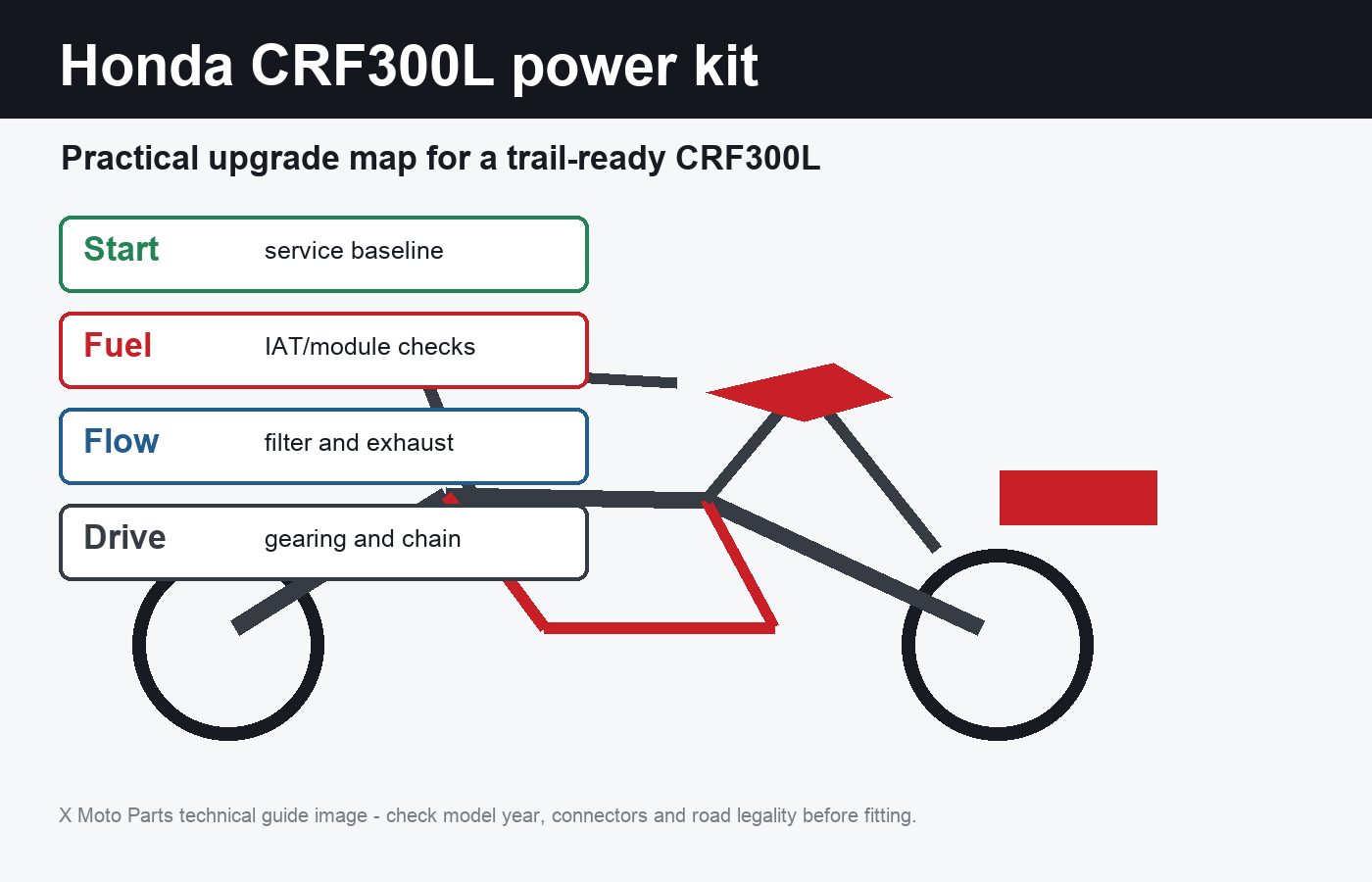
This guide is written from a workshop point of view. It explains what belongs in a sensible Honda CRF300L power kit, what to check before buying, what can realistically change on the road, which mistakes cause running problems and how to keep the motorcycle useful as a dual-sport rather than spoiling the qualities that made it good in the first place.
What a power kit can and cannot do
A Honda CRF300L power kit can make the bike feel cleaner and more eager if the parts suit the exact model and are installed carefully. The strongest improvement is usually throttle response, mid-range crispness and the feeling that the engine recovers better after a slow corner or a climb. On a 286 cc single-cylinder trail bike, that matters more than chasing a headline horsepower number.
It cannot turn the CRF300L into a CRF450R, and it should not be judged that way. The engine is built for easy road use, green-lane riding, commuting and low-stress travel. If an owner wants reliability, fuel range, manageable heat and a quiet enough bike for long days, a Honda CRF300L power kit needs to respect the original design rather than fight it.
Realistic gains on a small single-cylinder Honda
The practical gain from a Honda CRF300L power kit is rarely one dramatic number. It is the way the bike pulls from low rpm, the way it responds to small throttle openings and the way it feels when carrying camping gear or climbing a rough lane. A correctly chosen chip tuning module, freer-flowing but sensible exhaust, clean filter and correct gearing can make the bike easier to ride without forcing the engine to work outside its comfort zone.
Owners should also separate power from usability. Shorter final gearing can make the bike feel stronger off-road while lowering relaxed cruising speed. A louder exhaust can feel faster without making meaningful torque. A fuelling module can improve response if the sensor connection and setup are correct. The best Honda CRF300L power kit is the one that improves the part of the ride you actually care about.
Why the baseline matters more than the parts list
Before fitting a Honda CRF300L power kit, inspect the motorcycle as if you were diagnosing a customer bike. Check valve service history, air filter condition, plug colour, chain tension, sprocket wear, tyre pressure, brake drag, wheel bearings and coolant level. A tight chain, dirty air filter or dragging rear brake can make a healthy CRF300L feel flat, and no tuning part should be used to hide basic maintenance.
Anyone comparing compatible CRF300L upgrades should first read the existing Honda CRF300L derestriction guide, because it explains the bike’s limiters, road-use questions and realistic expectations before money is spent.
Baseline checks before buying parts
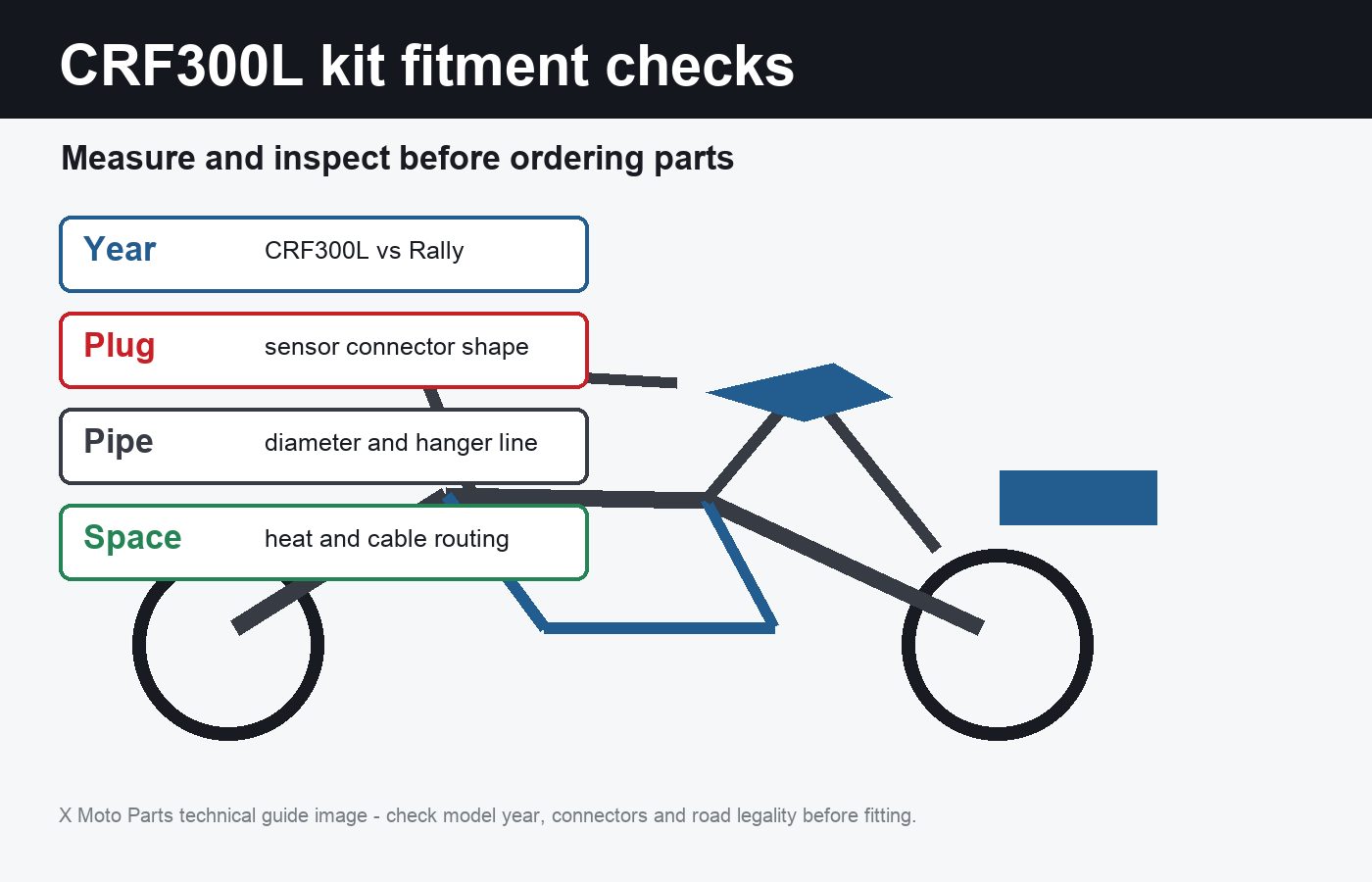
A Honda CRF300L power kit should begin with identification. Confirm the model year, whether it is a CRF300L or CRF300 Rally, market version, emissions standard, existing exhaust, intake changes and whether the bike has been previously modified. The CRF300L family is simple, but small connector or exhaust differences can decide whether a part is plug-in, adaptable or wrong.
| Check | What to inspect | Why it matters |
|---|---|---|
| Model identity | CRF300L, CRF300 Rally, year and market | Panels, exhaust routing and connector access can differ |
| Service condition | Air filter, spark plug, chain, fluids and valve history | A weak baseline makes tuning results misleading |
| Sensor layout | IAT sensor area and connector shape | Electronic modules must match the actual plug |
| Exhaust system | Silencer, header, catalyst position and leaks | Flow and fuelling decisions depend on exhaust condition |
| Riding use | Road, trail, luggage, commuting or private land | The best setup changes with the job the bike must do |
The most common workshop mistake is ordering a Honda CRF300L power kit before measuring anything. Take photos of the intake area, exhaust mounts and current connectors. If a product listing shows a connector image, compare it with the bike before buying. If the motorcycle has a non-standard airbox, aftermarket pipe or previous owner wiring work, assume nothing until you have the bike in front of you.
Compatibility
A Honda CRF300L power kit is compatible only when the parts match the exact motorcycle and the intended use. Some parts are model-specific, such as a chip module or exhaust bracket. Other parts, such as tools, chain lube, filters or generic guards, may fit a wider range. Treat every performance part as a fitment decision rather than a universal accessory.
| Vehicle or setup | Compatibility | Important note |
|---|---|---|
| Honda CRF300L | Yes, with CRF300L-specific parts | Confirm year, connector shape, exhaust routing and bracket points |
| Honda CRF300 Rally | Often, but not automatically | Bodywork and access can differ, especially around routing and panels |
| CRF250L | No direct assumption | Engine size, electronics and fitment can be different |
| Road-registered UK bike | Depends on parts | Noise, emissions, insurance and MOT condition must be considered |
| Trail or private-land bike | Often easier | Still needs safe throttle return, secure wiring and no fuel or exhaust leaks |
If the main aim is a reversible fuelling upgrade, the Honda CRF300L chip tuning module is the internal product page to check first. A Honda CRF300L power kit built around a reversible module is usually easier to return to standard than a permanent ECU flash, but the installation still needs care.
Kit options compared
There is no single Honda CRF300L power kit that suits every rider. A commuter who wants smoother response should not buy the same setup as a trail rider who wants stronger low-speed drive with luggage. A rider using the bike on UK roads also has different responsibilities from a rider building a private-land machine.
| Solution | Main advantage | Possible disadvantage | Best suited to |
|---|---|---|---|
| Service-first setup | Restores lost performance cheaply | Does not add dramatic power | Used bikes, commuters, unknown history |
| Fuelling module | Sharper response when matched correctly | Connector and setup must be right | Riders wanting reversible improvement |
| Exhaust upgrade | Weight, sound and flow potential | Noise and legality must be checked | Riders wanting feel and lighter rear section |
| Gearing change | Immediate effect off-road | May raise cruising rpm | Trail riding, hills, loaded travel |
| Full combined kit | Best overall balance if set up properly | Higher cost and more variables | Experienced owners or workshop installation |
A balanced Honda CRF300L power kit often feels better than an aggressive one. If you change intake, exhaust, fuelling and sprockets all at once, you may not know which change caused a problem. Fit parts in stages where possible. Record baseline idle quality, starting behaviour, fuel consumption, plug appearance and cruising rpm before the work begins.
Fuelling, airflow and exhaust
A Honda CRF300L power kit lives or dies by airflow and fuelling balance. A freer exhaust can reduce weight and change throttle feel, but if the bike becomes too lean, too loud or unpleasant at cruising speed, the modification has not improved the motorcycle. Likewise, a fuelling module should be used to refine response, not to cover intake leaks, blocked filters or poor mechanical condition.
Chip tuning module and sensor checks
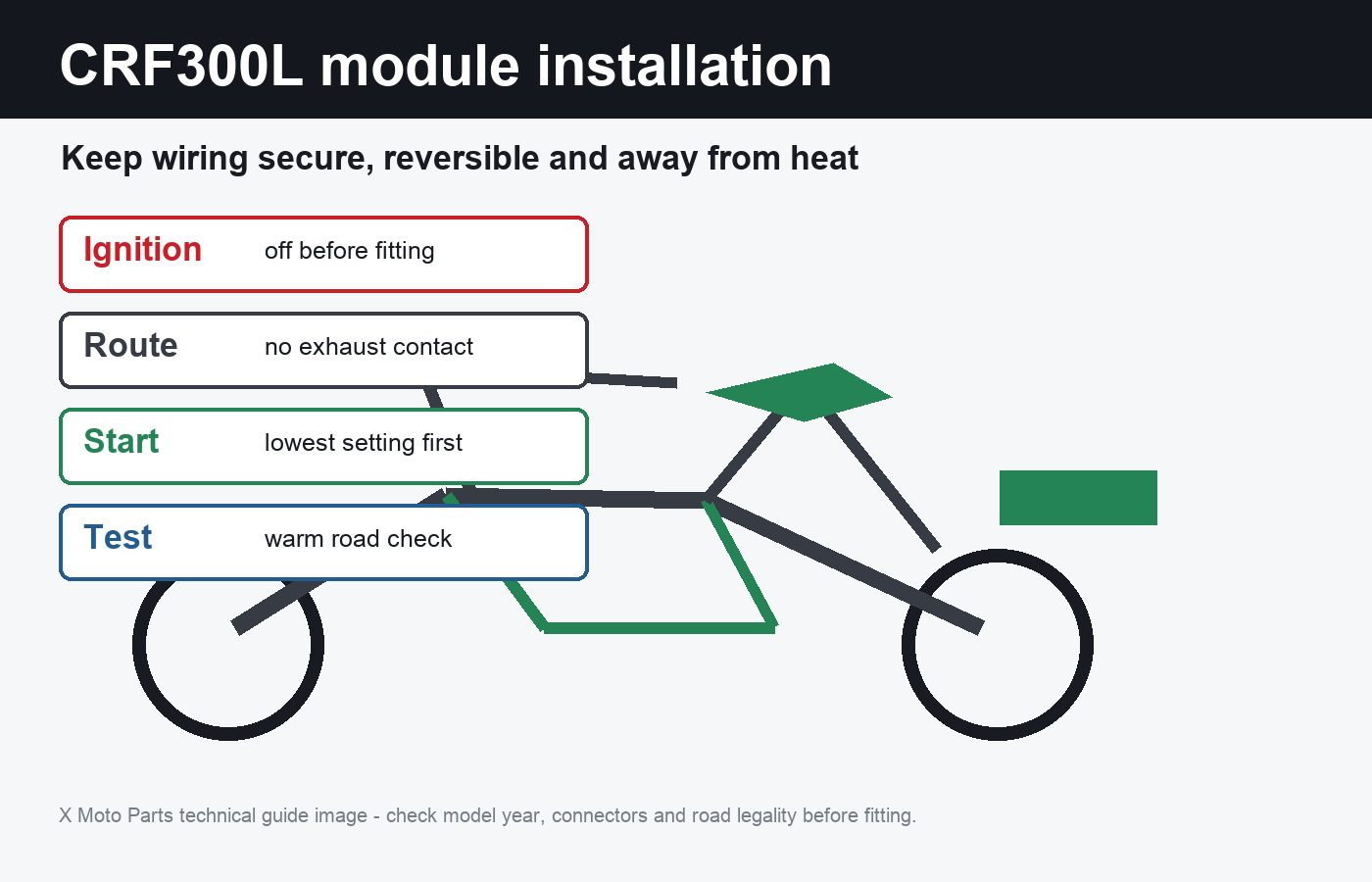
When a Honda CRF300L power kit includes a chip tuning module, look at the sensor connector before fitting. The ignition should be off, wiring should be routed away from heat and moving parts, and the module should be mounted where it is protected from water blast, sharp edges and exhaust temperature. Start from the most conservative setting and test the bike fully warm.
A module can be a sensible next step for riders who want a reversible change. Anyone looking at a fuelling-based Honda CRF300L power kit should compare the product instructions, connector photos and bike year before ordering. If the connector is wrong, do not cut the harness to make it fit; stop and check compatibility.
Exhaust, air filter and intake reality
A loud pipe is not automatically a good Honda CRF300L power kit. The original Honda system is quiet, durable and designed for road manners. An aftermarket exhaust can save weight and sharpen the feel, but it must seal at the joints, clear the plastics, line up with the hanger and suit the bike’s fuelling. If it deletes a catalyst or is marked for track use only, road legality can change.
The air filter deserves the same caution. A dirty filter reduces performance. A poorly oiled foam filter can restrict flow or pass dirt. A modified airbox may increase intake noise and change fuelling needs. Before buying a full Honda CRF300L power kit, decide whether the bike is a road commuter, trail bike, lightweight travel bike or private-land project.
Gearing, chain and clutch feel
Many riders think they need a Honda CRF300L power kit when they actually need gearing matched to their riding. A smaller front sprocket or larger rear sprocket can make the bike pull harder at low speed, especially on lanes and climbs. The trade-off is higher rpm on faster roads. Chain length, adjustment range, guide clearance and speedometer behaviour must all be considered.
After any sprocket change, use the motorcycle chain tension adjustment guide to check slack properly. A chain set too tight can damage bearings and make suspension movement harsh; a chain set too loose can slap, jump or wear guides quickly. A Honda CRF300L power kit should never compromise the basics of the final drive.
Installation workshop method
Fitting a Honda CRF300L power kit should be done like a diagnosis, not like a race against the clock. Wash the bike first, especially around the intake and side panels. Disconnect accessories that may block access. Lay out parts on a clean bench. Photograph standard routing. Keep original parts labelled so the bike can be returned to standard if needed.
Step-by-step fitting order
Start with service parts and checks, then fit one performance part at a time. If the Honda CRF300L power kit includes a module, fit it and test it before changing the exhaust. If it includes gearing, check chain slack and rear wheel alignment after the sprocket work. If it includes an exhaust, inspect clearance when the suspension moves and after the first heat cycle.
| Stage | Action | Workshop note |
|---|---|---|
| 1 | Baseline service check | Filter, plug, chain, tyre pressure, coolant and brake drag |
| 2 | Fit reversible module if used | Ignition off, no stretched wiring, lowest setting first |
| 3 | Fit exhaust or airflow part | Check gasket seal, bracket line, noise and heat clearance |
| 4 | Fit gearing if needed | Check chain length, guide clearance and axle alignment |
| 5 | Road and trail test | Warm engine, listen for leaks, check throttle return and idle |
If the bike feels worse after fitting a Honda CRF300L power kit, do not keep raising settings. Go backwards. Check connectors, intake boots, exhaust leaks, chain tension, fuel quality and whether the part was installed in the correct direction. The best technicians are not the ones who never make mistakes; they are the ones who test methodically and stop before turning one fault into three.
After-installation road test
A good road test for a Honda CRF300L power kit includes cold start, hot restart, steady low-speed throttle, mid-range roll-on, engine braking, clutch take-up, idle after heat soak and a short faster section if legal and safe. Watch for surging, flat spots, popping, excessive heat, stalling, engine warning lights or unusual fuel smell. Recheck fasteners after the first ride.
UK road legality and other markets
A CRF300L upgrade used on UK roads must be considered differently from a private-land or competition setup. For road use, the bike needs to remain roadworthy, reasonably quiet, safe and correctly insured. Exhaust noise, catalyst changes, emissions equipment, number plate angle, lighting, tyres and general condition can all matter when the bike is used on public roads.
For UK riders, the official GOV.UK motorcycle MOT exhaust noise guidance is a useful reference when exhaust changes are involved. The official Honda CRF300L specifications also help owners understand the standard motorcycle before changing parts.
In the United States, Canada, Australia, New Zealand and Ireland, rules can differ by state, province, territory or registration category. A CRF300L setup that is acceptable for off-road riding in one market may not be road legal in another. If a part is described as race use only, track use only or off-road use only, treat that wording seriously and check local requirements before fitting it to a road-registered bike.
Common mistakes
The easiest way to spoil a CRF300L upgrade is to buy parts only because they look exciting. The CRF300L is a light dual-sport motorcycle, so reliability, control and range matter. A loud exhaust, overly short gearing or badly routed module wiring can make the bike less pleasant on the road and more tiring on the trail.
- Buying a module without checking connector shape and model year.
- Assuming CRF250L parts automatically fit a CRF300L.
- Fitting an exhaust without checking hanger alignment, gasket seal and heat clearance.
- Ignoring MOT, insurance and road-use implications in the UK.
- Changing intake, exhaust, fuelling and gearing all at once, then not knowing what caused a problem.
- Using gearing to chase top speed when the real need is low-speed control.
- Routing wiring near the header, chain, sharp frame edges or steering movement.
- Expecting major horsepower from a small single without considering engine character.
- Failing to recheck chain tension and fasteners after the first ride.
- Confusing a universal part with a model-specific plug-and-play upgrade.
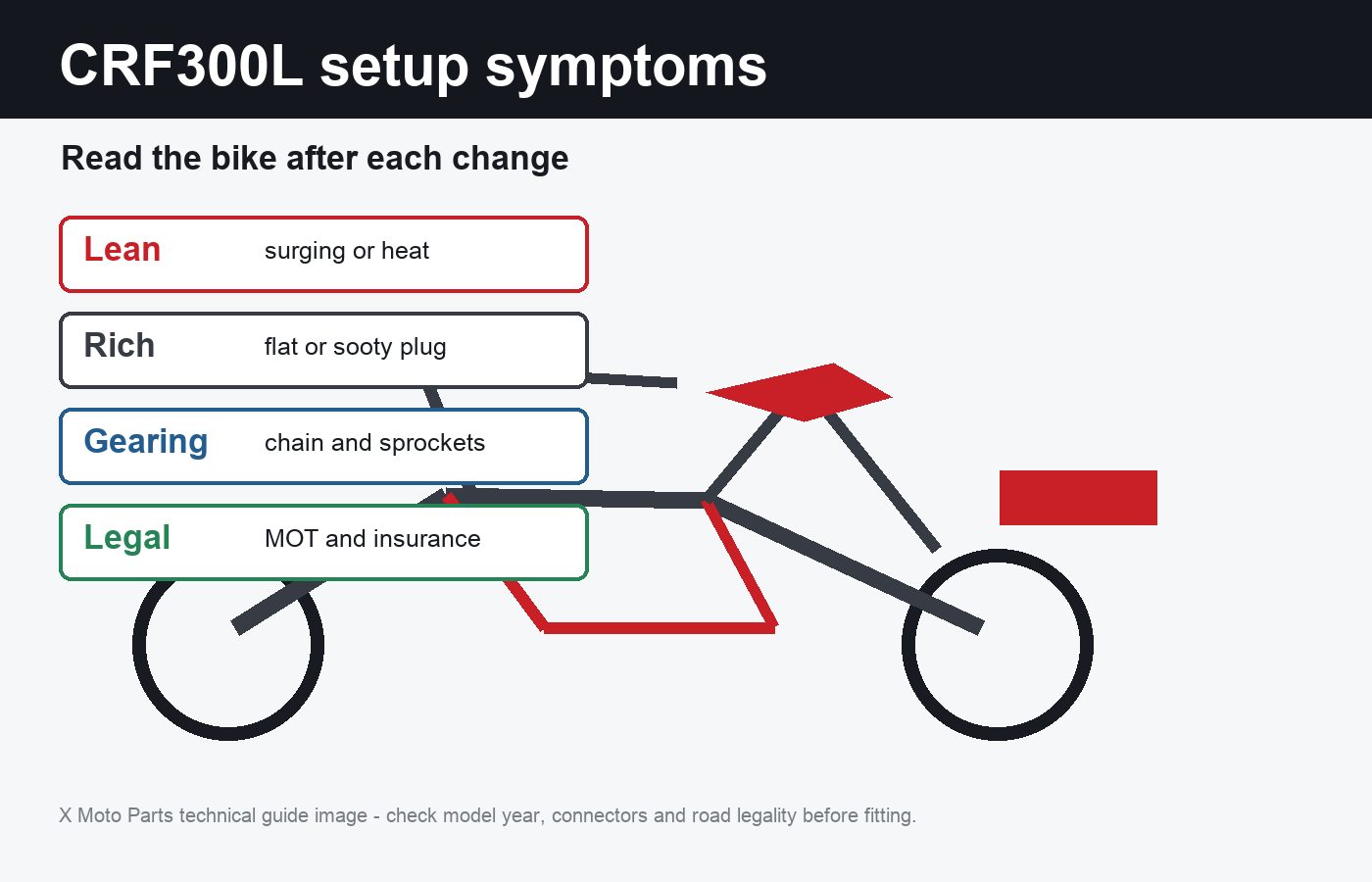
A sensible CRF300L setup keeps the motorcycle easy to start, easy to control and easy to service. If the bike starts hunting at idle, runs hotter, smells rich, surges at steady throttle or becomes unpleasantly loud, the setup needs checking rather than defending.
Buying advice and internal options
When choosing CRF300L performance parts, start with the weakest part of your current ride. If the bike feels lazy off-road but fine on the road, gearing may be more useful than an exhaust. If it feels hesitant after an intake or exhaust change, fuelling support may be the priority. If the bike is simply old, dirty or recently bought used, service work comes first.
For reversible fuelling, compare the Honda CRF300L chip tuning module. For wider upgrade planning, browse the performance parts category and use it together with the CRF300L derestriction and chain setup guides. Choose around the exact bike, not around the most aggressive description.
FAQ
What is included in a CRF300L upgrade package?
A CRF300L upgrade package may include a fuelling module, exhaust-related parts, intake service parts, gearing changes and setup guidance. The best kit is not always the biggest one; it is the combination that suits the bike’s year, connectors, riding use and legal requirements.
Will a CRF300L upgrade make the bike much faster?
A well-matched CRF300L upgrade can improve throttle response and real-world pull, but it should not be expected to transform the motorcycle into a larger enduro bike. The most noticeable gains are usually driveability, sharper pick-up and better matching of gearing to terrain.
Do I need to remap the CRF300L after fitting an exhaust?
It depends on the exhaust, intake condition and how the bike runs after installation. A mild silencer may not need major changes, while a freer system can benefit from fuelling correction. Any setup that changes airflow should always be tested for idle quality, heat, surging and throttle response.
Is a CRF300L upgrade legal on UK roads?
A CRF300L upgrade can be road acceptable only if the motorcycle remains roadworthy, properly insured and compliant with applicable noise and emissions expectations. Exhaust parts marked for race, track or off-road use should not be assumed legal for public roads.
Can I fit a power kit myself?
Many owners can fit simple parts if they are comfortable removing panels, identifying connectors and checking fasteners. If the job involves wiring, exhaust sealing, gearing or uncertain compatibility, a motorcycle mechanic is the safer option.
Should I choose gearing or a fuelling module first?
Choose based on the symptom. If the bike is too tall-geared for slow lanes, gearing may be the best first step. If throttle response feels flat after airflow changes, a module may help. A CRF300L upgrade works best when each part solves a real problem.
Will a power kit affect fuel economy?
It can. A setup that encourages harder riding, richer fuelling or shorter gearing may reduce fuel economy. A carefully set up bike ridden normally may remain close to standard, but owners should measure real consumption after changes.
What should I check after the first ride?
After fitting performance parts, check exhaust joints, wiring security, chain slack, idle stability, warning lights, fuel smell, fasteners and panel clearance. Recheck again after the first heat cycle and after the first rough trail ride.
Final practical conclusion
A CRF300L upgrade is worth considering when the bike is healthy, the owner has a clear goal and the parts are chosen around compatibility rather than hype. For most riders, the winning setup is simple: service the bike properly, decide whether the problem is response, gearing, sound or load-carrying, then fit one well-matched change at a time.
If the motorcycle is used on UK roads, check road legality, insurance, noise, emissions-related parts and MOT condition before committing. If it is used off-road or on private land, still care about heat, wiring, throttle return and secure mounting. The right setup should make the bike easier to ride, not more fragile, louder for no reason or harder to diagnose.
The most useful next step is to inspect the exact bike, photograph the connector and exhaust areas, then compare reversible options first. Start with the Honda CRF300L chip tuning module if fuelling response is the main concern, and keep the original parts until the setup has proven itself in real riding.
{
“@context”: “https://schema.org”,
“@type”: “Article”,
“headline”: “CRF300L upgrade kit guide”,
“description”: “CRF300L upgrade guide covering compatible parts, fuelling modules, exhaust choices, gearing, installation checks, UK road legality and common mistakes.”,
“author”: {
“@type”: “Organization”,
“name”: “X Moto Parts”
},
“publisher”: {
“@type”: “Organization”,
“name”: “X Moto Parts”,
“logo”: {
“@type”: “ImageObject”,
“url”: “https://xmotoparts.com/wp-content/uploads/x-moto-parts-logo.png”
}
},
“mainEntityOfPage”: {
“@type”: “WebPage”,
“@id”: “https://xmotoparts.com/honda-crf300l-power-kit/”
}
}
{
“@context”: “https://schema.org”,
“@type”: “FAQPage”,
“mainEntity”: [
{
“@type”: “Question”,
“name”: “What is included in a CRF300L upgrade package?”,
“acceptedAnswer”: {
“@type”: “Answer”,
“text”: “A CRF300L upgrade package may include a fuelling module, exhaust-related parts, intake service parts, gearing changes and setup guidance. The best kit is the combination that suits the bike’s year, connectors, riding use and legal requirements.”
}
},
{
“@type”: “Question”,
“name”: “Will a CRF300L upgrade make the bike much faster?”,
“acceptedAnswer”: {
“@type”: “Answer”,
“text”: “A CRF300L upgrade can improve throttle response and real-world pull, but it should not be expected to transform the motorcycle into a larger enduro bike.”
}
},
{
“@type”: “Question”,
“name”: “Do I need to remap the CRF300L after fitting an exhaust?”,
“acceptedAnswer”: {
“@type”: “Answer”,
“text”: “It depends on the exhaust, intake condition and how the bike runs after installation. A mild silencer may not need major changes, while a freer system can benefit from fuelling correction.”
}
},
{
“@type”: “Question”,
“name”: “Is a CRF300L upgrade legal on UK roads?”,
“acceptedAnswer”: {
“@type”: “Answer”,
“text”: “A CRF300L upgrade can be road acceptable only if the motorcycle remains roadworthy, properly insured and compliant with applicable noise and emissions expectations.”
}
},
{
“@type”: “Question”,
“name”: “Can I fit a power kit myself?”,
“acceptedAnswer”: {
“@type”: “Answer”,
“text”: “Many owners can fit simple parts if they are comfortable removing panels, identifying connectors and checking fasteners. Wiring, exhaust sealing, gearing and uncertain compatibility are better handled by a mechanic.”
}
},
{
“@type”: “Question”,
“name”: “What should I check after the first ride?”,
“acceptedAnswer”: {
“@type”: “Answer”,
“text”: “After fitting CRF300L performance parts, check exhaust joints, wiring security, chain slack, idle stability, warning lights, fuel smell, fasteners and panel clearance.”
}
}
]
}
{
“@context”: “https://schema.org”,
“@type”: “Product”,
“name”: “Honda CRF300L Chip Tuning Module”,
“description”: “Reversible chip tuning module option for riders researching compatible CRF300L fuelling response upgrades.”,
“brand”: {
“@type”: “Brand”,
“name”: “X Moto Parts”
},
“url”: “https://xmotoparts.com/product/honda-crf300l-chip-tuning-module/”,
“category”: “Motorcycle performance parts”
}