
PZ30 carburetor diagram
PZ30 carburetor diagram searches usually come from owners who have the carburettor on the bench and need to know what each screw, jet, hose and passage actually does. A PZ30 is a common slide carburettor used on larger small-displacement four-stroke engines, pit bikes, trail bikes, quads and custom projects. It looks simple from the outside, but poor identification of the pilot jet, main jet, float needle, idle screw, mixture screw, choke and throttle slide can quickly turn a cleaning job into a tuning problem.
This guide explains the carburettor visually and practically. It covers the air-filter side, engine side, float bowl, fuel inlet, overflow hose, pilot circuit, main jet, needle, slide, choke system, mixture screw, idle screw and common symptoms. A useful PZ30 carburetor diagram should help you diagnose the part in front of you, not just name components. The aim is to clean, assemble and adjust the carburettor without damaging brass jets, bending the float or confusing a blocked passage with wrong jetting.
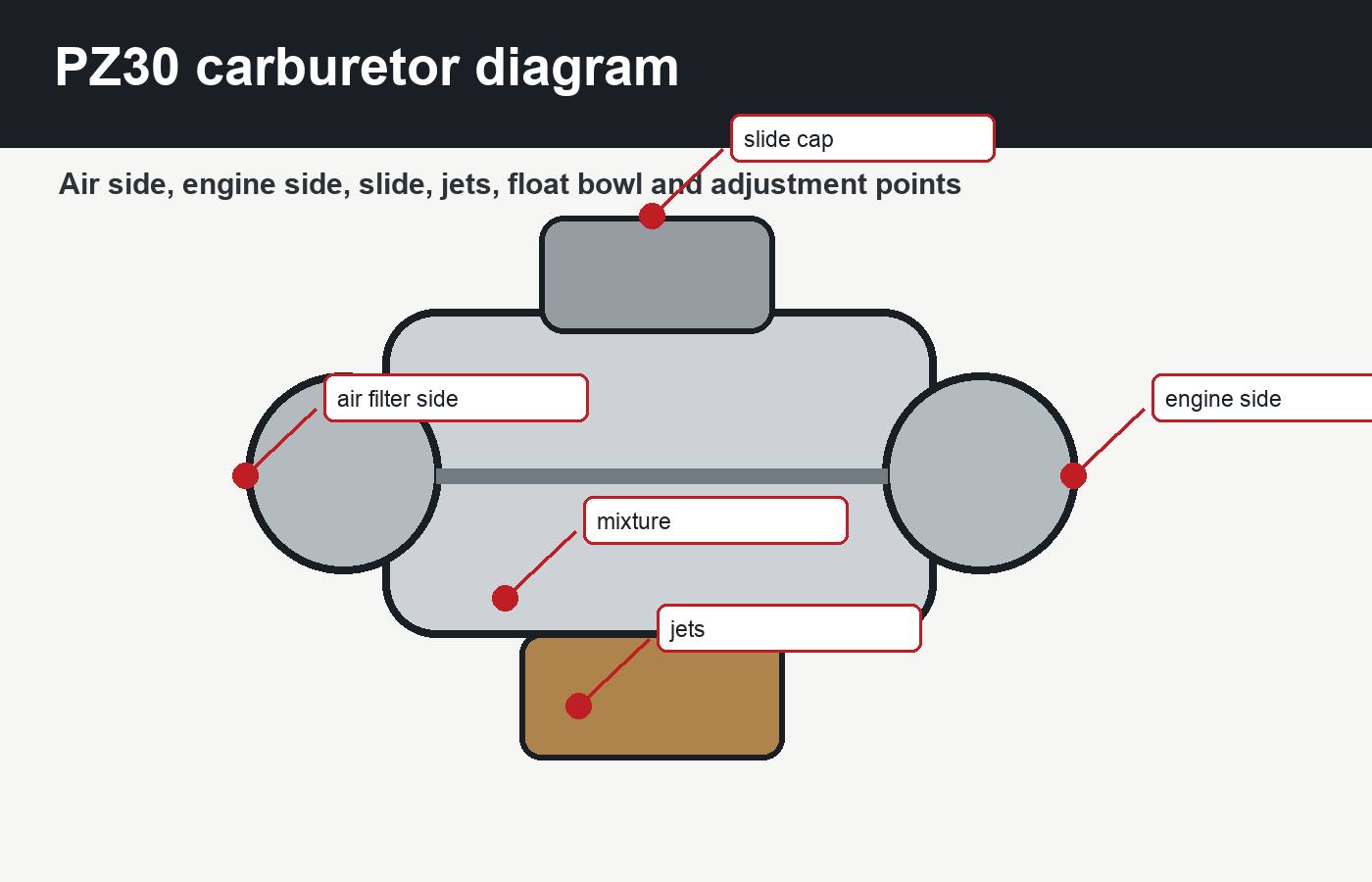
Overall PZ30 carburettor layout
PZ30 carburetor diagram work starts by orienting the carburettor correctly. One side faces the air filter or airbox. The other side faces the intake manifold and engine. The top cap holds the throttle slide, spring, needle and cable. The lower bowl holds fuel and contains the jets and float mechanism. The fuel inlet brings petrol into the bowl. Overflow and drain hoses route excess fuel safely away from hot engine parts.
Many running problems happen because a carburettor is reassembled with the slide turned wrongly, the needle clip misplaced, the float needle dirty, the bowl gasket pinched or a hose routed uphill. A PZ30 carburetor diagram gives you a mental map before the screws come out. Take photos before disassembly, especially if the carburettor has multiple hoses, a manual choke cable or custom intake parts.
For deeper adjustment and neighbouring carb sizes, compare the PZ30 carburetor manual, the PZ27 carburetor adjustment guide and the PZ19 carburetor manual. The PZ30 is larger, but the basic diagnosis sequence remains the same: clean fuel, no air leaks, correct cable return, clear pilot circuit and stable float level.
| Area | Main parts | Common fault |
|---|---|---|
| Top cap | Throttle cable, spring, slide, needle | Slide fitted wrong or cable too tight |
| Air-filter side | Bellmouth, filter mount, air passage | Loose filter or dirt entering engine |
| Engine side | Spigot, manifold seal, mixture outlet | Air leak at rubber or clamp |
| Float bowl | Float, float needle, pilot jet, main jet | Dirt, fuel overflow or blocked jet |
| External screws | Idle screw and mixture screw | Adjusted cold or forced into the seat |
Air-filter side and engine side
PZ30 carburetor diagram orientation matters because the two openings are not the same. The air-filter side is usually the wider, bellmouth-style end. It receives filtered air. The engine side fits the intake manifold and must seal tightly. If the carburettor is pushed into a cracked rubber or clamped at an angle, the engine can draw unmetered air and behave lean no matter how the jets are changed.
Check both diameters before fitting. A PZ30 may be too large for a mild engine or physically wrong for the manifold. A reducer sleeve can work only if it seals and supports the carburettor correctly. Do not leave the carburettor hanging from a soft filter or stretched rubber. Vibration can loosen clamps, crack manifolds and make tuning impossible. A proper PZ30 carburetor diagram should remind you that physical fitment is part of fuel metering.
Air filter and intake sealing
Run the engine with the normal air filter fitted when tuning. A pod filter, open bellmouth or missing airbox changes airflow. Dirt protection also matters. A trail bike that breathes dust through a poor filter may run well for a short time and then lose compression. The carburettor cannot protect the engine if the intake system is careless.
Pilot jet, main jet and float bowl diagram
PZ30 carburetor diagram detail is most useful inside the float bowl. The pilot jet feeds idle and the first small throttle opening. The main jet feeds high-throttle operation through the needle jet area. The float needle controls when fuel enters the bowl. The float height controls fuel level. The drain screw empties the bowl. The overflow hose prevents fuel from spilling directly onto hot parts when something goes wrong.
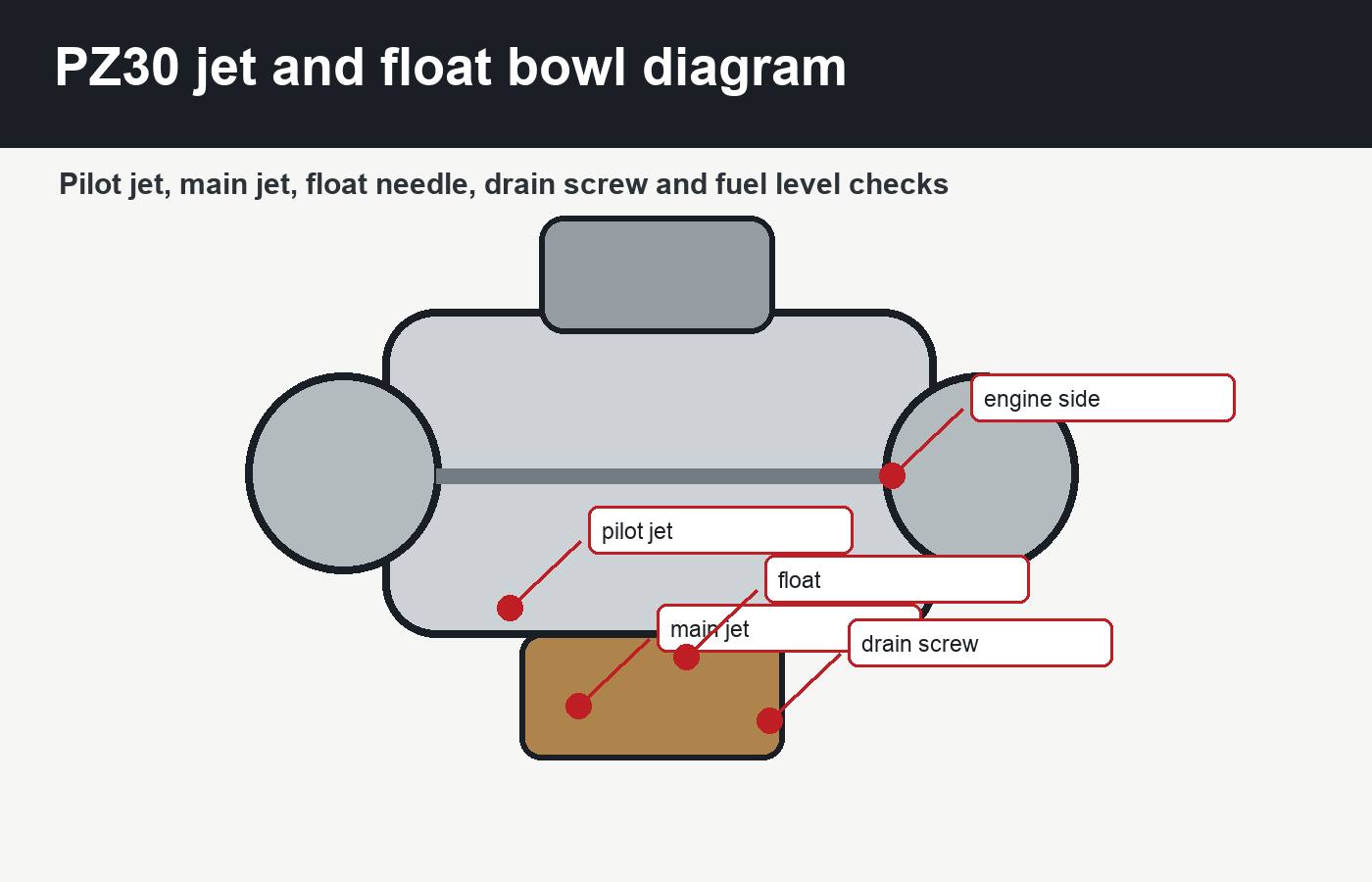
Do not clean jets with steel wire. Brass is soft and the holes are calibrated. Use carburettor cleaner, compressed air and patience. If the pilot jet is blocked with varnish after storage, the bike may only run on choke or may stall as soon as the throttle closes. If the main jet is wrong or blocked, the engine may pull at low speed but flatten at high throttle. A good PZ30 carburetor diagram tells you which jet belongs to which symptom.
Float needle and fuel level
A worn float needle can cause overflow, rich running and fuel smell. Low fuel level can cause high-throttle starvation. A stuck float can make the bike run perfectly one minute and pour fuel the next. Before blaming jet size, inspect the float pivot, needle tip and seat. Fuel level affects every circuit.
Idle screw, mixture screw and throttle cable
PZ30 carburetor diagram confusion often centres on the two external screws. The idle screw usually changes the slide stop, raising or lowering idle speed. The mixture screw trims idle fuelling or idle air depending on its location and carburettor version. A screw on the engine side is often a fuel screw; a screw on the airbox side is often an air screw. The direction of rich and lean change can therefore differ.
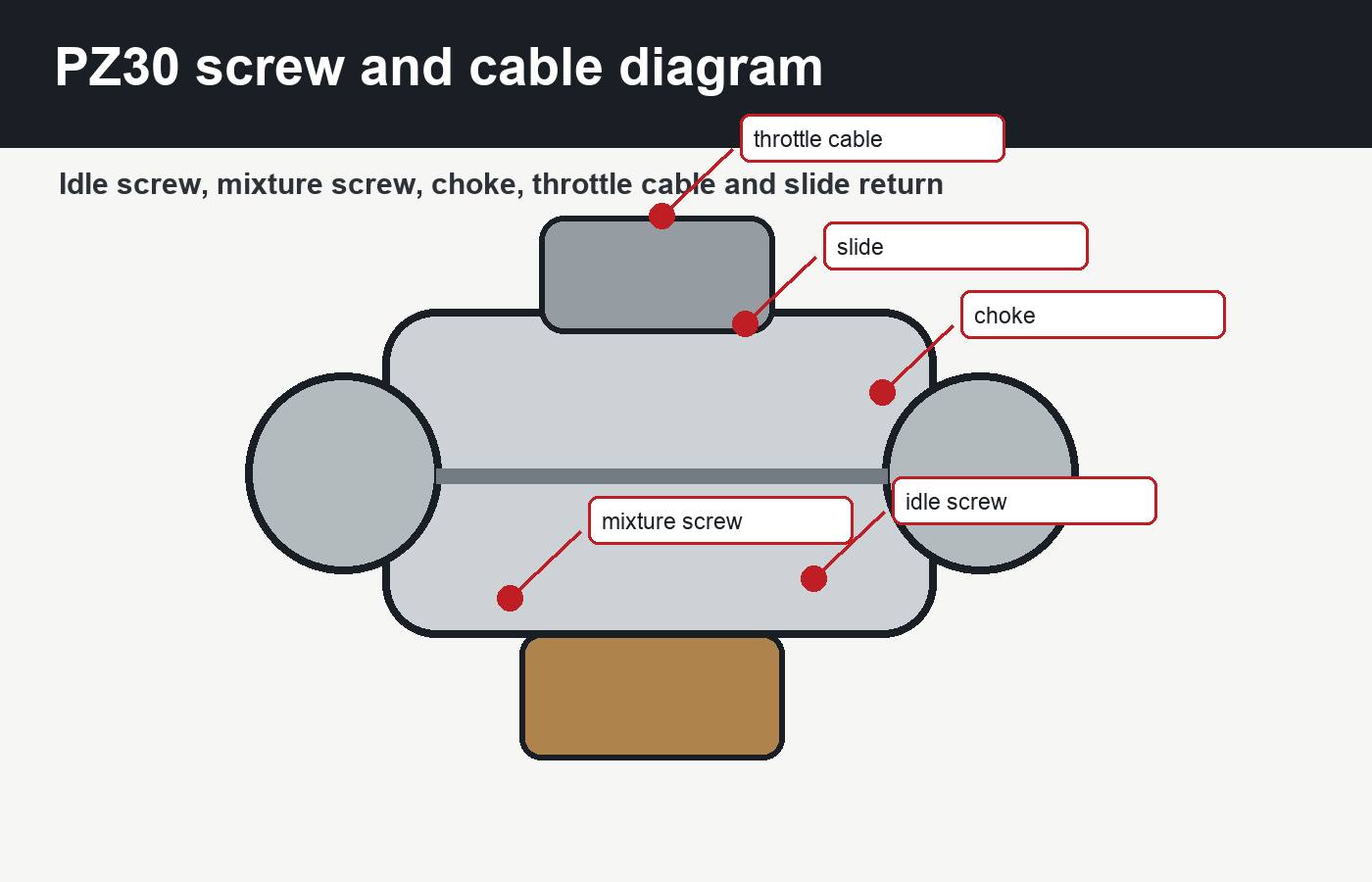
Never force the mixture screw closed. Lightly seat it, count the turns and record the baseline. Warm the engine before final adjustment. Make small changes and wait for the engine to respond. If the idle only works with the screw almost fully closed or far out, the pilot jet, air leak, float height or dirt problem may be outside the screw’s useful range. A PZ30 carburetor diagram is a starting point; diagnosis still requires listening to the engine.
Throttle slide position
The slide must face the correct direction and return freely. If the slide is installed backwards or the cable is too tight, the engine may idle high or rev dangerously. Turn the bars from lock to lock and check that the slide still returns. A stuck throttle is a safety fault, not a tuning detail.
Symptom map by carburettor circuit
PZ30 carburetor diagram troubleshooting should follow throttle position. Idle problems usually live in the pilot circuit, mixture screw, air leaks or slide stop. Mid-throttle problems often involve needle height, needle wear, slide movement or fuel level. Wide-open throttle problems point toward main jet, fuel flow, ignition, exhaust restriction or engine condition.
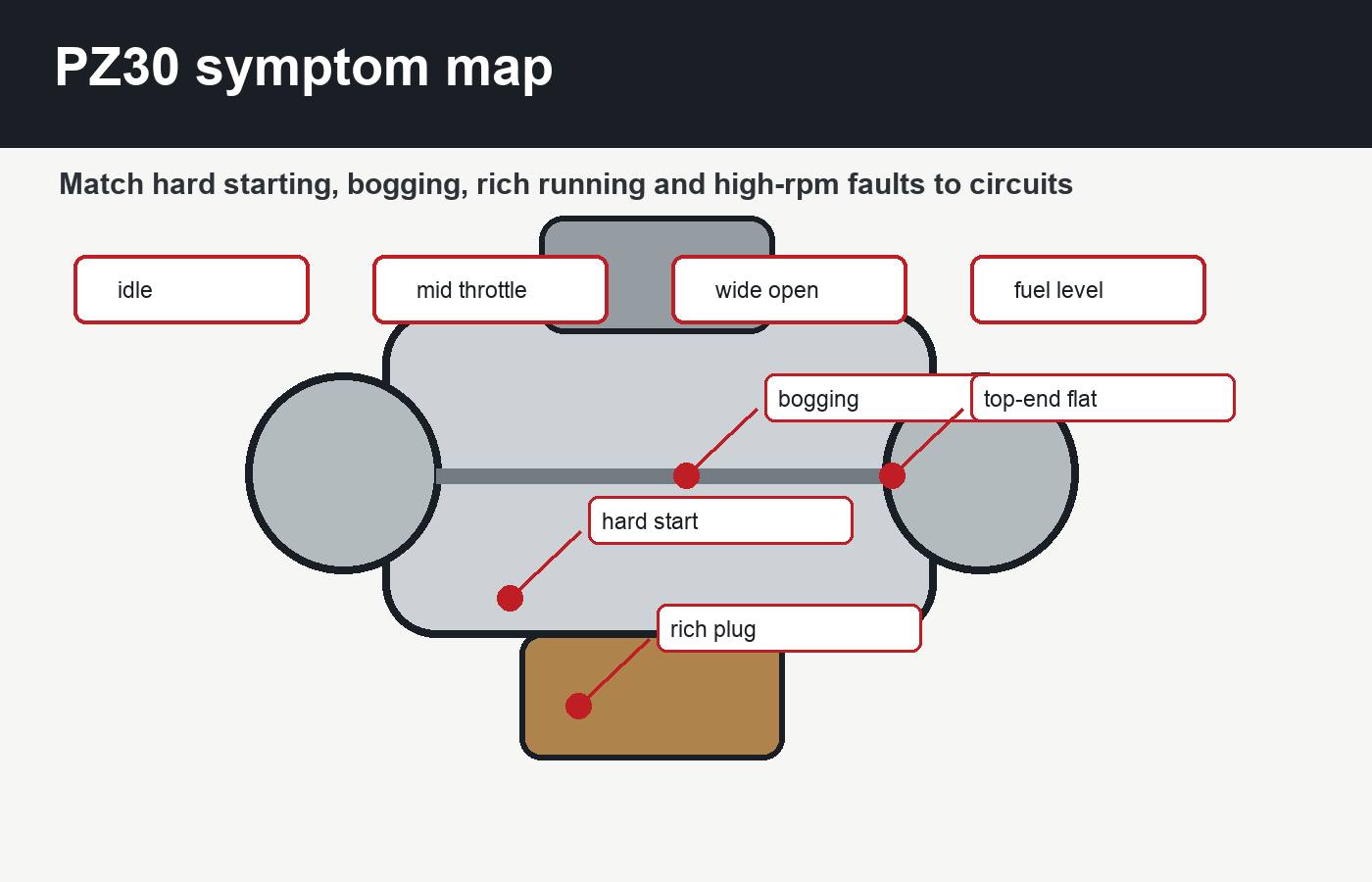
| Symptom | Likely circuit | First practical check |
|---|---|---|
| Only runs on choke | Pilot jet, air leak, fuel flow | Clean pilot jet and inspect manifold |
| Hanging idle | Lean idle, air leak, tight cable | Check cable free play and intake rubber |
| Bogs when throttle opens | Pilot transition or needle | Check slide movement and mixture baseline |
| Rich black plug | Float level, choke, jetting, filter | Check choke closure and float needle |
| Flat at full throttle | Main jet, fuel supply, ignition | Check fuel flow and main jet cleanliness |
| Fuel leaking from hose | Float needle or dirt in seat | Inspect float needle and bowl debris |
Compatibility and fitment checks
PZ30 carburetor diagram information does not mean the PZ30 suits every small engine. It is larger than PZ19 and PZ27 units and usually better suited to engines that can use the airflow. A carburettor that is too large may feel soft at low rpm. A carburettor that is too small may restrict top-end power. The correct choice depends on displacement, cam, intake manifold, exhaust, air filter, compression and riding use.
| Vehicle type | Compatibility | Important note |
|---|---|---|
| 125cc mild engine | Sometimes too large | Low-speed response may suffer if airflow is excessive |
| 140cc to 160cc pit bike | Often possible | Jetting and manifold size must be checked |
| Small ATV or quad | Depends on space and cable route | Check choke access, filter clearance and fuel hoses |
| Custom project | Possible with adaptation | Professional setup may be needed |
| Road motorcycle | Only with suitable legal and mechanical fitment | Emissions, insurance and inspection rules may apply |
When comparing carburettor parts, the X Moto Parts shop and performance parts category can help with the wider upgrade path. Still, measurements from the actual engine matter more than a listing title.
Cleaning and assembly advice
PZ30 carburetor diagram cleaning work should be calm and organised. Work on a clean bench. Photograph the carburettor before dismantling. Remove the float bowl carefully. Keep jets separate. Inspect the bowl for water, rust or varnish. Clean passages with suitable carburettor cleaner and compressed air. Replace damaged gaskets, stripped screws and suspect float needles rather than trying to tune around them.
After assembly, check that the throttle slide returns, the choke closes, the fuel hose is not kinked and the overflow hose is routed safely. Start with a known mixture-screw baseline and warm the engine before final adjustment. If petrol leaks, stop. Fuel leaking near an exhaust or hot engine is a fire risk. For official safety recall checks on road vehicles in the United States, the NHTSA database is a high-authority source: NHTSA recalls. For UK roadworthiness context, the official motorcycle MOT manual is available from GOV.UK.
Road-use and safety notes
PZ30 carburetor diagram advice is often used for off-road bikes and private-land machines, but many carburetted motorcycles are road registered. In the UK, a road bike must remain safe, roadworthy and insured correctly. A carburettor swap that causes fuel leaks, unstable idle, excessive smoke, unsafe throttle return or non-compliant emissions equipment can become a road-use problem. Track-use and private-land setups are different from public-road setups.
In the United States, Canada, Australia, Ireland and New Zealand, rules vary by state, province and vehicle class. If the carburettor change alters emissions equipment or declared specification, check local requirements. A diagram can show where parts are, but it cannot make a road modification legal by itself.
Common mistakes
PZ30 carburetor diagram mistakes usually come from rushing. The first mistake is mixing up air side and engine side measurements. The second is installing the slide the wrong way. The third is cleaning brass jets with wire. The fourth is bending the float tab without measuring fuel level. The fifth is forcing the mixture screw into its seat and damaging the tip.
The sixth mistake is changing the main jet to fix an idle problem. The seventh is ignoring air leaks at the manifold. The eighth is tuning without the normal air filter fitted. The ninth is routing overflow hoses near hot exhaust parts. The tenth is assuming a PZ30 is automatically better than a smaller carburettor. A larger carb only helps when the engine can use it.
| Mistake | What happens | Better method |
|---|---|---|
| Slide fitted wrong | High idle or no proper throttle control | Check slide orientation before starting |
| Wire through jets | Jet size is enlarged accidentally | Use cleaner, air and replacement jets |
| Air leak ignored | False lean symptoms | Inspect manifold rubber and clamps |
| Wrong carb size | Weak low-speed response | Match carb to engine and use |
| No baseline notes | Cannot return to previous setting | Record screw turns and jet sizes |
| Fuel leak tolerated | Fire risk and rich running | Stop and repair before testing |
FAQ
What does a PZ30 carburetor diagram show?
PZ30 carburetor diagram information should show the air-filter side, engine side, throttle slide, needle, pilot jet, main jet, float bowl, float needle, choke, idle screw and mixture screw so the owner knows which part affects each symptom.
Which side of the PZ30 faces the engine?
The engine side is the side that fits the intake manifold and must seal tightly. The air-filter side faces the filter or airbox. A PZ30 carburetor diagram helps prevent mixing up these two ends when measuring.
Where is the pilot jet on a PZ30?
The pilot jet is inside the float bowl area and controls idle and small throttle openings. If the bike only runs with choke, a PZ30 carburetor diagram helps you find the pilot jet and pilot passage before changing main-jet parts.
Where is the main jet on a PZ30?
The main jet is in the float bowl area and affects larger throttle openings. A clean main jet matters for high-throttle running, but it should not be changed to fix a bad idle.
How do I know which screw is the mixture screw?
The mixture screw is usually smaller than the idle stop screw and changes idle fuelling or idle air. Its effect depends on whether it is on the engine side or airbox side. A PZ30 carburetor diagram helps identify it before adjustment.
Can a PZ30 be too big?
Yes. A PZ30 can be too large for a mild small engine, causing weak low-speed response. Carburettor size must match engine displacement, cam, exhaust, intake and riding use.
Why does my PZ30 overflow fuel?
Fuel overflow usually points to dirt on the float needle seat, a worn float needle, stuck float, incorrect fuel level or a blocked overflow arrangement. Do not ride with a fuel leak.
Should I replace jets after cleaning?
Replace jets if they are damaged, enlarged, corroded or impossible to clean. If they are simply dirty, careful cleaning may be enough. Always record jet sizes before changing them, and use a PZ30 carburetor diagram to avoid mixing up pilot and main jets.
Final workshop advice
PZ30 carburetor diagram use is most valuable before disassembly. Identify the air side, engine side, slide cap, cable, choke, mixture screw, idle screw, float bowl, pilot jet, main jet and overflow hoses. Photograph everything, clean gently, inspect for leaks and put the carburettor back with the slide returning freely.
If the bike starts, idles, responds and pulls cleanly after cleaning, the diagram has done its job. If it still runs badly, diagnose by throttle position instead of changing random jets. Idle faults, mid-throttle faults and full-throttle faults come from different circuits. A clear PZ30 carburetor diagram turns the carburettor from a mystery into a set of checks you can repeat.
The best next step after understanding the diagram is controlled adjustment, not guesswork. Use the related PZ30, PZ27 and PZ19 guides above to compare circuit behaviour, and use the performance parts category only after the carburettor size and engine needs are clear. A final look at a PZ30 carburetor diagram before assembly can prevent a simple cleaning job from becoming a repeated tuning session.
{
“@context”: “https://schema.org”,
“@type”: “Article”,
“headline”: “PZ30 carburetor diagram”,
“description”: “PZ30 carburetor diagram guide showing air side, engine side, jets, float bowl, screws, throttle slide, symptoms and safe setup checks.”,
“author”: {
“@type”: “Organization”,
“name”: “X Moto Parts”
},
“publisher”: {
“@type”: “Organization”,
“name”: “X Moto Parts”
},
“mainEntityOfPage”: “https://xmotoparts.com/pz30-carburetor-diagram/”
}
{
“@context”: “https://schema.org”,
“@type”: “FAQPage”,
“mainEntity”: [
{
“@type”: “Question”,
“name”: “What does a PZ30 carburetor diagram show?”,
“acceptedAnswer”: {
“@type”: “Answer”,
“text”: “It should show the air side, engine side, slide, needle, pilot jet, main jet, float bowl, choke, idle screw and mixture screw.”
}
},
{
“@type”: “Question”,
“name”: “Which side of the PZ30 faces the engine?”,
“acceptedAnswer”: {
“@type”: “Answer”,
“text”: “The engine side fits the intake manifold and must seal tightly; the opposite side faces the air filter or airbox.”
}
},
{
“@type”: “Question”,
“name”: “Where is the pilot jet on a PZ30?”,
“acceptedAnswer”: {
“@type”: “Answer”,
“text”: “The pilot jet is inside the float bowl area and controls idle and small throttle openings.”
}
},
{
“@type”: “Question”,
“name”: “Where is the main jet on a PZ30?”,
“acceptedAnswer”: {
“@type”: “Answer”,
“text”: “The main jet is in the float bowl area and affects larger throttle openings.”
}
},
{
“@type”: “Question”,
“name”: “How do I know which screw is the mixture screw?”,
“acceptedAnswer”: {
“@type”: “Answer”,
“text”: “The mixture screw is smaller than the idle stop screw and changes idle fuelling or idle air depending on its location.”
}
},
{
“@type”: “Question”,
“name”: “Can a PZ30 be too big?”,
“acceptedAnswer”: {
“@type”: “Answer”,
“text”: “Yes. A PZ30 can be too large for a mild engine and may reduce low-speed response.”
}
},
{
“@type”: “Question”,
“name”: “Why does my PZ30 overflow fuel?”,
“acceptedAnswer”: {
“@type”: “Answer”,
“text”: “Overflow usually comes from a dirty or worn float needle, stuck float, incorrect fuel level or blocked overflow route.”
}
},
{
“@type”: “Question”,
“name”: “Should I replace jets after cleaning?”,
“acceptedAnswer”: {
“@type”: “Answer”,
“text”: “Replace jets only if they are damaged, enlarged, corroded or impossible to clean properly.”
}
}
]
}