
PZ27 carburetor adjustment
PZ27 carburetor adjustment is one of those jobs that looks simple until the engine starts hunting at idle, bogging when the throttle opens or fouling spark plugs after a short ride. The PZ27 is commonly used on 125cc, 140cc, 150cc and some 160cc small four-stroke engines, especially pit bikes, trail bikes, commuter-style singles, quads and custom projects. It can work very well, but only when the basic engine condition is sound and each circuit of the carburettor is adjusted in the right order.
This guide is written from a practical workshop point of view. It explains how to set a baseline, warm the engine properly, adjust idle speed, set the mixture screw, read the spark plug, understand pilot jet and main jet symptoms, check float height and avoid the mistakes that make a small engine worse. Good PZ27 carburetor adjustment is not about turning screws randomly. It is about listening to the engine, making small changes, recording what changed and knowing when the fault is not the carburettor at all.
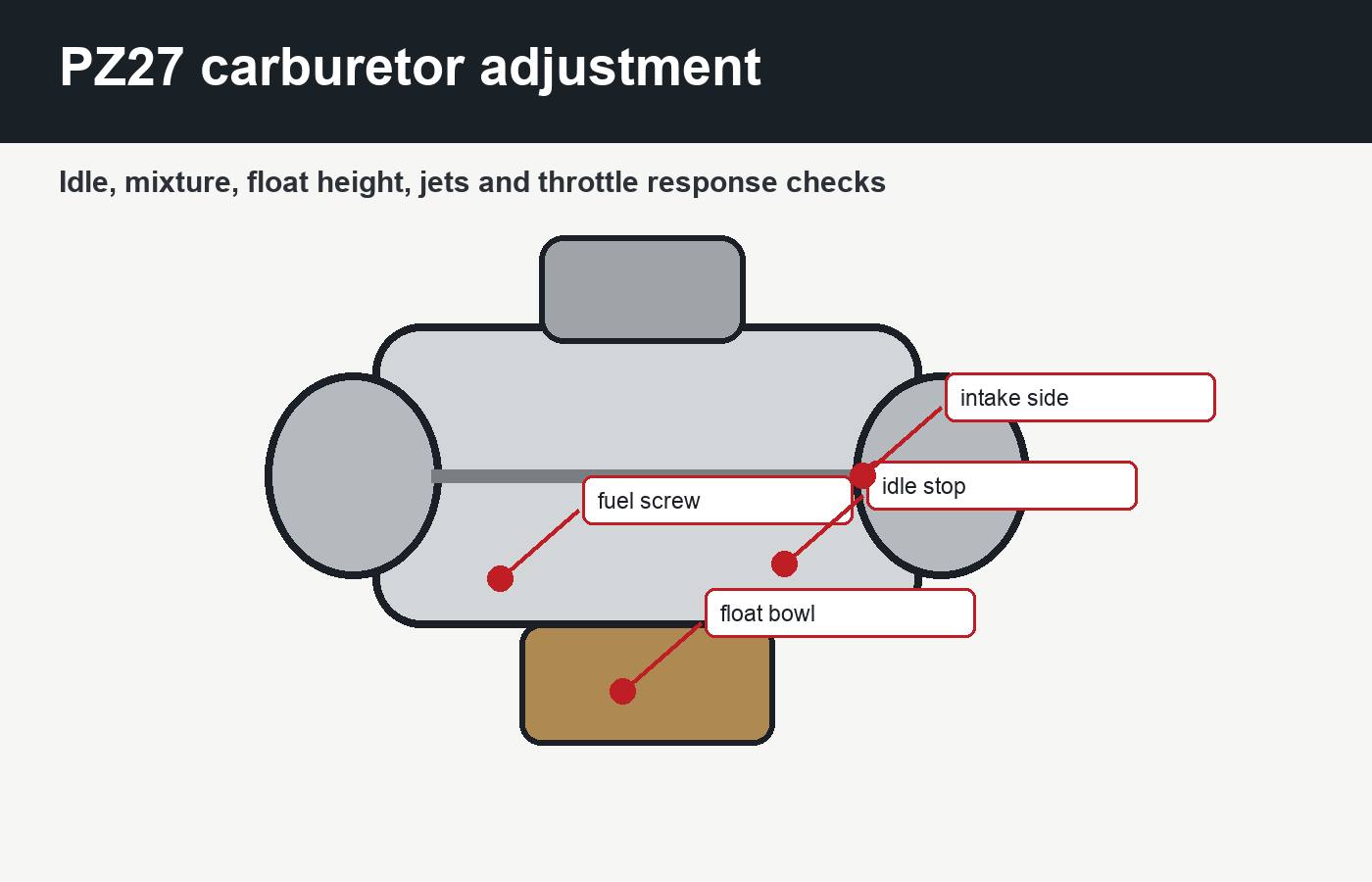
Baseline checks before touching the screws
PZ27 carburetor adjustment should never begin with the mixture screw. Start by confirming that the engine is healthy enough to tune. Check valve clearance history, compression, spark quality, plug cap condition, ignition timing where applicable, fresh petrol, fuel tap flow, air filter condition, intake manifold sealing, exhaust leaks and throttle cable free play. A carburettor cannot compensate for a tight valve, weak spark, dirty fuel or cracked intake rubber.
Cleanliness matters. If the bike has been standing, remove the float bowl and inspect for varnish, water, rust or sediment. A partially blocked pilot jet can make the engine impossible to adjust. A blocked tank vent can mimic lean running after a few minutes. A leaking intake gasket can make tuning feel impossible because the idle changes whenever the engine temperature or vibration changes.
Before adjusting, set a known baseline. Count the mixture screw turns from lightly seated and record it. Do not force the screw into the seat; the tip is delicate. Confirm the throttle slide returns fully and the cable has slight free play. Make sure the choke/enrichment plunger is fully off when warm. Use a clean air filter fitted in its normal housing because tuning without the filter can change the result.
| Check before adjustment | Why it matters | Practical workshop note |
|---|---|---|
| Fresh petrol | Old fuel causes poor starting and weak response | Drain stale fuel before blaming jets |
| Clean pilot jet | The idle circuit depends on a tiny passage | Clean with carb cleaner and air, not steel wire |
| Air filter fitted | Airflow changes mixture strength | Tune with the normal filter and airbox in place |
| No intake leak | Air leaks create false lean symptoms | Inspect rubber, clamps and gasket surfaces |
| Correct plug and spark | Weak ignition mimics fuelling faults | Check plug cap, coil connections and earth |
| Throttle free play | A tight cable holds the slide open | Leave slight free play before setting idle |
For related setup information, compare this article with the PZ27 carburetor manual, the PZ19 carburetor adjustment guide and the PZ30 carburetor manual. The sizes differ, but the discipline is similar: diagnose the symptom, confirm the circuit and make one change at a time.
How the PZ27 fuel circuits work
PZ27 carburetor adjustment becomes easier when you stop thinking of the carb as one single setting. It has overlapping circuits. The pilot jet and mixture screw control idle and the first small opening of the throttle. The needle position affects mid-throttle. The main jet matters most at larger throttle openings. The float height controls fuel level in the bowl, which influences all circuits. The choke or enrichment system helps cold starting but should not be used to hide poor warm settings.
If the engine only misbehaves at idle, do not immediately change the main jet. If it runs clean at idle but bogs when the throttle is snapped open, look at pilot transition, needle, slide response, air leaks and accelerator behaviour if the exact carb version has that feature. If it pulls cleanly at low and mid-throttle but flattens at high rpm, the main jet, fuel flow, ignition and exhaust restriction become more relevant. Careful PZ27 carburetor adjustment separates where the problem happens before touching parts.
Idle, off-idle and low-speed response
The pilot circuit is responsible for starting, idle stability, small throttle response and the first part of acceleration. A blocked pilot jet makes the bike hard to start without choke, reluctant to idle and weak just off idle. A pilot circuit that is too rich can make the engine lumpy, smoky, plug-fouling and slow to clean up. A correct low-speed setting gives a steady idle, crisp pick-up and no hanging rpm.
Mid-throttle and needle behaviour
The needle meters fuel as the slide lifts. Clip position changes how soon fuel is added. Raising the needle generally richens mid-throttle; lowering it generally leans mid-throttle. Do not move the needle to fix a blocked pilot jet or a wrong float level. When carb setup is done properly, needle changes come after the idle circuit and fuel level are known to be correct.
Idle and mixture screw adjustment
PZ27 carburetor adjustment at idle should be done with the engine fully warm. Start the motorcycle, let it reach normal temperature and make sure the choke is fully off. Set a slightly fast idle with the idle stop screw so the engine runs without stalling. Then turn the mixture screw in small increments, usually about one eighth to one quarter turn at a time. Wait a few seconds after each movement because the engine needs time to respond.
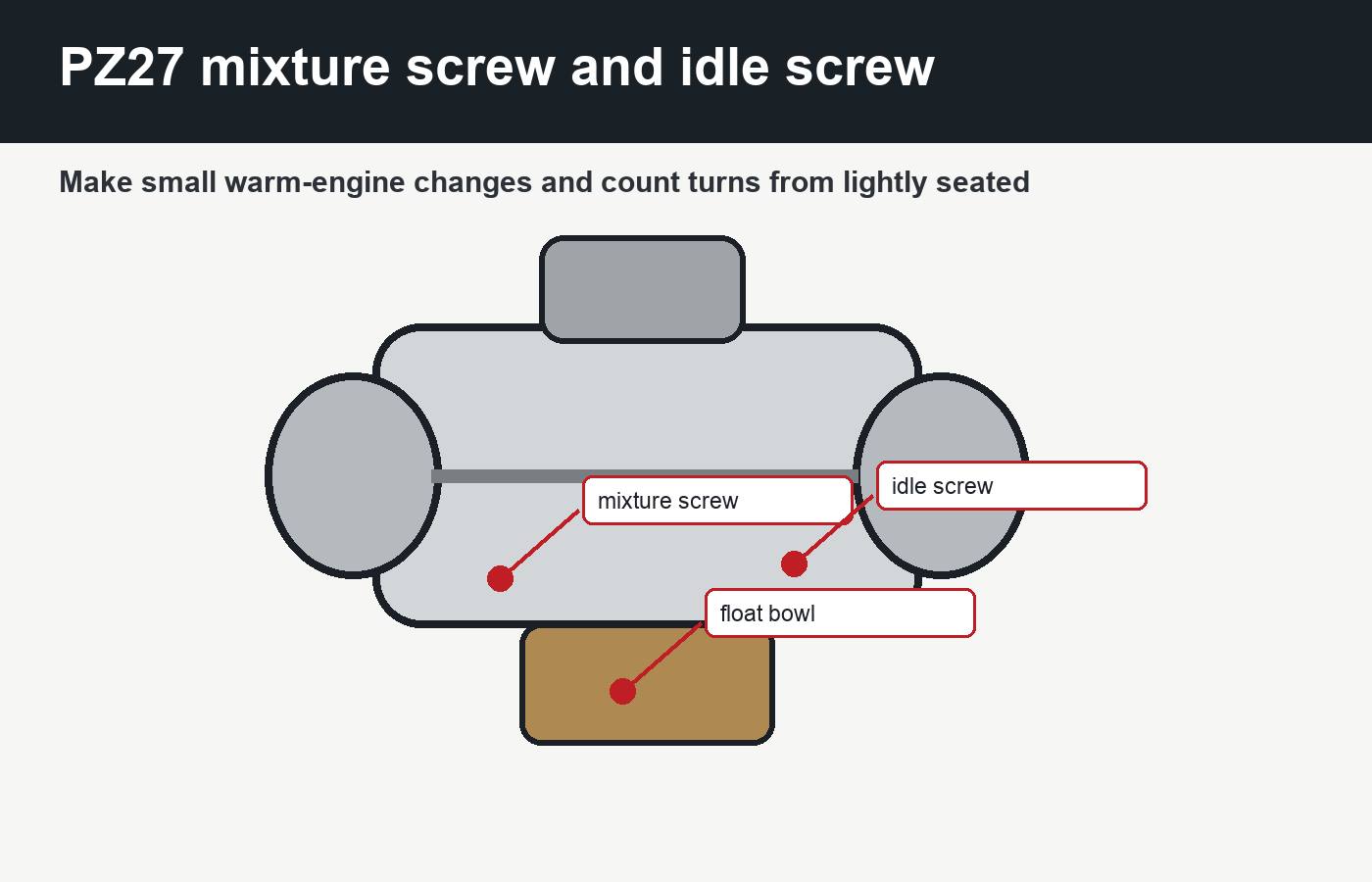
Many PZ-style carburettors use a fuel screw on the engine side of the carburettor. Turning a fuel screw out usually richens the idle mixture; turning it in usually leans it. If your exact carburettor has an air screw on the airbox side, the logic can be opposite. This is why blind advice from a forum can be dangerous. Identify the screw location before adjusting. Good PZ27 carburetor adjustment starts by understanding which screw you are actually turning.
Find the setting where idle speed is highest and smoothest, then use the idle stop screw to bring rpm back down. Blip the throttle. The engine should return to idle cleanly without hanging high and without dropping so low that it stalls. If the best setting is almost fully closed or very far out, the pilot jet may be the wrong size, the pilot circuit may be dirty or there may be an air leak.
Symptoms of a lean idle setting
A lean idle may cause hanging rpm, hesitation when the throttle is opened, popping through the intake, needing choke when warm or an idle that changes as the engine heats. Do not keep leaning the mixture because the plug looks dark after repeated cold starts. Warm running behaviour matters. Judge the final setting after the engine is hot and ridden normally.
Symptoms of a rich idle setting
A rich idle may cause a dull exhaust note, plug fouling, black smoke, fuel smell, rough idle and a slow response when the throttle is opened. If the engine only runs well with the mixture screw nearly closed, the pilot jet may be too large or the float level may be too high. Check fuel level before assuming the screw can fix everything.
Pilot jet, needle and main jet symptoms
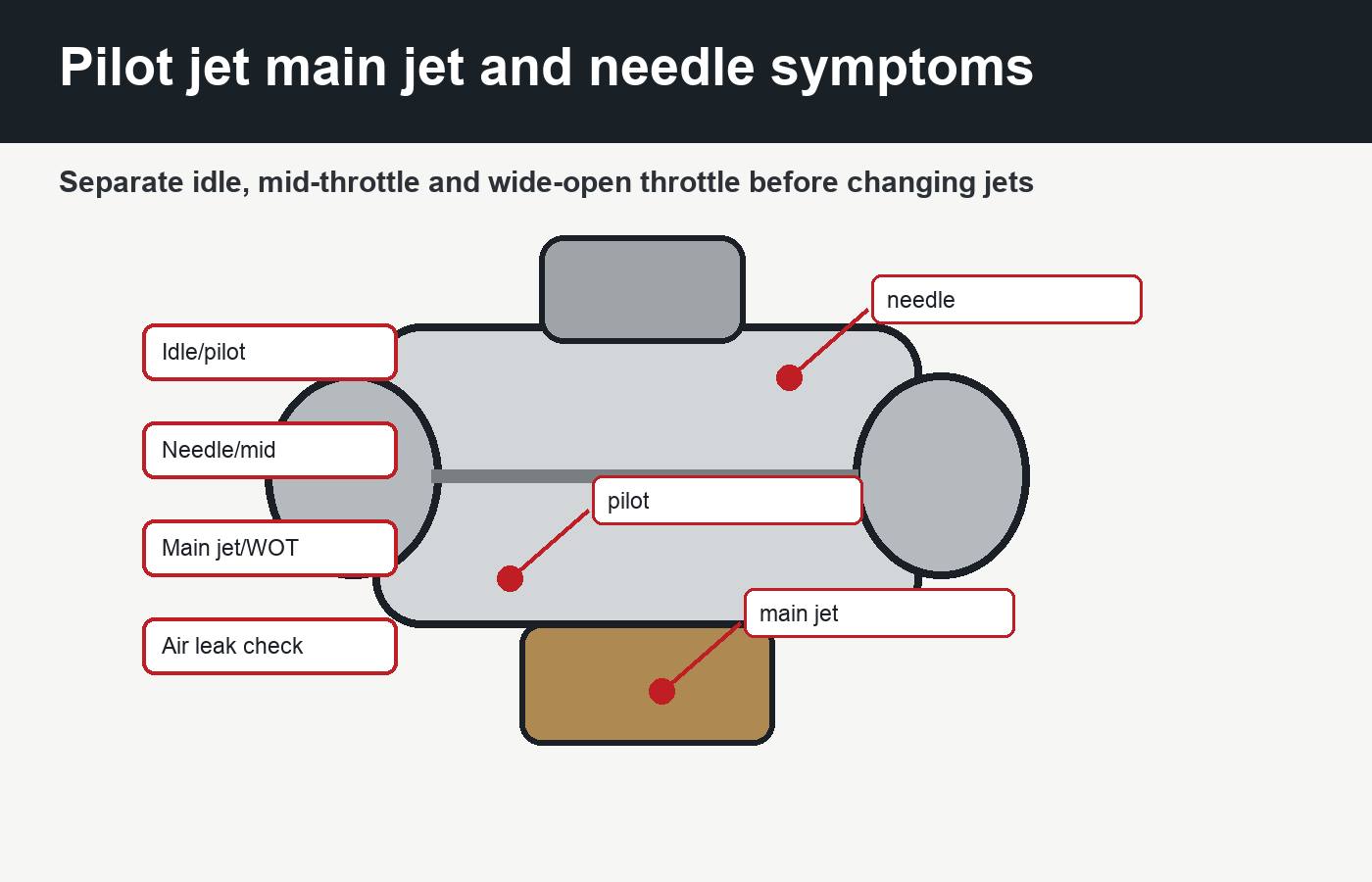
PZ27 carburetor adjustment sometimes reaches the limit of screw tuning. If the mixture screw cannot produce a clean idle within a sensible range, jetting needs attention. A pilot jet controls low-speed fuelling. The needle controls the middle. The main jet controls high-throttle fuelling. Changing the main jet to cure a bad idle is a common mistake. Changing the pilot jet to cure full-throttle weakness is another.
Work by throttle position, not by road speed alone. A bike climbing a hill at half throttle is asking different things from the carburettor than a bike cruising lightly at the same speed. Mark the throttle grip if needed: closed, one quarter, half, three quarters and wide open. That simple workshop trick makes PZ27 carburetor adjustment much less vague because the rider can report where the symptom happens.
| Throttle area | Main carburettor part | Typical symptom if wrong | First check |
|---|---|---|---|
| Idle to small opening | Pilot jet and mixture screw | Stalling, hanging idle, off-idle bog | Clean pilot jet and check intake leaks |
| Quarter to half throttle | Needle and needle jet | Flat mid-range, surging, rich blubbering | Check clip position and slide movement |
| Three-quarter to wide open | Main jet | Weak top-end, overheating, rich misfire | Check fuel flow and plug reading |
| All throttle positions | Float height and fuel supply | Random rich/lean behaviour | Inspect float valve, fuel level and tank vent |
| Cold start only | Choke/enrichment circuit | Hard cold start or over-rich start | Check plunger, cable and sealing |
Float height and fuel level checks
PZ27 carburetor adjustment can be ruined by the wrong float height. If the fuel level is too high, the engine may run rich, drip fuel, foul plugs or hesitate after bumps. If the fuel level is too low, the engine may starve under load, hesitate at high throttle or die after a long pull. The mixture screw cannot correct a float bowl that is physically overfilled or underfilled.
Inspect the float needle tip, seat cleanliness and float movement. Make sure the float does not rub the bowl or stick on its pivot. If the carburettor has overflow hoses, route them correctly and keep them clear. A blocked overflow or vent hose can cause strange running. For accurate tuning, fuel must enter and vent predictably before any jet choice makes sense.
Fuel flow from the tank
Open the fuel tap and confirm steady flow into a container. Check inline filters, hose kinks and tank cap venting. A partially blocked filter may flow enough at idle and not enough under load. A blocked cap vent can let the bike run for several minutes before it fades. This is one of the most common reasons owners change jets repeatedly without solving the real fault.
Compatibility and fitment table
PZ27 carburetor adjustment assumes the PZ27 is actually suitable for the engine. A carburettor that is too large can reduce low-speed response. A carburettor that is too small can restrict top-end power. The intake manifold diameter, air filter arrangement, throttle cable end, choke style, fuel hose, clearance under the frame and engine displacement all matter. PZ27 is common, but common does not mean universal.
| Vehicle type | Compatibility | Important note |
|---|---|---|
| 125cc four-stroke pit bike | Often possible | Check intake manifold, cable end, air filter and jet baseline |
| 140cc or 150cc trail bike | Commonly suitable | Jetting may differ with exhaust and airbox changes |
| Small ATV or quad | Depends on space and cable route | Confirm choke access, filter clearance and fuel hose routing |
| Road commuter motorcycle | Only if model-specific fitment works | Road legality, emissions equipment and insurance must be considered |
| Custom engine swap | Possible with adaptation | Professional setup may be needed for manifold and jetting |
| Two-stroke engine | Usually not appropriate | Use a carburettor designed and jetted for the two-stroke application |
When buying related parts, measure the inlet spigot, air-filter side diameter and cable arrangement before ordering. The X Moto Parts shop and performance parts category are useful places to compare upgrade paths, but the physical engine and manifold decide whether a part really belongs on the bike.
Road test and spark plug reading
PZ27 carburetor adjustment should be confirmed under load. A bike can sound perfect on a stand and behave badly on the road or track. Warm the engine, ride gently, then test steady low throttle, clean mid-throttle roll-on and short high-throttle pulls where safe and legal. Do not run long wide-open tests on a fresh or uncertain setup. Listen for hesitation, knocking, flat spots, misfire, fuel smell and engine heat.
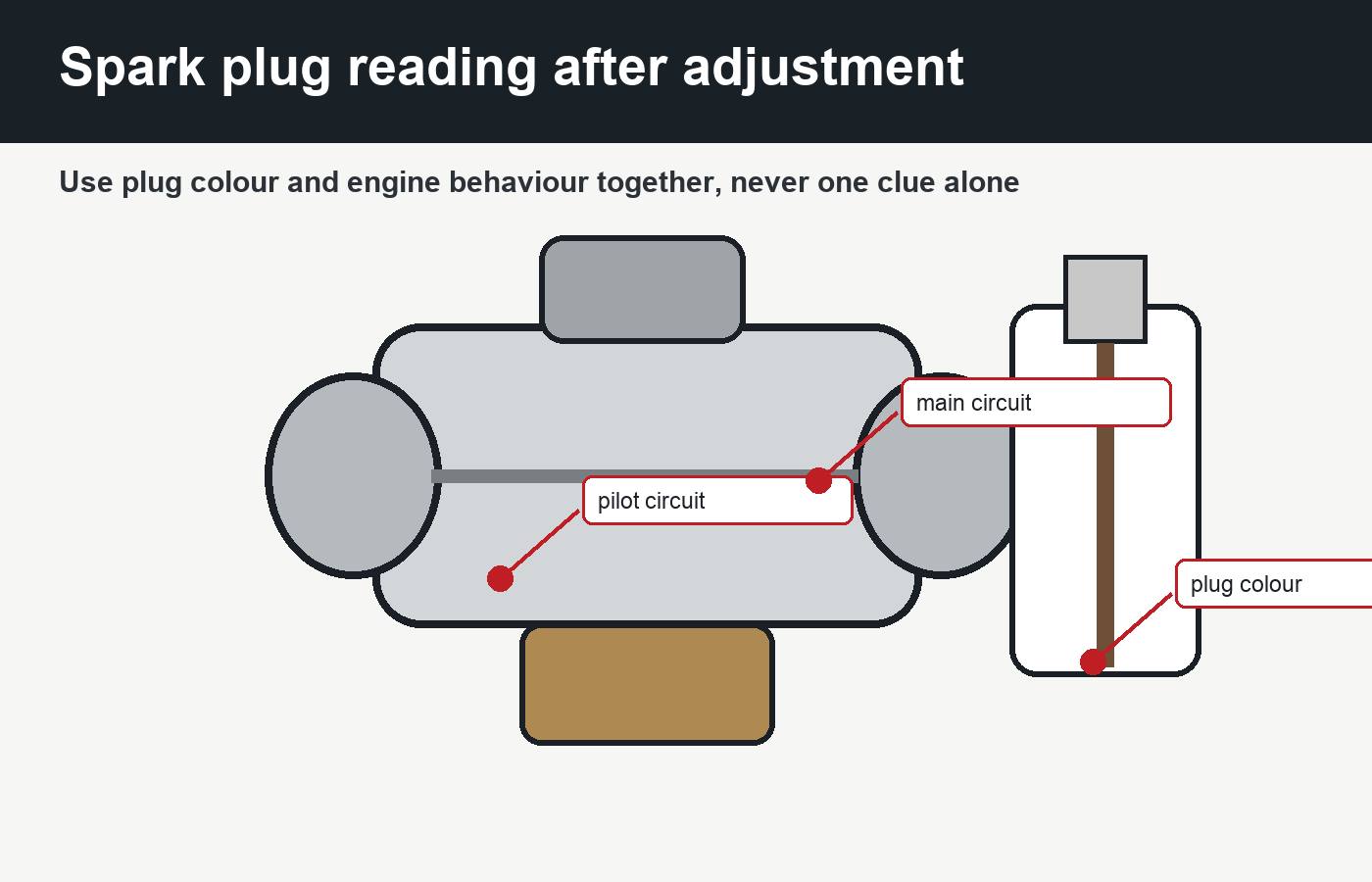
Spark plug reading is useful, but it is not magic. Repeated cold starts can make a plug look darker than the real running mixture. Long idling can hide high-throttle leanness. Modern fuels can leave different colours from older tuning charts. NGK’s technical spark plug guidance is a useful authoritative reference for understanding plug condition, heat range and deposits; see NGK technical spark plug information. Use plug evidence alongside temperature, throttle response and engine sound.
For wider roadworthiness context in the UK, the official motorcycle MOT inspection manual explains how testers assess items such as exhaust condition, smoke and general defects. It is not a carb tuning manual, but it reminds owners that road bikes must remain safe and suitable for public roads. See the relevant GOV.UK motorcycle MOT manual section at GOV.UK. Sensible PZ27 carburetor adjustment should not create excessive smoke, unstable idle or unsafe throttle response.
UK and anglophone road-use notes
PZ27 carburetor adjustment is often performed on off-road bikes, pit bikes and private-land machines, but some PZ-equipped vehicles are used on public roads. The legal context changes with the country, vehicle registration, emissions equipment and inspection requirements. In the UK, a road motorcycle must remain roadworthy, insured as modified where relevant and capable of passing inspection requirements. Removing emissions equipment or creating excessive smoke can cause problems.
In the United States, Canada, Australia, New Zealand and Ireland, rules can vary by state, province or vehicle class. A carburettor change that is acceptable on a competition pit bike may not be acceptable on a road-registered motorcycle. Track-use-only, off-road-use-only and private-land machines are different from road vehicles. If the adjustment follows an exhaust, airbox or engine change, check the local rules before assuming the setup is road legal.
Common mistakes
PZ27 carburetor adjustment goes wrong when owners skip the boring checks. The first mistake is adjusting a dirty carburettor. The second is tuning with the choke partly on. The third is turning the mixture screw without counting the starting point. The fourth is using a screwdriver that damages the screw head. The fifth is forcing jets with wire and enlarging them by accident.
The sixth mistake is treating every bog as a lean problem. A rich bog can feel similar to a lean hesitation until you test carefully. The seventh is changing three things at once: pilot jet, needle clip and main jet in one session. The eighth is tuning without the air filter fitted. The ninth is ignoring valve clearance and ignition faults. The tenth is assuming internet jet numbers match your engine, exhaust, altitude, fuel and airbox.
| Mistake | What it causes | Better method |
|---|---|---|
| Adjusting cold | Settings become wrong when hot | Warm the engine fully before final tuning |
| No baseline count | You cannot return to the old setting | Record screw turns from lightly seated |
| Wrong circuit diagnosis | Jet changes do not fix the symptom | Identify throttle position first |
| Dirty pilot jet | Unstable idle and poor response | Clean passages before tuning |
| Ignoring intake leaks | False lean condition | Inspect manifold rubber and clamps |
| Over-tightening bowl screws | Damaged threads and leaks | Use correct tools and light, even pressure |
FAQ
What is the basic starting point for PZ27 carburetor adjustment?
PZ27 carburetor adjustment normally starts by lightly seating the mixture screw, backing it out to a sensible baseline, warming the engine, setting idle speed and then finding the smoothest mixture position. The exact number of turns can vary by carb version, engine, jetting and screw type, so record the original setting before changing it.
Why does my PZ27 carburettor only run with the choke on?
If the engine only runs with choke, it is often too lean at idle or the pilot circuit is blocked. Check the pilot jet, intake leaks, fuel flow and mixture setting. Poor PZ27 carburetor adjustment can cause this, but dirt or an air leak is very often the real reason.
How do I know if the PZ27 pilot jet is too small?
A pilot jet that is too small can cause hard starting, hanging idle, off-idle hesitation and a need for choke when warm. Before changing jet size, clean the jet and inspect for air leaks. PZ27 carburetor adjustment should always separate a wrong jet from a blocked jet.
How do I know if the PZ27 carburettor is too rich?
Rich running can cause black smoke, fuel smell, dull throttle response, plug fouling and a heavy exhaust note. It can come from an over-large pilot jet, high float level, dirty air filter, choke not closing or wrong needle position. A careful PZ27 carburetor adjustment checks each cause instead of guessing.
Should I change the main jet first?
No. Change the main jet only when the problem appears at large throttle openings and after fuel flow, ignition and float level are checked. If the bike will not idle properly, start with pilot circuit and mixture checks. That keeps the process logical.
Can a PZ27 carburettor work on a 125cc engine?
It can work on many 125cc four-stroke engines, but compatibility depends on intake size, cam, exhaust, airbox, riding use and jetting. A large carb can weaken low-speed response if the engine cannot use the airflow. PZ27 carburetor adjustment works best when the carb size suits the engine.
Why does the idle hang after I blip the throttle?
Hanging idle often points to a lean condition, intake leak, tight throttle cable, slide not closing or mixture setting too lean. Check mechanical return and air leaks before opening the carb again. PZ27 carburetor adjustment should not be used to hide a cable or manifold fault.
Do I need a mechanic for carb adjustment?
A careful owner can perform basic warm idle and mixture checks, but a mechanic is sensible if the engine has compression issues, damaged screws, leaking fuel, uncertain jetting, road-use legality questions or repeated plug fouling. Professional help is cheaper than engine damage caused by unsafe carburettor tuning.
Final workshop advice
PZ27 carburetor adjustment should be calm, measured and reversible. Start with the engine’s health, clean the carburettor, check for air leaks, confirm fuel flow, set a warm idle, adjust the mixture in small steps and test by throttle position. Record every change. If a setting improves one area and ruins another, do not keep turning screws; identify which circuit is responsible.
The best setup is not always the richest, loudest or most aggressive one. A good small-engine carburettor setting starts easily, idles without drama, pulls cleanly from low rpm, responds smoothly in the mid-range and does not overheat, smoke or foul plugs. Use plug readings, road behaviour and mechanical checks together. For riders comparing broader tuning parts after the carburettor is correct, the performance parts category is the logical next stop, but the engine should be running cleanly before any upgrade is judged.
If you remember only one thing, make it this: PZ27 carburetor adjustment is a sequence, not a single screw position. Clean first, baseline second, warm adjustment third, circuit diagnosis fourth and road testing last. That order saves parts, prevents frustration and keeps the engine safer.
{
“@context”: “https://schema.org”,
“@type”: “Article”,
“headline”: “PZ27 carburetor adjustment”,
“description”: “PZ27 carburetor adjustment guide for idle mixture, pilot jet, needle, main jet, float height, plug reading and safe small-engine tuning.”,
“author”: {
“@type”: “Organization”,
“name”: “X Moto Parts”
},
“publisher”: {
“@type”: “Organization”,
“name”: “X Moto Parts”
},
“mainEntityOfPage”: “https://xmotoparts.com/pz27-carburetor-adjustment/”
}
{
“@context”: “https://schema.org”,
“@type”: “FAQPage”,
“mainEntity”: [
{
“@type”: “Question”,
“name”: “What is the basic starting point for PZ27 carburetor adjustment?”,
“acceptedAnswer”: {
“@type”: “Answer”,
“text”: “Start from a recorded mixture screw baseline, warm the engine, set a stable idle and adjust the mixture in small steps until idle and throttle return are clean.”
}
},
{
“@type”: “Question”,
“name”: “Why does my PZ27 carburettor only run with the choke on?”,
“acceptedAnswer”: {
“@type”: “Answer”,
“text”: “It often means the pilot circuit is blocked, the idle setting is too lean, fuel flow is poor or there is an intake air leak.”
}
},
{
“@type”: “Question”,
“name”: “How do I know if the PZ27 pilot jet is too small?”,
“acceptedAnswer”: {
“@type”: “Answer”,
“text”: “Hard starting, hanging idle, off-idle hesitation and needing choke when warm can point to a small or blocked pilot jet.”
}
},
{
“@type”: “Question”,
“name”: “How do I know if the PZ27 carburettor is too rich?”,
“acceptedAnswer”: {
“@type”: “Answer”,
“text”: “Rich symptoms include black smoke, fuel smell, plug fouling, dull response and a heavy exhaust note.”
}
},
{
“@type”: “Question”,
“name”: “Should I change the main jet first?”,
“acceptedAnswer”: {
“@type”: “Answer”,
“text”: “No. The main jet should be changed only for large-throttle symptoms after idle circuit, fuel level, air leaks and ignition have been checked.”
}
},
{
“@type”: “Question”,
“name”: “Can a PZ27 carburettor work on a 125cc engine?”,
“acceptedAnswer”: {
“@type”: “Answer”,
“text”: “It can work on many 125cc four-stroke engines, but intake size, exhaust, airbox, cam and jetting decide whether it is appropriate.”
}
},
{
“@type”: “Question”,
“name”: “Why does the idle hang after I blip the throttle?”,
“acceptedAnswer”: {
“@type”: “Answer”,
“text”: “A hanging idle may come from a lean setting, intake leak, tight throttle cable, sticking slide or incorrect pilot circuit setup.”
}
},
{
“@type”: “Question”,
“name”: “Do I need a mechanic for carb adjustment?”,
“acceptedAnswer”: {
“@type”: “Answer”,
“text”: “Basic idle adjustment is manageable for careful owners, but damaged screws, fuel leaks, uncertain jetting, road-use concerns or repeated fouling justify mechanic support.”
}
}
]
}