
PZ19 carburetor manual
PZ19 carburetor manual is a useful reference for riders and mechanics working on small four-stroke motorcycles, pit bikes, mini quads, horizontal-engine projects and simple commuter engines that use a compact slide carburettor. The PZ19 is smaller than a PZ27 or PZ30, so it is usually chosen for lower-capacity engines where clean starting, stable idle and smooth low-speed response matter more than maximum airflow. It can be reliable, but only if it is fitted, cleaned and adjusted with a little patience.
This guide explains the carburettor layout, the main parts, compatibility checks, fuel-hose routing, throttle cable setup, choke operation, cleaning method, idle setting, mixture adjustment, jet symptoms, float bowl checks and common problems. A good PZ19 carburetor manual should help the owner understand what each part does before turning screws or buying jets. Most running issues on a small engine come from dirt, air leaks, stale petrol, wrong cable setup, poor spark or a carburettor that is simply the wrong size for the engine.
What the PZ19 carburettor is used for
PZ19 carburetor manual information is most useful on small-capacity four-stroke engines, commonly around 50cc, 70cc, 90cc, 110cc and some mild 125cc applications depending on the engine, intake and riding use. A PZ19 is often seen on pit bikes, dirt bikes, monkey-bike style builds, small ATVs and simple learner or field bikes. It is not a magic performance part. It is a simple mechanical fuel-metering device that must match the engine’s airflow demand.
A carburettor that is too small can limit high-rpm breathing, while a carburettor that is too large can make low-speed response lazy. On small engines, throttle response and easy starting are often more important than peak power. That is why a properly fitted PZ19 can feel better than a larger carburettor on a small engine used for trail riding, paddock riding or short urban journeys. The point of a PZ19 carburetor manual is to make the basic system understandable before tuning choices become confusing.
For neighbouring carb sizes and more adjustment detail, use the PZ19 carburetor adjustment guide, the PZ27 carburetor manual and the PZ27 carburetor adjustment guide. Those internal guides are useful when comparing symptoms across pilot jets, mixture screws, needle position and float height.
Main parts and what they do
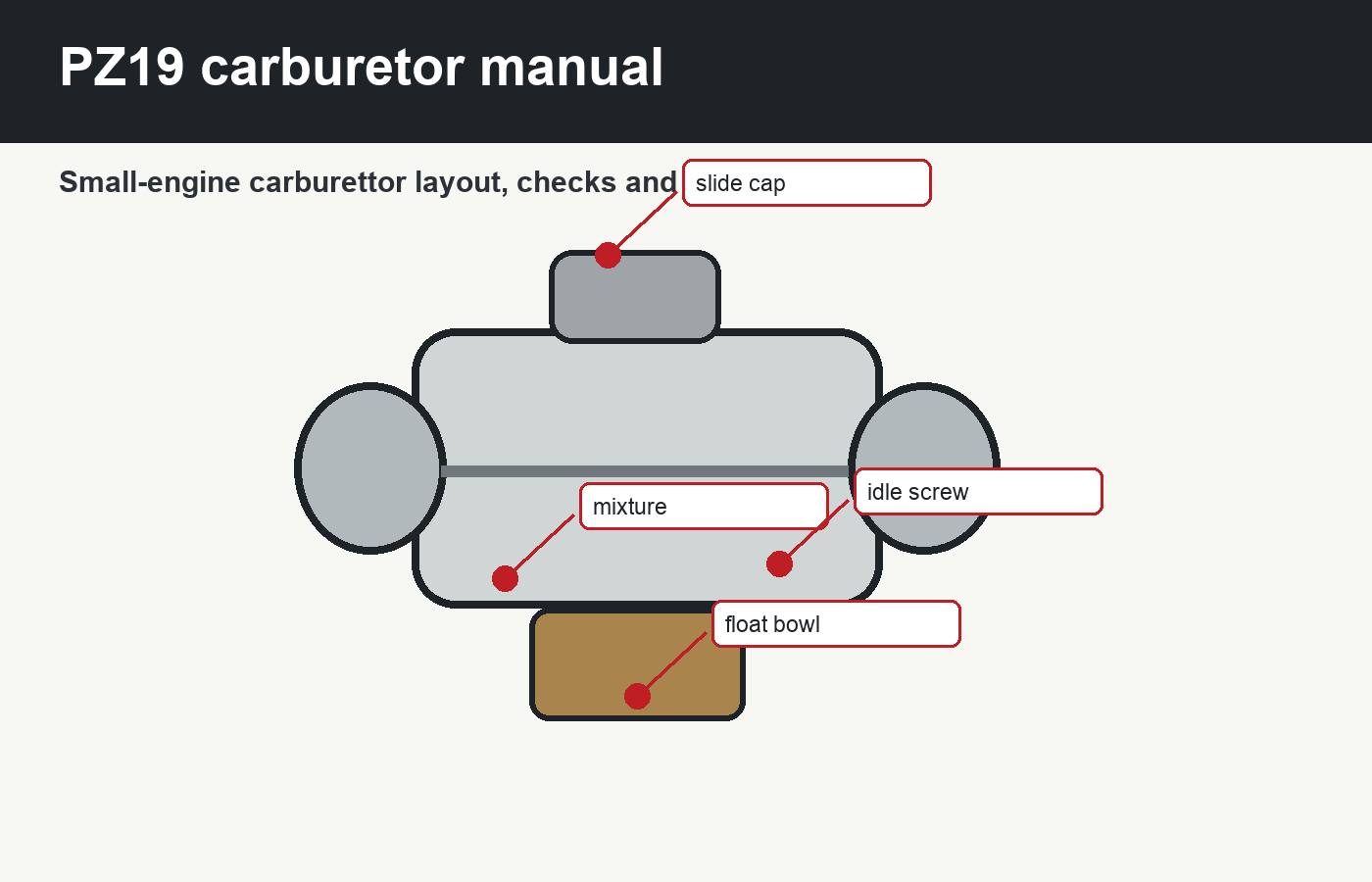
PZ19 carburetor manual diagnosis begins with the parts. The throttle slide opens and closes the air passage. The needle moves with the slide and meters fuel through the needle jet. The pilot jet controls idle and the first throttle opening. The main jet controls larger throttle openings. The float and float needle control fuel level in the bowl. The choke or enrichment circuit helps cold starting. The idle screw holds the slide slightly open. The mixture screw trims idle fuelling or idle air, depending on the exact screw position and carb version.
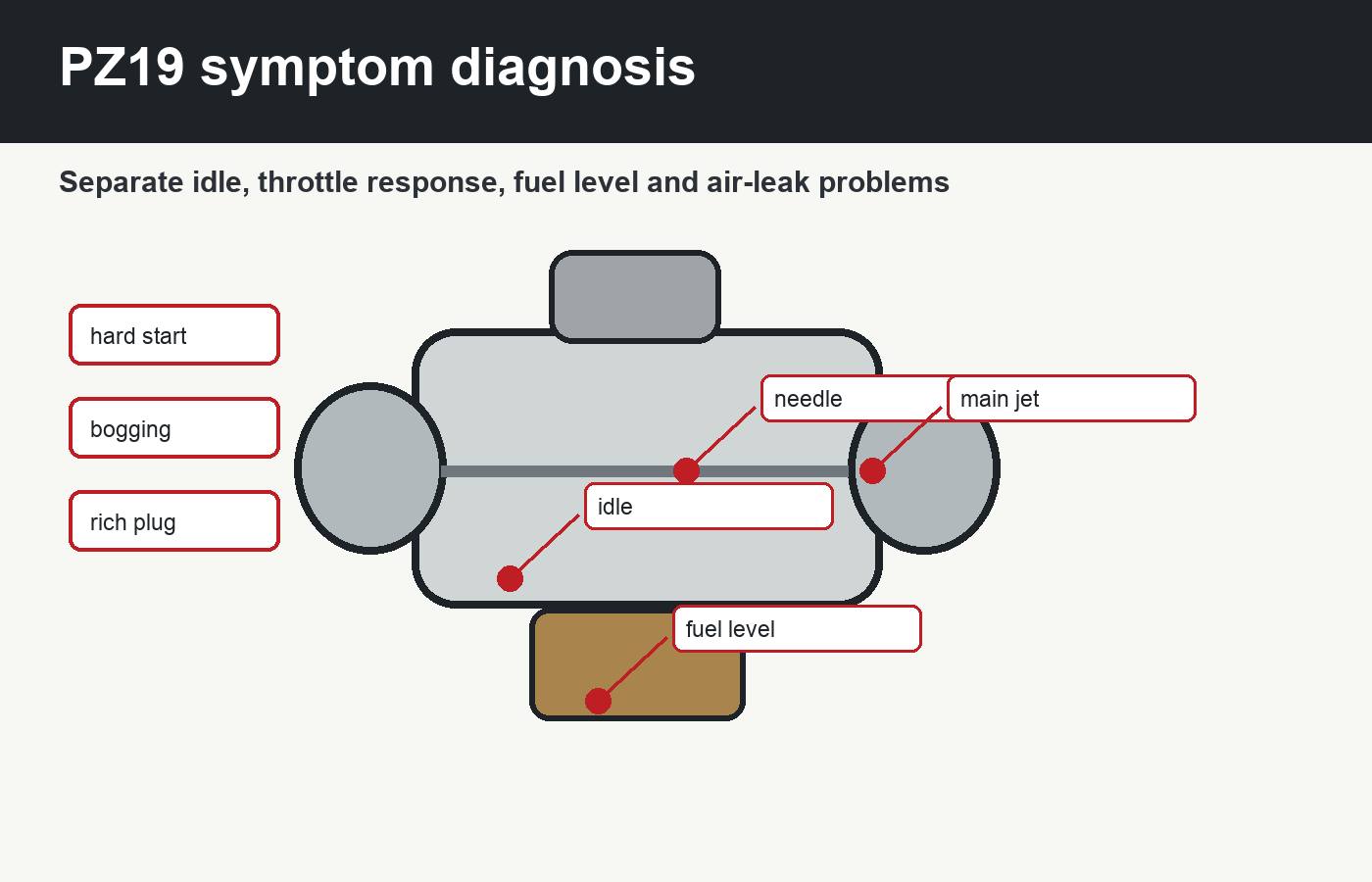
Each circuit overlaps the next. The engine does not switch from pilot jet to needle to main jet like an electric switch; the change is gradual. That is why a symptom must be matched to throttle position. If a bike stalls at idle, start with the pilot circuit and air leaks. If it bogs at half throttle, look at needle position, slide movement and fuel level. If it fails at wide-open throttle, fuel flow and main jet become more relevant. A clear PZ19 carburetor manual keeps those areas separate.
| Part | Job | Common fault |
|---|---|---|
| Pilot jet | Feeds idle and small throttle opening | Blocks easily after storage |
| Main jet | Feeds high-throttle running | Wrong size after exhaust or air-filter changes |
| Needle | Controls mid-throttle mixture | Wrong clip position or worn needle |
| Float needle | Stops fuel when bowl is full | Sticking, leaking or dirt on the seat |
| Idle screw | Sets slide opening at idle | Used to hide wrong mixture or air leaks |
| Choke/enrichment | Helps cold starting | Left partly on or not sealing fully |
Compatibility and fitment table
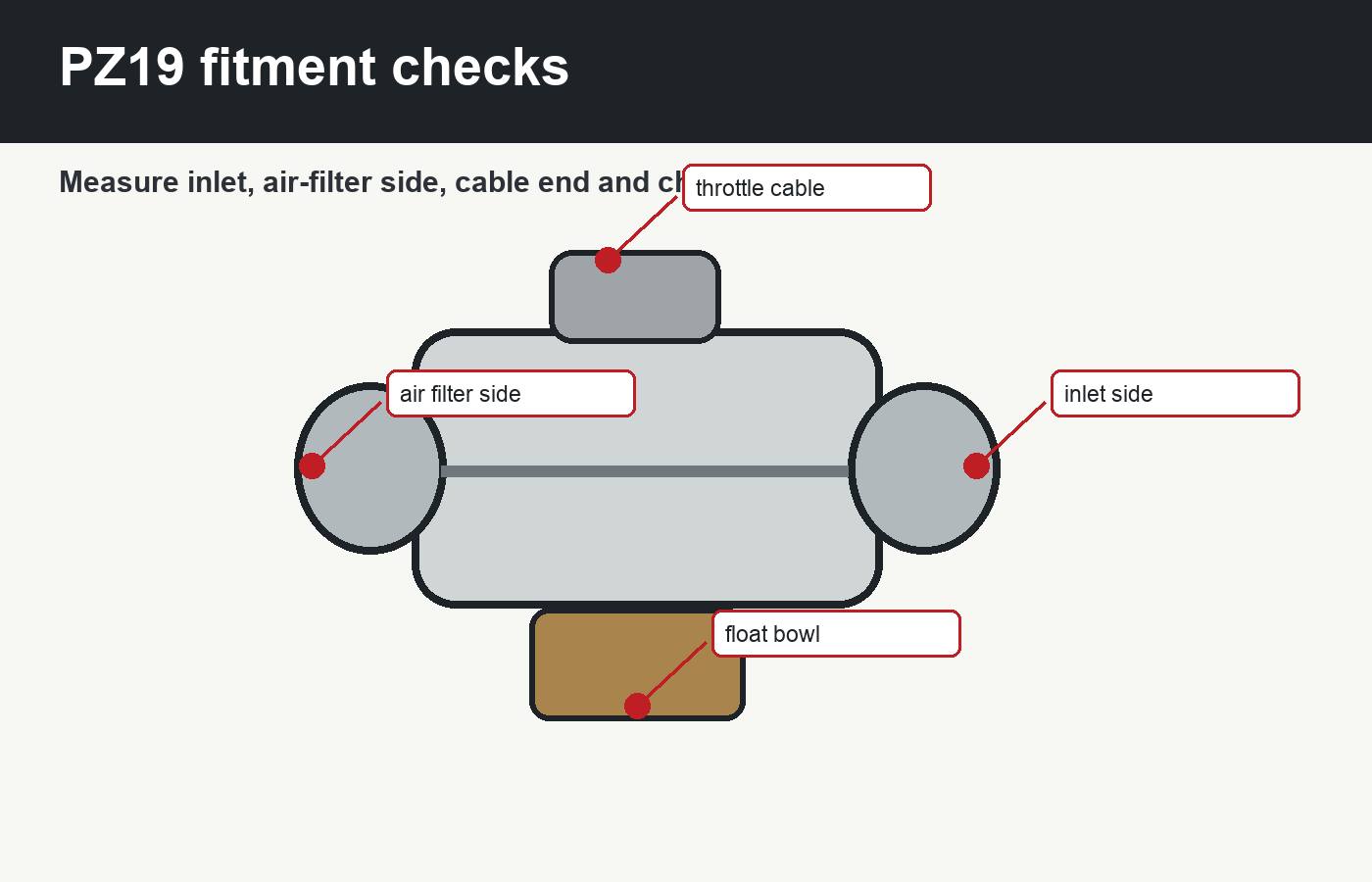
PZ19 carburetor manual fitment starts with measurements. Check the intake manifold side, the air-filter side, throttle cable end, choke style, fuel hose size, drain hose position and available frame clearance. Many PZ carburettors look similar in photos, but the spigot diameter, cable cap and choke arrangement can differ. If the carburettor does not mount squarely or the air filter rubs the frame, the engine may never run consistently.
| Vehicle type | Compatibility | Important note |
|---|---|---|
| 50cc four-stroke pit bike | Often possible | Jetting may need to be modest to keep response clean |
| 90cc or 110cc horizontal engine | Commonly suitable | Check manifold size and cable end before fitting |
| Small ATV or quad | Depends on frame space | Fuel hose, choke access and air-filter clearance matter |
| 125cc mild engine | Sometimes suitable | May favour low-speed response over top-end airflow |
| Road motorcycle | Only with correct legal and mechanical fitment | Emissions, insurance and inspection rules may apply |
| Custom project | Possible with adaptation | Professional setup may be needed for manifold and jetting |
Anyone comparing carburettors, filters, throttle cables and small-engine parts can use the X Moto Parts shop and the performance parts category as starting points, but measurements from the engine should decide the order. A PZ19 carburetor manual cannot replace checking the actual bike in front of you.
Installation checks before starting
PZ19 carburetor manual installation work should be done with clean hands, clean fuel and the engine safely supported. Fit the carburettor squarely to the intake manifold. Tighten clamps evenly without crushing rubber. Route the fuel hose without kinks. Make sure overflow and drain hoses point safely away from the engine and exhaust. Check the throttle cable has free play and the slide returns with a clean click when the throttle is released.
Do not start the engine until the throttle returns fully. A stuck slide can make a small bike launch unexpectedly or rev dangerously. Turn the bars from lock to lock and confirm the rpm will not rise because the cable is too tight. Check that the choke lever or cable moves fully on and fully off. Good installation prevents many problems that owners later blame on jetting.
Fuel supply and venting
Open the tap and confirm fuel reaches the bowl. If the bike starts and then dies after a few minutes, check the tank cap vent, filter and fuel line before changing jets. A blocked vent can create vacuum in the tank. A dirty filter can feed the engine at idle but not under load. Fuel supply is part of PZ19 carburetor manual diagnosis because no screw can compensate for an empty bowl.
Cleaning and maintenance procedure
PZ19 carburetor manual cleaning is simple but must be gentle. Remove the float bowl, main jet, pilot jet and accessible brass parts carefully. Use carburettor cleaner and compressed air where safe. Do not push steel wire through the jets because it can enlarge the calibrated hole. If a jet is badly blocked, replace it rather than scraping it. Clean the float bowl, check for sediment and inspect the float needle tip.
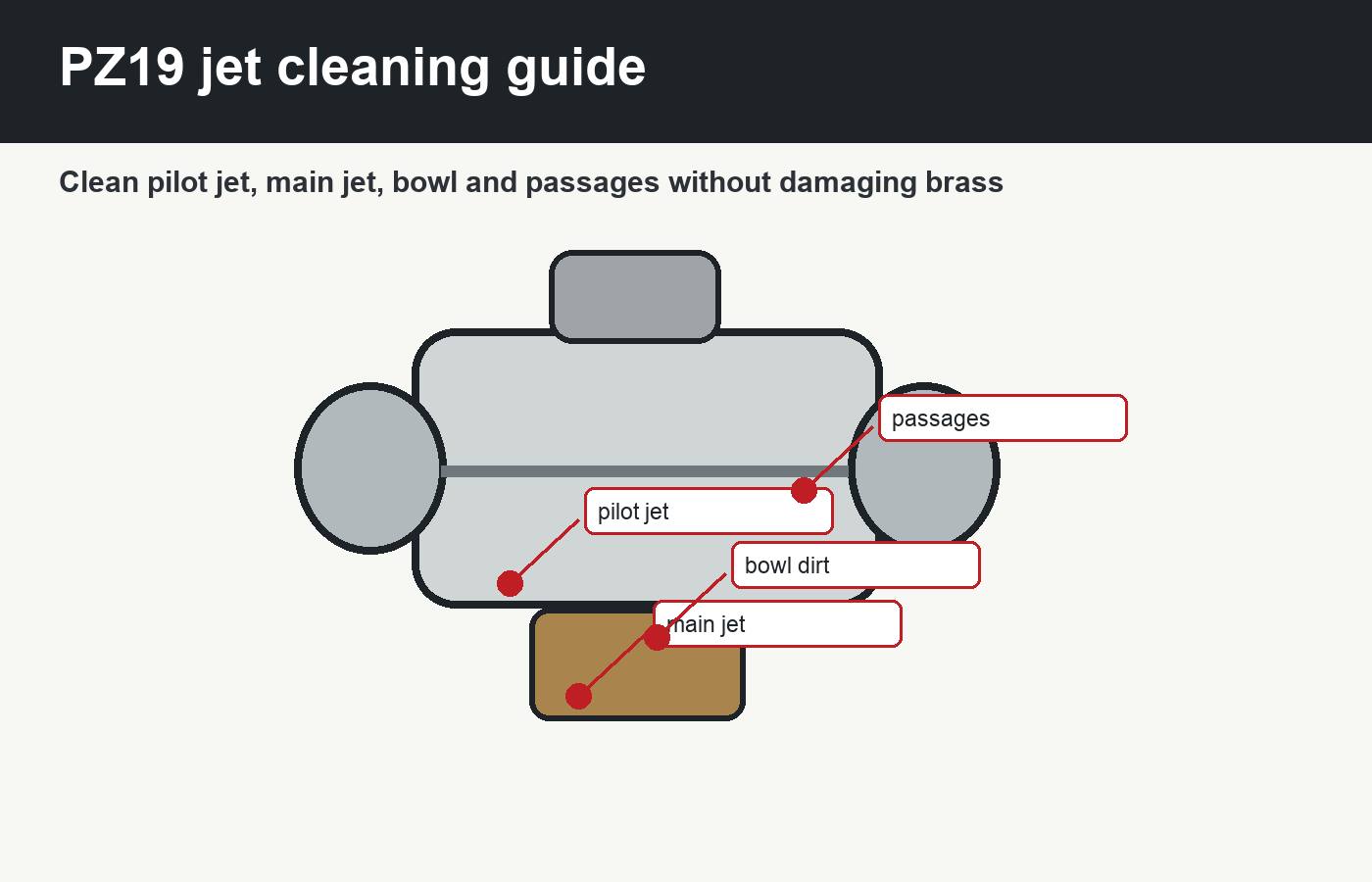
Look at the rubber parts. Intake rubbers can crack. O-rings can flatten. Bowl gaskets can leak. A leaking gasket may only show after the engine vibrates. If the bike has been stored with fuel inside, varnish can block the pilot circuit even when the main jet looks clean. A practical PZ19 carburetor manual approach is to clean before adjusting, because a dirty pilot jet will make the mixture screw feel useless.
How often should it be cleaned?
Clean the carburettor when symptoms appear, after dirty fuel, after long storage or during a rebuild. For bikes used in dust, mud or wet paddocks, inspect the air filter more often than the carburettor. Dirt usually enters because the filter is poor, the airbox does not seal or the intake boot is loose. Cleaning the carb without fixing the source of dirt only resets the same problem.
Basic idle and mixture setup
PZ19 carburetor manual setup should be done with the engine warm and the choke fully off. Start with a recorded baseline. Lightly seat the mixture screw and count the turns out, or record where it was before changing anything. Set the idle screw so the engine runs a little fast. Turn the mixture screw in small steps, wait for the engine to respond and find the smoothest idle. Then lower idle speed to a sensible level.
If the engine only runs with the mixture screw nearly closed or very far out, do not keep forcing the setting. The pilot jet may be wrong, the pilot circuit may be dirty, the float level may be wrong or there may be an air leak. The separate PZ19 carburetor adjustment guide goes deeper into screw movement, rich/lean symptoms and plug reading. This PZ19 carburetor manual keeps the bigger operating picture in view.
Warm-engine rule
A cold engine lies. Choke use, cold oil and cold combustion can make a setting look correct for two minutes and wrong after a ride. Always finalise idle and mixture after warming the engine. If the bike stalls only hot, check valve clearances, intake leaks and fuel level as well as the mixture screw.
Troubleshooting symptoms
PZ19 carburetor manual troubleshooting works best when you describe the symptom precisely. “Runs badly” is not enough. Does it fail cold, hot, at idle, when the throttle snaps open, at half throttle, at full throttle, after bumps, after a few minutes or only with the air filter fitted? Each answer points to a different part of the system.
| Symptom | Likely area | First check |
|---|---|---|
| Hard cold start | Choke circuit, fuel level, pilot jet | Confirm choke movement and clean pilot jet |
| Needs choke when warm | Lean idle, blocked pilot, air leak | Inspect manifold and pilot circuit |
| Black plug | Rich mixture, high float, dirty filter | Check choke, float needle and air filter |
| Bog when throttle opens | Pilot transition, needle, air leak | Check slide movement and mixture baseline |
| Dies after minutes | Fuel flow or tank vent | Test cap vent, filter and hose flow |
| High idle hanging | Lean setting, air leak, tight cable | Check cable free play and intake sealing |
Spark plug reading helps, but do not rely on colour alone. Cold starts, idle time and modern fuels can affect the plug. NGK’s official technical spark plug information is a useful reference for plug condition, deposits and heat range: NGK technical centre. Use that knowledge with real riding symptoms, not as a shortcut.
Road-use and safety notes
PZ19 carburetor manual advice changes when the bike is road registered. A field bike or private-land pit bike is different from a motorcycle used on public roads. In the UK, road motorcycles must remain roadworthy and able to meet relevant MOT inspection expectations where applicable. The official motorcycle MOT manual is available from GOV.UK. Carburettor changes that create unstable idle, fuel leaks, excessive smoke or unsafe throttle behaviour can become more than a tuning inconvenience.
In the United States, Canada, Australia, Ireland and New Zealand, requirements can vary by state, province, inspection scheme and vehicle class. If a carburettor swap changes emissions equipment, declared specification or road behaviour, check local rules and insurance obligations. A PZ19 carburetor manual can explain the mechanical process, but legal responsibility still belongs to the owner and installer.
Common mistakes
PZ19 carburetor manual mistakes are usually avoidable. The first is buying by photo without measuring the inlet and air-filter side. The second is tuning with old fuel. The third is cleaning jets with hard wire. The fourth is overtightening bowl screws. The fifth is running without an air filter and then wondering why the setting changes when the filter is fitted. The sixth is ignoring air leaks.
The seventh mistake is fitting a bigger carburettor because the bike feels slow, when the real problem is a dirty pilot jet, weak spark, dragging brake or worn chain. The eighth is adjusting cold. The ninth is changing pilot, needle and main jet together. The tenth is assuming a forum jet number works at every altitude, with every exhaust and every airbox. A useful PZ19 carburetor manual keeps the work repeatable and conservative.
| Mistake | Result | Better method |
|---|---|---|
| No measurement before buying | Carb does not fit the manifold or filter | Measure both sides and cable type |
| Dirty fuel left in bowl | Blocked pilot jet and hard starting | Drain stale fuel after storage |
| No throttle free play | High idle or dangerous revving | Set cable before starting |
| Adjusting without air filter | Wrong final mixture | Tune with normal intake fitted |
| Changing too many parts | No clear diagnosis | Change one variable at a time |
| Ignoring fuel leaks | Fire risk and poor running | Fix leaks before testing |
FAQ
What engines use a PZ19 carburettor?
PZ19 carburetor manual guidance usually applies to small four-stroke engines such as 50cc, 70cc, 90cc, 110cc and some mild 125cc engines, depending on intake size and setup. Always check physical fitment and jetting before assuming compatibility.
Is a PZ19 carburettor good for a 125cc engine?
It can work on some mild 125cc engines, especially where low-speed response matters, but it may restrict top-end airflow on stronger setups. A PZ19 carburetor manual should be used with engine size, cam, exhaust and airbox in mind.
Why will my PZ19 only run on choke?
That usually means the pilot circuit is blocked, the idle mixture is too lean, fuel flow is poor or there is an intake air leak. Clean the pilot jet and inspect the manifold before changing random parts.
How do I set the idle on a PZ19?
Warm the engine, make sure the choke is off, set a slightly fast idle, adjust the mixture for the smoothest running and then lower idle speed. For detailed screw tuning, use the dedicated adjustment guide linked above.
Can I clean PZ19 jets with wire?
Do not use hard wire because it can enlarge brass jets. Use carburettor cleaner, compressed air and proper care. Replace damaged jets rather than scraping them larger.
Why does the PZ19 overflow fuel?
Overflow usually points to dirt on the float needle seat, a worn float needle, stuck float, wrong fuel level or a damaged overflow arrangement. Fuel leaks must be fixed before riding.
Should I use a pod filter?
A pod filter can work on some custom or off-road setups, but it may require rejetting and can expose the engine to more dirt if poor quality. A sealed airbox is usually easier to tune for road and wet-weather use.
Do I need a mechanic?
Basic cleaning and idle checks are manageable for careful owners, but use a mechanic for fuel leaks, damaged fasteners, uncertain road legality, major jetting changes or repeated poor running after proper cleaning.
Final mechanic advice
PZ19 carburetor manual work should be simple, clean and methodical. Confirm the carburettor fits, make sure the throttle returns safely, clean the jets, check fuel flow, warm the engine and adjust only after the basic engine condition is known. Most small-engine carburettor problems become expensive only when owners guess, force parts or ignore fuel leaks.
If the engine starts easily, idles hot without choke, picks up cleanly from low throttle and does not foul plugs, the carburettor is doing its job. If it still runs badly after cleaning and baseline adjustment, look beyond the carb: valve clearance, compression, ignition, exhaust leaks, air leaks, dirty fuel and mechanical drag all matter. A good PZ19 carburetor manual gives you an order of work, not a magic screw position, and this PZ19 carburetor manual is most useful when those checks are followed patiently.
For small-engine tuning, the best result is rarely the biggest carburettor or loudest intake. It is the setup that starts, responds and survives real use. Keep notes, make one change at a time and use the internal PZ19/PZ27/PZ30 guides when comparing symptoms. That is how PZ19 carburetor manual information becomes useful in a real garage.
{
“@context”: “https://schema.org”,
“@type”: “Article”,
“headline”: “PZ19 carburetor manual”,
“description”: “PZ19 carburetor manual for small-engine fitment, cleaning, jets, idle setup, fuel level, troubleshooting and safe maintenance.”,
“author”: {
“@type”: “Organization”,
“name”: “X Moto Parts”
},
“publisher”: {
“@type”: “Organization”,
“name”: “X Moto Parts”
},
“mainEntityOfPage”: “https://xmotoparts.com/pz19-carburetor-manual/”
}
{
“@context”: “https://schema.org”,
“@type”: “FAQPage”,
“mainEntity”: [
{
“@type”: “Question”,
“name”: “What engines use a PZ19 carburettor?”,
“acceptedAnswer”: {
“@type”: “Answer”,
“text”: “PZ19 carburettors are usually used on small four-stroke engines such as 50cc, 70cc, 90cc, 110cc and some mild 125cc applications.”
}
},
{
“@type”: “Question”,
“name”: “Is a PZ19 carburettor good for a 125cc engine?”,
“acceptedAnswer”: {
“@type”: “Answer”,
“text”: “It can work on some mild 125cc engines, but stronger setups may need more airflow depending on intake, exhaust and use.”
}
},
{
“@type”: “Question”,
“name”: “Why will my PZ19 only run on choke?”,
“acceptedAnswer”: {
“@type”: “Answer”,
“text”: “The most common causes are a blocked pilot circuit, lean idle setting, poor fuel flow or intake air leak.”
}
},
{
“@type”: “Question”,
“name”: “How do I set the idle on a PZ19?”,
“acceptedAnswer”: {
“@type”: “Answer”,
“text”: “Warm the engine fully, make sure the choke is off, set idle speed, adjust the mixture for smooth running and then lower the idle to a sensible level.”
}
},
{
“@type”: “Question”,
“name”: “Can I clean PZ19 jets with wire?”,
“acceptedAnswer”: {
“@type”: “Answer”,
“text”: “Hard wire can enlarge brass jets, so carburettor cleaner and compressed air are safer.”
}
},
{
“@type”: “Question”,
“name”: “Why does the PZ19 overflow fuel?”,
“acceptedAnswer”: {
“@type”: “Answer”,
“text”: “Fuel overflow usually comes from dirt on the float needle seat, a worn float needle, stuck float or incorrect fuel level.”
}
},
{
“@type”: “Question”,
“name”: “Should I use a pod filter?”,
“acceptedAnswer”: {
“@type”: “Answer”,
“text”: “A pod filter can work on some setups, but may require rejetting and often gives less consistent protection than a sealed airbox.”
}
},
{
“@type”: “Question”,
“name”: “Do I need a mechanic?”,
“acceptedAnswer”: {
“@type”: “Answer”,
“text”: “Use a mechanic for fuel leaks, damaged fasteners, uncertain legal use, major jetting changes or persistent poor running after cleaning.”
}
}
]
}