Description
Honda Monkey 125 chip tuning: reversible module setup for a small fuel-injected bike
Honda Monkey 125 chip tuning makes sense only when the rider treats the Monkey like the small, fuel-injected motorcycle it is: simple to enjoy, sensitive to maintenance and not designed for exaggerated power promises. The 125 cc engine is charming because it is light, economical and easy to ride, so any tuning module should aim for cleaner response and careful setup rather than unrealistic top-speed claims.
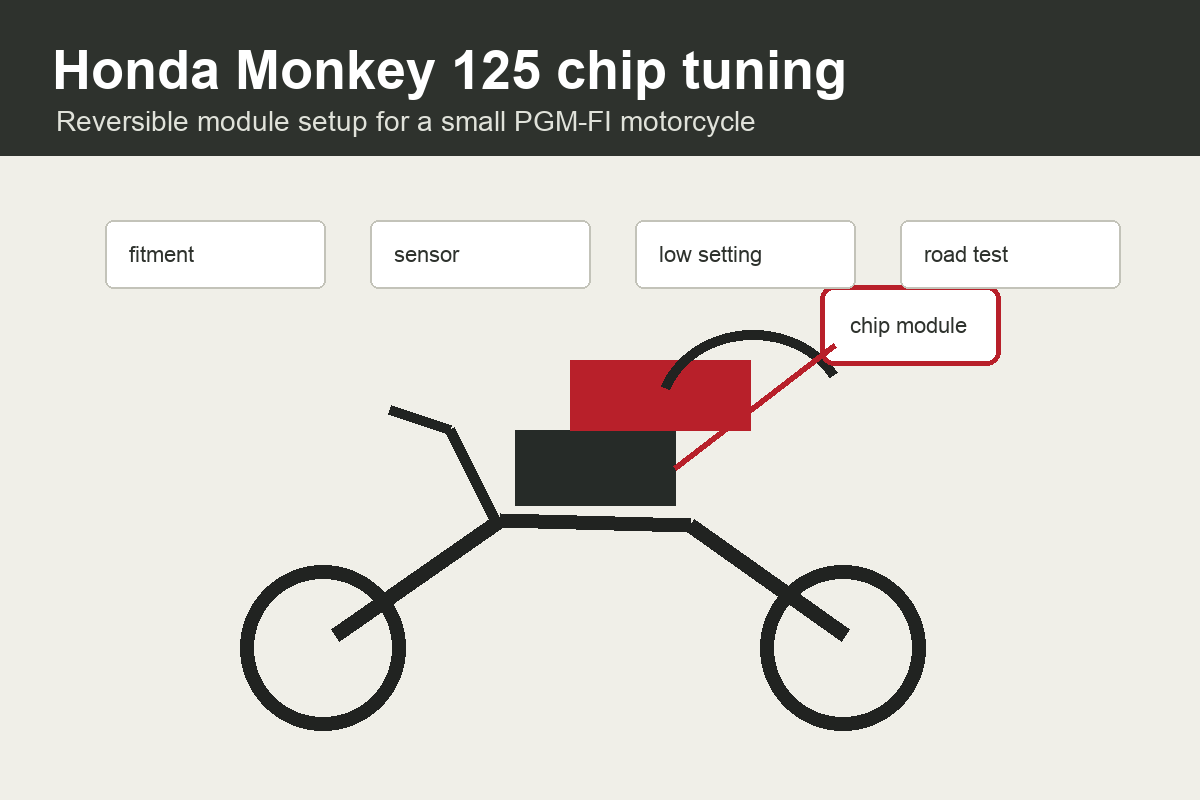
This page explains how to check fitment for the Honda Monkey 125 Chip Tuning Module, what to inspect before ordering, how to install the module without messy wiring and how to judge the result on real roads.
Understand the motorcycle before tuning it
The modern Monkey is a small motorcycle with electronic fuel injection, not an old mini bike with a carburetor and a handful of jets. Honda’s UK specification page lists a 124 cc air-cooled two-valve OHC single-cylinder engine with PGM-FI electronic fuel injection, 6.9 kW output and 10.7 Nm of torque. Those figures are useful because they keep expectations honest; see the official Honda Monkey 125 specifications for the current reference data.
Honda Monkey 125 chip tuning should therefore be evaluated around throttle pickup, part-throttle smoothness and the way the bike responds after warm-up. A module cannot turn a Monkey into a large-capacity motorcycle, and it should never be used to cover up poor servicing.
Fitment checks before ordering
Before buying, confirm the model year, market version and current condition of the bike. Monkey model codes and emissions equipment can differ by country. If your bike has an aftermarket exhaust, intake changes, sprocket changes or previous ECU work, those details matter because they change the way the motorcycle feels.
| Check | Why it matters | Good owner action |
|---|---|---|
| Exact year and market | Connector layout and emissions equipment can vary | Confirm registration year and model version |
| Fuel injection connector access | The module must match the correct sensor plug | Compare photos before installation |
| Bike maintenance | Small engines show service issues quickly | Check plug, oil, chain, filter and battery first |
| Existing modifications | Exhaust or intake parts can change response | List every change before choosing a setup |
What a module can realistically improve
A reversible module can help refine the signal used for fueling strategy, depending on the product design and fitment. The practical aim is smoother pickup, a more willing feel through the lower and middle range, and a setup that remains repeatable when the engine is hot. It is not a guarantee of a specific horsepower number.
For a wider setup view, read our Honda Monkey 125 tuning guide. If your real question is speed limitation, licensing or legality, use the Honda Monkey 125 derestriction guide before buying performance parts. Riders comparing realistic gains can also read the Honda Monkey 125 power increase guide.
Installation method
Install with the ignition off and the key removed. Let the engine cool, work in good light and avoid pulling on wires. The connector should seat cleanly; forcing it is a sign that something is wrong. Once connected, secure the harness so it cannot rub the cylinder head, exhaust, frame edge, steering area or moving suspension parts.
- Identify the correct sensor area before disconnecting anything.
- Compare the plug shape and locking tab direction.
- Connect the module without twisting or stretching the harness.
- Secure the wiring with enough slack for normal movement.
- Start from the lowest setting.
- Warm the engine fully before judging the result.
Setup and road testing
Honda Monkey 125 chip tuning should be tested one step at a time. Use the same road, the same riding style and the same warm-up routine when comparing settings. The best setting is the one that feels clean and consistent, not the one that sounds most aggressive in the garage.
If the bike hesitates, smells rich, idles poorly or feels worse after a setting change, step back. Small air-cooled engines can feel different between cold starts, warm traffic and open-road cruising, so give the bike enough time before making a judgment.
| Result during test ride | Likely meaning | Next step |
|---|---|---|
| Smoother roll-on throttle | Setting may suit the bike | Keep testing across normal rides |
| Poor idle or uneven warm running | Setting may be too strong or connector needs checking | Return to a lower setting and inspect fitment |
| No clear improvement | Bike may already be well matched or issue is mechanical | Check maintenance and expectations |
| Warning light | ECU has detected an issue | Remove the change and diagnose before riding further |
Maintenance matters more than riders admit
The Monkey is fun because it is simple, but simple does not mean immune to basic problems. A worn chain, low tyre pressure, dirty air filter, weak battery or tired spark plug can make the motorcycle feel slower than it is. Honda Powersports notes the 2025 Monkey uses a 124 cc air-cooled single-cylinder four-stroke engine and Programmed Fuel Injection with a 24 mm throttle body; the official Honda Monkey ABS technical page is a useful specification reference for U.S. riders.
Before judging any module, make the bike healthy. Check tyre pressure, chain slack, oil level, air filter condition and stored fault lights. A good baseline makes tuning results easier to feel and easier to trust.
Who this product is for
This module suits riders who want a reversible electronic upgrade and understand that the result must be tested conservatively. It is best for a healthy bike where the owner wants sharper response without permanent ECU flashing. It is not ideal for a motorcycle with unresolved faults, unknown wiring changes or a rider expecting dramatic engine transformation.
Honda Monkey 125 chip tuning is also more sensible when paired with restraint. If the bike already has an exhaust, intake and gearing changes, tell us before ordering so the setup advice can match the whole motorcycle.
Responsible use
Performance products may be restricted to private-road, track or competition use depending on local law. Check road legality, insurance terms and inspection rules before using tuning parts on public roads. Use a qualified workshop if you are not comfortable working around sensors, bodywork and wiring.
FAQ
Will this make the Monkey dramatically faster?
No. The realistic aim is response and ride feel, not turning a 124 cc engine into a different class of motorcycle.
Can I remove it later?
Yes, the product is intended as a reversible module when installed correctly. Keep the original routing clean so returning to stock is straightforward.
Should I install it with an aftermarket exhaust?
You can, but tell us what exhaust is fitted. Exhaust changes can affect how the bike responds and how the setting should be evaluated.
What is the safest first setting?
Start from the lowest setting, warm the engine fully and make only one change at a time.
Final buying advice
Buy this module if you want a careful, reversible way to refine a healthy Monkey 125. Do not buy it as a shortcut around maintenance or as a promise of unrealistic power. The best result comes from correct fitment, conservative adjustment and honest road testing.