
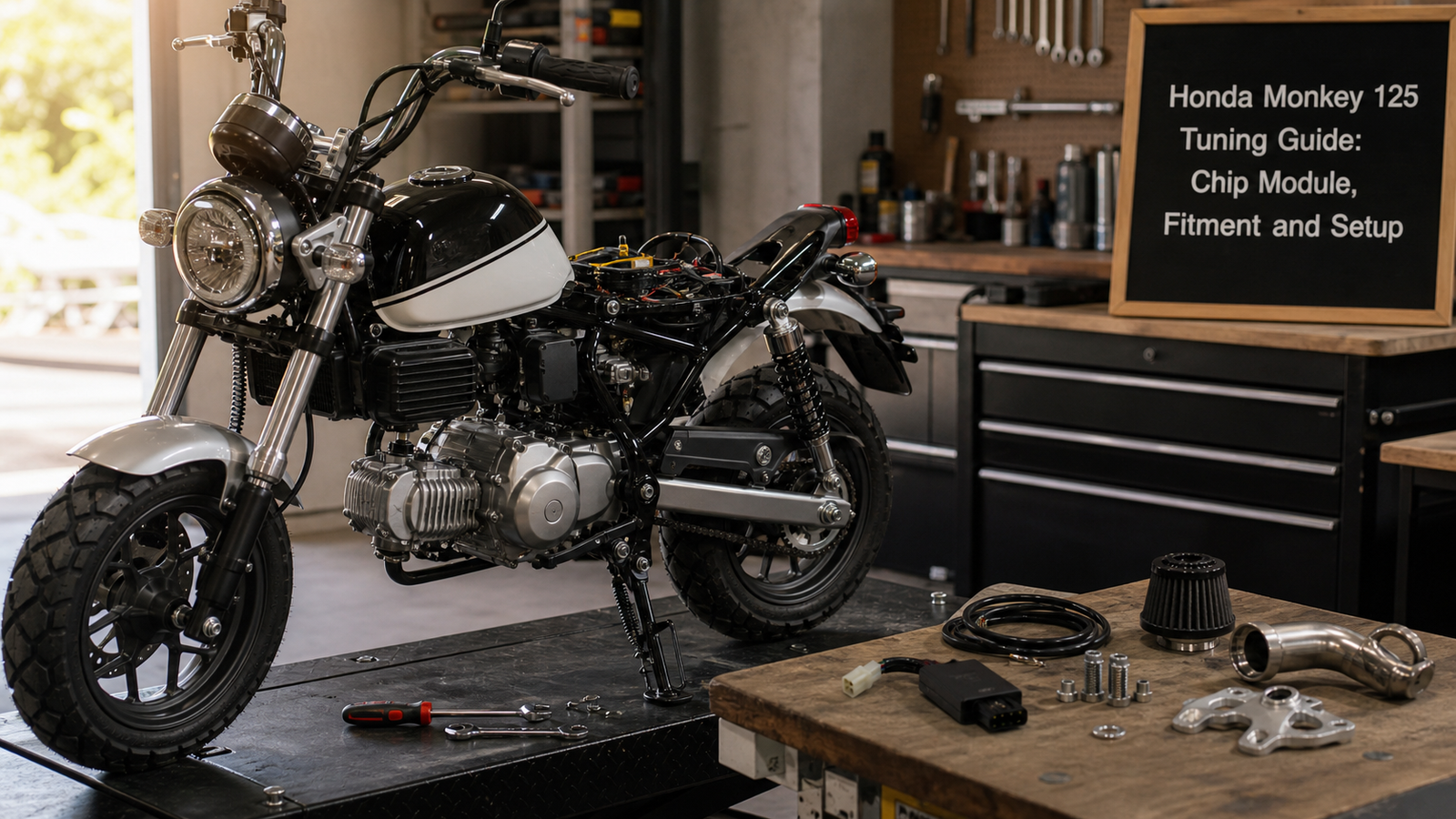
Honda Monkey 125 Tuning Guide: Chip Module, Fitment and Setup
Honda Monkey 125 tuning should be approached differently from tuning a big motorcycle. The Monkey is light, simple, air-cooled, fuel-injected and built around charm as much as speed. A chip tuning module can make sense for riders who want a cleaner throttle feel, a little more urgency after exhaust or intake changes, or a reversible way to fine-tune the engine signal. It should not be treated as a magic box that turns a 125 into a highway machine.

This guide is written for the owner standing next to the bike with the seat off, trying to understand where a module fits, what has to be checked before ordering and how to set it up without creating poor running. The goal is practical: confirm compatibility, install cleanly, start conservatively and judge the result like a mechanic, not like a brochure.
If you are researching a reversible module, use this page together with the Honda Monkey 125 chip tuning module product page and the more general Honda Monkey 125 derestriction guide. The product page helps with ordering and fitment, while the derestriction guide explains the wider legal and mechanical picture.
What the Monkey 125 is before you tune it
The modern Monkey 125 is not an old carburettor minibike with a few wires and a simple jet change. It is a modern fuel-injected 125 based around Honda’s small horizontal single-cylinder platform. Depending on model year and market, it may use different emissions equipment, mapping strategy, connector layout and transmission generation. That is why Honda Monkey 125 tuning starts with identification, not parts.
The Monkey’s strength is not peak horsepower. It is low-speed fun, light weight, easy maintenance and a riding position that makes every short trip feel special. Any tuning work should protect that character. A module that makes the bike snatchy in traffic, hard to start or annoying on steady throttle has missed the point, even if it feels sharper during one hard acceleration run.
Before making changes, check Honda’s official model information for your market. Honda’s current Monkey pages, such as Honda Powersports Monkey, are useful for confirming the broad engine family and equipment, but your exact year and country still matter. A 2019 bike, a later five-speed version and a market-specific emissions version should not be treated as identical without checking connectors.
What a chip module can and cannot do
A tuning module for a small fuel-injected motorcycle generally works by altering a sensor signal within a safe operating range. On bikes like the Monkey, the most common approach is connected around the intake air temperature sensor circuit or a related signal used by the ECU to calculate fueling. The module does not rewrite the ECU like a full remap. It is reversible, external and usually adjusted with simple settings.
That simplicity is useful, but it also sets the limit. Honda Monkey 125 tuning with a chip module may improve throttle response, support a freer-flowing exhaust or intake, and make the engine feel less flat in certain conditions. It will not change displacement, cam timing, valve size, compression ratio or gearbox ratios. If the bike is struggling because of gearing, tyre drag, poor maintenance or unrealistic expectations, a module alone will not solve it.
| Rider expectation | Realistic outcome | Workshop note |
|---|---|---|
| Cleaner throttle response | Possible when the bike is healthy and the module is set mildly | Test warm engine response, not only cold starts |
| More pull after exhaust | Possible if the exhaust changed fueling demand | Check for lean hesitation and hot running |
| Higher top speed | Usually limited by power, gearing, rider size and wind | Do not judge only by indicated speed |
| Big horsepower gain | Not realistic from a simple external module | Use honest expectations on a 125 cc engine |
Compatibility checklist before ordering
Most fitment problems happen before the box is opened. The owner assumes “Monkey 125” is enough information, but a supplier may need model year, market, connector photos and whether the bike is stock. A careful Honda Monkey 125 tuning order should include a few minutes of inspection.
Start with the registration year, but do not rely on it alone. The manufacturing year and model year can differ. Check the VIN plate, service documents and engine configuration. If the bike has already been modified with an exhaust, intake, big-bore kit or previous electronics, say so before ordering. A module selected for a stock motorcycle may not be ideal for a heavily modified one.
Check the sensor area
Remove the seat and inspect the intake area with good light. Look for the intake air temperature sensor or the connector specified by the module supplier. Do not pull wiring by the cable. Release the connector lock properly and check whether the plug shape matches the module harness. Photos are valuable here. A clear photo of the connector often prevents the wrong part being sent.
Check previous modifications
A Monkey with a slip-on exhaust, open intake, velocity stack or altered gearing behaves differently from a stock bike. That does not mean a module will not work. It means setup must be more careful. Honda Monkey 125 tuning is best when parts are matched: exhaust, intake, fueling and gearing should not fight each other.
Check the bike’s health first
Do not install a module to hide a fault. If the engine has old fuel, a dirty air filter, tight valves, weak battery, damaged wiring, poor earths or stored fault codes, fix those first. A healthy small engine responds to fine adjustment. An unhealthy one becomes harder to diagnose after extra electronics are added.
| Before ordering | What to confirm | Why it matters |
|---|---|---|
| Model year | Year, market and engine generation | Connector and ECU strategy can vary |
| Connector photo | Clear picture of the sensor plug | Prevents wrong harness selection |
| Bike condition | Service status, filter, plug, valves and battery | Bad maintenance can mimic tuning problems |
| Current upgrades | Exhaust, intake, gearing, big-bore work | Setup depends on the full package |
| Use case | Town riding, hills, commuting or private-area use | The best setting depends on how the bike is ridden |
How to install the module cleanly
Installation should be tidy enough that another mechanic can understand it later. Start with the ignition off and the key removed. Let the engine cool if you have just ridden. Work in good light, keep the harness away from the cylinder, exhaust, chain, steering movement and sharp frame edges. A good Honda Monkey 125 tuning installation should look almost factory when finished.
Connect the module only to the intended sensor circuit. Do not force plugs. If the connector does not lock easily, stop and re-check fitment. Secure the module body where it is protected from water spray, heat and vibration. Use cable ties, but do not crush wiring. Leave enough slack for normal engine movement and steering movement, especially if the harness runs near the frame or under the tank area.
First start after installation
Start from the lowest or most conservative setting. Turn the ignition on and watch for warning lights. Start the engine and let it idle without touching the throttle. Listen for unstable idle, misfire, fuel smell or abnormal engine note. If anything feels wrong, switch off and re-check the connector before riding.
Warm-engine testing
Do not judge the module after thirty seconds on a cold engine. Let the Monkey reach normal temperature. Ride gently at first, then test steady throttle, low-speed roll-on and a short hill. The useful part of Honda Monkey 125 tuning is not the loudest moment; it is the way the bike responds when you use it normally.
How to choose the right setting
Small engines make it tempting to turn every adjustment to the maximum. Resist that. The highest setting is not automatically the best setting. If the module changes fueling influence, too much correction can make the engine feel heavy, rich, uneven or inconsistent. The best setting is the one that gives clean response without side effects.
Use a repeatable test route. Include a cold start, a warm restart, slow town riding, a steady 40-60 km/h section, a hill and a short full-throttle pull where legal and safe. Change one setting at a time and write down the result. If a setting feels better for the first minute but worse after heat builds, it is not the correct setup.
| Symptom after fitting | Likely meaning | What to do |
|---|---|---|
| Sharper response with no warning lights | Setting may be suitable | Keep testing through heat cycles |
| Flat or heavy throttle | Correction may be too strong | Reduce setting and retest |
| Hesitation after exhaust change | Fueling may need careful adjustment | Try mild changes and inspect for leaks |
| Engine light appears | Signal or connector issue possible | Stop, scan if possible, re-check installation |
| Poor hot restart | Setup may be too aggressive or fault exists | Return to conservative setting and diagnose |
Exhaust and intake combinations
Many riders look at a module because they have fitted, or plan to fit, an exhaust. That is understandable. A lighter silencer can improve sound and styling, and the Monkey responds well to tasteful parts. But exhaust work on a 125 should be judged by rideability. If a pipe removes too much low-rpm strength, the bike can sound faster while feeling weaker where you ride most.
For mild Honda Monkey 125 tuning, a quality road-legal exhaust, clean air filter and conservative module setting are usually more sensible than an open intake and maximum correction. If the intake is changed, filtration and water protection matter. The Monkey is often used in town, rain, back roads and short trips. A setup that only works on a dry test ride is not a good road setup.
Gearing and tyre pressure matter too
A chip module is not the only way to improve the feel of a Monkey. Final-drive gearing can change acceleration and cruising feel. Tyre pressure, chain condition, brake drag and rider position also affect performance more than many owners expect. Before blaming the ECU, make sure the motorcycle rolls freely and the chain is not tight or worn.
If the goal is better hill climbing, a small gearing change may be more noticeable than electronic correction. If the goal is a cleaner engine response after an exhaust, the module becomes more relevant. The best Honda Monkey 125 tuning plan asks what problem you are solving before choosing parts.
Road legality and responsible use
Performance products can be restricted to private roads, competition use or markets where the modification is legal. Always check local rules before using any tuning part on public roads. In Europe, 125 cc motorcycles are tied closely to licence and type-approval limits, and the EU framework for two- and three-wheel vehicles is set out in Regulation (EU) No 168/2013.
That does not mean every owner should be frightened of tuning. It means the owner should be honest. Keep the original parts, keep installation reversible, save product information and ask a qualified workshop if you are not comfortable with sensor wiring. Responsible Honda Monkey 125 tuning is easier to live with and easier to undo if inspection rules or riding needs change.
Common installation mistakes
The most common mistake is fitting the module to the wrong connector because the plug looks close enough. The second is routing the harness near heat. The third is setting the module too high immediately. The fourth is blaming the module for a pre-existing service problem. The fifth is forgetting to test hot restart and steady throttle.
Another mistake is comparing a Monkey to the wrong motorcycle. A tuned 125 sport bike, a big-bore Grom and a stock Monkey are different machines. Use the right comparison. A good result is a Monkey that feels cleaner, livelier and still easy to ride. It does not need to become aggressive to be improved.
When a workshop should do the job
If you are unsure which connector is correct, if the bike already has electrical faults, if a warning light is present, or if the harness has been previously modified, use a workshop. Sensor circuits are not a place for rough work. A mechanic can also check for exhaust leaks, intake leaks, battery condition and fault codes before the module is blamed for everything.
A workshop is also useful after several modifications. Exhaust, intake, gearing and electronics interact. The more parts you add, the more important it becomes to test the whole motorcycle rather than one component. For owners comparing Honda 125 tuning ideas, the Honda CB125R power increase guide and Honda CB125R ECU remap guide show the difference between small external changes and deeper ECU work.
Monkey, Dax and Grom-style 125 tuning
The Monkey shares the small-Honda tuning world with bikes like the Dax, Grom and Super Cub, but each one is used differently. The Monkey is often bought for style and short-distance fun. The Dax has its own retro utility feel. The Grom is often modified more aggressively. If you own both a Monkey and Dax, the Honda Dax 125 derestriction guide is a useful companion because it explains similar 125 cc limits from another small-Honda angle.
For the Monkey, keep tuning friendly. It should start easily, idle calmly, pull cleanly from low rpm and remain enjoyable in traffic. The best Honda Monkey 125 tuning does not remove the reason people love the bike in the first place.
How to judge the result after a week
The first ride only tells you whether the bike is basically happy. The better judgement comes after several normal rides: one cold morning start, one hot restart after fuel, one slow town journey, one hill and one longer steady section. A Monkey can feel exciting for ten minutes with a sharper setting, then become tiring if the throttle is too abrupt or if the engine feels loaded once fully hot.
Keep notes like a mechanic would. Write down the module setting, weather, fuel used, whether the exhaust is stock, whether the air filter is stock, and what the bike did at low, mid and full throttle. If you change gearing or exhaust later, do not assume the old setting is still correct. Retest from a conservative point. That slow method is less dramatic than turning a dial to maximum, but it usually gives a better motorcycle.
Signs the setup is working
A good setup is calm. The engine starts without extra throttle, idle settles normally, the throttle opens cleanly from small inputs, and the bike feels consistent after heat builds. On a small air-cooled 125, consistency matters more than one strong pull. If the Monkey feels the same on the third ride as it did on the first, you are closer to a usable setup.
Signs you should step back
Reduce the setting or return to stock for diagnosis if the engine light appears, hot restart becomes poor, fuel smell increases, idle hunts, the bike feels flat at steady speed, or the harness has moved near heat. Also step back if the only improvement appears at full throttle but town riding gets worse. A road Monkey spends much of its life at partial throttle, so that is where the setup has to be clean.
| After one week | Good sign | Warning sign | Next action |
|---|---|---|---|
| Cold start | Starts normally and settles quickly | Needs throttle or stalls | Lower setting and check connector |
| Hot restart | Restarts cleanly after a fuel stop | Cranks longer or smells rich | Return to mild setting and retest |
| Town riding | Smooth small throttle openings | Snatchy or uneven response | Check chain slack, throttle free play and setting |
| Hill pull | Cleaner drive without hesitation | No improvement or worse heat feel | Inspect intake/exhaust leaks and gearing |
| Harness check | Dry, secure and clear of heat | Loose ties or rub marks | Reroute before riding again |
Maintenance that changes the tuning result
Small motorcycles react strongly to basic maintenance. A tight chain can make the bike feel lazy. Low tyre pressure can remove the crispness you expected from the module. A dirty air filter can make one setting feel rich. Old fuel can make starting poor. Valve clearance that has drifted tight can make a hot engine hard to restart. Before changing the module again and again, bring the motorcycle back to a known healthy baseline.
The same applies after washing the bike or riding in heavy rain. Check that connectors are seated, the module body is protected, and water has not collected where the harness was mounted. The Monkey is simple, but simple machines still punish careless wiring. A reversible tuning part should remain reversible in practice: no cut wires, no crushed cables, no hidden joins and no installation that requires guessing when the next mechanic opens the seat.
FAQ
Will a chip module make the Honda Monkey 125 much faster?
No simple module should be expected to make the Monkey dramatically faster. It may improve response and support light intake or exhaust changes, but displacement, gearing and wind resistance still limit the result.
Can I install the module myself?
Many owners can install it if the connector is correct and they work carefully. If you are uncomfortable around sensor wiring, use a workshop. Clean installation is more important than fast installation.
Should I use the highest setting?
No. Start low and increase only if the engine runs cleanly. The highest setting can be worse than a mild setting if it makes the bike rich, flat or inconsistent.
Do I need an exhaust first?
No. A module can be used on a stock bike if compatible, but it often makes the most sense when the owner wants to refine response or support a mild exhaust/intake package.
What should I check after the first ride?
Check that the harness has not moved, no warning light is present, the engine restarts hot, idle is stable and throttle response is clean at steady speed. Recheck cable ties after the first few rides.
Final setup advice
Honda Monkey 125 tuning is best when it stays reversible, tidy and realistic. Confirm the exact model, inspect the connector, start with a conservative setting and test the bike in the conditions you actually ride. If the Monkey becomes smoother, cleaner and more responsive without losing reliability, the setup is doing its job.
Use the module as one part of a balanced package, not as a shortcut around maintenance. A fresh filter, correct tyre pressure, healthy chain, clean wiring and careful installation will do more for the riding experience than a rushed maximum setting. That is how a small 125 remains fun, dependable and genuinely better to ride.