
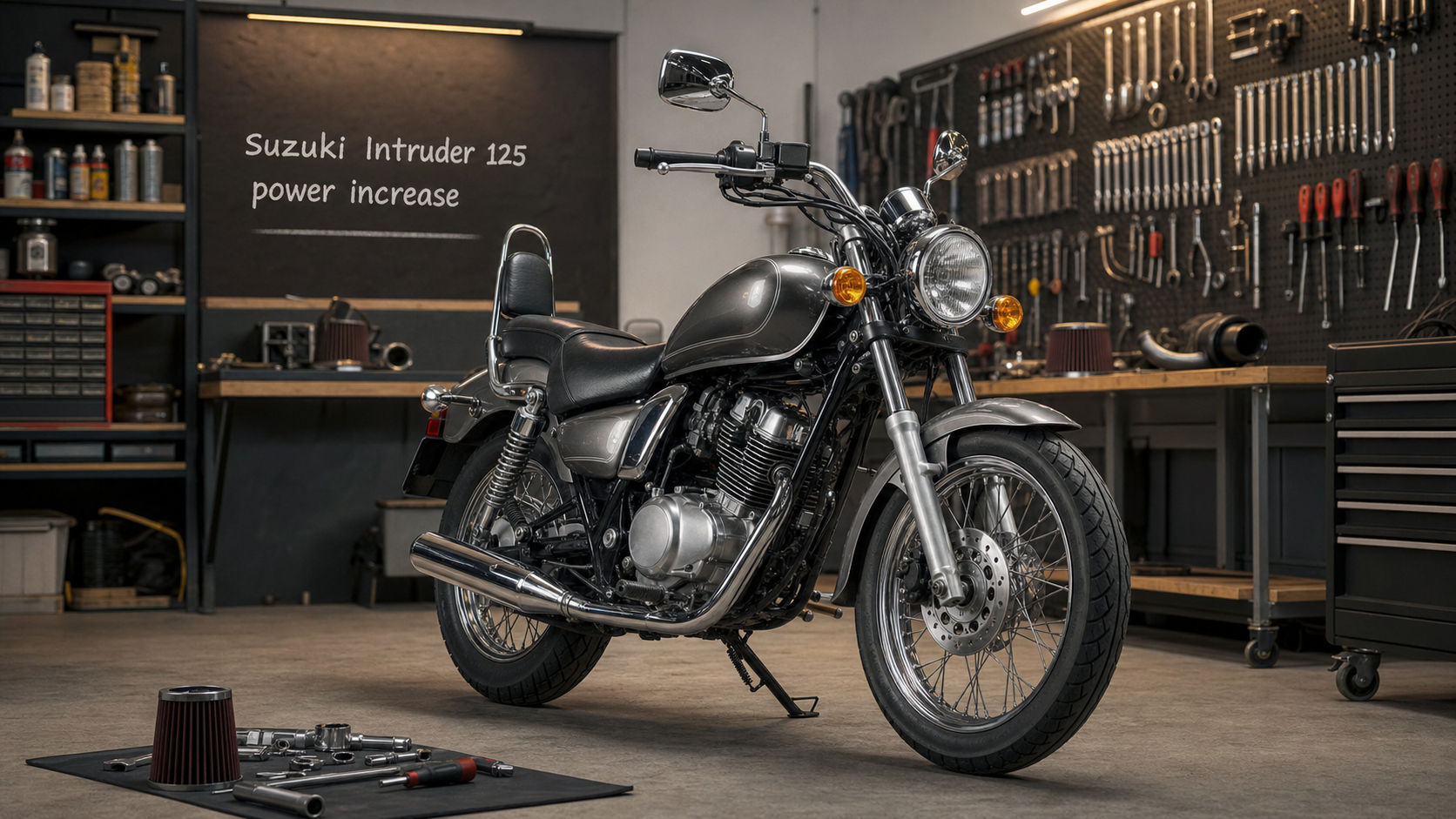
Suzuki Intruder 125 power increase: a real-world mechanic’s guide to making the small V-twin pull better
Suzuki Intruder 125 power increase is one of those topics where honest expectations matter more than shiny parts. The VL125 Intruder is a small-capacity cruiser with the look and riding position of a bigger bike, but it is still a 125 cc four-stroke V-twin built for learners, commuting and relaxed riding. You can improve how it responds. You can make it cleaner, smoother and more willing on hills. What you cannot do cheaply or reliably is turn it into a middleweight cruiser.

The best Suzuki Intruder 125 power increase plan starts with the basics: compression, valve clearance, carburettor condition, intake sealing, exhaust leaks, chain gearing, tyre pressure and brake drag. On a heavy 125 cruiser, small losses feel huge. A tired chain, dirty carburettor or dragging rear drum can steal more real performance than a bolt-on part can add.
A good Suzuki Intruder 125 power increase does not chase noise first. It restores the engine, lets the V-twin breathe correctly, sharpens gearing where appropriate and keeps the motorcycle legal for the rider’s licence and local road rules. If you own one because you like the low seat, chrome, long wheelbase and relaxed feel, the goal is stronger usable pull, not a nervous engine that becomes unpleasant to ride.
What owners are really searching for
Search Console shows the same intent in several languages: riders ask for more power, tuning, exhaust options and ways to make the small Intruder climb hills with less effort. The German phrase “mehr Leistung” and the Polish “zwiększenie mocy” both point to the same workshop question: how do I make a 125 cruiser feel less lazy without wasting money?
| Search intent | What the rider usually means | Best answer |
|---|---|---|
| More power | Better hill climbing and overtaking feel | Service health, carb setup and gearing before parts |
| Tuning | Which modifications actually work | Air, fuel, exhaust and sprockets as a balanced package |
| Exhaust | More sound and possible weight saving | Choose road-legal parts and avoid killing low rpm torque |
| Top speed | Higher indicated speed on flat roads | Reduce losses, test gearing, accept 125 cc limits |
That is why this guide treats Suzuki Intruder 125 power increase as a practical build, not a shopping list. A 125 V-twin rewards careful work because every small restriction, air leak or bad adjustment matters. It also punishes unrealistic tuning because there is not much spare displacement to cover mistakes.
Know the motorcycle before modifying it
The Intruder 125, often referred to as VL125 or Intruder 125LC in Europe, is a learner-friendly cruiser. It uses a small V-twin, five-speed gearbox and chain final drive. It was never designed as a high-revving sport 125. Its character is soft throttle, easy riding and cruiser styling. That character matters when planning Suzuki Intruder 125 power increase.
Many riders come from scooters or small naked bikes and expect a 125 cruiser to feel similar. It does not. The Intruder carries cruiser weight and a long chassis. That means it may feel slower even when the engine is running correctly. Before blaming the motor, check whether the motorcycle is losing performance through maintenance neglect or an unsuitable final-drive setup.
The old Suzuki Intruder family also includes many bigger machines, so parts research can become confusing. A forum thread about an 800, 1400 or 1500 Intruder is not automatically relevant to the 125. For Suzuki Intruder 125 power increase, model identification is critical: year, market, carburettor version, emissions equipment and sprocket sizes all matter.
The legal ceiling for a 125
In many European markets, 125 motorcycles sit around the A1 licence framework. The common ceiling is 125 cc and 11 kW, with power-to-weight limits depending on jurisdiction. The European type-approval framework for L-category vehicles is explained in Regulation (EU) No 168/2013, and it is worth understanding before tuning a road motorcycle.
This is the boring paragraph that saves expensive mistakes. A Suzuki Intruder 125 power increase that makes the bike illegal for your licence, insurance or inspection is not a clever upgrade. It can create problems after an accident, during roadside checks or at annual inspection. Keep documents for any road-approved exhaust or intake parts, and be cautious with changes that remove emissions equipment.
Baseline check before spending money
The first step in Suzuki Intruder 125 power increase is a baseline service. Do not fit a performance exhaust onto an engine with tight valves, old fuel, cracked intake rubbers or a half-blocked pilot jet. On a small carburetted engine, one dirty passage can make the bike feel flat below half throttle and weak on hills.
Compression and valve clearance
Compression tells you whether the engine can make power at all. Valve clearance tells you whether the valves are sealing and opening correctly. If clearances are too tight, starting can worsen, idle can become unstable and warm performance can fade. If they are too loose, the engine can become noisy and inefficient. A careful Suzuki Intruder 125 power increase begins with measuring, not guessing.
Carburettor condition
The Intruder 125’s carburettor setup must be clean and sealed. Look for blocked jets, varnish from old fuel, incorrect float height, hardened intake boots and air leaks. A vacuum leak can make the mixture lean and give exactly the symptoms riders try to fix with tuning parts: weak acceleration, hanging idle and poor throttle response.
Ignition and charging
Fresh plugs, good caps, healthy battery voltage and clean grounds matter. A small V-twin with weak spark can feel dull under load. Before calling a bike slow, make sure it is firing cleanly on both cylinders throughout the rev range. This is basic workshop discipline, but it is also the cheapest form of Suzuki Intruder 125 power increase.
| Check | Why it matters | What to fix first |
|---|---|---|
| Valve clearance | Controls sealing and breathing | Adjust to service specification |
| Compression | Confirms engine health | Investigate low or uneven readings |
| Carburettor | Controls mixture and response | Clean jets, set float, check diaphragms if fitted |
| Intake boots | Air leaks cause lean running | Replace cracked rubber and clamps |
| Chain and sprockets | Final drive changes real acceleration | Replace worn parts before changing ratios |
| Brakes and bearings | Drag steals power | Free dragging shoes, calipers and wheel bearings |
Air filter and intake work
Intake work is often oversold. For mild Suzuki Intruder 125 power increase, a clean standard airbox with a quality filter is usually better than an exposed pod filter. The original airbox helps stabilize airflow and protects the engine from water and road dirt. Removing it can make the carburettor harder to tune and can weaken low-speed pull.
If the existing filter is dirty, collapsed or badly sealed, replacing it can make the bike feel stronger. If you install a freer-flowing filter, expect to check fueling. More air without correct fuel can make the engine run lean, hotter and weaker in the mid-range. On a small cruiser, that mid-range is exactly where you need strength.
For that reason, Suzuki Intruder 125 power increase intake work should be conservative. Keep the filter sealed, keep rain protection in mind and make sure any extra airflow is matched by stable carburation rather than guesswork.
Exhaust: sound, weight and the torque trap
An exhaust can be part of Suzuki Intruder 125 power increase, but it must be chosen carefully. A road-approved silencer may save weight and make the bike sound deeper. A badly matched open pipe can do the opposite of what the rider wants: more noise, less low-rpm torque and awkward fueling.
Small four-stroke engines are sensitive to exhaust length, back pressure and mixture. If the exhaust is too open, the bike can feel hollow at the rpm used in town and on hills. That is why a cruiser exhaust should be judged by rideability, not just volume. The best setup lets the bike pull cleanly from low and middle rpm, where a 125 cruiser spends most of its life.
When rejetting is needed
If the exhaust and intake are changed, carburettor tuning may be needed. Plug colour, throttle response, starting behaviour, hot running and hesitation all tell a story. Do not throw jets at the bike randomly. Change one thing, test, record the result and keep the engine safe. A measured Suzuki Intruder 125 power increase is slower to build but much better to ride.
Carb tuning for better pull
Carb tuning is where many Intruder 125 owners can recover lost response. Clean the pilot circuit, check the main jet, inspect the needle, confirm float height and make sure the choke/enricher works properly. A bike that starts only with too much choke, stalls warm or hesitates off idle is not ready for performance parts.
Good Suzuki Intruder 125 power increase carb work is not about making the mixture rich everywhere. Rich running can feel soft, foul plugs and waste fuel. Lean running can create heat and hesitation. The aim is crisp cold start, steady idle, clean transition from pilot to needle and no flat spot at full load.
Final drive gearing: the most honest change
For many riders, gearing is the most noticeable Suzuki Intruder 125 power increase because it changes how the available power reaches the rear wheel. Shorter gearing can help the bike pull away more strongly and climb hills better. Taller gearing can reduce rpm at cruise but may make the bike weaker in top gear.
Because the Intruder 125 is not a high-power bike, gearing changes must be realistic. If you make it too tall, fifth gear becomes decorative on hills and into wind. If you make it too short, the engine becomes busy and top speed may not improve. The right ratio depends on rider weight, passenger use, terrain and whether you want better acceleration or quieter cruising.
| Goal | Likely direction | Trade-off |
|---|---|---|
| Better hill climbing | Slightly shorter gearing | More rpm at cruising speed |
| Quicker town response | Slightly shorter gearing | More gear changes on open roads |
| Lower motorway rpm | Slightly taller gearing | Weaker pull in fifth gear |
| Higher real top speed | Usually maintenance first | Taller gearing may reduce speed if power is insufficient |
Weight, rolling resistance and hidden drag
A cruiser 125 does not have power to waste. Heavy luggage, large windscreens, underinflated tyres, worn wheel bearings, tight chain adjustment and dragging brakes can all ruin performance. Before buying parts for Suzuki Intruder 125 power increase, make the motorcycle roll freely.
Check tyre pressure cold. Spin both wheels. Feel for rough bearings. Inspect chain slack at the tightest point. Make sure the rear drum releases fully and the front brake is not dragging. These checks sound ordinary, but on a 125 they are performance work. A bike that rolls easily accelerates more easily.
Camshafts, big-bore ideas and engine swaps
Deep engine work is where Suzuki Intruder 125 power increase becomes expensive. Cam changes, cylinder work, compression changes and custom carb setups can be interesting projects, but the cost rarely makes sense for a road-going 125 cruiser. Reliability, parts availability and legal classification all become concerns.
A big-bore conversion may sound tempting, but it can create insurance and inspection problems and may overstress cooling, clutch and fueling if done badly. If the goal is genuinely much more power, the most honest answer is often a larger legal motorcycle. If the goal is making the Intruder 125 nicer to ride, stay with reversible, serviceable improvements.
Stage plans that make sense
A structured plan keeps Suzuki Intruder 125 power increase from becoming random spending. Stage 0 is health. Stage 1 is response. Stage 2 is carefully matched breathing. Stage 3 is only for owners who understand the legal and mechanical compromises.
Stage 0: restore what Suzuki built
Service the engine, adjust valves, clean carburettor, replace the air filter, fit fresh plugs, inspect exhaust leaks, clean the chain, set tyre pressures and remove brake drag. Many bikes feel dramatically better here because they were never slow; they were neglected.
Stage 1: sharpen the ride
After Stage 0, consider gearing suited to your roads, a high-quality standard-style filter, fresh chain and sprockets, and careful carb fine-tuning. This is the best value area for Suzuki Intruder 125 power increase because it improves what you feel every time you pull away.
Stage 2: matched intake and exhaust
Use a road-legal exhaust, retain sensible filtration and tune the carburettor properly. Test for plug colour, hesitation and hot running. Do not chase a loud idle if the motorcycle becomes weak at real road speeds.
Stage 3: specialist engine work
Only consider this if you accept the cost and legal implications. For most owners, Stage 3 money is better spent on licence progression, a larger motorcycle or making the Intruder 125 mechanically perfect and enjoyable.
How to test results properly
Testing is part of Suzuki Intruder 125 power increase. Use the same road, same fuel level, same tyre pressures and similar weather where possible. Time a hill climb in the same gear. Record rpm feel, speed, throttle opening and whether the bike holds fifth gear. Seat-of-the-pants impressions can be fooled by louder sound.
Do not test only top speed. A small cruiser is judged by pulling away, rolling through traffic, holding speed on mild hills and staying smooth two-up. If a modification adds noise but makes the bike harder to ride slowly, it has failed the motorcycle’s purpose.
A sensible Suzuki Intruder 125 power increase test ride should include town starts, a long hill, a steady cruise and a hot restart. Those four moments reveal more about the setup than one short full-throttle run.
Common mistakes
The first mistake is fitting a loud exhaust to a sick engine. The second is removing the airbox and then wondering why the carburettor is difficult. The third is changing gearing before replacing a worn chain. The fourth is ignoring valves. The fifth is expecting a 125 cruiser to behave like a sport 125.
Another mistake is chasing only peak horsepower. Real Suzuki Intruder 125 power increase should improve the first half of the throttle as much as the last half. If the bike pulls better from junctions and holds speed more confidently, the work is useful even if the dyno number is modest.
Internal guides worth reading next
If you are comparing small cruiser tuning approaches, read the guide to Kawasaki VN 900 power increase for the same torque-first mindset on a bigger cruiser. The Yamaha XVS 650 Drag Star power increase article is useful for understanding exhaust and gearing choices on a classic V-twin. For another 125 cruiser-style route, the Hyosung GV 125 power increase guide gives good comparison points.
Useful official references
For model-family context, Suzuki’s official global pages are the safest starting point before searching old parts information: Suzuki Global. For road legality and European vehicle classification, use the EU legal text linked earlier rather than forum summaries. A responsible Suzuki Intruder 125 power increase should always respect the motorcycle’s paperwork and your licence category.
FAQ
Can the Intruder 125 be made much faster?
Suzuki Intruder 125 power increase can make the bike feel better, especially in response and hill climbing, but the displacement and weight set a hard limit. Expect improvement, not transformation.
Is an exhaust worth fitting?
An exhaust is worth fitting if it is legal, well made and matched to the carburettor. If it is only louder, it may make the bike less pleasant and can reduce low-rpm pull.
Should I change sprockets?
Sprockets can help if your roads demand more acceleration or better hill climbing. Make only small changes and replace worn chain parts first.
Do I need to rejet the carburettor?
If intake or exhaust flow changes significantly, rejetting or needle adjustment may be needed. A plug check and road test are better than guessing.
What is the best first upgrade?
The best first upgrade is not an upgrade at all: full service, valve check, carb clean, fresh filter, good plugs, correct tyre pressures and a free-running chain. That is the foundation for every Suzuki Intruder 125 power increase.
Final verdict
Suzuki Intruder 125 power increase is most successful when it is honest. The motorcycle is a relaxed 125 cruiser, not a hidden race bike. Make it healthy, remove drag, tune the carburettor, choose gearing carefully and fit breathing parts only when they improve real road behaviour.
The right Suzuki Intruder 125 power increase result is a bike that starts easily, pulls away cleanly, holds hills better, sounds tasteful and remains dependable. That is the kind of tuning an owner actually enjoys after the first week, and it is the kind that keeps a small cruiser useful for years.