Category: Automotive Electronics Guides

  • Opel Mokka key programming: Complete Key and Immobilizer Guide

    Opel Mokka key programming: Complete Key and Immobilizer Guide

    Opel Mokka key programming: Complete Key, Remote and Immobilizer Guide

    Opel Mokka key programming is a search that usually begins with a stressful moment: the remote no longer locks the car, a spare key does not start the engine, a battery was changed and the fob stopped responding, or every key has been lost. The important first step is to separate three different jobs: remote synchronization, transponder/immobilizer programming and physical key cutting. They are related, but they are not the same repair.

    A remote that no longer locks the doors may need a battery, resynchronization or fob repair. A key that turns but does not start the engine may involve the immobilizer transponder. A keyless Mokka that says the key is not detected may involve fob battery condition, antenna detection, receiver faults or programming. Treating all of these as one “key programming” problem is how owners waste money.

    This guide explains Opel Mokka key programming as a practical owner and buyer reference. It covers reader need, related topics, key types, battery replacement, remote pairing, immobilizer programming, lost-key situations, dealer versus automotive locksmith choices, used-car checks, warning messages and what not to do with cheap blank keys.

    Opel Mokka key programming

    What owners need to know first

    This guide is written for owners, buyers and technicians dealing with Opel Mokka key programming in the real world. It focuses on symptoms, checks, realistic repair decisions, legal limits where relevant, and the points worth confirming before buying parts or trusting a seller’s claim.

    Common related topics include Opel Mokka key fob programming, Opel Mokka remote synchronization, Vauxhall Mokka key programming, Mokka key not detected, Opel key battery replacement, immobilizer programming, transponder chip, keyless entry, central locking remote, security code, PIN code, car pass, spare key coding, lost all keys, automotive locksmith, dealer key programming, key blade cutting, diagnostic tool, BCM, immobilizer module, remote control resync and smart key fault.

    Reader needOwner questionCorrect first answer
    Remote stopped workingCan I resync it?Check fob battery and remote synchronization first
    Key will not start carIs the immobilizer involved?Yes, transponder programming may be needed
    Need spare keyCan a blank be coded?Only if correct key type, cut blade and security access are available
    Lost all keysCan this be done at home?Usually dealer/locksmith with proof of ownership is required

    Start with the exact Mokka generation

    The first rule of Opel Mokka key programming is to identify the vehicle generation, model year and key type. Opel Mokka, Vauxhall Mokka and Mokka X naming can vary by market and year. Some cars use a flip remote key, some use keyless entry/start, and some procedures differ between older GM-era vehicles and newer Stellantis-era models.

    For official brand and owner context, start with Opel’s official site. Owner-manual access is also important because key battery, emergency start and keyless detection procedures are model-specific; Opel routes manual access through its public servicebox at Opel owner manual resources.

    Remote synchronization is not immobilizer programming

    Opel Mokka key programming often gets confused because owners use one phrase for several jobs. Remote synchronization teaches the car to recognize lock/unlock radio commands from the fob. Immobilizer programming teaches the car to authorize the transponder chip for engine start. A key can unlock the doors but fail to start the car. Another key can start the car but have a dead remote.

    FunctionWhat it controlsTypical symptomCommon solution
    Remote lockingDoor lock/unlock signalButtons do nothingBattery, fob repair, remote resync
    Transponder/immobilizerEngine start authorizationCranks/no start or security warningKey coding with security access
    Mechanical bladePhysical lock/ignition turningBlade will not turn lockCorrect cutting from code or original
    Keyless detectionProximity and start authorizationKey not detectedFob battery, emergency start, antenna/diagnosis

    Battery replacement first

    The safest first step in Opel Mokka key programming is the simple one: replace the fob battery correctly. Many remote complaints begin with a weak coin-cell battery, dirty contacts, a cracked solder joint or buttons worn inside the fob. Use the correct battery type and install it with the correct polarity. Do not bend contacts aggressively.

    After battery replacement, some vehicles may require a remote resync or a short recognition procedure. The exact method depends on model year and key type. If the remote still fails but the spare works, the problem is likely in the fob. If both remotes fail, the car side, fuse, receiver, battery voltage or body control system may need diagnosis.

    When professional programming is required

    Opel Mokka key programming becomes a professional job when the immobilizer transponder must be coded, all keys are lost, a new keyless fob is added, a used module was replaced, or security access is required. Modern vehicle security is designed to prevent theft, so legitimate key programming normally requires proof of ownership and the correct diagnostic equipment.

    Do not trust anyone who promises immobilizer bypass as a normal road repair. The correct route is lawful programming, correct key parts and verified ownership. A dealer or qualified automotive locksmith should be able to explain what will be coded and what documents are needed.

    Security code, PIN and car pass

    Many discussions of Opel Mokka key programming mention security code, PIN or car pass. These terms refer to security information used by authorized diagnostic tools to add or program keys. Availability depends on market, year and ownership documentation. Without the right security access, a blank key may be cut physically but still not start the car.

    A used car should ideally come with more than one key and any relevant security documentation. If it has only one key, budget for a spare before the remaining key is lost. Making a spare while one working key exists is usually easier and cheaper than an all-keys-lost job.

    Keyless entry and “key not detected”

    Opel Mokka key programming on a keyless Mokka often starts with a “key not detected” message. A weak fob battery is the first suspect, but not the only one. The vehicle may have an emergency start location where the fob must be placed when the battery is weak. Antennas, receiver circuits, fob damage, vehicle battery voltage and interference can also play a role.

    Do not immediately buy a new fob. Try the spare, replace the battery, use the emergency start procedure from the owner manual, and check the vehicle battery. If the problem repeats with multiple keys, scan the body/security system before condemning the fob.

    Dealer versus automotive locksmith

    For Opel Mokka key programming, a dealer and a qualified automotive locksmith can both be valid choices. The dealer may have direct brand procedures, parts and security access. A specialist locksmith may offer mobile service, faster spare-key creation and competitive pricing. The right choice depends on key type, urgency, location, proof of ownership and whether all keys are lost.

    OptionStrengthBest forQuestion to ask
    Opel/Vauxhall dealerBrand parts and proceduresNew OEM key, warranty-sensitive casesWhat documents and lead time are required?
    Automotive locksmithMobile and often fasterSpare keys, lost-key callout, fob diagnosisCan you code this exact Mokka generation?
    DIY battery/resyncLow costRemote stopped after battery issueIs engine start still authorized?
    Cheap online blankLow purchase priceOnly when correct and programmableIs frequency, blade, transponder and FCC/CE style correct?

    Why cheap keys often fail

    Opel Mokka key programming can become expensive when a cheap blank is wrong. A key must match blade profile, remote frequency, transponder type, keyless/proximity system where fitted and vehicle generation. A key shell that looks identical online may not contain the correct electronics. A used fob may be locked to another vehicle or incompatible.

    Ask the locksmith or dealer which part number is correct before ordering. Saving money on the wrong blank is not saving money. It is just buying a plastic object that cannot be coded.

    Lost all keys

    All-keys-lost Opel Mokka key programming is the most serious scenario. The vehicle may need proof of ownership, VIN, identity documents, security access, key cutting from code, immobilizer programming and sometimes module-level work. This is not the same as replacing a coin-cell battery.

    If all keys are lost, avoid towing the car to multiple places without confirming capability. Call the dealer or locksmith with the vehicle year, VIN, key type and location. Ask if they can complete both cutting and programming. Ask what documents they require.

    Used Opel Mokka buying checklist

    A buyer researching Opel Mokka key programming should pay attention before purchase. A Mokka with one key is not automatically bad, but it should be priced with spare-key cost in mind. A Mokka with keyless faults, intermittent recognition, damaged fobs or missing emergency blade needs deeper inspection.

    CheckGood signWarning sign
    Number of keysTwo working keysOnly one key and no history
    Remote operationBoth fobs lock/unlock reliablyOne works only near the car
    Engine startStarts cleanly with every keySecurity warning or key not detected
    Keyless systemEmergency start procedure knownSeller dismisses repeated warnings
    DocumentationInvoices/security docs where applicableUnknown fobs and no proof

    Diagnostic table

    Before paying for Opel Mokka key programming, match the symptom to the likely system. Many owners pay for programming when the fob battery or damaged button is the real issue.

    SymptomLikely areaFirst check
    Remote buttons deadFob battery, contacts, remote boardBattery, spare fob, button feel
    Remote works but car will not startTransponder/immobilizerSecurity light, spare key, scan data
    Key not detectedFob battery, keyless antenna, vehicle batteryEmergency start position, spare key
    New key blade turns but no startUnprogrammed transponderConfirm key coding status
    Both fobs intermittentVehicle-side issue or low vehicle voltage12V battery, receiver/body module scan

    What not to do

    The biggest mistake in Opel Mokka key programming is clearing codes or buying parts before identifying whether the fault is remote, transponder, keyless detection or mechanical blade. The second mistake is buying used fobs blindly. The third is ignoring the spare key until the only working key is lost. The fourth is letting someone cut or code keys without proof of ownership or clear procedure.

    Do not attempt immobilizer bypasses. Apart from legal and security concerns, bypass-style work can create unreliable starts, warning lights and resale problems. Proper programming protects the car and the owner.

    Cost planning and why prices vary

    Key work prices vary because the job may include several separate operations: supplying the correct fob, cutting the blade, coding the transponder, pairing the remote, verifying keyless functions and deleting lost keys from memory if security requires it. A cheap quote that includes only a shell or blade is not the same as a complete working key.

    Mobile callout, all-keys-lost work, emergency service, dealer ordering time and proof-of-ownership processing all affect cost. When comparing quotes, ask exactly what is included and whether the key will both start the engine and operate the remote functions.

    Simple checks before calling for coding

    Before booking professional coding, try the spare key, replace the fob battery with a known quality cell, check that the vehicle 12V battery is healthy and inspect the key blade or fob case for physical damage. If the car battery is weak, keyless entry and body-control behavior can become inconsistent.

    Also test distance. A remote that works only very close to the car may have a weak battery, damaged antenna in the fob, poor solder joint or vehicle-side receiver issue. That symptom is different from a key that is not authorized for engine start.

    Mokka, Mokka X and market differences

    The Mokka name has been used across different markets and generations, including Vauxhall branding in the UK and Mokka X naming on some versions. Procedures, fob shape, transponder type and keyless systems can differ. A guide or blank key for one year may not match another.

    That is why the VIN, model year and key type matter. If a seller or locksmith asks for photos of the existing key, VIN and registration documents, that is usually a good sign. They are trying to avoid supplying the wrong part.

    Keeping keys reliable

    Key reliability is partly owner behavior. Keep fobs dry, avoid dropping them, replace batteries before they leak, do not store the spare with a flat battery for years and test the spare every few months. A spare that has not been tested since purchase is not a real backup.

    For keyless cars, keep the emergency blade accessible and know the emergency start location before there is a problem. Reading that section of the manual during a breakdown is not nearly as pleasant as learning it at home.

    Vehicle battery and body control checks

    Key faults are not always key faults. A weak 12V vehicle battery can make body-control systems behave strangely, especially on cars that sit for long periods or make many short trips. Before ordering a new fob, check vehicle battery voltage, charging health and whether other electrical symptoms are present.

    Door locks, interior lights, alarm behavior, central locking and dashboard messages all give clues. If several body features behave inconsistently at the same time, the car side deserves diagnosis before another key is blamed. A scan of body and security modules can reveal low-voltage history, antenna faults or communication issues that a basic engine-code reader will never show.

    What a good invoice should say

    A useful key invoice should identify the supplied key or fob, cutting work, coding work, remote pairing, number of keys tested and whether lost keys were removed from memory. That detail helps future owners and future technicians understand what was done. A vague invoice that says only “key fixed” is much less helpful.

    Related internal reading

    For more electrical and diagnostic context, read our Toyota electronic key system fault guide, Opel Service StabiliTrak warning guide, and automotive electronics guides. Those articles help separate battery, module, sensor and warning-message issues before parts are replaced.

    FAQ

    Can I program an Opel Mokka key myself?

    For simple remote resync after battery replacement, sometimes owner procedures may help. For immobilizer or transponder coding, Opel Mokka key programming usually needs dealer or locksmith equipment and security access.

    Why does my remote unlock but not start the car?

    The remote locking function and immobilizer transponder function are different. The fob can operate doors while the engine authorization chip is not accepted.

    Can a used key fob be programmed?

    Sometimes no. Many used fobs are locked, incompatible or wrong frequency/transponder type. Confirm part compatibility before buying.

    What should I do if all keys are lost?

    Contact a dealer or qualified automotive locksmith with proof of ownership, VIN, model year and key type. Expect cutting and programming, not a quick battery procedure.

    Final practical verdict

    The practical answer to Opel Mokka key programming is to diagnose the key system before buying parts. A dead remote, an unprogrammed transponder, a weak fob battery, a keyless detection problem and an all-keys-lost situation are different jobs with different costs.

    Opel Mokka key programming should begin with model year and key type identification.

    Opel Mokka key programming may only require battery replacement when the remote is dead.

    Opel Mokka key programming for immobilizer authorization usually needs professional equipment.

    Opel Mokka key programming with keyless faults should include emergency start and spare-key tests.

    Opel Mokka key programming becomes more expensive when all keys are lost.

    Opel Mokka key programming should avoid unknown cheap blanks and undocumented used fobs.

    Opel Mokka key programming is safest with proof of ownership, correct parts and lawful coding.

    Opel Mokka key programming should include a spare-key plan before the only working fob fails.

    Opel Mokka key programming with repeated warnings should be diagnosed before another key is ordered.

    Opel Mokka key programming on a used car should affect the inspection and negotiation.

    Opel Mokka key programming is easiest when one working key still exists and the owner acts before it is lost.

  • 07E8 code / 07E8 engine code: Complete OBD-II Scanner Guide

    07E8 code / 07E8 engine code: Complete OBD-II Scanner Guide

    07E8 code / 07E8 engine code: What It Really Means on an OBD-II Scanner

    07E8 code / 07E8 engine code is one of the most misunderstood messages a driver can see on a scan tool. In many cases, 07E8 is not the actual diagnostic trouble code that tells you what is broken. It is commonly a response address or module header used by the engine control module during OBD-II communication. The real fault is usually the P-code, pending code, freeze-frame data or live-data pattern that appears after you enter that module.

    This distinction matters. If a driver treats 07E8 code / 07E8 engine code as a repair code, they may replace oxygen sensors, spark plugs, catalytic converters or fuel parts without evidence. A serious diagnosis starts by asking what the scanner is actually showing: a module label, a request response, or a stored diagnostic trouble code.

    This guide explains 07E8 code / 07E8 engine code in plain language for owners, used-car buyers, technicians and anyone holding a budget Bluetooth scanner while a check engine light is on. It covers reader need, related topics, what 07E8 means, what it does not mean, how to find the true DTC and how to avoid the most expensive diagnostic mistakes.

    07E8 code / 07E8 engine code

    What owners need to know first

    This guide is written for owners, buyers and technicians dealing with 07E8 code / 07E8 engine code in the real world. It focuses on symptoms, checks, realistic repair decisions, legal limits where relevant, and the points worth confirming before buying parts or trusting a seller’s claim.

    Common related topics include 07E8 engine control module, 07E8 OBD2 code, 07E8 and 07E9, OBD-II scanner codes, check engine light, diagnostic trouble code, DTC, powertrain code, freeze frame data, pending code, stored code, permanent code, readiness monitors, Mode 03, Mode 07, oxygen sensor code, EVAP code, misfire code, catalytic converter code, fuel trim, live data, ELM327 scanner, generic OBD reader, emissions test, ECU response, CAN bus, module address and engine control unit.

    Problem wordingLikely user intentCorrect response
    07E8 engine codeDriver thinks 07E8 is the faultExplain module/header versus real DTC
    07E8 OBD2 codeScanner confusionShow how to enter module and retrieve P-codes
    07E8 07E9 codeMultiple module responsesExplain engine/transmission or module response labels
    Check engine 07E8Active MIL with unclear scanner resultRead stored, pending and permanent codes

    The short answer

    07E8 code / 07E8 engine code usually means your scanner is communicating with the engine control side of the vehicle, not that “07E8” itself identifies the failed part. The next screen matters. A meaningful OBD-II fault code normally looks like P0300, P0420, P0171, P0442 or another letter-plus-four-digit diagnostic trouble code.

    If your scanner stops at 07E8, select it, open the stored codes, pending codes and freeze-frame information, then record the actual P-code. Without that next step, the repair path is incomplete.

    Why 07E8 appears on scan tools

    OBD-II communication involves requests and responses between a scan tool and vehicle modules. Some tools display module addresses or response identifiers in a way that looks like a fault code. That is how 07E8 code / 07E8 engine code becomes confusing. The number appears on the screen, but it may simply identify where the scan data is coming from.

    Budget scanners and phone apps vary widely. Some show “07E8 Engine,” some show “7E8,” some show “ECM,” and some show multiple entries such as 07E8 and 07E9. The driver may assume every displayed number is a code. A professional scan tool usually makes the distinction clearer by separating modules, DTCs, live data, readiness monitors and freeze-frame records.

    What 07E8 is not

    07E8 code / 07E8 engine code is not normally a complete fault definition. It does not mean the oxygen sensor is bad. It does not automatically mean the catalytic converter has failed. It does not tell you to replace the engine control unit. It does not identify a cylinder misfire, EVAP leak, lean condition or transmission issue by itself.

    The danger is that many drivers search the phrase and land on generic lists that treat it like a direct repair instruction. That is backwards. The real diagnostic trouble code and freeze-frame data must come first.

    How a real OBD-II trouble code looks

    A standard diagnostic trouble code begins with a letter. P means powertrain, C means chassis, B means body and U means network communication. The following digits narrow the system and fault. For example, P0300 means random/multiple cylinder misfire, while P0420 points toward catalyst system efficiency below threshold. Those examples are real DTC shapes; 07E8 code / 07E8 engine code is different.

    For official background on onboard diagnostics and emissions-related fault monitoring, use the U.S. EPA transportation and emissions resources. For safety recalls that may relate to a vehicle’s symptoms, use the official NHTSA recalls database.

    DisplayWhat it often meansRepair information?
    07E8 or 7E8Engine module response/header on many toolsNo, not by itself
    07E9 or 7E9Another module response, often transmission on some toolsNo, not by itself
    P0300Random/multiple misfireYes, with diagnosis
    P0171System too lean on bank 1Yes, with fuel-trim data
    P0420Catalyst efficiency below thresholdYes, with oxygen-sensor and exhaust checks
    U0100Lost communication with ECM/PCMYes, with network diagnosis

    Step-by-step: what to do when you see it

    The first step with 07E8 code / 07E8 engine code is to slow down. Do not clear anything yet. Clearing codes erases freeze-frame data that may show engine load, coolant temperature, vehicle speed, fuel trim and other clues at the moment the fault was detected.

    Open the engine module entry. Read stored codes. Read pending codes. Read permanent codes if the tool supports them. Save freeze-frame data. Check whether readiness monitors are complete. Then write down the exact letter-plus-number DTCs. Only then should diagnosis begin.

    Basic scanner workflow

    Connect the scanner with ignition on and engine off. Let it identify modules. Select the 07E8 or engine entry if shown. Choose diagnostic trouble codes. Record every stored, pending and permanent code. Open freeze frame. Save or photograph the data. Check live data only after recording the original evidence.

    Why clearing the message is risky

    07E8 code / 07E8 engine code often appears when the driver wants the check engine light gone quickly. Clearing codes may turn off the light temporarily, but it does not repair the cause. It can also reset readiness monitors, which may prevent an emissions inspection from passing until the vehicle completes drive cycles.

    If the vehicle has a misfire, overheating, low oil pressure, fuel smell, severe hesitation or flashing check engine light, do not clear and continue driving. A flashing check engine light usually means catalyst-damaging misfire risk. The correct response is diagnosis, not code deletion.

    Common real codes found after 07E8

    Once the driver gets past 07E8 code / 07E8 engine code, the real fault may be in many categories. Lean codes such as P0171 can involve vacuum leaks, intake leaks, fuel delivery, dirty mass-airflow sensors or exhaust leaks. Misfire codes such as P0300 or P0301 can involve ignition, fuel, compression or air leaks. EVAP codes can involve caps, valves, hoses and leak detection. Catalyst codes can involve the converter, oxygen sensors, exhaust leaks or fuel-control problems.

    Actual code familyCommon symptomsData to inspectCommon mistake
    P01xx fuel/airLean running, hesitation, rough idleFuel trim, MAF/MAP, oxygen sensor dataReplacing oxygen sensors without checking air leaks
    P03xx misfireRough running, flashing MIL, poor powerMisfire counters, plugs, coils, compressionSwapping parts without locating the cylinder pattern
    P04xx emissionsInspection failure, fuel smell, EVAP warningPurge command, pressure data, smoke testReplacing gas cap blindly every time
    P0420/P0430 catalystMIL, emissions failure, sometimes no symptomsUpstream/downstream oxygen sensor patternsReplacing converter before fixing misfire or fuel trim
    U-codesMultiple warnings, communication faultsModule scan, voltage, grounds, CAN networkUsing engine-only scanner data

    Freeze-frame data: the evidence people skip

    07E8 code / 07E8 engine code is only the doorway. Freeze-frame data is often the room. It can show whether the fault occurred cold or hot, idling or highway cruising, under load or deceleration, in open loop or closed loop, with lean fuel trim or normal fuel trim. Those facts change the repair plan.

    A P0171 lean code at idle with high positive fuel trim suggests a different path from a lean condition under heavy load. A misfire at cold start differs from a misfire under acceleration. A catalyst-efficiency code after a misfire history should not be diagnosed like an isolated catalyst code.

    Freeze-frame interpretation also protects the owner from coincidence. A code stored at full operating temperature on the highway tells a different story from a code stored during the first minute after startup. Vehicle speed, calculated load, coolant temperature and fuel trim can separate a small vacuum leak from a weak fuel pump, a cold-start misfire from a coil that fails under heat, or a catalyst monitor from a broader fuel-control issue.

    Readiness monitors are just as important when inspection is due. After codes are cleared, the vehicle must run enough self-tests before many emissions programs will accept it. A car can have no visible warning light and still fail because monitors are incomplete. That is why a serious diagnostic report includes monitor status before and after repair.

    Live data that helps most

    After recording codes, live data can make 07E8 code / 07E8 engine code useful. Look at short-term fuel trim, long-term fuel trim, coolant temperature, intake air temperature, mass airflow, manifold pressure, oxygen sensor behavior, engine rpm, vehicle speed, misfire counters and commanded EVAP purge. The right data depends on the actual DTC.

    Do not stare at every PID. Choose data that matches the code. For a lean code, fuel trim and air-measurement data matter. For misfire, counters, ignition and fuel evidence matter. For catalyst efficiency, oxygen sensor switching and exhaust integrity matter. For communication codes, voltage and module status matter.

    When 07E8 and 07E9 appear together

    Some scanners show both 07E8 and 07E9. Drivers often panic because two entries look like two faults. In many cases, the tool is showing more than one module response. One may relate to engine control and another may relate to transmission or another powertrain controller, depending on the vehicle and scanner.

    If this display appears with 07E9, open each module entry separately and record the real DTCs inside each one. Do not assume the numbers themselves identify engine and transmission failures.

    Repair priority and safety

    Some actual codes are more urgent than others. A loose gas cap code is not the same as a flashing misfire. A stored historical code is not the same as a current fault that returns immediately. A permanent emissions code may need drive cycles after repair. A network code with multiple warning lights may require broader electrical diagnosis.

    SituationPriorityBest action
    Flashing check engine lightVery highStop heavy driving and diagnose misfire risk
    Rough running or fuel smellHighInspect before continuing normal use
    Single EVAP code, normal drivingMediumRecord data, inspect cap/hoses/valves
    Readiness monitors not completeMediumComplete drive cycle after repair
    07E8 displayed with no DTCsLow-to-mediumUse better scanner or verify module data

    Used-car buyer checklist

    A buyer who sees 07E8 code / 07E8 engine code on a seller’s scanner should ask for the actual stored and pending DTCs. If the seller says “it only says 07E8,” the scan is incomplete. Ask whether the check engine light was recently cleared, whether readiness monitors are complete and whether emissions inspection is due.

    Bring a scanner that can show readiness monitors and freeze-frame data. A car with all monitors incomplete may have been cleared recently. A car with permanent codes may need confirmed repair and drive cycles. A car with misfire, catalyst or lean codes should be priced with diagnostic risk in mind.

    Common mistakes to avoid

    The first mistake with 07E8 code / 07E8 engine code is Googling the number and buying a part. The second is clearing evidence before saving freeze frame. The third is using an engine-only scan when the symptoms involve transmission, ABS or network warnings. The fourth is treating a pending code as meaningless. The fifth is assuming a catalyst code means the converter is bad before checking misfire and fuel control.

    Good diagnosis is boring in the best way. It records data, checks basics, follows the actual DTC and verifies the repair. Bad diagnosis starts with a guess and ends with a box of replaced parts.

    When to use a better scan tool

    If your tool shows only 07E8 code / 07E8 engine code and no actual DTC, use a better scanner or ask a workshop for a full report. The report should include all modules scanned, stored/pending/permanent codes, freeze frame, readiness monitor status and relevant live data. For modern vehicles, a single generic reader may not see enough information.

    This is especially important when there are multiple dashboard warnings, limp mode, transmission behavior, hybrid-system messages, ABS lights or communication codes. The engine module is only one part of the vehicle network.

    Related internal reading

    For more diagnostic logic, see our Opel stability-control warning guide, Toyota electronic key fault guide, and automotive electronics guides. The systems are different, but the discipline is the same: identify the module, collect data and avoid blind parts replacement.

    FAQ

    Is 07E8 a real trouble code?

    Usually no. 07E8 code / 07E8 engine code is commonly a module response or engine-module entry shown by the scanner. The real diagnostic trouble code is usually a P, C, B or U code inside that module.

    Can 07E8 cause a check engine light?

    The check engine light is caused by the actual stored or pending fault. 07E8 code / 07E8 engine code may simply be the scanner’s way of showing the engine module where that fault information lives.

    Should I clear it?

    Do not clear codes before recording stored codes, pending codes, permanent codes and freeze-frame data. Clearing can erase useful evidence and reset readiness monitors.

    What if no P-code appears?

    Try a better scanner, update the app, check vehicle compatibility and scan all modules. If symptoms are present, a workshop scan is worth the cost.

    Final diagnostic verdict

    The right way to handle 07E8 code / 07E8 engine code is to treat it as a signpost, not a diagnosis. Enter the module, read the actual DTCs, save freeze-frame data, check readiness monitors and then diagnose the system named by the real code.

    07E8 code / 07E8 engine code with no P-code means the scan is incomplete.

    07E8 code / 07E8 engine code with a misfire code should be treated seriously.

    07E8 code / 07E8 engine code with a catalyst code needs fuel-control and misfire history checked first.

    07E8 code / 07E8 engine code with EVAP codes needs leak and purge diagnosis.

    07E8 code / 07E8 engine code with U-codes needs network, battery and ground checks.

    After clearing, the same scanner display may hide readiness-monitor problems.

    07E8 code / 07E8 engine code on a used car should trigger a complete scan report.

    07E8 code / 07E8 engine code is not a license to replace parts without evidence.

    07E8 code / 07E8 engine code becomes useful only when the real diagnostic trouble code and data behind it are recorded.

  • Opel Service StabiliTrak warning: Complete ESC Diagnostic Guide

    Opel Service StabiliTrak warning: Complete ESC Diagnostic Guide

    Opel Service StabiliTrak warning: What It Means, Why It Appears, and How to Diagnose It Properly

    Opel Service StabiliTrak warning is a problem wording that usually describes a stability-control or traction-control fault on a GM-related Opel, Vauxhall, Buick, Chevrolet or Holden platform. Strictly speaking, StabiliTrak is General Motors terminology, while many Opel markets use names such as ESC, ESP, TC, traction control or electronic stability control. The owner’s problem is the same: the car is warning that the system that helps manage wheel slip, yaw and braking intervention may not be fully available.

    The warning can be annoying, but it should not be dismissed as a dashboard decoration. Stability control shares information with ABS, wheel-speed sensors, steering-angle data, brake-light switching, yaw/lateral sensors, engine torque management, battery voltage and sometimes power steering. One small fault can cause several warning lamps to appear together.

    This guide explains Opel Service StabiliTrak warning like a diagnostic story, not a code list. It covers reader need, likely causes, symptoms, safety priorities, repair logic, used-car checks and the difference between a real stability-system fault and a secondary warning caused by voltage, wiring or engine management.

    Opel Service StabiliTrak warning

    What owners need to know first

    This guide is written for owners, buyers and technicians dealing with Opel Service StabiliTrak warning in the real world. It focuses on symptoms, checks, realistic repair decisions, legal limits where relevant, and the points worth confirming before buying parts or trusting a seller’s claim.

    Related terms include Opel ESC warning, Opel ESP light, Service StabiliTrak, traction control warning, ABS light, wheel speed sensor, steering angle sensor, yaw rate sensor, brake light switch, traction control off, reduced engine power, Opel Astra stability control, Opel Insignia ESP fault, Opel Mokka traction control, Vauxhall Service ESP, GM StabiliTrak warning, C0561 code, C0035 wheel speed sensor, C0040 wheel speed sensor, U0121 ABS communication, low battery voltage, bad ground, brake pedal sensor, tire size mismatch and stability control calibration.

    Reader needDriver questionBest answer
    SafetyCan I keep driving?Drive cautiously only if brakes feel normal; stop for brake, steering or power-loss symptoms
    Repair costIs it a sensor or module?Scan ABS/ESC data before replacing parts
    Model confusionWhy does Opel show a GM phrase?Explain shared platforms and naming differences
    DIY diagnosisWhat should I check first?Battery, tires, wheel sensors, brake switch, live data

    What stability control actually does

    Electronic stability control compares what the driver asks for with what the car is actually doing. Steering angle, wheel speeds, yaw rate, lateral acceleration and brake inputs allow the control module to estimate whether the car is understeering, oversteering or losing traction. If intervention is needed, the system can brake individual wheels and reduce engine torque.

    That is why Opel Service StabiliTrak warning can appear with ABS lights, traction control lights, engine power reduction messages or steering warnings. The system is not isolated. It is a network. When one data source becomes unreliable, the vehicle may disable stability intervention because it cannot trust the calculation.

    For authoritative safety context, use the official NHTSA electronic stability control resource. For brand and owner information, start from Opel’s official site and the correct owner manual for the vehicle market.

    Why Opel and StabiliTrak appear together

    Opel Service StabiliTrak warning exists because owners, scan tools and forums often mix naming from related GM vehicles. Opel, Vauxhall, Chevrolet, Buick and Holden models have shared platforms, modules, engines and diagnostic vocabulary across markets. A scan tool may show “StabiliTrak” because its database uses GM naming, while the dashboard or manual may say ESC, ESP or traction control.

    The diagnostic approach should not depend on the label. Whether the display says ESP fault, ESC service, traction control warning or Service StabiliTrak, the technician should inspect the same families of data: wheel speeds, steering angle, brake switch, yaw/lateral sensor values, communication codes, voltage stability and engine control requests.

    Most common causes

    The most common cause behind Opel Service StabiliTrak warning is not always the most expensive module. Wheel-speed sensors and hub wiring are frequent suspects because stability control depends on comparing wheel rotation. Corrosion, damaged tone rings, broken sensor wires or debris around a sensor can make one wheel report implausible speed.

    Battery voltage is another major cause. Modern control modules dislike weak voltage. A tired battery, loose terminal, poor ground or alternator problem can create warning lights that look unrelated. If several systems complain at once after a cold start, voltage testing should happen early.

    Brake-pedal switches, steering-angle sensors and tire issues also matter. A brake switch that sends conflicting signals can confuse the stability system. A steering-angle sensor that is not calibrated can make the car think the driver is steering differently from reality. Mismatched tire sizes or very uneven tread can upset wheel-speed comparisons.

    CauseTypical clueDiagnostic checkRisk
    Wheel-speed sensorABS and traction lights togetherRead live wheel-speed data while movingHigh
    Weak battery or groundMultiple warnings after startLoad-test battery, inspect terminals and charging voltageMedium
    Steering-angle calibrationWarning after alignment or steering workScan steering angle and perform calibrationMedium
    Brake-light switchBrake lights behave oddlyCheck switch data and lamp operationHigh
    Tire mismatchWarning after tire replacementVerify size, pressure and rolling diameterMedium
    ABS module communicationNetwork or U-codesScan all modules, inspect power, ground and CAN linesHigh

    Symptoms that change the urgency

    Opel Service StabiliTrak warning alone, with normal brake pedal feel and no engine power loss, is usually less urgent than a combined warning with brake, steering or reduced-power symptoms. If the brake pedal feels abnormal, the car pulls during braking, steering assistance changes, or the engine enters limp mode, the situation deserves immediate inspection.

    Weather matters too. If the warning appears on wet roads, snow, gravel or after hitting a pothole, inspect wheel sensors, harnesses and tires. If it appears after battery replacement, alignment, suspension work or tire changes, look for calibration, connector or rolling-diameter issues.

    Diagnostic order that saves money

    The right first step for Opel Service StabiliTrak warning is a full module scan, not a generic engine-only code read. Many cheap OBD readers show only powertrain codes. Stability control faults usually live in ABS, chassis, steering or body modules. Without those codes and live data, replacing parts is mostly guessing.

    Start with freeze-frame information and all stored/pending/current codes. Then inspect battery voltage, charging voltage, grounds and fuses. After that, read live wheel-speed data at low speed and compare all four wheels. Then check steering-angle value with wheels straight, brake switch status, yaw sensor communication and tire size/pressure.

    A good workshop report should include more than a code number. It should list the modules scanned, whether the fault was current or stored, the battery voltage observed, the live-data values that looked wrong and the road-test condition that reproduced the message. That report protects the owner from vague repairs and gives the next technician a real trail if the fault returns.

    Why live data matters

    A code can say which system complained; live data shows why. A wheel sensor may read normally when parked and fail only while moving. A steering angle may show an offset only after the wheels are straight. A brake switch may flicker between on and off. Live data turns Opel Service StabiliTrak warning from a warning into evidence.

    Battery, charging and ground checks

    Many owners underestimate voltage. A car can crank and start while still producing module faults from low voltage during the crank event. Test the battery under load, measure charging voltage with accessories on, inspect ground straps and clean terminals. Do not assume a new battery is good without testing; new parts can be discharged, underspecified or poorly connected.

    If Opel Service StabiliTrak warning appears together with random dashboard warnings, clock resets, steering assistance messages or communication codes, the electrical foundation deserves attention before any expensive stability-control module is blamed.

    Ground checks are especially important on cars that have lived through wet winters, battery changes or previous body repairs. A ground strap can look acceptable from above and still have corrosion between the cable and mounting point. Cleaning the contact surface, tightening the fastener and confirming voltage drop under load is often more useful than staring at the part. Stability systems need clean power because they compare fast sensor signals in real time.

    Wheel-speed sensors and hubs

    Wheel-speed sensors are central to ABS, traction control and stability control. They report wheel rotation so the module can detect lockup, slip and instability. Dirt, rust, cracked tone rings, failing hub bearings, damaged wiring and poor connectors can interrupt that data. Sometimes the harness flexes near the wheel and fails intermittently.

    A scan tool should show all four wheel speeds increasing smoothly and consistently. If one wheel drops to zero, spikes, or differs sharply from the others at the same speed, the fault has a direction. Visual inspection should include sensor wiring, connector seating, signs of rubbing, corrosion and wheel bearing play.

    Steering-angle and yaw sensors

    Opel Service StabiliTrak warning after alignment, suspension work, steering rack work or battery disconnection can involve steering-angle calibration. The car needs to know what “straight ahead” means. If the module sees the steering wheel turned while the vehicle travels straight, it may distrust the stability calculation.

    Yaw and lateral acceleration sensors are less commonly replaced first, but they matter. They tell the module how the vehicle body is rotating and moving sideways. A communication failure, incorrect calibration or internal sensor fault can disable intervention. These components should be diagnosed with scan data, not suspicion.

    Brake switch and brake system issues

    The brake switch is a small part with a large role. Stability control needs to know whether the driver is braking. If the switch reports contradictory status, if brake lights stay on, or if brake lights fail to illuminate, warnings can appear. Because this touches safety, brake-switch faults should be handled quickly.

    Brake-fluid level, ABS pump operation, hydraulic faults and worn brake components can also change the warning story. A stability warning with brake warning light, soft pedal or fluid loss is not a casual diagnostic project. Stop driving and inspect the brake system.

    Tires, alignment and suspension

    Tires are part of the stability-control system even though they have no wires. Mismatched sizes, incorrect pressure, severe tread differences, low-quality tires, uneven wear or a recent spare-wheel installation can create wheel-speed differences. Alignment and worn suspension parts can also make the car behave differently from the steering-angle calculation.

    A car with Opel Service StabiliTrak warning after tire replacement should have all four tire sizes, load ratings, pressures and tread depths checked before modules are blamed. This is especially important on vehicles sensitive to rolling diameter.

    Engine faults that trigger stability warnings

    Sometimes the stability system is not the root cause. Engine misfires, throttle faults, turbo or intake problems, reduced engine power and communication problems can disable traction or stability functions because the stability module cannot control torque reliably. That is why an engine light and stability warning can appear together.

    If the car has rough running, hesitation, misfire codes or reduced power, diagnose the engine condition alongside the chassis warnings. Clearing the stability message without fixing torque-control problems may only make the warning return.

    Cost and repair planning

    Opel Service StabiliTrak warning can be cheap or expensive depending on evidence. A brake switch, battery service or sensor wiring repair may be straightforward. A failed ABS module, network fault or repeated intermittent wiring issue can take more time. The costly mistake is replacing modules before checking voltage, tires, grounds, wheel data and service history.

    Repair pathWhen it makes senseMistake to avoid
    Battery/ground serviceLow voltage or multiple random warningsIgnoring charging voltage
    Wheel sensor repairOne wheel shows bad live dataReplacing all sensors blindly
    CalibrationWarning after alignment or steering workReplacing sensors before calibration
    Brake switch replacementBrake switch data or lamps are wrongIgnoring brake safety symptoms
    ABS module diagnosisPower, ground and communication evidence points thereCondemning the module from one code

    Used Opel buyer checklist

    A buyer who sees Opel Service StabiliTrak warning during a test drive should not accept “it only needs clearing” as proof. Ask for a full scan report, check whether the warning returns after driving, inspect tires, confirm brake lights, look for recent battery replacement, review alignment or suspension work and test the car on a safe road at low speed.

    If the seller says the fault appeared after a battery change, alignment or tire replacement, that may be plausible, but it still needs verification. If the warning is paired with ABS, brake, steering or engine power warnings, budget for proper diagnosis or walk away.

    What not to do

    Do not clear the warning and call the car fixed. Do not replace a wheel sensor without checking live data. Do not ignore mismatched tires. Do not assume the ABS module is bad because a forum thread said so. Do not keep driving normally if brake feel, steering assist or engine power changes.

    Most of all, do not treat this warning as a single-part problem. It is a system warning. The right repair follows the evidence.

    Related internal reading

    For deeper electrical thinking, read our Toyota electronic key fault guide, automotive electronics guides, and Kymco X-Town diagnostic guide. The vehicles differ, but the method is the same: understand the system, test power and signals, then replace parts only when the data supports it.

    FAQ

    Can I drive with the warning on?

    You may be able to drive cautiously if brakes and steering feel normal, but Opel Service StabiliTrak warning means stability intervention may be unavailable. Avoid aggressive driving, wet-road risk and high-speed maneuvers until diagnosed.

    Is it always a wheel-speed sensor?

    No. Wheel-speed sensors are common, but Opel Service StabiliTrak warning can also come from battery voltage, grounds, brake switch faults, steering-angle calibration, tire mismatch, engine faults or ABS module communication issues.

    Why did it appear after changing tires?

    Incorrect tire size, pressure difference, rolling-diameter mismatch or disturbed sensor wiring can trigger stability warnings after tire work.

    Why did it appear after battery replacement?

    Low voltage, disconnected modules, steering-angle calibration needs or disturbed terminals can create warnings after battery work. Scan and voltage-test before replacing parts.

    Final diagnostic verdict

    The practical answer to Opel Service StabiliTrak warning is disciplined diagnosis. Start with all-module scan data, battery and ground health, tire condition, wheel-speed live data, steering-angle values and brake-switch status. Then decide whether the issue is a simple sensor fault, a calibration need, a voltage problem or a deeper ABS/ESC concern.

    Opel Service StabiliTrak warning with ABS light should begin with wheel-speed and brake-system checks.

    Opel Service StabiliTrak warning after a battery event should begin with voltage, charging and grounds.

    Opel Service StabiliTrak warning after tire replacement should begin with size, pressure and rolling diameter.

    Opel Service StabiliTrak warning after alignment should include steering-angle calibration.

    Opel Service StabiliTrak warning with reduced engine power should include engine and throttle diagnostics.

    Opel Service StabiliTrak warning with brake symptoms should stop the car until inspected.

    Opel Service StabiliTrak warning with intermittent behavior should be diagnosed with live data, not guesswork.

    Opel Service StabiliTrak warning on a used car should affect the purchase price and inspection plan.

    Opel Service StabiliTrak warning can be minor, but only evidence can prove it.

    Opel Service StabiliTrak warning deserves a careful, safety-first repair path because stability control is there for the moments when grip disappears quickly.

  • Toyota Corolla electronic key system fault: Complete Diagnostic Guide

    Toyota Corolla electronic key system fault: Complete Diagnostic Guide

    Toyota Corolla electronic key system fault: the complete diagnostic guide for owners who want the real cause, not a guess

    Toyota Corolla electronic key system fault is the kind of warning that looks simple on the dashboard and immediately becomes complicated in real life. The car may still unlock, it may refuse to start, it may start only when the key fob is held near the button, or it may behave normally for days before the same message returns. That uncertainty is why owners often replace a key battery, then a second key battery, then start wondering whether the smart key, immobilizer, receiver, 12-volt battery, brake switch, start button, or body control module is actually responsible.

    The useful way to approach a Toyota Corolla electronic key system fault is not to treat the key fob as the only suspect. The electronic key system is a chain. The fob has to wake up, the car has to detect it, the security system has to authenticate it, the brake or clutch signal has to be believable, the 12-volt supply has to stay stable, and the start authorization logic has to agree that the vehicle is safe to power on. A weak link anywhere in that chain can look like a key problem from the driver seat.

    This guide is written for Corolla owners, independent technicians, used-car buyers, and anyone trying to understand the warning before paying for unnecessary parts. It covers the common causes, the checks you can do at home, the situations where a dealer scan is worth it, and the difference between a temporary low-battery symptom and a genuine smart key system fault.

    Toyota Corolla electronic key system fault
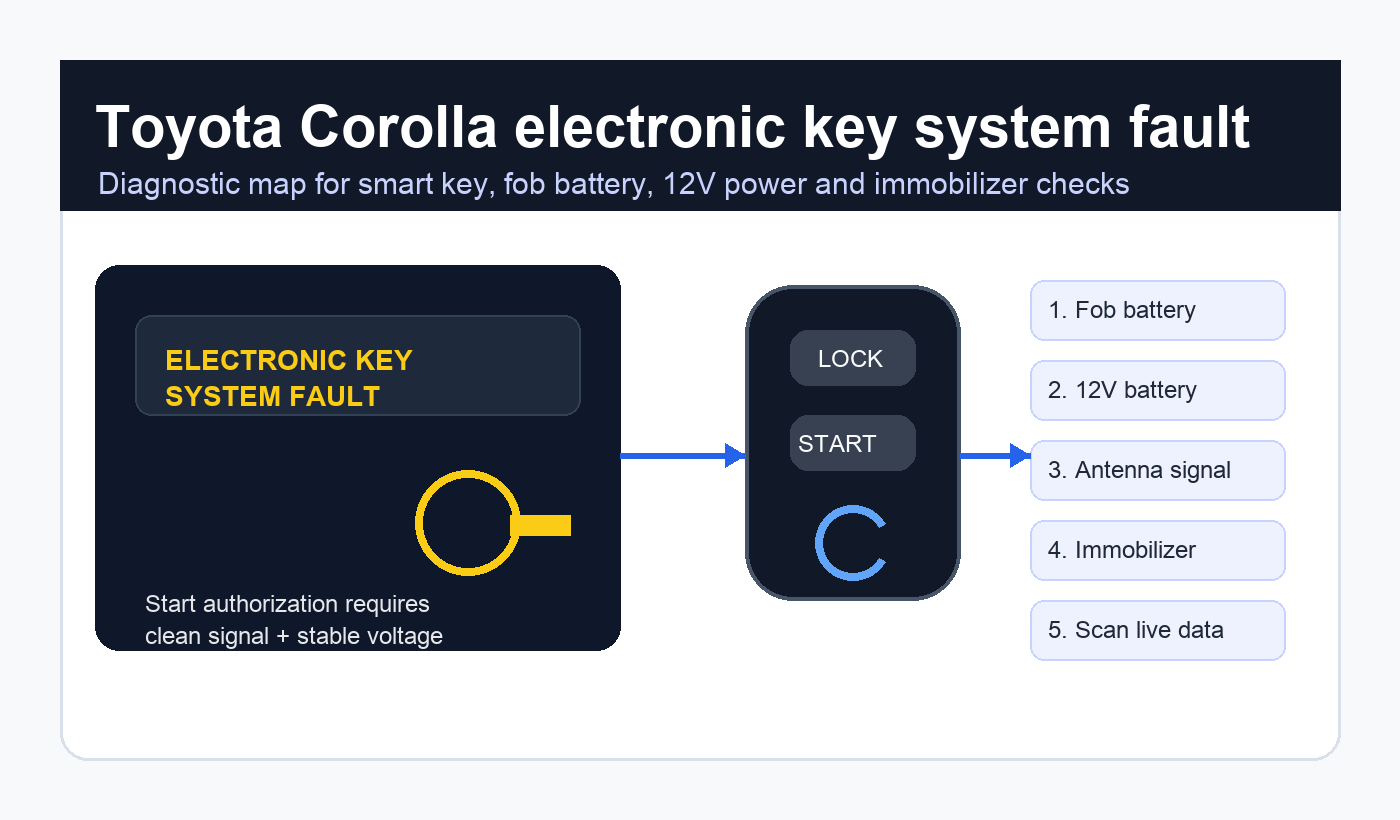
    Toyota Corolla electronic key system fault diagnostic path: fob battery, 12-volt battery, antenna detection, immobilizer authorization and start-button logic.

    Quick answer: what the warning usually means

    A Toyota Corolla electronic key system fault usually means the vehicle cannot reliably complete communication between the electronic key, the smart key antennas, and the immobilizer/start authorization system. In many cases the cause is ordinary: a weak CR2032 key fob battery, a low 12-volt battery, radio interference, a key stored beside a phone or metal object, or a start procedure issue such as the brake pedal signal not being seen. In less common cases, the fault can point to a damaged key, water intrusion, a failing interior/exterior antenna, a defective start switch, wiring corrosion, or a control-module fault that needs Toyota Techstream or an equivalent professional scan tool.

    The important detail is that the message should not be diagnosed from the dashboard wording alone. A Corolla can display a smart key warning because the fob is weak, but it can also display a similar warning because the car itself is under-voltage. Modern keyless entry systems are convenient, but they depend on clean electrical supply and correctly synchronized security communication.

    SymptomMost likely areaFirst checkUrgency
    Car unlocks but will not startSmart key detection, brake switch, 12-volt batteryHold fob against start button and press brake firmlyMedium to high
    Message appears only in cold weatherWeak fob battery or weak 12-volt batteryTest both batteries under loadMedium
    Both keys fail at the same timeVehicle-side power, receiver, antenna, moduleCheck 12-volt battery and scan codesHigh
    One key fails, spare worksKey fob battery, damaged fob, lost programmingReplace fob battery and compare spareLow to medium
    Intermittent no-detect near certain locationsRadio interference or key shieldingMove vehicle/key away from interference sourcesLow

    What owners need to know first

    The exact phrase Toyota Corolla electronic key system fault is a long-tail diagnostic question. It is not a broad shopping topic. People using it are usually already seeing a dashboard message, a no-start condition, or an intermittent smart key failure. In public search behavior, exact-match volume for a phrase this specific is typically low, but the surrounding cluster is much larger because owners search the same fault in many different ways.

    The strongest associated phrases include Toyota Corolla smart key system malfunction, Toyota Corolla key not detected, Toyota Corolla key fob not working, Toyota Corolla push button start not working, Toyota Corolla immobilizer problem, Toyota Corolla key battery warning, Toyota Corolla keyless entry problem, Toyota Corolla remote key not unlocking, Toyota Corolla start button no response, Toyota smart key system warning, Toyota electronic key malfunction, Toyota Corolla spare key works, Corolla cannot detect key, Corolla key fob battery replacement, Toyota Corolla 12V battery smart key issue, Toyota Corolla security light flashing, Toyota Corolla no start key symbol, Toyota Corolla key programming, Toyota Corolla door handle sensor not working, Toyota Corolla antenna smart key fault, Toyota Corolla body control module key fault, Toyota Corolla brake switch start problem, Toyota Corolla dealership key diagnosis, and Toyota Corolla diagnostic trouble codes.

    That cluster matters because a driver may not know Toyota’s exact wording. Some will type Toyota Corolla electronic key system fault; others will type “key not detected” or “Corolla won’t start with smart key.” A good diagnostic article has to answer all of those intents without becoming a stack of topics. The owner wants a decision tree: what to check first, what not to replace blindly, when the vehicle is safe to drive, and when professional diagnosis is the cheaper route.

    How the Corolla electronic key system works

    To understand a Toyota Corolla electronic key system fault, picture the system as a conversation rather than a single part. The key fob is not simply a remote. It is a coded transmitter and transponder. The vehicle has antennas and receivers positioned to detect whether the key is outside the car for locking/unlocking or inside the cabin for starting. The immobilizer verifies that the key is authorized. The push-button start logic then checks other inputs, including brake pedal status, gear selector position, and vehicle power state.

    When everything is healthy, the driver touches the door handle, the car detects the key, unlocks the door, and later authorizes the start sequence when the brake pedal and start button are pressed. When something is weak or inconsistent, the same process can fail at different points. That is why one Corolla may unlock but not start, while another may start but show a warning after shutdown.

    The key fob side

    The electronic key contains a small battery, a transmitter circuit, buttons, a passive transponder function, and sometimes an emergency mechanical blade. A low fob battery can reduce range long before it dies completely. The buttons may still work at close distance while the passive smart key detection becomes unreliable. This is one reason a Toyota Corolla electronic key system fault can appear even though the lock button still seems to operate.

    The vehicle side

    The vehicle side includes smart key antennas, a certification ECU or smart key control logic depending on model year and market, the immobilizer system, body electrical control, door handle sensors, start switch, brake switch, wiring, fuses, and the 12-volt electrical supply. A fault on the vehicle side is more likely when both key fobs fail, when the car behaves differently after a jump start, or when the warning appears with other electrical symptoms.

    The authorization side

    The authorization step is the security gate. The car does not only need to “see” a key; it needs to verify that the key belongs to the vehicle. If the key is damaged, unregistered, desynchronized, or blocked by interference, the immobilizer can refuse start authorization. In that moment, the driver may see a key symbol, a smart key warning, or a no-start condition that feels random.

    Most common causes, ranked by probability

    A good diagnosis starts with probability. The most common causes of a Toyota Corolla electronic key system fault are not the most expensive modules. They are usually small, testable, and often related to power quality.

    RankCauseWhy it happensTypical clueBest next action
    1Weak key fob batteryReduced signal strength or unstable fob wake-upWorks close to vehicle, fails at distanceReplace with quality CR2032 and retest
    2Weak 12-volt batteryModules wake up slowly or voltage drops during start requestWarnings after sitting overnightLoad-test the 12-volt battery
    3Interference or key shieldingRF communication is blocked or disturbedProblem occurs in one location or with key near phoneMove key/vehicle, remove metal cases
    4Brake switch or start condition issueCar does not see a valid start requestBrake lights inconsistent, start button does not change modeCheck brake lights and scan live data
    5Damaged key fobWater, impact, worn buttons, cracked boardSpare key works normallyInspect fob and test spare
    6Antenna/receiver faultVehicle cannot detect key in one zoneWorks in cabin but not at handle, or oppositeScan smart key data and antenna codes
    7Module or wiring faultControl unit, connector, fuse, corrosion, prior repairBoth keys fail, codes return after clearingProfessional diagnosis

    Step-by-step diagnosis before replacing parts

    Step 1: try the emergency start method

    If the Corolla does not recognize the key, hold the fob close to the start button while pressing the brake pedal and then press the start button. Many Toyota smart key systems include a fallback recognition method for a weak key battery. If this works, the fault is likely related to fob power or detection range rather than a completely dead immobilizer system.

    When a Toyota Corolla electronic key system fault disappears after using the fob near the start button, do not stop at “it started.” Replace the fob battery and test the spare key. The emergency start trick is a clue, not a permanent repair.

    Step 2: replace the key fob battery correctly

    Use the correct battery type for your fob, commonly CR2032 on many Toyota smart keys, but always confirm for your exact key. Install it with clean hands, avoid bending the battery contacts, and make sure the case snaps shut evenly. Cheap old-stock batteries can test acceptably with no load but fail in real use. If the warning began after a battery change, reopen the fob and check polarity and contact pressure.

    A Toyota Corolla electronic key system fault after a fob battery replacement often comes from a poor contact, a damaged shell, or a battery that was already weak in the package. Comparing the main key against the spare is one of the fastest ways to separate key-side faults from vehicle-side faults.

    Step 3: check the 12-volt battery, not just the key battery

    Many owners overlook the 12-volt battery because the warning mentions the electronic key. That is a mistake. Smart key modules, immobilizer logic, relays, and brake/start authorization circuits all rely on stable low-voltage power. A Corolla can have enough power to light the dash and still be weak enough to confuse modules during start-up.

    If the car has been parked for days, if the warning appears in cold weather, if multiple warning lights appear together, or if the message comes after a jump start, test the 12-volt battery under load. Voltage at rest is useful, but it is not the whole story. A battery can show around 12 volts and still collapse during a start request.

    Step 4: compare both keys

    The spare key is not just a backup; it is a diagnostic tool. If one key produces a Toyota Corolla electronic key system fault and the other key works normally in the same location, the problem is probably the key fob, its battery, or its registration. If both keys fail in the same way, the vehicle side becomes more suspicious.

    When testing, keep conditions identical. Stand in the same place, use the same door, press the same buttons, and try the same start procedure. Do not test one key at home and the other at a fuel station surrounded by different interference sources.

    Step 5: remove interference and bad storage habits

    Smart keys can be affected by where they are stored. A key fob pressed against a smartphone, tablet, wireless charger, metal wallet, RFID-blocking pouch, laptop, or stack of other keys may not communicate cleanly. Some owners only see the problem when the fob is in a particular bag or pocket.

    Before assuming a serious Toyota Corolla electronic key system fault, place the key by itself, away from electronics and metal. Try unlocking from a few positions around the car and then try starting with the fob in the center console area. If the symptom changes dramatically, the issue may be signal environment rather than a failed module.

    Step 6: inspect simple vehicle inputs

    The car must see the correct conditions before it starts. On automatic models, it expects the gear selector position to be valid. It expects the brake pedal signal. It expects the start button press. A brake light switch fault can feel like a key problem because the car sees the key but does not accept the start request.

    Check whether the brake lights illuminate consistently. Notice whether the start button changes from accessory to ignition-on modes. If the dash acts alive but the vehicle refuses to crank or ready-on, the electronic key may not be the only part of the story.

    When the fault appears after a battery replacement or jump start

    A Toyota Corolla electronic key system fault after battery work deserves special attention. Disconnecting or jump-starting a weak 12-volt battery can expose a marginal electrical system. Sometimes modules need a clean restart. Sometimes a fuse, terminal, ground, or battery sensor connection was disturbed. Sometimes the original battery was not the only issue.

    Start with the basics: confirm the battery terminals are tight, clean, and correctly seated. Check the ground connection. Look for corrosion. Verify that the battery is the correct size and specification. If the warning appeared immediately after someone worked under the hood, inspect what was touched before replacing electronic parts.

    Dashboard messages that owners confuse with this fault

    Not every key-related warning is the same. Owners may describe several messages as Toyota Corolla electronic key system fault, but the root meaning can vary by model year, market, trim, and instrument cluster language.

    Driver descriptionLikely meaningDiagnostic direction
    “Key not detected”Vehicle cannot detect an authorized fob in rangeFob battery, antenna zone, interference
    “Key battery low”Fob battery voltage is weakReplace fob battery and retest
    “Smart key system malfunction”Vehicle detected a system faultScan smart key/immobilizer codes
    Security light flashingImmobilizer status or key authorization issueCompare spare key, check immobilizer codes
    No message, no startMay not be a key fault at all12-volt battery, brake switch, starter circuit

    What a professional scan should include

    If basic checks do not solve the Toyota Corolla electronic key system fault, the next step is a proper scan. A generic OBD reader may not be enough. The problem may live in body control, smart key, immobilizer, certification, or gateway modules rather than the engine ECU. Toyota Techstream or a professional scan tool with deep Toyota coverage is the right approach.

    A useful diagnostic session should check stored and current DTCs, key registration status, antenna recognition data, start switch input, brake switch input, vehicle battery voltage during start request, door handle sensor status, and immobilizer authorization. Clearing codes without recording them is bad practice. Intermittent smart key problems often depend on freeze-frame clues.

    Codes do not replace logic

    A diagnostic trouble code can point to a circuit, but it does not always name the failed part. For example, an antenna-related code may be caused by the antenna, wiring, connector corrosion, water intrusion, or a control-unit issue. A Toyota Corolla electronic key system fault should be diagnosed with live data and physical checks, not only with a code list.

    Can you drive with this warning?

    If the Corolla starts normally and the warning appears only briefly, you may be able to drive to a safe location or repair appointment. But you should not ignore a recurring Toyota Corolla electronic key system fault. The risk is not usually that the car will suddenly shut off while driving; the more common risk is being unable to restart after parking.

    If the car is already refusing to start, if both keys fail, if the 12-volt battery is weak, or if the warning appears with multiple electrical warnings, treat the issue as urgent. Do not keep cycling the start button repeatedly until the battery is drained. That can add a second problem to the first.

    Owner checks versus dealer-level checks

    CheckOwner can do?Tools neededWhat it proves
    Replace fob batteryYesCorrect coin cell, small toolRules out the most common key-side cause
    Try spare keyYesSpare keySeparates key fault from vehicle fault
    Move away from interferenceYesNoneIdentifies location or storage-related signal issues
    12-volt load testSometimesBattery testerConfirms power stability
    Smart key live dataNo, usuallyToyota-capable scan toolShows antenna and authorization status
    Key registrationNoDealer/locksmith equipmentConfirms programmed key identity

    How not to waste money

    The expensive mistake is replacing parts in the order they are imagined rather than tested. A Toyota Corolla electronic key system fault should not automatically lead to a new key, a new start button, or a new module. The best order is battery, spare key comparison, interference check, 12-volt test, scan data, then parts.

    Another mistake is buying a used key online and expecting it to work without programming. Smart keys are security components. Depending on model year and system, adding or replacing a key may require proper registration equipment and proof of ownership. A cheap key shell may fix a broken case; it will not create authorization by itself.

    Model year differences and why they matter

    Corolla electronics differ by generation, trim, market, and whether the vehicle uses a traditional key, remote keyless entry, or full smart key with push-button start. A 2014 Corolla with a conventional ignition does not behave like a late-model hybrid Corolla with smart entry and start. That is why a Toyota Corolla electronic key system fault must be matched to the exact vehicle.

    When searching for information or ordering parts, use the VIN, market, model year, trim, and key type. The wrong assumption can lead to the wrong battery, wrong fob, wrong programming method, or wrong diagnosis.

    Security context: why keyless systems are complex

    Remote and passive keyless systems are designed to be convenient while resisting unauthorized access. That requires rolling codes, encrypted communication, immobilizer validation, and safeguards against accidental start authorization. Academic research into remote keyless entry and passive keyless systems shows why these systems are more than simple radio remotes: they are security protocols running in a noisy real-world environment.

    For an owner, this explains why a Toyota Corolla electronic key system fault may feel inconsistent. The system is trying to avoid accepting a weak, invalid, or suspicious signal. It is better for the car to refuse a start request than to accept the wrong key. The downside is that low voltage, interference, or a marginal fob can produce a frustrating warning.

    When to call Toyota, a dealer, or an automotive locksmith

    Call a Toyota dealer or a qualified automotive locksmith if both keys fail, the car will not start after a fresh fob battery and 12-volt battery test, the warning returns immediately after clearing codes, the vehicle was recently repaired after water damage or collision, or the key was lost and replaced with an unregistered unit.

    For official owner documentation, use Toyota’s owner manual portal: Toyota Owner’s Manuals and Warranty Guides. For safety recalls and VIN-based recall checks, use the official U.S. government recall lookup: NHTSA recalls database. These two references are more reliable than forum guesses when you need model-specific safety or service context.

    Related diagnostic reading on this site

    If you work on other electronic systems, the same diagnostic discipline applies: power first, signal second, module last. You may also find these internal guides useful: motorcycle electronics guides, fitment guides, and motorcycle electronics parts. They are not Corolla-specific, but they follow the same practical logic: confirm compatibility, check power and connectors, and avoid replacing parts without evidence.

    Practical diagnostic checklist

    Use this checklist when a Toyota Corolla electronic key system fault appears:

    • Confirm the exact dashboard wording and when it appears.
    • Try the spare key under the same conditions.
    • Replace the key fob battery with a fresh quality cell.
    • Hold the fob against the start button and try the emergency start method.
    • Move the key away from phones, metal cases, wallets, and wireless chargers.
    • Test the 12-volt battery under load, especially after cold starts or parking.
    • Check brake lights and start-button behavior.
    • Look for water damage, recent repair work, or loose battery terminals.
    • Scan Toyota body/smart key/immobilizer modules, not only engine codes.
    • Record all codes before clearing them.

    Frequently asked questions

    Can a weak key fob battery cause this message?

    Yes. A weak fob battery is one of the most common reasons for a Toyota Corolla electronic key system fault. The confusing part is that the fob may still unlock the doors in some conditions. Passive detection and button operation do not always fail at the same moment.

    Can the 12-volt battery cause a key system warning?

    Yes. A weak 12-volt battery can cause modules to wake up incorrectly, communicate slowly, or drop voltage during a start request. If multiple warnings appear together, check the 12-volt battery before blaming the smart key.

    Why does the car start when I hold the key near the start button?

    That usually means the fallback recognition method is working. It often points to a weak fob battery or reduced detection range. It does not prove the system is fully healthy; it simply helps separate a completely dead authorization system from a weak key detection condition.

    Is the fault dangerous?

    The biggest practical risk is being stranded after parking. A recurring Toyota Corolla electronic key system fault should be handled before it becomes a no-start problem. If the warning comes with other electrical faults, treat it more urgently.

    Do I need a new key?

    Not necessarily. You need evidence first. If the spare key works perfectly and the main key fails after a fresh battery, a damaged or unregistered key becomes likely. If both keys fail, look at the vehicle side before buying another fob.

    Final diagnosis strategy

    The best way to solve a Toyota Corolla electronic key system fault is to move from simple evidence to deeper evidence. Start with the fob battery because it is cheap and common. Compare the spare key because it is decisive. Test the 12-volt battery because modern electronics are sensitive to voltage. Remove interference because wireless systems are vulnerable to environment. Then scan the smart key and immobilizer modules because hidden body-electrical codes often tell the truth.

    When you follow that order, the warning becomes less mysterious. A Toyota Corolla electronic key system fault is not a command to replace the most expensive part. It is a request to verify the communication chain: key, power, antenna, immobilizer, start input, and module logic. Diagnose that chain carefully and the repair becomes much clearer.

    Owner notes by situation

    Toyota Corolla electronic key system fault after rain or a car wash should make you think about moisture around handles, connectors and the key itself.

    Toyota Corolla electronic key system fault after a long airport parking stay should make you test the 12-volt battery before condemning the fob.