Honda NSC 50 R power increase
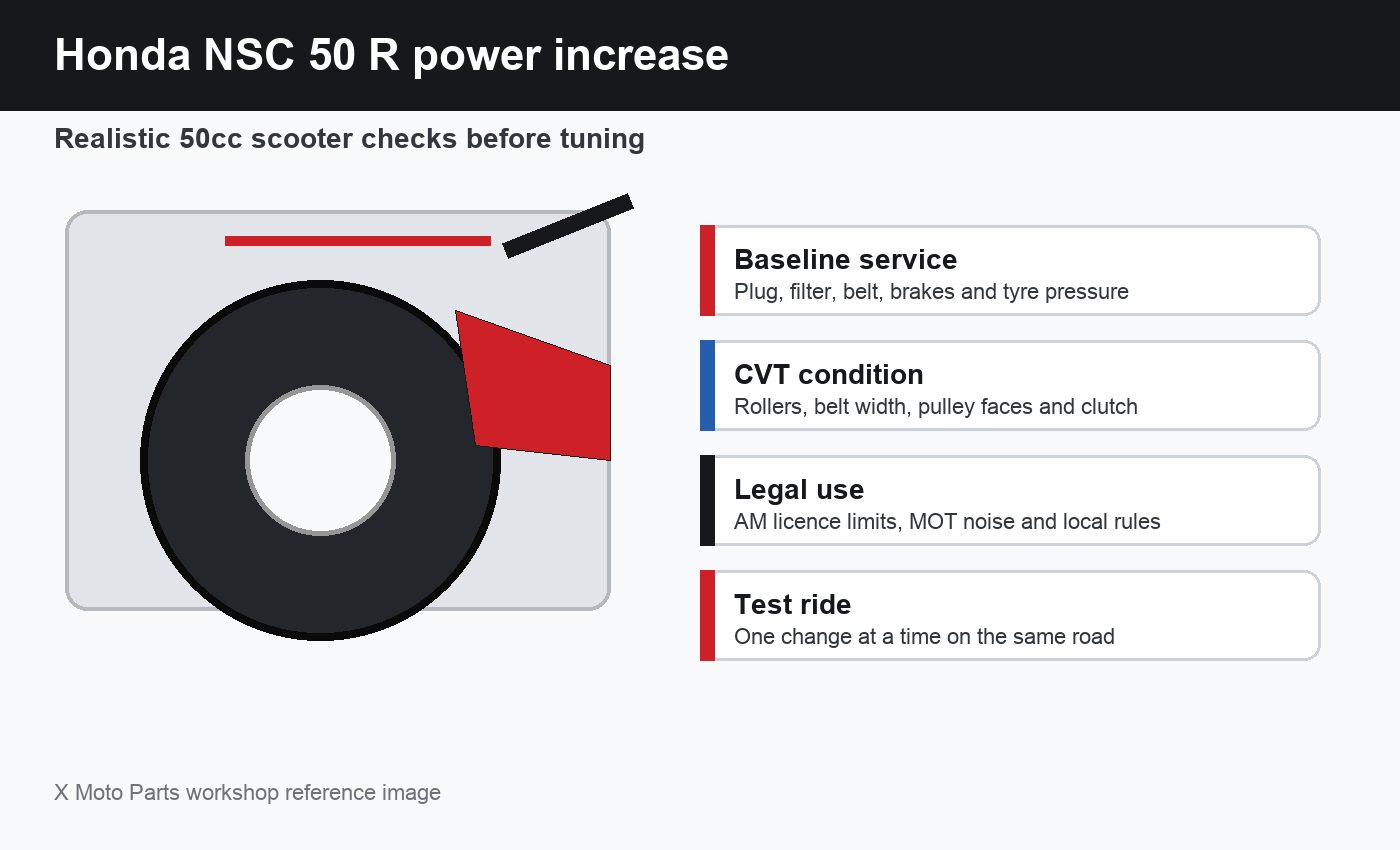
Honda NSC 50 R power increase is not about turning a fuel-injected 49cc scooter into a fast motorcycle. It is about finding the performance the scooter can safely deliver, removing the drag created by worn parts, setting up the V-Matic transmission properly and choosing only the upgrades that make the bike nicer to ride in the real world.
The NSC50R is a small, efficient Honda scooter with a four-stroke air-cooled engine, PGM-FI fuel injection, an automatic centrifugal clutch and a belt-driven CVT. That combination is reliable, economical and easy to use, but it also means every improvement has to be judged carefully. A loud exhaust, an extreme roller weight or a badly fitted intake part can make the scooter slower, noisier and less pleasant. A good Honda NSC 50 R power increase plan starts with diagnosis, not shopping.
Owners usually search this topic because the scooter feels lazy uphill, struggles to hold speed in traffic, has poor launch from a standstill or feels restricted compared with expectations. Sometimes the answer is tuning. More often, the answer is a tired belt, flat-spotted rollers, poor tyre pressure, dragging brakes, a dirty air filter or a service item that has been ignored. The practical route is to restore the baseline first, then improve the setup step by step.
What realistic gains look like on the Honda NSC50R
Honda NSC 50 R power increase should be measured by rideability first. On a 50cc four-stroke scooter, the useful improvements are usually cleaner launch, stronger pull from low speed, less hesitation after opening the throttle, steadier climbing on gentle hills and less of that tired feeling when the belt gets warm in traffic. Expecting a dramatic top-speed jump is the fastest way to make bad decisions.
Honda’s own NSC50R press information describes a compact 49cc air-cooled SOHC two-valve single with PGM-FI electronic fuel injection, V-Matic belt drive, CBS braking and a fuel-saving design. In other words, the engine was built for urban mobility and reliability, not high-output tuning. That does not make improvement impossible. It simply means the best work is precise and restrained.
A healthy NSC50R should start easily, idle steadily, pull away without a long delay and climb through the CVT ratio smoothly. If yours does not, tuning parts may hide the symptom for a short time, but they will not fix the cause. Before considering a chip tuning module category or exhaust work, confirm the scooter is mechanically sound.
| Owner complaint | Likely first check | Why it matters |
|---|---|---|
| Slow pull-away | Rollers, belt width, clutch glazing | The CVT decides how quickly engine torque reaches the rear wheel. |
| Poor hill speed | Tyre pressure, brake drag, variator travel | A small engine loses performance quickly when drag rises. |
| Flat throttle response | Air filter, spark plug, injector condition | Fuel-injected scooters need clean airflow and stable combustion. |
| More noise but no speed | Exhaust fitment and fueling behaviour | A freer pipe can reduce low-rpm pull if badly matched. |
| Intermittent hesitation | Battery voltage, sensor plugs, intake leaks | EFI problems can feel like tuning problems. |
Baseline checks before spending money
Honda NSC 50 R power increase begins with boring checks, which is exactly why it works. Put the scooter on the centre stand, let the engine cool and inspect it like a mechanic taking over an unknown machine. Check oil level and condition, spark plug type and gap, air filter condition, battery voltage, throttle free play, brake drag, tyre pressure, rear wheel bearing feel and any unusual CVT noise.
The scooter’s small engine has very little spare torque. A rear brake that drags slightly, a soft rear tyre or a worn belt can steal enough performance to make the bike feel restricted. If the belt is old or narrow, the variator may not reach its full ratio range. If the rollers are flat-spotted, the engine can hang in the wrong rpm band. If the air filter is blocked, the ECU has less clean air to work with.
For a careful Honda NSC 50 R power increase, record the scooter’s behaviour before changing parts. Use the same route, rider weight, tyre pressure and fuel load as much as possible. Note how it launches, how it climbs a familiar hill and how warm performance compares with cold performance. That simple baseline saves money because you can see whether each change actually helped.
Service parts that restore lost performance
A fresh spark plug, clean air filter, correct oil, healthy battery and properly inflated tyres can do more for a neglected scooter than a performance part fitted on top of poor maintenance. The aim is not glamour. The aim is to remove friction, restriction and inconsistency so the little Honda works as intended.
If the scooter has high mileage, inspect the variator guides, ramp plate, drive face, belt and clutch shoes. Dust inside the CVT cover is normal, but heavy belt dust, heat marks and glazed clutch surfaces show that the transmission has been working hard. Honda NSC 50 R power increase done properly treats the CVT as a wear system, not just a place to throw lighter rollers. A patient Honda NSC 50 R power increase check also looks for small drag losses that riders often overlook.
CVT, variator and roller setup
The V-Matic transmission is the centre of any sensible Honda NSC 50 R power increase project. A CVT scooter does not have gears for the rider to choose. Roller weight, belt condition, pulley angle, clutch engagement and contra spring behaviour decide whether the engine stays in its useful rpm range. If the CVT is wrong, the engine can sound busy without converting that noise into acceleration.
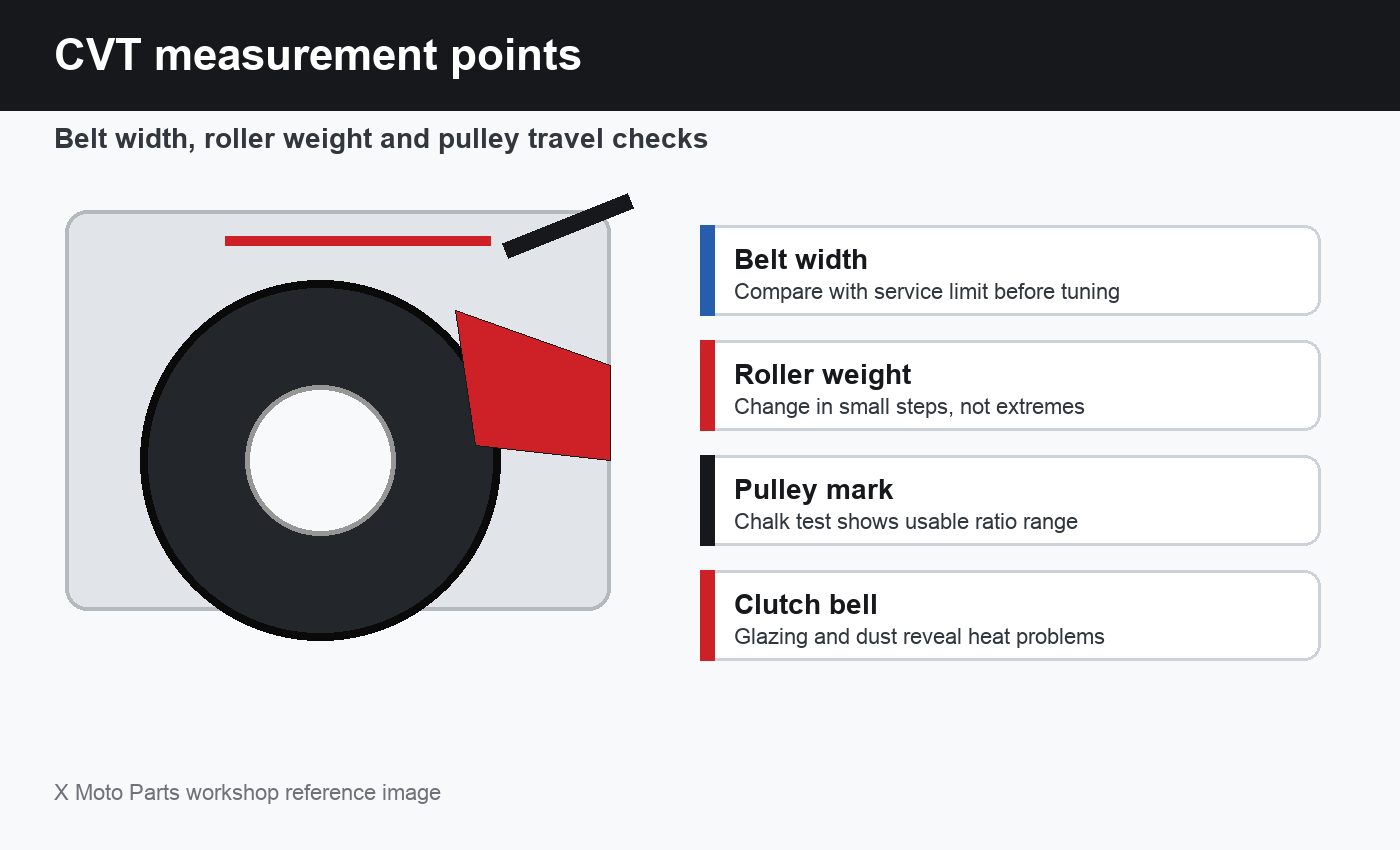
Start with inspection. Remove the CVT cover, clean the dust, check for oil contamination and inspect every rotating part. Measure the belt width with a vernier caliper if possible. Look for cracks, glazing and uneven wear. Check rollers for flat sides. If the clutch judders, inspect the bell for glazing and the shoes for uneven contact. When the parts are worn, replacing them with correct-quality standard parts may be the most honest performance upgrade.
Only after the baseline is healthy should you consider different roller weights or a variator kit. Lighter rollers usually let the engine rev higher before the ratio changes; too light, and the scooter screams without gaining speed. Heavier rollers can feel calmer, but too heavy makes the engine labour. Good Honda NSC 50 R power increase work changes roller weight in small steps and tests the same road after each change.
| CVT option | Main advantage | Possible downside | Best use case |
|---|---|---|---|
| Correct stock refresh | Restores smooth original performance | Does not change the character much | Unknown service history or worn commuter scooter |
| Slightly lighter rollers | Sharper launch and better hill response | More revs and possible noise if overdone | Urban riding and heavier riders |
| Performance variator | Can improve ratio behaviour | Needs correct setup, not plug-and-forget | Owners willing to test carefully |
| Clutch spring changes | Can alter take-off feel | May create harsh engagement | Only after clutch condition is confirmed |
| Final drive changes | Potential top-speed bias | Can weaken acceleration badly | Rarely the first choice on a 50cc commuter |
The chalk test for pulley travel
A workshop trick for a Honda NSC 50 R power increase check is to mark the drive face with chalk or a removable marker from centre to edge, then ride normally and inspect how much of the mark has been wiped away. If a wide band remains near the outer edge, the belt may not be climbing fully. The cause might be belt width, roller weight, variator wear or a setup mismatch.
This test does not replace service data, but it gives useful evidence. A small scooter needs the transmission to use as much safe ratio range as possible. When the CVT operates cleanly, the rider feels a scooter that pulls with less fuss and reaches its normal cruising speed with less strain. For Honda NSC 50 R power increase, that repeatable feel matters more than a single optimistic speed reading.
Fuel injection, airbox and exhaust choices
Honda NSC 50 R power increase often attracts quick-fix promises around fuel modules, open filters and louder exhausts. Be careful. The NSC50R uses PGM-FI injection and was designed around a specific airbox, exhaust catalyst, throttle body and sensor layout. If you change airflow without thinking, the scooter can become less stable at low rpm, lose fuel economy or fail to pull cleanly when hot.
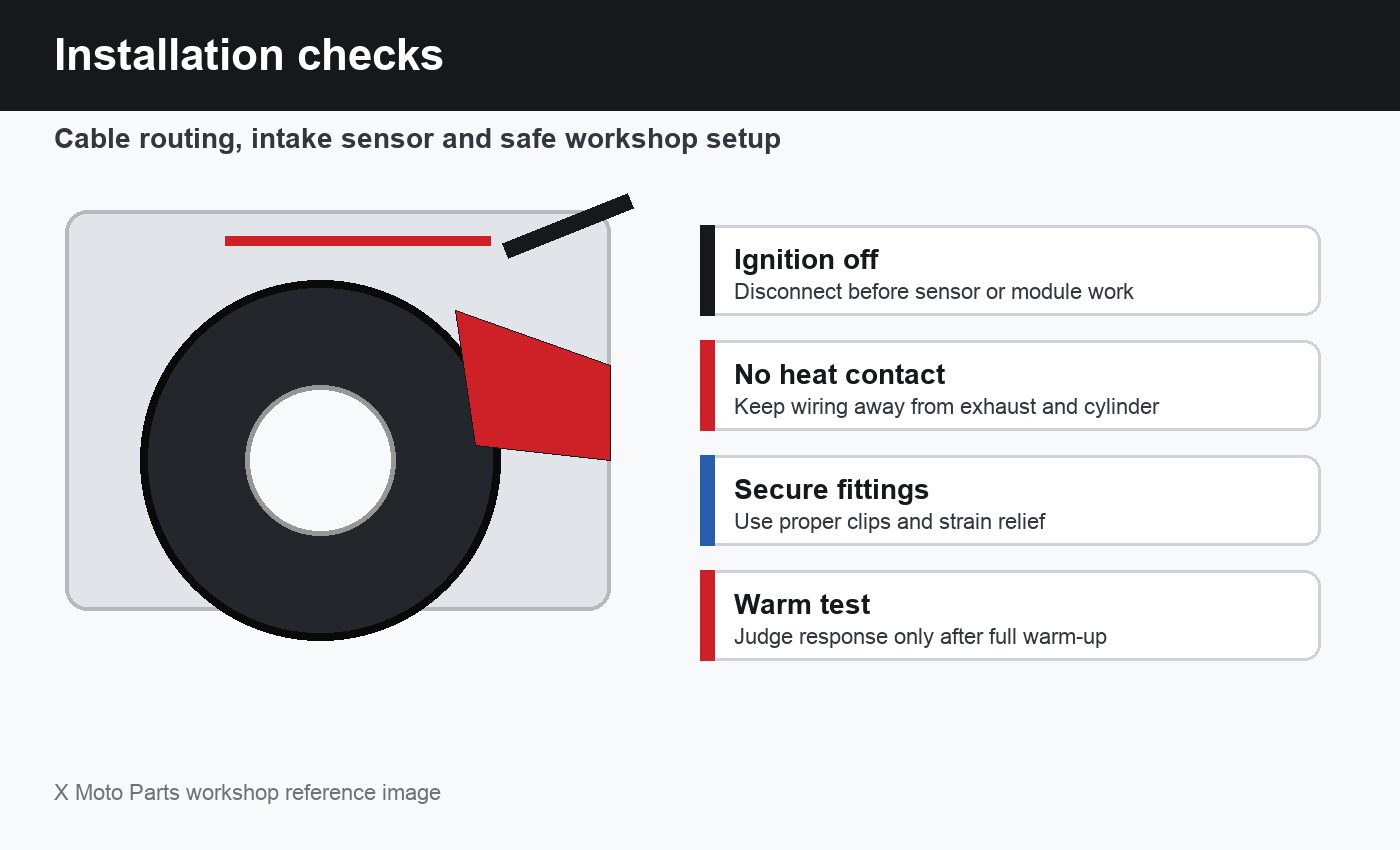
The standard airbox is usually better than an exposed cone filter for daily use because it shields the intake from rain, road dirt and hot air. A clean panel filter and sealed airbox are often the correct choice. Intake leaks around the manifold can create lean symptoms, hard starting and hesitation. Before fitting any electronic product, inspect the sensor connectors and wiring condition. A compatible module should be reversible, secure and set conservatively.
Exhaust work needs the same restraint. A lighter silencer can improve appearance and sound, but on a 49cc four-stroke the wrong pipe can reduce low-speed torque. The exhaust must fit securely, clear bodywork and suspension, seal correctly at the header and remain suitable for the intended use. Anyone comparing exhaust parts should also read the universal motorcycle exhaust buying guide before assuming that a universal silencer is plug-and-play.
When a chip module makes sense
A module only makes sense when it matches the exact connector layout and the scooter is already healthy. For Honda NSC 50 R power increase, electronics should be treated as fine adjustment, not a cure for worn mechanical parts. Start from the lowest setting, warm the engine fully and watch for rich smell, rough idle, hesitation or worse fuel economy.
If the scooter runs worse after the part is fitted, do not keep increasing the setting. Return to the baseline, inspect the connectors and test again. If a fault light appears, stop guessing and diagnose the issue. A small Honda that starts cleanly every morning is worth more than a slightly sharper throttle that becomes unreliable in wet traffic.
Compatibility checks for parts and upgrades
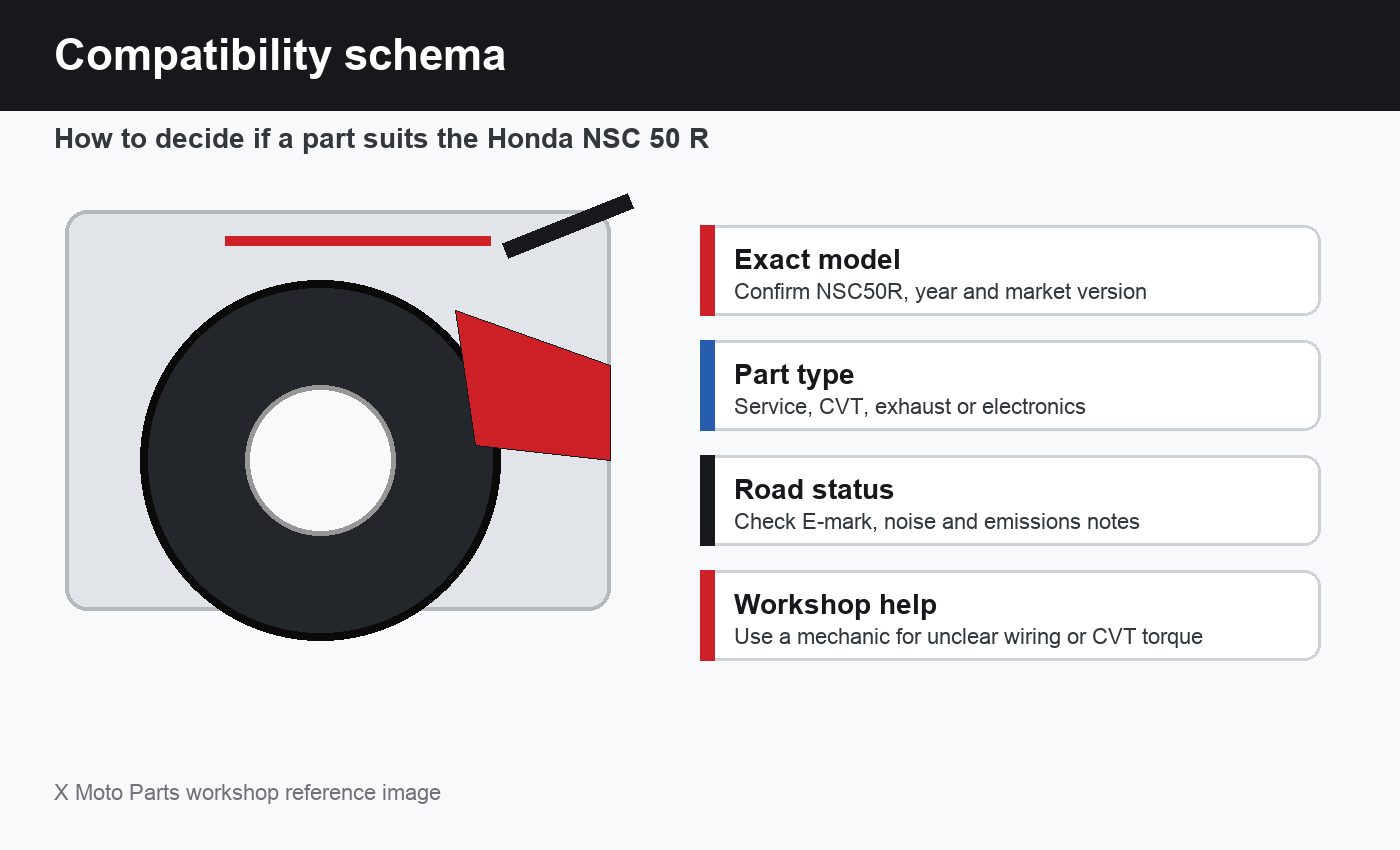
Compatibility is where many 50cc scooter projects go wrong. Honda NSC 50 R power increase searches often mix the NSC50R, Vision 50, regional model names and different production years. Before buying anything, confirm the exact model, market version, engine type, sensor location, exhaust mounting points and CVT dimensions. Theoretical fitment is not the same as real fitment on a scooter that has been repaired, modified or imported.
| Part or vehicle area | Compatibility | Important note |
|---|---|---|
| Honda NSC50R / Vision 50 engine service parts | Usually model-specific | Confirm year, plug type, filter shape and engine code before ordering. |
| CVT belt and rollers | Depends on exact dimensions | Measure belt width and roller size; do not rely only on model name. |
| Aftermarket exhaust | Depends on mounting and road approval | Check flange, bracket, clearance, catalyst notes, DB-killer and E-mark where relevant. |
| Fuel or chip module | Only with matching sensor connectors | Inspect intake air temperature sensor area and wiring before ordering. |
| Universal scooter parts | Often possible with adaptation | Universal does not mean plug-and-play; professional fitting may be necessary. |
For product browsing after the checks above, the performance parts category is a better next step than buying blindly from a generic listing. Riders comparing similar Honda small-capacity tuning approaches can also use the Honda Vision 110 tuning guide and the Piaggio Liberty 50 4T power increase guide to understand how service condition and CVT setup affect small scooters.
UK and anglophone road-use rules
Honda NSC 50 R power increase has to be separated into road use, track use, private-area use and off-road use. In the UK, a moped and its rider must remain within the correct licence, CBT and vehicle category rules. GOV.UK explains CBT requirements for mopeds and motorcycles, including the basic age and training framework for riding on the road. Always check your own licence position before modifying a 50cc scooter.
For MOT, the UK motorcycle inspection manual states that the exhaust should not be clearly unreasonably louder than a similar motorcycle with a standard silencer in average condition, and the structure section treats insecure exhausts and silencers marked “track use only” or similar as serious defects. That is why exhaust legality is not just about volume. It is about marking, security, leaks, noise and intended use.
In practical terms, road riders should verify E-mark information where relevant, keep any DB-killer fitted if the exhaust is approved with it, avoid removing emissions equipment and tell the insurer about modifications. In the United States, Canada, Australia, New Zealand and Ireland, rules differ by state, province or national framework. Do not assume a part accepted in one market is legal in another. GOV.UK CBT motorcycle and moped training is a useful UK starting point, while the GOV.UK motorcycle MOT exhaust noise section explains how exhaust noise is assessed in Britain.
Road tuning versus private-use tuning
Road-focused Honda NSC 50 R power increase should keep the scooter civil, quiet enough, reliable and compatible with inspection rules. Track-only or private-area experimentation can be different, but the rider still needs safe installation, secure exhaust mounting and predictable braking. A 50cc scooter with more revs, worn tyres and weak brakes is not an upgrade; it is a problem waiting for traffic.
Common mistakes that make the scooter worse
The most common Honda NSC 50 R power increase mistake is fitting parts before diagnosing the scooter. Owners buy an exhaust because the bike is slow, then discover the belt was worn. They fit extreme rollers because a forum suggested it, then the engine revs more without moving faster. They install an intake filter because it sounds sporty, then rain and heat soak make the scooter worse in daily riding.
Other mistakes include ignoring tyre pressure, not measuring belt width, assuming every NSC50R variant uses identical parts, fitting an exhaust without checking bracket alignment, removing a DB-killer on a road bike, running wiring near the cylinder or exhaust, leaving the battery weak, and judging performance by sound instead of measured road behaviour. Good tuning is calm, repeatable and easy to live with.
| Mistake | What usually happens | Better approach |
|---|---|---|
| Buying a loud exhaust first | More noise, possible loss of low-speed torque | Service and test CVT condition before exhaust changes. |
| Using very light rollers | High revs with little extra road speed | Move in small weight steps and compare on the same hill. |
| Ignoring belt wear | Poor ratio range and inconsistent warm performance | Measure belt width and replace worn parts with correct dimensions. |
| Assuming universal fitment | Bracket, clearance or sensor mismatch | Check physical dimensions and connector layout before ordering. |
| Skipping legal checks | MOT, insurance or road-use problems | Confirm approval markings, intended use and local rules. |
Workshop-style setup sequence
A careful Honda NSC 50 R power increase sequence looks like this: service the engine, inspect the brakes and tyres, clean the CVT, measure the belt, refresh worn standard parts, test the scooter, then make one tuning change at a time. The order matters because every later decision depends on the earlier evidence.
After each change, ride the scooter warm. Listen for belt slap, clutch judder, exhaust leaks and flat spots. Check that the rear wheel spins freely, the throttle returns instantly and the scooter starts normally after a hot stop. If performance improves for five minutes then fades, suspect heat, belt slip, clutch glazing or fueling inconsistency.
When to use a mechanic
Use a mechanic when you are unsure about CVT torque settings, exhaust sealing, wiring, sensor identification, fuel leaks, brake drag or strange noises after installation. Honda NSC 50 R power increase should not leave the scooter difficult to start, unstable at idle or unsafe to stop. Professional help is cheaper than replacing damaged transmission parts or chasing an electrical fault caused by poor routing.
Buying advice before choosing parts
Before buying, decide what problem you are solving. If the scooter is slow from a stop, look at belt, rollers and clutch condition. If it struggles only on hills with a heavy rider, a mild CVT setup may help more than exhaust work. If throttle response is flat after intake or exhaust changes, check fueling only after the mechanical side is confirmed. A balanced Honda NSC 50 R power increase plan chooses parts around evidence.
Anyone shopping for scooter parts should write down the exact model name, production year, current mileage, engine condition, any existing modifications, belt size, roller size and intended use. Then compare products based on compatibility and support, not only price. The X Moto Parts shop can be used as a starting point for checking categories and related motorcycle parts after those measurements are known. A sensible Honda NSC 50 R power increase purchase should make the scooter easier to use, not harder to maintain.
FAQ about Honda NSC50R tuning and power
Can a Honda NSC50R be made much faster?
Honda NSC 50 R power increase can improve the way the scooter pulls and responds, but a 49cc four-stroke has strict physical limits. Expect better setup and recovered performance rather than big motorcycle speed.
What is the best first upgrade for a slow NSC50R?
The best first upgrade is often maintenance: belt, rollers, air filter, plug, tyre pressure and brake check. If those are neglected, tuning parts will not give a fair result.
Do lighter rollers always improve acceleration?
No. Slightly lighter rollers can help launch and hill response, but rollers that are too light make the engine rev without useful speed. Testing in small steps is essential.
Will an exhaust improve Honda NSC 50 R power increase results?
An exhaust can change sound, weight and response, but it must match the engine and remain suitable for the road if used legally. A badly matched pipe can reduce low-rpm torque.
Do I need to remap a Honda NSC50R after fitting an exhaust?
Not always. A mild exhaust on a healthy scooter may not need electronic changes. If intake or exhaust changes create clear fueling symptoms, use only compatible and conservative products.
Is derestricting a 50cc scooter legal in the UK?
It depends on the scooter category, licence position, road use and resulting performance. If changes move the vehicle outside its legal moped classification or affect MOT/insurance status, road use can become a problem.
Can I fit universal tuning parts to the NSC50R?
Some universal parts can be adapted, but universal does not mean plug-and-play. Measure CVT parts, exhaust brackets, pipe diameter and wiring connectors before buying.
Why does my scooter feel slower after tuning?
The usual causes are rollers that are too light or heavy, belt slip, exhaust mismatch, intake leaks, clutch glazing, poor wiring or judging the scooter before it is fully warm.
Final verdict
Honda NSC 50 R power increase is worth doing when the goal is a cleaner, healthier and more responsive scooter. The right path is simple: restore the service baseline, measure the CVT, make modest changes, keep road-use rules in mind and test each result honestly. The wrong path is chasing noise, extreme rollers or vague universal parts without checking what the scooter actually needs.
Before placing an order, check the exact model year, belt and roller dimensions, exhaust mounting points, sensor connectors, intended road legality and the condition of the bike you already own. If the part needs adaptation or the wiring is unclear, use a mechanic. A well-set NSC50R should start easily, pull away smoothly, hold its normal speed with less effort and remain dependable for daily riding.