
Polaris Sportsman 800 problems: the real-world guide to EFI, overheating, charging, AWD and driveline faults
Polaris Sportsman 800 problems is a search that usually comes from owners who already know the Sportsman 800 can be a strong, useful ATV, but have run into the familiar frustrations of an older high-displacement utility machine: heat, hard starting, weak charging, belt trouble, AWD complaints, suspension wear, brake drag and electrical gremlins. The Sportsman 800 is not one single model year or one single symptom, so the best answer is a diagnostic map rather than a verdict.
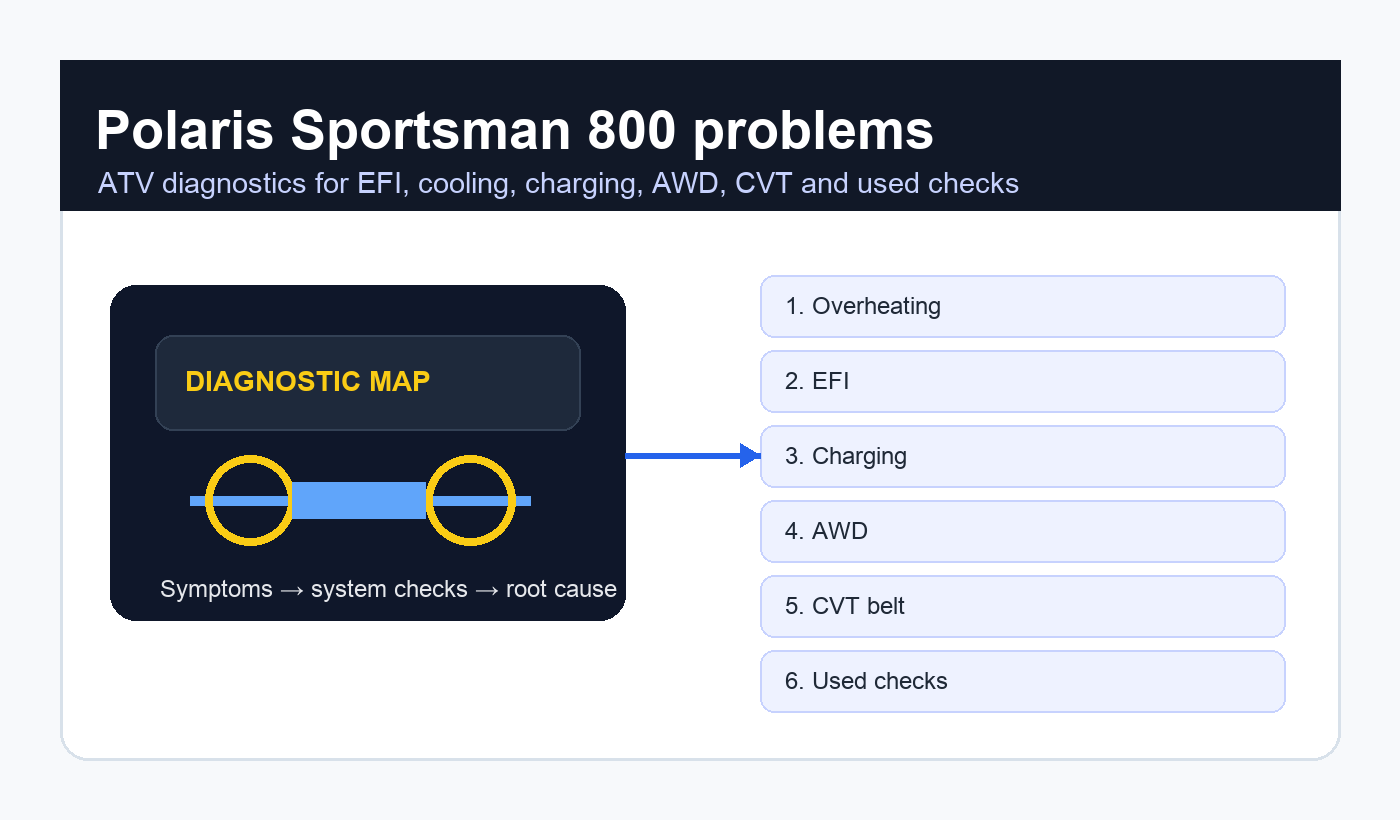
The 800-class Sportsman earned its reputation because it could work, tow, trail ride and handle rough terrain with serious torque. But that same use profile exposes every weakness: mud blocks radiators, oversized tires stress clutches and axles, winches drain batteries, water reaches connectors, and old maintenance records disappear. A smart diagnosis starts with the exact model year, hours, mileage, tires, accessories and service history.
What owners need to know first
This guide is written for owners, buyers and technicians dealing with Polaris Sportsman 800 problems in the real world. It focuses on symptoms, checks, realistic repair decisions, legal limits where relevant, and the points worth confirming before buying parts or trusting a seller’s claim.
Common related topics include Polaris Sportsman 800 EFI problems, Sportsman 800 overheating, Sportsman 800 hard starting, Polaris Sportsman 800 charging problems, Sportsman 800 voltage regulator, Polaris Sportsman 800 stator, Sportsman 800 fuel pump, Polaris Sportsman 800 AWD not working, Sportsman 800 front differential, Polaris Sportsman 800 belt problems, Sportsman 800 clutch noise, Polaris Sportsman 800 transmission, Sportsman 800 ADC problems, Polaris Sportsman 800 brake problems, Sportsman 800 wheel bearings, Polaris Sportsman 800 suspension bushings, Sportsman 800 oil leak, Sportsman 800 coolant leak, Polaris ATV recalls, Sportsman 800 used buying guide, Sportsman 800 maintenance and Polaris Sportsman 800 reliability.
The strongest article for Polaris Sportsman 800 problems must separate three things: normal wear on an older ATV, owner-created issues from accessories or oversized tires, and genuine faults that need professional diagnosis. That distinction saves money and prevents random parts replacement.
| Searcher intent | Likely question | Best answer |
|---|---|---|
| Buying used | Is the Sportsman 800 reliable? | Inspect cooling, charging, AWD, CVT, suspension and records. |
| Current fault | Why does it overheat or start badly? | Follow symptom-based diagnostics, not forum guesses. |
| Electrical | Why does the battery die or EPS act strange? | Load-test battery, stator, regulator and grounds. |
| Driveline | Why is AWD, ADC or clutching inconsistent? | Inspect fluids, sensors, clutch wear, tires and actuator behavior. |
Official context and safety baseline
Polaris Sportsman 800 problems should be discussed with two official references in mind. Polaris keeps owner resources, manuals, parts information and support pathways through its Off-Road Help Center, which is the right place to begin when a model-year-specific detail matters. The U.S. Consumer Product Safety Commission also stresses that ATVs carry serious risks, including overturning, collisions and injuries, and recommends training, protective gear, no public-road use except where allowed, no alcohol and age-appropriate machines.
Those sources matter because many Sportsman 800 complaints are not just mechanical. A braking issue, steering issue, AWD failure or overheating episode can become a safety problem on hills, mud, snow or rough trails. The owner should read the manual, confirm recalls where applicable, and avoid testing a fault in risky terrain.
Use the Polaris Off-Road Help Center for manuals and owner resources, and the CPSC OHV and ATV safety center for safety guidance.
Overheating and cooling system issues
One of the most common Polaris Sportsman 800 problems is overheating. The Sportsman 800 works hard at low speed, and mud, grass, leaves, radiator damage or a weak fan can turn a normal trail ride into a temperature warning. A radiator that looks acceptable from a distance can be blocked deep in the fins.
Begin cold. Check coolant level, cap condition, hoses, radiator fins, fan operation, thermostat behavior and water pump leakage. Clean the radiator gently from the back side where possible. Do not blast fins with excessive pressure or bend them flat. If the machine overheats only in mud or slow crawling, airflow and radiator cleanliness become the first suspects.
If the machine pushes coolant, overheats on open trails, loses coolant repeatedly or mixes coolant and oil, stop riding and diagnose deeper. Head gasket, water pump, cap pressure or internal restriction can turn an annoyance into a major repair.
| Heat symptom | Likely cause | First check |
|---|---|---|
| Hot in mud | Blocked radiator or weak airflow | Clean fins, verify fan and shrouds. |
| Hot at speed | Coolant flow or cap issue | Check thermostat, pump, cap and coolant level. |
| Coolant loss | Leak, cap, hose, gasket | Pressure test before more riding. |
| Fan never runs | Fan motor, relay, sensor, wiring | Test circuit and scan where possible. |
EFI, hard starting and fuel delivery
Polaris Sportsman 800 problems often show up as hard starting, rough idle, hesitation, backfiring, stalling or weak throttle response. EFI needs clean fuel, correct pressure, good battery voltage, accurate sensors and a sealed intake. A worn pump, clogged filter, weak injector, dirty throttle body, cracked intake boot or tired spark plug can feel like a mysterious engine failure.
Do not start with the most expensive part. Check fuel age, battery voltage under load, air filter, spark plug, intake boots and diagnostic codes. If the symptom appears only hot, include heat soak and sensor behavior. If it appears only under load, separate engine stumble from belt slip.
Owners who use the machine seasonally should be especially careful with fuel. Old fuel and moisture can create weeks of bad running. A clean fuel system and a strong battery solve more starting complaints than many people expect.
Charging system, stator and regulator failures
Electrical Polaris Sportsman 800 problems often begin with the battery. A weak battery can mimic EFI trouble, starter problems, EPS issues, relay chatter and random warning behavior. The Sportsman 800 may also be loaded with winches, heated grips, plows, sprayers, lights or chargers, and all of them add demand to the charging system.
Load-test the battery first, then measure charging voltage at idle and raised rpm. Inspect terminals, grounds, main fuses, regulator connections and stator output. Heat and vibration can damage connectors. Accessories should be fused and grounded correctly, not twisted into the nearest wire.
| Electrical symptom | Likely area | What to measure |
|---|---|---|
| Battery dies after rides | Charging system or parasitic draw | Charging voltage and key-off draw. |
| Starter visits | Battery, relay, cable, starter | Voltage drop while cranking. |
| Lights dim | Regulator, stator, grounds | AC stator output and DC charge voltage. |
| Random EFI faults | Low voltage or poor ground | Battery load test and ground continuity. |
AWD and front differential problems
Another major group of Polaris Sportsman 800 problems involves AWD not engaging, front differential noise, delayed engagement or inconsistent traction. Polaris AWD systems depend on electrical signals, fluids, mechanical engagement and correct wheel speed conditions. Mud, water, old fluid and damaged wiring can all create symptoms.
Check the simplest things first: correct switch operation, battery voltage, front gearcase fluid, wiring to the differential, connectors, hub or front drive components depending on year, and tire size consistency. Mismatched tires or extreme oversize tires can create driveline stress and odd engagement behavior.
If grinding or metal appears in the front gearcase fluid, stop using the machine until it is inspected. Continuing to test AWD under load can turn a service issue into a gearcase replacement.
CVT belt, clutch and transmission complaints
Belt and clutch Polaris Sportsman 800 problems are common because the Sportsman 800 has torque and often gets used for mud, towing or heavy trail work. A belt that burns, slips, squeals or breaks can be caused by wrong belt, poor break-in, clutch wear, water in the CVT housing, oversized tires, heavy load or riding in the wrong range.
Inspect the belt width, side glazing, cracks and dust. Clean clutch sheaves. Look at one-way bearing behavior, secondary movement, motor mounts and clutch alignment. Use low range for slow heavy work. High range crawling is one of the fastest ways to make a belt hot.
| CVT symptom | Likely cause | Fix direction |
|---|---|---|
| Belt smell | Heat from load or slippage | Use low range, inspect belt and clutches. |
| Squeal at idle | Belt deflection or clutch drag | Check belt fit and clutch condition. |
| Poor backshift | Dirty/worn secondary | Service secondary clutch. |
| Water in CVT | Seals, snorkel, deep water use | Drain, dry and inspect sealing. |
ADC, brakes and hill-control complaints
Polaris Sportsman 800 problems can also involve ADC, brake drag, soft levers or poor downhill control. Brake systems live in mud and water, so pads, sliders, rotors and fluid condition matter. A dragging brake can make the ATV feel weak, hot and thirsty; a weak brake can make a hill dangerous.
Inspect pad thickness, rotor condition, caliper slides, parking brake release and fluid age. If ADC behavior is odd, check fluid, sensors, wiring and model-specific service procedures. Do not assume downhill control complaints are normal until basic brake health is confirmed.
Suspension, wheel bearings and steering wear
Many Polaris Sportsman 800 problems on used machines are chassis wear. Ball joints, tie rods, wheel bearings, bushings, CV boots and shocks take abuse. A machine that wanders, clunks, pulls or vibrates may not have an engine problem at all; it may be loose underneath.
Lift the ATV safely and check each wheel for play. Inspect CV boots for tears, axle shafts for clicking, shock leaks, control arm bushings and steering stem play. Oversized tires accelerate this wear and can make steering heavy.
Oil leaks, water intrusion and maintenance history
Fluid-related Polaris Sportsman 800 problems need careful evidence. Oil around the engine, gearcase seepage, milky fluid, coolant stains or water-contaminated oil should be cleaned, documented and rechecked. A tiny seep is not the same as a failing seal, but milky fluid after water riding is a serious warning.
Change fluids on schedule and after deep water incidents. Check engine oil, front gearcase, transmission/rear gearcase and brake fluid. A used Sportsman with unknown fluid history deserves a full baseline service before judgment.
How to build a reliable baseline service
A baseline service is the moment when an unknown machine becomes your machine. Replace or inspect all wear items that can distort diagnosis: engine oil, oil filter, air filter, spark plug, coolant condition, front gearcase fluid, transmission or rear gearcase fluid, brake fluid, belt, tires, wheel bearings and battery. This is not glamorous work, but it prevents chasing faults that were created by neglect.
Document everything. Write down fluid brands and dates, belt measurements, tire size, battery age, charging voltage, coolant level, brake pad thickness, wheel play and any codes or warning lights. Take photos of connector corrosion, radiator condition and accessory wiring before changing anything. A written baseline lets you identify new changes after the next ride rather than relying on memory.
After the first service, ride gently and recheck. Look for leaks, hot brakes, coolant smell, belt dust, loose clamps, fresh warning lights and abnormal wheel heat. Many old ATVs reveal their real condition only after the first complete heat cycle and the first few miles under a careful owner.
| Baseline item | Why it matters | Evidence to keep |
|---|---|---|
| Charging voltage | Separates electrical faults from weak battery symptoms | Idle and raised-rpm readings. |
| Belt inspection | Prevents clutch guesses | Photos, width measurement and part number. |
| Fluid changes | Reveals water, metal or neglect | Color, smell and drain plug condition. |
| Radiator cleaning | Prevents repeated heat complaints | Before and after photos. |
Used buyer checklist
A used purchase is where Polaris Sportsman 800 problems can become expensive. Ask for cold-start behavior, charging history, radiator cleaning, belt receipts, AWD repairs, fluid changes, tire size changes, winch wiring and whether the machine was used for plowing, mud parks, towing or farm work. Hours, terrain and owner habits matter as much as miles.
Inspect the airbox for dust downstream of the filter, the radiator for packed debris, the CVT cover for dust and water marks, the frame for impacts, and the wiring for added accessories. A clean plastic body can hide a tired machine.
| Used check | Why it matters | Red flag |
|---|---|---|
| Cold start | Shows EFI and battery health | Seller warms it before arrival. |
| Radiator | Shows overheating risk | Packed fins, bent fins, coolant stains. |
| CVT | Shows belt and clutch history | Burnt smell, heavy dust, water marks. |
| AWD test | Shows front driveline function | No engagement, grinding, warning behavior. |
| Fluids | Shows maintenance and water intrusion | Milky, burnt or metallic fluid. |
Internal guides for comparison
If you are comparing Polaris Sportsman 800 problems, read Arctic Cat 1000 problems for another high-displacement ATV/side-by-side diagnostic pattern. The CFMoto ZForce 1000 problems guide helps with CVT, heat and electrical thinking. The Kymco MXU 500 problems article is useful for smaller ATV comparison and used-machine inspection logic.
Owner field checklist
When Polaris Sportsman 800 problems appear after larger tires, review clutching, belt heat, steering load and axle stress before blaming the engine.
When Polaris Sportsman 800 problems appear after water riding, inspect fluids, connectors, airbox, CVT housing and wheel bearings before the next trip.
When Polaris Sportsman 800 problems appear after plow season, inspect winch wiring, battery health, charging output, front suspension and radiator airflow.
When Polaris Sportsman 800 problems appear only hot, record coolant temperature behavior, fan operation, restart quality and whether the issue disappears after cooling.
When Polaris Sportsman 800 problems appear as repeated no-start complaints, load-test the battery before replacing EFI parts.
When Polaris Sportsman 800 problems appear as AWD complaints, verify tire sizes and pressures because mismatched rolling diameter creates confusing driveline behavior.
When Polaris Sportsman 800 problems appear with grinding, stop riding and inspect fluids and bearings before damage spreads.
When Polaris Sportsman 800 problems appear right after service, inspect the components that were touched rather than assuming a new failure.
FAQ
Are Polaris Sportsman 800 problems mostly electrical?
Electrical issues are common, especially battery, charging, grounds and accessory wiring, but heat, CVT wear, AWD problems and chassis wear are just as important.
What is the first check for overheating-related Polaris Sportsman 800 problems?
Check radiator cleanliness, coolant level, fan operation, cap condition and whether the machine overheats only in slow mud or also on open trails.
Can oversized tires cause Polaris Sportsman 800 problems?
Yes. Larger or heavier tires increase belt heat, clutch load, steering effort, axle stress and braking demand.
Should I buy a Sportsman 800 with known Polaris Sportsman 800 problems?
Only if the fault is documented, priced correctly and inspected. Unknown electrical, AWD or overheating problems can become expensive quickly.
How do I prevent Polaris Sportsman 800 problems after buying used?
Do a full baseline service: fluids, filters, battery, radiator cleaning, CVT inspection, brake check, AWD test, bearing inspection and wiring review.
Final verdict
Polaris Sportsman 800 problems are best handled by evidence and sequence. Start with the battery, fluids, radiator, airbox, belt, clutches, tire size, accessory wiring and AWD function before replacing expensive parts. A Sportsman 800 that has been maintained correctly can still be a useful, strong ATV, but neglected machines punish guesswork.
A final road or trail test should be conservative. Warm the engine fully, confirm fan cycling, test brakes at low speed, engage AWD in a suitable area, listen for driveline noise, then stop and check for heat at the wheels, belt smell, coolant odor and fresh leaks. Do not test a suspected charging, steering, braking or overheating fault in deep mud, steep terrain or public roads. A controlled test gives better evidence and keeps a repairable machine from becoming a recovery job.
Keep the old parts until the repair is proven. A replaced belt, plug, regulator or sensor can reveal clues after the fact: glazing, heat marks, corrosion, fuel fouling or melted connectors. Throwing everything away too early removes evidence that could explain why the failure happened in the first place.
The owner who avoids most Polaris Sportsman 800 problems keeps the radiator clean, uses low range for heavy work, respects belt heat, maintains fluids after water and mud, tests charging health, protects wiring and inspects the chassis after hard rides. That discipline turns a scary list of complaints into a manageable maintenance plan.